
Beehiiv vs GetResponse looks like an easy category match on paper, both send email, both call themselves marketing platforms, both have pricing pages full of checkmarks. In practice they are answering different sized questions. GetResponse wants to be the one platform behind your entire funnel: email, automation, landing pages, webinars, a course, even SMS if you go big enough. Beehiiv wants to be the best possible engine for one specific thing, growing and monetizing a newsletter. If you ask “which one has more features,” GetResponse wins every time, it is simply a bigger product. If you ask “which one grows a newsletter faster,” that is a different question with a different answer, and most people shopping this comparison are actually asking the second one without realizing it.
I set up test accounts on both, built a welcome automation in each, priced out real lists at 1,000 and 10,000 contacts, and poked at the features that only show up once you are actually inside the product, not just reading the pricing page. Here is the honest verdict: choose GetResponse if you run a business where email is one channel among several, webinars, sales funnels, ecommerce recovery, maybe SMS, and you want one login for all of it. Choose beehiiv if the newsletter itself is the business, and your growth depends on referrals, cross-promotion, and an audience that compounds instead of a funnel that converts. The rest of this comparison is the pricing, the feature gaps in both directions, and the specific situations where the obvious choice is wrong.
Disclosure: some links in this post are affiliate links. If you sign up through them, we may earn a commission at no extra cost to you. That never changes our verdict.
The 30-second verdict
Read this if you read nothing else.
GetResponse wins on breadth. Marketing automation with real conditional branching, sales funnels, abandoned cart recovery, a website and course builder, and full webinar hosting all live under one login. If your business already runs on funnels and you are tired of stitching five tools together, GetResponse genuinely replaces several of them.
Beehiiv wins on newsletter-specific growth and economics. A built-in referral program, a Boosts marketplace that pays you to recommend other newsletters, an ad network that brings sponsors to you, and 0% platform fees on paid subscriptions have no real equivalent inside GetResponse. Beehiiv was built by people who grew one newsletter into a media company; it shows in exactly these four features.
The decision comes down to one honest question: is your business funnel-shaped or audience-shaped? Funnel-shaped (webinars into a course, cart recovery into a sale, sequences into a booked call) points to GetResponse. Audience-shaped (the newsletter itself is the asset, and it earns through sponsors, referrals, or subscriptions) points to beehiiv.
If you already suspect your business is audience-shaped, the fastest way to know is to feel it, not read about it. I would open a free beehiiv publication and send one real issue this week. The free plan runs to 2,500 subscribers with unlimited sends and a custom domain, so testing it costs nothing.
Beehiiv vs GetResponse at a glance
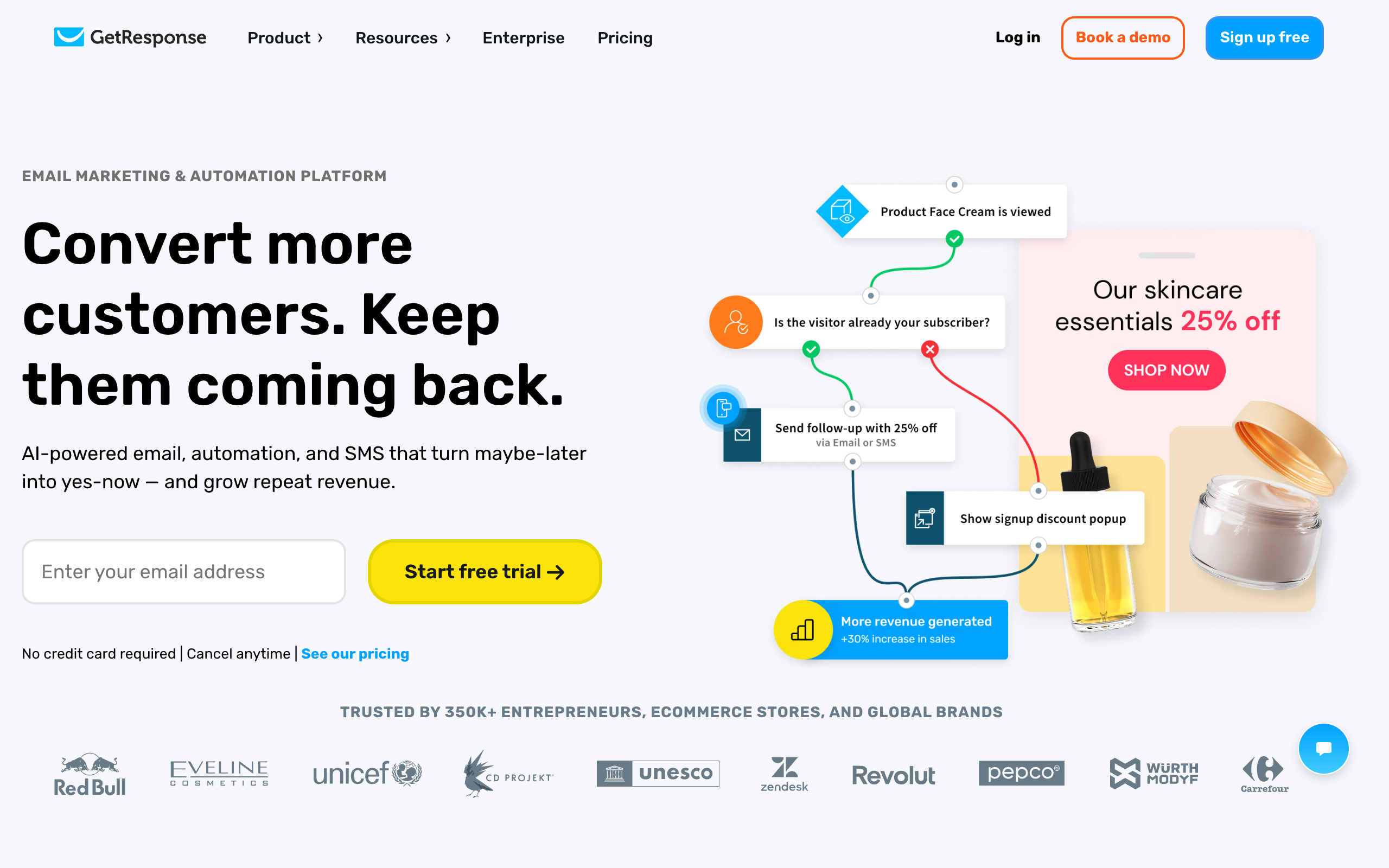
Every figure below is pulled from both live pricing pages, captured July 2026.
| beehiiv | GetResponse | |
|---|---|---|
| Built for | Newsletter as the business, growth and monetization | All-in-one marketing: email, automation, funnels, webinars |
| Free plan | Up to 2,500 subscribers, unlimited sends, custom domain, website | None as of July 2026, only a 14-day free trial of paid features |
| Entry paid plan | Scale, from $43/mo on annual billing | Starter, from $19/mo at 1,000 contacts (monthly billing) |
| Automation | Journey builder, welcome flows, segment triggers | Deep marketing automation with conditional branching, unlocked from Marketer up |
| Growth tools | Referral program, recommendations, Boosts, SEO website | None built in; growth depends on your own traffic and ads |
| Beyond email | Website, podcast hosting, digital products | Landing pages, sales funnels, webinars, course creator, SMS (Enterprise) |
| Paid subscriptions | 0% platform take rate on Scale and above | Premium newsletters supported on Creator plan; fee structure not published in detail |
| Best-fit user | Media operators, writers building an audience asset | Businesses running funnels, webinars, or ecommerce recovery flows |
For the deep dive on beehiiv’s own strengths and weaknesses, my full beehiiv review covers the referral program and Boosts marketplace feature by feature. This article stays focused on the head-to-head against GetResponse.
Why are beehiiv and GetResponse such different shapes of product?
Because they were built two decades apart, for two different problems, and neither one ever pivoted away from its founding bet.
GetResponse launched in 1998, founded by Simon Grabowski, making it one of the oldest email service providers still operating today. Nearly thirty years of feature accretion is exactly what you would expect: autoresponders, then landing pages, then marketing automation, then webinars, then a course creator, then ecommerce integrations, then SMS. Every acquisition of a new customer segment (course creators, ecommerce stores, agencies) added a new module rather than replacing an old one. The result is a genuinely broad platform, and also one where you will pay for a lot of things you personally never touch.
beehiiv launched in 2021, built by Tyler Denk and other early Morning Brew employees, the team credited with growing that single newsletter into a media company that Insider Inc. acquired majority control of in a 2020 deal reported around $75 million. Its founding bet was narrow on purpose: newsletters do not die from a lack of automation triggers, they die from a lack of distribution, so productize exactly the referral and cross-promotion machinery Morning Brew built by hand. Every beehiiv feature still traces back to that one bet, which is why the product feels sharper and narrower than GetResponse, on purpose.
Neither approach is wrong. A course creator running webinars into a $497 offer genuinely benefits from GetResponse’s breadth. A writer trying to grow a newsletter from 200 to 20,000 subscribers genuinely benefits from beehiiv’s narrowness. The comparison only breaks down when someone evaluates one against the other’s home turf.
What does beehiiv vs GetResponse actually cost in 2026?
Here are both live pricing pages, plus the one thing that surprised me most in this research.
beehiiv pricing
| Plan | Price | What you actually get |
|---|---|---|
| Launch (free) | $0 | Up to 2,500 subscribers, unlimited sends, custom domain, website, recommendation network, campaign analytics |
| Scale | From $43/mo on annual billing ($517/year, saves $71/year) | Everything in Launch plus referral program, Boosts, ad network, email automations, 0% fee on paid subscriptions, digital products, webhooks, 3 team seats, human support. Steps up by subscriber tier to 100,000 |
| Max | From $96/mo on annual billing ($1,151/year, saves $157/year) | Everything in Scale plus beehiiv branding removed, up to 10 publications, sponsorship storefront, RSS-to-send, audio newsletters, unlimited team seats, priority support |
| Enterprise | Custom | 100,000+ subscribers, dedicated IPs, Send API, dedicated account manager, SSO |
GetResponse pricing (at 1,000 contacts, USD)
| Plan | Price | What you actually get |
|---|---|---|
| Starter | $19/mo monthly, or around $15.58/mo on 12-month billing (18% off) | Unlimited email sends, AI content generators (3 uses), 1 automation workflow, landing page builder, forms and popups, welcome series, 3 users |
| Marketer | $59/mo monthly, or around $48.38/mo on 12-month billing | Everything in Starter plus unlimited automation workflows, abandoned cart recovery, sales funnels, advanced segmentation, contact tagging and scoring, promo codes, unlimited web push, 5 users |
| Creator | $69/mo monthly, or around $56.58/mo on 12-month billing | Everything in Marketer plus website builder, course creator (up to 40,000 students), premium newsletters, live webinars (100 attendees), Stripe and PayPal integration, 5 users |
| Enterprise | Custom | SMS marketing, mobile push, AI product recommendations, dedicated IP and sending domain, transactional email, unlimited users, dedicated Customer Experience Manager |
The surprise: GetResponse does not currently list a permanently free plan. Older reviews and comparison posts mention a free tier capped around 500 contacts, and that plan did exist for years, but as of my July 2026 check of GetResponse’s live pricing page, only a 14-day free trial of the paid plans is offered, no credit card required, and no separate free-forever tier. If a competitor article tells you GetResponse has a free plan, verify it yourself before you plan around it, because it quietly disappeared from the current pricing structure. Beehiiv, by contrast, still runs a genuine free-forever plan to 2,500 subscribers, which makes it the only truly free option between the two as of this writing.
Both platforms tier pricing by list size, stepping through 1k, 2.5k, 5k, 10k, 25k, 50k, and 100k brackets, so the entry price you see is only accurate at the smallest tier. I break down exactly where beehiiv’s tiers land as your list grows in my full beehiiv pricing breakdown, and the same modeling exercise is worth doing on GetResponse’s calculator before you commit to either.
Which platform has deeper automation and funnels? GetResponse, clearly
I will not pretend this one is close. If your business runs on branching sequences, GetResponse’s Marketer plan and above gives you real marketing automation: conditional workflows based on tags, scores, purchase behavior, and visited URLs, plus dedicated sales funnel and webinar funnel builders that walk a prospect from opt-in to registration to purchase inside one connected flow. Abandoned cart recovery, revenue tracking per campaign, and ecommerce store integrations round it out. This is infrastructure built for a business that sells things, not just a business that publishes things.
beehiiv’s journey builder covers what a newsletter actually needs: welcome sequences, triggers on signup or segment entry, delays, and branching, and for most newsletters that genuinely is enough. But there is no dedicated sales-funnel builder, no webinar funnel, and the conditional logic is shallower than GetResponse’s Marketer tier. If your dream flow has more than one “if” in it (if they attended the webinar and clicked the offer link, wait two days, then…), you want GetResponse, not beehiiv, and no amount of newsletter growth tooling will make up the gap.
(Worth naming directly: this is the one section where beehiiv is not even trying to compete. Its automation exists to support the newsletter, not to run your whole sales process. If your whole sales process is the point, this section alone should end the comparison.)
Which platform wins on newsletter growth? Beehiiv, and GetResponse has nothing to answer with
Flip the question and the result flips completely.
Three systems compound inside beehiiv that simply do not exist in GetResponse at any price:
- The referral program. Native to the Scale plan: set milestone rewards, and every send automatically carries each reader’s unique share link. This is the exact mechanic Morning Brew used to grow its own list, shipped as a checkbox.
- Boosts. A two-sided marketplace where newsletters pay each other for engaged subscribers. For a small newsletter, this is frequently the first dollar it ever earns, often before ads or paid subscriptions make sense.
- The Ad Network. beehiiv matches you with sponsors directly inside the dashboard instead of leaving you to cold-pitch brands, and it handles billing on your behalf.
GetResponse has no referral mechanic, no recommendation network, and no sponsor marketplace. Its growth story runs through paid ads (it does integrate Google and Facebook ad management inside the Marketer plan) and its own lead-generation tools: landing pages, popups, and forms. Those are genuinely solid, but they capture traffic you already have to find, they do not generate new traffic on their own the way beehiiv’s referral loop and Boosts marketplace do.
The other structural gap is the website. Every beehiiv publication ships with a real site: homepage, tag pages, an archive, and a custom domain, with every post indexable by Google. GetResponse’s Creator plan does include a website builder with up to five active sites, which is a genuine feature most competitors do not offer, but it is a general-purpose website builder for a business, not an archive purpose-built around turning your back catalog of newsletter issues into compounding search traffic the way beehiiv’s is.
Growth tooling is the one thing you cannot judge from a features table, you have to watch it move real subscribers. My honest suggestion: open a free beehiiv account, turn on the recommendation network, and watch where your next hundred subscribers come from. That single report will teach you more than the rest of this comparison.
What about webinars, courses, and paid subscriptions?
This is where GetResponse’s breadth genuinely pays for itself, and where beehiiv’s narrowness starts to show its limits, if your business needs these things.
GetResponse’s Creator plan ($69/mo monthly, around $57/mo annual, at 1,000 contacts) bundles a course creator with student capacity up to 40,000 on the current pricing table, live webinars for up to 100 attendees with three hours of recording storage and up to three presenters, and premium newsletters with paid subscription support connected to Stripe and PayPal. For a coach or consultant whose funnel is webinar to course to community, this is genuinely one login doing the job of three or four separate tools. One caveat worth flagging honestly: GetResponse’s own pricing and help pages do not spell out the exact platform fee or take rate on premium newsletter subscriptions the way beehiiv publishes its 0% rate, so confirm that number directly with GetResponse before you model your paid-subscription math on it. confirm the exact platform fee GetResponse charges on paid subscriptions with their support team before launch.
beehiiv has no webinar product and no course creator at all. Its equivalent monetization stack is narrower but sharper: digital products, paid newsletter subscriptions at a published 0% platform take rate on Scale and above (you keep everything after standard Stripe processing), Boosts income, and ad network revenue. If your product actually is the newsletter, and not a course sold alongside it, beehiiv’s stack is more focused on exactly that outcome. If your business needs webinars or a course as the core product, GetResponse does a job beehiiv was never built to do.
How is the day-to-day editing experience different?
Beehiiv’s editor is a modern, Notion-style block editor: fast to write in, with slash commands, polls, and referral blocks that drop straight into a post, and one piece of content that publishes to both email and web simultaneously. In testing, it is the nicer place to write a content-heavy issue, though it is not without small rough edges, an occasional block that needs re-adding or formatting that misbehaves after a heavy paste from Google Docs.
GetResponse’s editor is more traditional drag-and-drop, with a large template library and an AI content generator built into the flow for drafting subject lines and body copy (limited to a handful of uses on Starter, unlimited on higher tiers). It handles design-heavy promotional emails competently, closer in spirit to a general marketing ESP than to a writer’s tool. Neither editor is bad; they are simply optimized for different jobs, one for writing an issue quickly, the other for assembling a campaign. I go deeper on GetResponse’s day-to-day workflow, including its automation builder screen by screen, in my full GetResponse review.
Beehiiv or GetResponse: which fits your situation?
Here is the direct call, persona by persona, because averages rarely match one specific business.
- Newsletter operator building a media asset: beehiiv. Referral loops, Boosts, the ad network, and 0% fees on subscriptions are exactly what you need and GetResponse has none of them.
- Coach or consultant selling through webinars: GetResponse. The webinar funnel, course creator, and marketing automation stack do a job beehiiv does not attempt.
- Ecommerce store: GetResponse, on the Marketer plan. Abandoned cart recovery, promo codes, and revenue tracking are built for exactly this, and beehiiv has no ecommerce features at all.
- Paid-newsletter-first writer: beehiiv. A published 0% take rate on subscriptions beats an unpublished fee structure, and the growth tools compound your subscriber base at the same time.
- Agency managing funnels for multiple clients: GetResponse. The breadth of one platform covering email, landing pages, and automation for varied client needs outweighs beehiiv’s narrower newsletter focus.
- Total beginner who just wants to write and grow a list: beehiiv. The free plan is real, setup takes an evening, and the growth tools matter most exactly when you have the smallest list and the least to lose testing them.
If you want the wider field mapped out beyond just these two, my ranking of the best newsletter platforms compares beehiiv against Substack, Kit, and the rest. And if GetResponse’s breadth appeals but the price at your list size gives you pause, my GetResponse alternatives guide lines up the other all-in-one options.
How hard is it to migrate between beehiiv and GetResponse?
Neither move is difficult technically. The real cost is what does not transfer.
GetResponse to beehiiv starts with exporting your contact list as a CSV, including any tags, and importing into beehiiv with tags mapped to segments. Rebuilding your automations will usually mean simplifying them; beehiiv’s journey builder is not going to replicate a five-branch GetResponse workflow one-to-one, so audit which branches actually matter before you grieve the rest. If you were using GetResponse’s landing pages or sales funnels, you will need a separate home for those, since beehiiv does not build funnels.
beehiiv to GetResponse moves your subscriber list cleanly as a CSV, but leaves behind your referral program and every subscriber’s accumulated referral count, your Boosts relationships and income, and your SEO-indexed archive, which has no real equivalent inside GetResponse’s general website builder. I would only make this move if funnel and automation depth has become more valuable to your business than the growth mechanics, which does happen once a newsletter shifts into being primarily a sales channel for a course or service.
Both directions share the same two rules: prune unengaged contacts before importing, since dragging a stale list onto new sending infrastructure is the fastest route to the spam folder, and warm up gradually by sending to your most engaged segment first.
Common mistakes people make comparing beehiiv and GetResponse
- Assuming GetResponse still has a free plan. As of July 2026 it does not, only a 14-day trial. Budget for Starter at minimum if you plan to keep using it past two weeks.
- Buying GetResponse for growth features it does not have. No referral program, no Boosts-style marketplace, no ad network. If that is why you are shopping, this comparison is already decided in beehiiv’s favor.
- Buying beehiiv expecting webinar or course infrastructure. It has none. If your funnel includes a webinar, GetResponse’s Creator plan is the only one of the two that does this job.
- Comparing headline prices instead of your-list-size prices. Both platforms tier by contact count. Model your cost at 10,000 and 25,000 subscribers before committing; the entry price you see is only true at 1,000.
- Ignoring the take-rate question on paid subscriptions. beehiiv publishes 0%. GetResponse’s fee on Premium Newsletters is not published in the same way, so confirm it directly before you build a paid-subscription business plan around either platform.
Frequently asked questions
Is beehiiv better than GetResponse? For growing and monetizing a newsletter specifically, yes: beehiiv’s referral program, Boosts marketplace, ad network, and 0% fee on paid subscriptions have no equivalent in GetResponse. For running a broader marketing operation with automation, sales funnels, webinars, and a course, no: GetResponse’s breadth clearly wins. The better platform depends on whether your business is audience-shaped or funnel-shaped.
Does GetResponse have a free plan? Not as of July 2026. GetResponse currently offers a 14-day free trial with access to premium features and no credit card required, but no permanently free tier. Beehiiv’s Launch plan, by contrast, is free indefinitely up to 2,500 subscribers.
Does beehiiv take a cut of paid subscription revenue? No. On Scale and above, beehiiv’s take rate on paid subscriptions is 0 percent; you pay the flat plan fee plus standard Stripe processing. GetResponse supports paid Premium Newsletters on its Creator plan, but its specific fee structure is not published in the same detail, so confirm current terms directly with GetResponse.
Can I migrate from GetResponse to beehiiv without losing my list? Yes. Export your contacts and tags as a CSV and import them into beehiiv, mapping tags to segments. Automations must be rebuilt by hand in beehiiv’s journey builder, typically in a simplified form since GetResponse’s conditional branching runs deeper. Prune inactive contacts before importing and warm up sending gradually.
Which is cheaper, beehiiv or GetResponse? At 1,000 contacts, GetResponse’s Starter plan ($19/mo monthly) is cheaper than beehiiv’s Scale plan ($43/mo annual). But beehiiv’s free plan runs a full newsletter to 2,500 subscribers at no cost, while GetResponse has no permanent free tier, so below 2,500 subscribers beehiiv is often the cheaper way to run a real newsletter.
Does GetResponse have anything like beehiiv’s referral program or Boosts? No. GetResponse has no native subscriber-referral mechanic and no marketplace for paid subscriber recommendations. Its growth tools are lead-generation focused (landing pages, forms, popups, and paid ad integrations) rather than the audience-network features that define beehiiv.
The bottom line
Strip away the feature grids and this comparison is really about how many jobs you want one platform to do. GetResponse wants to be the whole marketing department: email, funnels, webinars, a course, eventually SMS. Beehiiv wants to be the best possible engine for exactly one job, growing and monetizing a newsletter, and it does that one job with tools GetResponse has never built.
My own bias, stated plainly: if the newsletter itself is your business, or you are trying to find out whether it could be, I would start on beehiiv, because the free plan is real and the growth tools are the ones you will wish you had turned on from month one. If your business already runs on webinars, funnels, or ecommerce recovery sequences, GetResponse will save you from stitching together four separate tools, and its breadth genuinely earns its higher price at that point. The expensive mistake is picking based on which pricing page has more line items, rather than which shape actually matches your business.
Whichever way you are leaning, stop deciding on paper. Set up a free beehiiv publication tonight, connect your domain, and send your first issue to ten people. An hour inside the product will settle what another five comparison articles never will, and the free plan runs to 2,500 subscribers with no card required.
Pricing captured from vendor pricing pages, July 2026. Plans change, so confirm current details before you buy.


