

Every “ghost alternatives” search starts the same way: you opened your theme’s Handlebars files to change a font size, or you spent a Saturday updating a self-hosted instance because a security patch could not wait, or you looked at the jump from the Starter plan to Business and realized 10,000 members costs $199 a month before you have sold a single sponsorship. Ghost is honest software. It is also, for most people who are not developers, more platform than they signed up to run.
Here is the answer up front. The best Ghost alternative in 2026 for most people is beehiiv: it keeps Ghost’s headline feature, a genuine 0% fee on paid subscription revenue, but removes almost all the technical setup, and adds growth tools (referrals, Boosts, an ad network) that Ghost never built. Kit is the pick if your business already runs on automated funnels and digital products. Substack is the zero-setup option if you will accept a 10% cut for never touching a config file. WordPress.com fits writers who want a full CMS with a real page builder instead of theme code. Patreon and Medium round out the list for community-first and pure-writing use cases. The rest of this guide is the pricing, the honest trade-offs, and the cases where staying on Ghost is still the right call.
Disclosure: some links in this post are affiliate links. If you sign up through them, we may earn a commission at no extra cost to you. That never changes our verdict.
Why are people leaving Ghost in 2026?
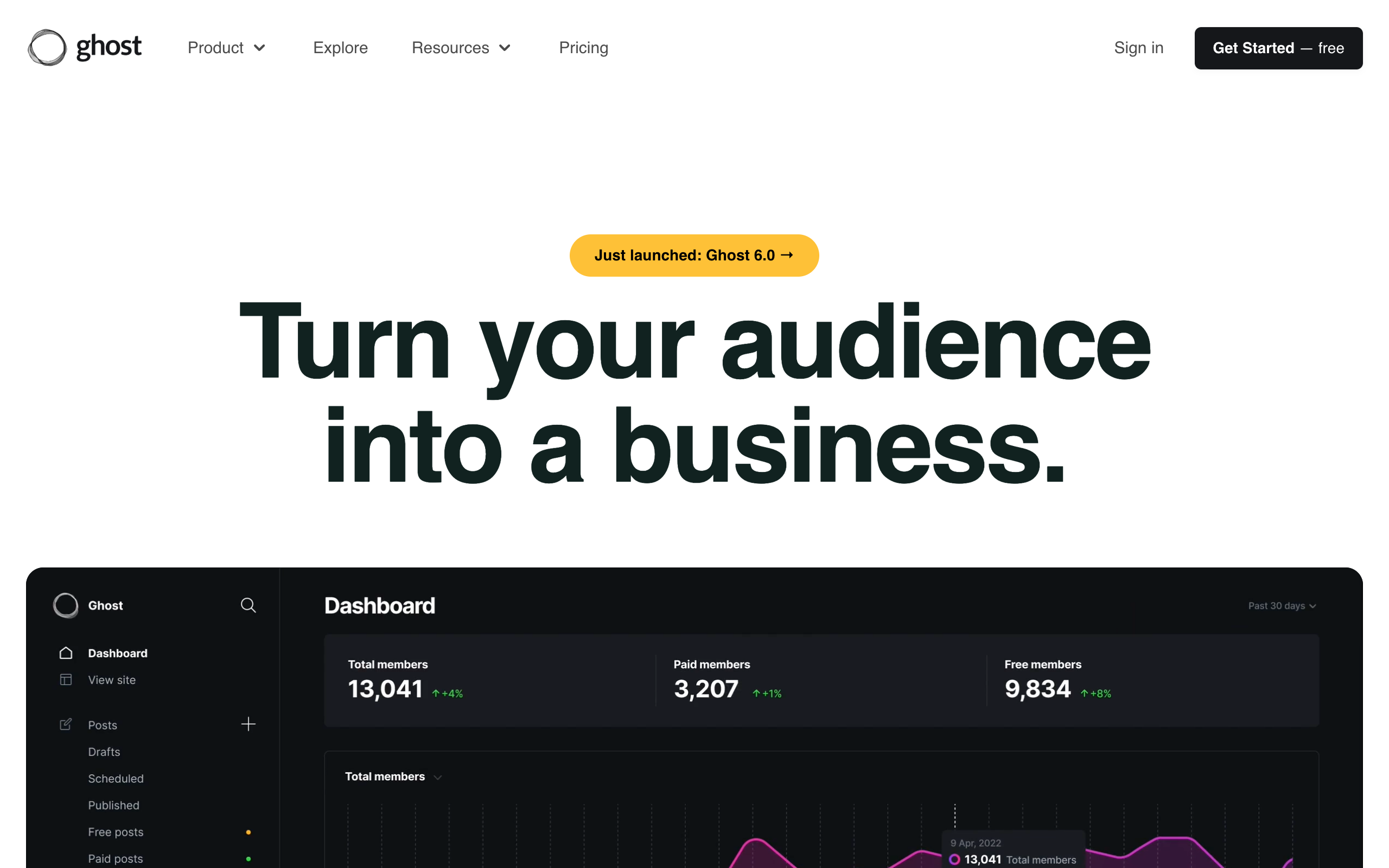
Ghost is not a bad product, and I want to say that before spending four thousand words helping you replace it. It is open-source, genuinely fast, and it takes 0% of your membership revenue whether you self-host or pay for Ghost(Pro). That last part is rare and real. But four complaints show up again and again in Ghost operator forums, in the Ghost community Slack, and in my own time running a test publication on it, and none of them are the kind of thing a support ticket fixes.
1. Customization means writing code, not clicking a menu. Ghost’s theming layer runs on Handlebars templates and raw CSS. The default themes look clean out of the box, but the moment you want a layout change that is not in the theme settings panel, you are editing template files or hiring someone who can. Compare that to a drag-and-drop website builder and the gap is obvious within the first hour.
2. Self-hosting is a second job. Choose self-hosted Ghost to dodge Ghost(Pro) fees and you take on server management, Node.js version upgrades, database backups, and security patching yourself. Ghost(Pro) removes that burden, but only by moving you to option three.
3. Ghost(Pro) pricing steps up hard at scale. Per Ghost’s live pricing page in July 2026, Ghost(Pro) runs $18 a month for Starter (1,000 members) and $29 a month for Publisher (1,000 members, adds custom themes and paid subscriptions), then jumps to $199 a month for Business once you need 10,000 members and 15 staff seats. That is not an unreasonable price for a growing publication, but it is a much bigger jump than most switchers expect, and it lands right when your revenue is still proving itself. We break down every tier and where the member-count cliffs sit in our full Ghost pricing guide.
4. There is no built-in growth engine. Ghost gives you a fast website and a clean editor and then leaves acquisition entirely to you. No referral program, no cross-promotion network, no marketplace connecting you to sponsors. Every subscriber you get, you found yourself, through channels you built outside the platform.
If none of those four bother you, skip ahead to the section called “When you should stay on Ghost,” because ownership has real value too. If at least two of them made you nod, keep reading.
If it were my publication, I would not wait to find out whether the switch is worth it. I would open a free beehiiv account tonight and import my Ghost subscriber export before the weekend. The free plan covers 2,500 subscribers on your own custom domain, so you can run it side by side with Ghost before you cancel anything.
How I ranked these Ghost alternatives
I set up test publications on the platforms below where that was possible, imported the same sample subscriber list, rebuilt a basic welcome sequence, and published a post to see how each platform’s website and SEO controls actually behaved. I scored four things: how closely each option replaces what Ghost does for a paid publication, what it truly costs at a realistic starting size, how much technical setup it demands compared with Ghost’s theme-and-server overhead, and where it beats Ghost outright rather than merely matching it. Pricing was captured from each vendor’s live pricing page in July 2026 unless a plan is noted as dynamically calculated.
The 7 best Ghost alternatives in 2026
1. beehiiv: the best Ghost alternative for most publications
beehiiv is the platform I point Ghost switchers to first, because it is the only one on this list that keeps Ghost’s core financial promise (0% platform fee on paid subscriptions) while removing almost everything that made Ghost feel like a technical project. There is no theme code to edit, no server to patch, no Node version to upgrade. You sign up, pick a template, and start writing.
What you gain the day you switch goes beyond convenience. Every post lives on an SEO-indexable web page on your own domain, same as Ghost, but with a referral program built in natively (no plugin, no third-party tool), a Boosts marketplace that pays you to recommend other newsletters and pays other newsletters to recommend you, and an internal ad network that connects sponsors to your publication once you have an audience worth advertising to. Ghost gives you the website. beehiiv gives you the website plus the machinery to fill it with readers.
The pricing, from beehiiv’s live pricing page in July 2026: the free Launch plan covers up to 2,500 subscribers with unlimited sends and a custom domain, more generous than Ghost’s paid entry tier for the same member count. Scale starts at $43 a month on annual billing and is where the 0% fee on paid subscriptions, the referral program, Boosts, the ad network, and automations all unlock, scaling with list size up to 100,000 subscribers. Max starts at $96 a month annually, removing beehiiv branding and adding up to 10 publications. Our full beehiiv pricing breakdown walks through every tier and where the subscriber-count jumps land.
The honest trade-offs, because a list that only flatters its top pick is an advertisement: beehiiv’s website builder, while far easier than Ghost’s, is more template-constrained. If you want pixel-level design control down to the CSS, Ghost still wins that specific fight. Automations are functional but shallower than Kit’s, and the editor still has small rough edges. None of that changes the verdict for someone leaving Ghost specifically to escape technical overhead; it just means you are trading a small amount of design ceiling for a large amount of saved Saturdays. I cover every strength and weakness in the full hands-on beehiiv review, and the direct comparison lives in beehiiv vs Ghost.
Migration effort: low to medium. Export your member list from Ghost as a CSV and import it into beehiiv; that part takes under an hour. Rebuilding your archive as beehiiv posts (if you want your old content live on the new site) is the slower part, and paid Stripe subscriptions need to be reconnected on the new platform rather than simply copied over.
Choose beehiiv over Ghost if: you want the 0% fee without the server, the theme code, or the maintenance calendar, and you would trade some design flexibility for built-in growth tools. Stay on Ghost if: pixel-perfect custom design and full platform ownership matter more to you than convenience.
2. Kit: the best pick if you sell digital products through funnels
Kit (formerly ConvertKit) is not trying to be a publishing platform the way Ghost is, and that is exactly why it fits a specific kind of Ghost refugee: the creator whose real business is selling an ebook, a course, or a coaching program, and whose newsletter exists to feed that funnel rather than stand alone as the product.
Per Kit’s live pricing page in July 2026, the free Newsletter plan covers up to 10,000 subscribers with one basic automation, which is a far larger free tier than Ghost offers at any price. Creator starts at $33 a month on annual billing and unlocks unlimited automations, A/B testing, and Kit Commerce for selling digital products directly. Pro starts at $66 a month annually and adds subscriber-level engagement analytics and a referral system. None of Kit’s plans take a percentage of your subscription or product revenue the way Ghost’s payment processor does, though standard Stripe fees still apply on anything you sell.
What you give up moving from Ghost to Kit is the publication itself. Kit has no real concept of a post archive as an SEO asset the way Ghost and beehiiv do, and its website features are thin compared to a dedicated publishing tool. If your Ghost site’s blog and member portal are the product, Kit is a downgrade. If your Ghost site was really a landing page for a course you sell through email sequences, Kit’s automation canvas will feel like coming home.
Migration effort: low. CSV export and import handle subscribers cleanly; you will rebuild your paid offer as a Kit Commerce product or connect an existing checkout, and any Ghost-native content pages will need a new home if you still want them public. Read our full Kit review before you commit if automation depth is the deciding factor.
3. Substack: zero setup, with a 10% asterisk
Substack is the fastest way off Ghost’s technical treadmill, full stop. There is no theme, no server, no config file. You create an account, pick a name, and start publishing within minutes, and the built-in Notes feed and recommendation network can genuinely put your writing in front of new readers without you doing any distribution work.
The trade is well known but worth stating plainly with real numbers: Substack takes 10% of your paid subscription revenue, on top of standard Stripe processing fees, and it takes that cut forever, not just during a trial period. On a publication earning $1,500 a month in paid subscriptions, that is $150 a month, or $1,800 a year, which is more than three years of beehiiv’s Scale plan at its annual price. Ghost switchers moving specifically to escape technical work but who still want to keep their 0% fee should look at beehiiv first; Substack only makes sense if simplicity outweighs the fee for you, or if the built-in discovery network is genuinely bringing you readers you would not otherwise find.
Substack’s other real gap for former Ghost users: almost no customization and thin analytics. You get one look, a handful of layout options, and open-rate-level reporting. If your Ghost site had a distinct visual identity, Substack will feel like a step down in ownership even as it is a step up in convenience.
Migration effort: very low. Export your list, import, write. That speed is the entire product.
4. MailerLite: the budget-friendly newsletter option
MailerLite is what I recommend when a Ghost switcher says, plainly, “I just want to send emails cheaply and I do not care about a fancy website.” It is not a publishing platform in the way Ghost is, but its editor, automations, and landing pages cover the newsletter half of what Ghost does at a fraction of the setup effort and cost.
As of MailerLite’s live pricing page in July 2026, the free plan covers 250 subscribers with 2,500 monthly email sends, functioning more as a trial than a permanent home these days. Paid plans start with Comfort at $12 a month and Power at $25 a month, both scaling with subscriber count, and both far below Ghost’s Business tier if your website ambitions are modest. There is no membership or paid-subscription fee structure to compare, because MailerLite does not natively handle gated paid content the way Ghost does; you would need a separate tool like Memberful or a simple paywall plugin if that matters to you.
Migration effort: low. Straightforward CSV import; you will rebuild any automations by hand and will need a separate solution if paid membership content is core to your business.
5. WordPress.com: the pick for writers who want a real CMS without theme code
WordPress.com is the closest thing to Ghost’s ownership philosophy without Ghost’s coding requirement. You get a genuine content management system, a large template library you customize through a visual editor rather than Handlebars files, and (on paid plans) a built-in Newsletter feature and paid subscriber gating.
Per WordPress.com’s live pricing page in July 2026, plans run Personal at $9 a month ($4 on annual billing), Premium at $18 a month ($8 annual), Business at $40 a month ($25 annual), and Commerce at $70 a month ($45 annual). The detail that matters most for anyone comparing this to Ghost’s 0% fee: WordPress.com’s transaction fee on paid subscriber content scales down as you go up in plan, from 8% on Personal to 4% on Premium, 2% on Business, and 0% only on the Commerce plan. So the genuinely fee-free tier costs more than Ghost’s equivalent Publisher plan, and you are paying for a full website platform, not just a newsletter.
Where WordPress.com wins outright: if you want a real website with pages beyond a blog, an actual visual page builder, and the enormous plugin and theme ecosystem the broader WordPress world offers, nothing else on this list matches that flexibility without asking you to touch code.
Migration effort: medium. Content import tools exist for common formats, but rebuilding a Ghost membership program as WordPress.com paid subscriptions takes deliberate setup, and you should plan the Stripe reconnection carefully.
6. Patreon: the pick for community-first creators
Patreon solves a different problem than Ghost solves, and that is precisely why some Ghost switchers land here: their real product was never the blog post, it was the sense of ongoing access and community their paying members wanted. Patreon leans fully into that with membership tiers, posts, native video and livestreaming, chats, and DMs, all built around the relationship rather than the archive.
Per Patreon’s own pricing information, the platform now runs a single fee structure of 10% of the income you earn, plus payment processing, currency conversion, and payout fees, with every feature available from day one rather than gated behind separate plan tiers. That fee sits between Ghost’s 0% and Substack’s 10%-plus-Stripe, but you are paying for a fundamentally different product: discovery inside an existing app with millions of active patrons, not a website you control.
What you lose moving from Ghost to Patreon is the website itself. Patreon posts are not built to rank in Google the way a Ghost or beehiiv archive is, and content lives inside Patreon’s ecosystem rather than on your own domain. If SEO and long-term content ownership were part of why you started on Ghost, Patreon is a step away from that goal even as it is a step toward easier community monetization.
Migration effort: medium. Patreon supports exportable member lists for outreach, but moving paid members onto Patreon’s own billing requires them to actively resubscribe, which is the one migration step you cannot automate away.
7. Medium: the easiest option for writers who do not want to run a business
Medium is the honest answer for one specific kind of Ghost switcher: someone who realizes, partway through fighting a theme file, that they never actually wanted to run a publishing business. They wanted to write, and Medium is built for exactly that, with zero setup, zero hosting, and a built-in audience of readers already browsing the platform.
Medium’s monetization runs through its Partner Program rather than a subscription you set up yourself. Readers pay Medium directly, $5 a month or $50 a year for standard membership, with a “Friend of Medium” tier at $15 a month that pays writers roughly four times as much per engaged read. Writers earn a share of that pool based on read time and engagement from paying members on their stories, with payouts issued once earnings cross $10. There is no percentage cut framed as a fee, because you are not selling your own subscription; you are earning a slice of Medium’s collective membership pool.
The trade-off is real and worth stating clearly: you do not own your subscriber list, you cannot set your own price, and your income depends on Medium’s algorithm and read-time formula rather than a direct relationship with people who chose to pay you specifically. Ghost switchers who valued owning their audience will find Medium the biggest step away from that value on this entire list, even though it is also the easiest.
Migration effort: low for republishing content, but there is no true subscriber migration since Medium does not import an external paid membership list the way the other platforms here do.
Ghost alternatives compared: pricing and best use
| Platform | Free plan | Paid entry price | Cut of paid revenue | Best for |
|---|---|---|---|---|
| beehiiv | 2,500 subscribers, unlimited sends, custom domain | $43/mo annual (Scale) | 0% on Scale and above | Ghost’s 0% fee, none of the technical overhead |
| Kit | 10,000 subscribers, 1 basic automation | $33/mo annual (Creator) | 0% (Stripe fees apply) | Digital product and course funnels |
| Substack | Everything free | $0 | 10% + Stripe fees | Zero-setup writing with built-in discovery |
| MailerLite | 250 subscribers, 2,500 emails/mo | $12/mo (Comfort) | n/a (no native paid gating) | Cheap, simple newsletters |
| WordPress.com | None (free.wordpress.com is limited) | $9/mo ($4 annual, Personal) | 8% down to 0% by plan | Full CMS and visual page building |
| Patreon | Free to start, pay only on earnings | $0 upfront | 10% + processing fees | Community-first membership |
| Medium | Free to write and publish | $0 (readers pay $5/mo) | Partner Program pool, not a direct cut | Pure writing, zero ownership or setup |
| Ghost (baseline) | None (self-host possible) | $18/mo at 1,000 members (Starter) | 0% | Full ownership, technical comfort required |
Prices captured from each vendor’s live pricing page in July 2026 at entry tiers, annual billing where offered. Patreon’s fee is stated per its current pricing page as of mid-2026; confirm before you commit a migration.
Which Ghost alternative should you choose?
Rankings are averages, and your publication is not average. Match your situation instead:
- You want Ghost’s 0% fee without Ghost’s setup: beehiiv, and it is not close for this specific complaint. Same financial promise, none of the theme code or server maintenance, plus growth tools Ghost never shipped.
- Your newsletter feeds a course or digital product funnel: Kit, for the automation depth.
- You want to write today and worry about tooling never: Substack, with eyes open about the 10%.
- You just need cheap, simple email sends: MailerLite.
- You want a full website with a visual builder, not a newsletter tool: WordPress.com.
- Community and access matter more than the archive: Patreon.
- You want to write with zero business overhead: Medium.
If you are comparing the whole market rather than specifically leaving Ghost, our roundup of the best newsletter platforms in 2026 starts from a blank slate.
The cheapest way to settle this for yourself: open a free beehiiv publication and import your Ghost export this week. It costs nothing up to 2,500 subscribers, and one real send will tell you more about the technical-overhead trade-off than any comparison table, including this one.
When should you stay on Ghost?
An honest alternatives guide includes this section, because migrating away from a platform you already own has real costs that never show up on a pricing page. Stay on Ghost if any of these describe you.
You genuinely want full design and code ownership. If you already know how to work with Handlebars templates and custom CSS, or you have a developer on retainer, Ghost’s flexibility is a feature, not a burden. Nothing on this list gives you the same depth of control over your site’s actual code.
Self-hosting already works for you. If you are technical enough that server maintenance is routine rather than a chore, self-hosted Ghost is the only option on this list, or in this entire category, with zero platform fee and zero monthly subscription cost beyond hosting.
You are under 1,000 members and the Starter plan is comfortable. At $18 a month, Ghost’s entry tier is not the expensive part of this equation. The pain shows up at scale, at the jump to Business, not at the price you are paying today. Migrate when the constraint becomes real, not before.
You have already built a distinct visual identity you would lose. A custom Ghost theme that took real design work to build is not something you want to abandon casually. Weigh the switching cost against the ongoing maintenance tax honestly before you move.
The pattern behind all four: Ghost rewards people who want to own their tools and are willing to spend time on that ownership. If that trade still makes sense for you, stay. If you have been quietly resenting the theme files for months, that resentment is the signal this guide exists to act on.
How to migrate off Ghost without losing subscribers
Whichever platform you choose, the move follows roughly the same sequence. Skipping a step here is how people lose deliverability or a chunk of their paid members mid-migration, so the order matters as much as the individual steps.
- Export your full member list, not just email addresses. Ghost’s export includes subscription status and labels; pull the complete CSV so you can distinguish free from paid members on the new platform.
- Set up and authenticate your sending domain before importing. Configure SPF, DKIM, and DMARC on the new platform first, and send test emails to seed accounts at Gmail and Outlook. A migration’s first real send from an unauthenticated domain is the single most common way it ends up in spam.
- Handle paid subscriptions as their own project. Active Stripe subscriptions tied to Ghost do not simply transfer to a new platform’s billing system. Plan how existing paying members will move over, whether that means a guided re-subscribe flow or a direct Stripe migration your new platform supports, before you announce anything.
- Decide what happens to your archive. If your old posts are ranking in Google, either republish them on the new platform’s own domain structure or set up redirects from your Ghost URLs so you do not lose that search equity.
- Run both platforms in parallel for two or three sends. Keep Ghost live for a few weeks, compare deliverability and engagement on the same content, and cancel from evidence rather than hope.
Budget a weekend for a simple newsletter-only move, and a full week of part-time attention if you are migrating a paid membership program with an existing archive you want preserved.
Frequently asked questions
What is the best Ghost alternative in 2026? For most publications, beehiiv is the best Ghost alternative in 2026: it matches Ghost’s 0% fee on paid subscriptions once you are on the Scale plan, removes the theme-code and server-maintenance overhead entirely, and adds a referral program, Boosts, and an ad network that Ghost does not offer. Kit fits better if your business runs on digital-product funnels, and WordPress.com fits writers who want a full CMS with visual page building.
Is beehiiv better than Ghost? beehiiv is better than Ghost for anyone who wants Ghost’s 0% fee without running a server or editing theme files, and it adds growth tools (referrals, Boosts, an ad network) Ghost never built. Ghost is better for anyone who wants full code-level design ownership or plans to self-host. Our detailed beehiiv vs Ghost comparison breaks down each scenario.
Does Ghost really take 0% of my revenue? Yes. Both self-hosted Ghost and Ghost(Pro) take 0% of your membership or paid subscription revenue; you only pay Ghost’s hosting fee (or your own server costs if self-hosting) plus standard Stripe processing fees on transactions. This is confirmed on Ghost’s live pricing page as of July 2026.
What is the cheapest Ghost alternative? On sticker price, MailerLite (paid plans from $12 a month as of July 2026) is the cheapest credible replacement for the newsletter half of Ghost, though it does not natively handle paid membership gating the way Ghost does. For a fee-free paid subscription setup at low volume, beehiiv’s free plan covers up to 2,500 subscribers at no cost at all.
Can I migrate from Ghost without losing my subscribers? Yes, for free and paid member lists exported as CSV. What does not transfer automatically is active Stripe billing for paid members, which needs a deliberate migration plan, and any custom theme design, which must be rebuilt on the new platform’s own tools.
Do I need to know how to code to use Ghost? Not for basic use; Ghost’s default themes and settings panel cover font, color, and layout choices without code. But any customization beyond what the theme settings expose requires editing Handlebars templates and CSS, which is exactly the friction point that sends most people searching for Ghost alternatives in the first place.
The bottom line
Remember why you started this search: the theme file you should not have to touch, the server patch that ate your Saturday, or the pricing jump that arrived faster than your revenue did. Every alternative on this list solves a different piece of that. Kit for funnels. Substack for pure speed. WordPress.com for a real CMS without code. Patreon for community. Medium for writing with zero overhead. And for the majority of people who searched “ghost alternatives” because they wanted the 0% fee without the second job, beehiiv, which is the only platform here that keeps Ghost’s core financial promise while cutting the technical setup down to an afternoon.
You do not have to take a ranked list on faith. Open a free beehiiv account, import your Ghost member export, and publish one real post. It costs nothing up to 2,500 subscribers, your list stays yours either way, and one real send will tell you more than four thousand words ever could.
Pricing captured from vendor pricing pages, July 2026. Plans change, so confirm current details before you buy.


