

GetResponse tries to be five products at once: email marketing, marketing automation, a website and landing page builder, a course platform, and a webinar host. For an agency running a client’s entire funnel, that breadth is the appeal. For a solo newsletter operator, it is usually the reason to leave, because you end up paying for webinar hosting and course infrastructure you will never touch just to get decent automation. The best GetResponse alternative depends heavily on which slice of that bundle you actually use: beehiiv wins for people who only ever wanted the newsletter and its growth tools, Kit wins for creators who sell digital products through tagged automation, and ActiveCampaign wins if automation depth was the one GetResponse feature you genuinely needed.
Disclosure: some links in this post are affiliate links. If you sign up through them, we may earn a commission at no extra cost to you. That never changes our verdict.
Key takeaways
- GetResponse’s free plan caps out at 500 contacts and 2,500 emails a month with no automation and GetResponse branding on everything you send.
- Starter, GetResponse’s cheapest paid tier, runs $19/month at 1,000 contacts but climbs to roughly $79/month once your list crosses 10,000, a jump many newsletter operators do not expect.
- beehiiv is the strongest pick if your business is the newsletter itself: it adds a referral program, a paid recommendation marketplace, and 0% fees on paid subscriptions, none of which GetResponse offers.
- If automation and a built-in CRM were the actual reason you chose GetResponse, ActiveCampaign matches or beats that depth without the webinar and course bloat.
- MailerLite and AWeber both undercut GetResponse’s Starter price at nearly every list size, with AWeber’s free plan alone covering 500 subscribers with full automation included.
If the newsletter is the part of GetResponse you actually use, the fastest way to see the difference is to open a free beehiiv publication and send your next issue from there. The free Launch plan covers 2,500 subscribers with no card required, so you can compare the two side by side before switching your live list.
Why do people look for a GetResponse alternative?
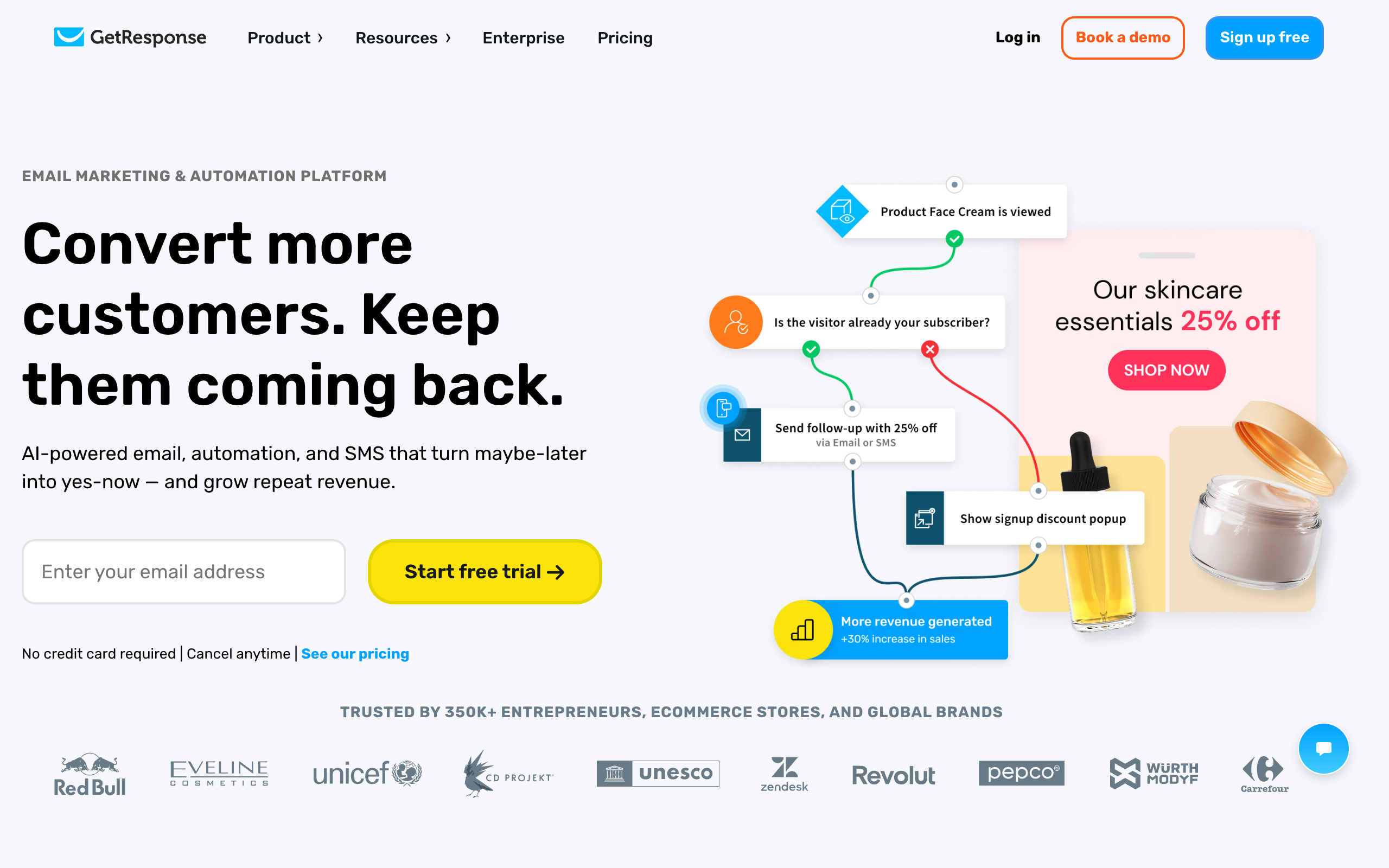
GetResponse has been around since 1998, which shows in both directions: the automation engine is genuinely mature, and the product surface has accumulated features the way an old house accumulates rooms nobody uses. In 2026 the paid tiers are named Starter, Marketer, and Creator, and the jump between them is steep. Starter at $19/month for 1,000 contacts limits you to a single automation workflow and just three uses of the AI writing tools, which is a strange restriction for a tool marketed on its automation. Marketer at $59/month unlocks unlimited automation and ecommerce tools. Creator at $69/month adds a full course platform (up to 40,000 students) and webinars for 100 attendees, features that are wasted entirely if what you run is a weekly newsletter.
The free plan is the other sore point. It covers 500 contacts and 2,500 sends a month, thinner than AWeber’s free tier at the same subscriber count, and it carries GetResponse branding with no automation at all, so it functions mainly as an extended trial rather than a usable starting point. Worth saying plainly: none of this makes GetResponse a bad platform for what it is built for, which is small businesses running email, a funnel, and maybe a webinar off one login. The mismatch shows up specifically for newsletter-first creators who are paying for course and webinar infrastructure they never open.
How we evaluated these GetResponse alternatives
Every price below came from each vendor’s own pricing page in July 2026, cross-checked against a second live fetch where the first pull returned a localized currency instead of USD (GetResponse’s own pricing page, for instance, auto-converts to local currency depending on where the request comes from, so we confirmed the USD figures below against GetResponse’s published rate card separately), pulled fresh rather than reused from an old comparison post, because GetResponse itself has restructured its plan names and tiers more than once in the past two years and several competitors on this list have too. Beyond price, we weighed whether the platform has a genuine growth mechanism beyond “send more emails,” how deep automation actually goes past a welcome sequence, what a free plan honestly lets you do without a card on file, and whether the tool is trying to be a newsletter platform, a general marketing suite, or an ecommerce engine, because GetResponse straddles all three and that straddle is exactly what sends people looking for alternatives.
How much does GetResponse actually cost as your list grows?
The number on GetResponse’s homepage is the number at 1,000 contacts. Almost nobody stays at 1,000 contacts for long if the newsletter is working, and the bill moves with you. Here is the pattern across the tiers people actually hit.
| Plan | At 1,000 contacts | At roughly 10,000 contacts | What unlocks at this tier |
|---|---|---|---|
| Starter | $19/mo (annual billing) | ~$79/mo | 1 automation workflow, 3 AI tool uses, 3 users |
| Marketer | $59/mo (annual billing) | Scales up from there by the same tiered pattern | Unlimited automation, ecommerce tools, abandoned cart, 5 users |
| Creator | $69/mo (annual billing) | Scales up from there by the same tiered pattern | Courses (40k students), paid newsletters, webinars (100 attendees), 0% transaction fees |
Two things worth flagging before you budget against this table. First, GetResponse’s own pricing page renders in your local currency by default depending on where you access it from, converting to a rough USD equivalent at whatever exchange rate applies that day, so the numbers above are the USD list price, not necessarily what you will see on your first visit. Second, the jump from 1,000 to 10,000 contacts on Starter alone (from $19 to roughly $79 a month) is a four-times increase for the same feature set, which is the exact pattern that sends people searching for “GetResponse alternatives” the month their list actually starts growing. If you are comparing that scaling curve against beehiiv’s, our beehiiv pricing guide breaks down the equivalent jump on Scale and Max.
The best GetResponse alternatives at a glance
| Platform | Best for | Starting price | Standout feature GetResponse lacks |
|---|---|---|---|
| beehiiv | Newsletter operators focused on growth | Free to 2,500 subs; Scale from $43/mo (annual) | Referral program, Boosts marketplace, 0% fee on paid subs |
| Kit | Creators selling digital products | Free to 10,000 subs; Creator $33/mo | Deep tagging and visual automation |
| ActiveCampaign | CRM-heavy, complex automation | Starter from $15/mo (1,000 contacts) | Native CRM and predictive sending |
| MailerLite | Budget-conscious small lists | Free to 250 subs; Comfort from ~$12/mo | Lower entry price with real automation |
| AWeber | Beginners who want a real free plan | Free to 500 subs; Lite from $12.49/mo | Full automation on the free tier |
| Mailchimp | Small businesses already in its ecosystem | Free to 250 contacts; Essentials from $13/mo | Broadest third-party integrations |
| Klaviyo | Ecommerce stores needing revenue attribution | Free to 250 profiles; Email from ~$20/mo | Native Shopify/ecommerce data sync |
| Brevo | Email plus SMS on a low budget | Free forever; Starter from $9/mo | Native SMS bundled into email plans |
| Substack | Writers who want free publishing and discovery | Free to publish, 10% of paid revenue | In-app Notes and recommendation network |
What are the 9 best alternatives to GetResponse?
Ordered by who should look first, not alphabetically.
1. beehiiv, best for newsletter operators who want growth built in
beehiiv strips away everything GetResponse bundles in (webinars, course infrastructure, generic funnel builders) and replaces it with tools built specifically for growing an audience: a native referral program, the Boosts recommendation marketplace where other newsletters pay to send you subscribers, and an internal ad network connecting you to sponsors. The free Launch plan covers 2,500 subscribers with unlimited sends, already more generous than GetResponse’s 500-contact free tier. Scale, from $43/month on annual billing, takes 0% of your paid subscription revenue, unlocks the growth toolkit, and gives every post a home on an SEO-indexable website. The trade-off against GetResponse: you lose the webinar host and course platform entirely, so if you actually run webinars through GetResponse today, you would need to replace that separately. Full details in our hands-on beehiiv review and the direct comparison in beehiiv vs GetResponse, plus the complete tier breakdown in our beehiiv pricing guide.
2. Kit, best for selling digital products through automation
Kit, the platform formerly named ConvertKit, matches GetResponse’s automation ambitions from a different angle: instead of a generic drag-and-drop builder, Kit’s whole product is built around tagging subscribers by behavior and routing them through sequences based on what they click, buy, or ignore. The free Newsletter plan runs to 10,000 subscribers with one basic automation and built-in digital product sales, genuinely useful if you sell templates or a mini-course alongside your list. Paid Creator starts at $33/month for 1,000 subscribers and unlocks unlimited automations and A/B testing. Where Kit does not compete with GetResponse is webinars and full course hosting; if that is the actual feature keeping you on GetResponse’s Creator plan, Kit will not replace it.
3. ActiveCampaign, best if automation depth is the real reason you stayed
If you chose GetResponse specifically for its automation builder and outgrew it, ActiveCampaign is the direct upgrade path. Starter begins at $15/month for 1,000 contacts (annual billing) with a built-in CRM layer most email tools do not attempt, and Plus at $49/month adds predictive sending, unlimited automation actions, and landing pages. There is no free plan, only a 14-day trial. ActiveCampaign’s automation builder handles conditional branching, lead scoring, and sales pipeline stages in one place, genuinely deeper than GetResponse’s Marketer tier. What you give up is the newsletter-specific polish; ActiveCampaign was built for marketing teams and CRM users first, creators second.
4. MailerLite, best budget alternative with real automation included
MailerLite undercuts GetResponse’s Starter tier at nearly every list size while still including genuine automation, not a stripped demo version of it. The free plan covers 250 subscribers with 2,500 monthly sends and three active automations. Comfort, the mid tier, starts around $10.80/month on annual billing and unlocks 50 active automations, an AI writing assistant, and multivariate testing, a feature GetResponse only offers on its Marketer tier and above. The design and template library are more basic than GetResponse’s, and the ecommerce tooling is thinner, but for a straightforward newsletter with light automation, MailerLite is simply cheaper for the same job.
5. AWeber, best for beginners who actually want a usable free plan
AWeber’s free plan is the most generous entry point on this list for anyone starting from zero: 500 subscribers, 3,000 emails a month, and full automation, landing pages, and forms included with no time limit and no card required. Compare that against GetResponse’s free tier, which caps automation entirely. Paid Lite starts at $12.49/month on annual billing (500 subscribers) and Plus at $19.99/month adds unlimited automations, lists, and sales tracking with a 0.6% transaction fee. AWeber will not match GetResponse’s webinar or course tools, but for a beginner who mainly needs to send a reliable weekly email and automate a welcome sequence, the free tier alone often settles the decision.
6. Mailchimp, best if you need broad third-party integrations
Mailchimp earns a spot here less on newsletter merit and more on ecosystem gravity: if your store, ads, and CRM already run through Mailchimp-connected tools, consolidating there avoids a multi-tool migration. The free plan covers 250 contacts and 500 sends a month. Essentials starts at $13/month and Standard at $20/month, both scaling by contact count after 12 months, with Standard unlocking up to 200 automation flows and AI features. Mailchimp has no referral program and no recommendation network, so if your GetResponse complaint was specifically “I need help growing, not just automating,” Mailchimp will not solve that any better than GetResponse did.
7. Klaviyo, best for ecommerce stores that need revenue attribution
Klaviyo is the specialist choice if your newsletter exists to drive product sales rather than stand alone as the business. The free plan covers 250 profiles and 500 sends a month. Paid Email plans start around $20/month for 251 to 500 contacts and scale by list size, running roughly $30/month at 1,000 contacts and climbing steeply from there (confirm your exact tier at klaviyo.com/pricing, since the live page renders pricing through an interactive slider rather than a static table). What you get for that price is native Shopify and ecommerce data sync, so every email links directly to revenue per campaign and per flow, a level of attribution GetResponse’s ecommerce tools do not match. If your list is not attached to a product catalog, Klaviyo is overkill and overpriced for the job.
8. Brevo, best for bundling email and SMS at a low price
Brevo prices by emails sent rather than contacts stored, which flips the math in your favor if you have a large, infrequently-emailed list, something GetResponse’s contact-based pricing never rewards. The free plan is genuinely free forever, storing up to 100,000 contacts and sending around 300 emails a day. Starter begins at $9/month for 5,000 emails, and Business at $18/month adds landing pages, A/B testing, and unlimited automation. The standout feature is native SMS marketing bundled into the same account, something GetResponse only offers as an add-on at the Enterprise tier. If you already send text alerts alongside email, Brevo’s combined email and SMS platform is worth checking specifically for that bundle.
9. Substack, best free option if discovery matters more than automation
Substack sits at the opposite end of the spectrum from GetResponse entirely: no automation builder to speak of, no funnel tools, and no webinar hosting, but publishing itself costs nothing regardless of list size, and monetizing costs 10% of paid subscription revenue plus Stripe’s processing fees. What that fee buys is the in-app Notes feed and recommendation network, a genuine discovery engine none of the automation-focused tools on this list attempt. This is the right move only if your growth actually comes from Substack’s network today, or if you are starting from zero and want to test whether a newsletter has an audience before investing in automation infrastructure at all.
Curious whether the growth side alone justifies a switch? Start a free beehiiv publication, import your GetResponse list, and turn on the referral program for one send cycle. It costs nothing to test and the free plan runs to 2,500 subscribers with no card required.
Which GetResponse alternative should you actually choose?
The honest filter is what you actually use inside GetResponse today, not what the pricing page promises you might use eventually. If you have never once opened the webinar tool or the course builder, you are paying for infrastructure that exists purely as a sunk cost, and beehiiv or Kit will feel like a lighter, cheaper version of the 20% of GetResponse you actually touch. If automation and CRM logic are the real reason you signed up, ActiveCampaign goes deeper without dragging the unused features along. If price was always the sticking point and your needs are simple, MailerLite or AWeber’s free plan will save real money without asking you to give up automation entirely. And if your newsletter’s whole job is pushing product sales, Klaviyo’s ecommerce attribution earns its higher price in a way GetResponse’s generic ecommerce tools do not. See the fuller category rundown in our best newsletter platforms guide and the head-to-head cost breakdown in GetResponse vs Mailchimp if Mailchimp is your other finalist.
One thing worth naming directly: GetResponse is not a bad product. It is a wide product, and wide products are expensive to be mediocre at five things instead of excellent at one. The question that actually resolves this decision is whether you are paying GetResponse for breadth you use or breadth you were sold.
Frequently asked questions
What is the best alternative to GetResponse in 2026? For newsletter-first creators, beehiiv is the strongest pick because it adds a referral program, a paid recommendation marketplace, and 0% fees on paid subscriptions, none of which GetResponse offers. For automation-heavy users, ActiveCampaign matches or beats GetResponse’s automation depth without the unused webinar and course bloat.
Is GetResponse’s free plan any good? It is limited: 500 contacts, 2,500 emails a month, one landing page, and no automation, with GetResponse branding on everything. AWeber’s free plan covers the same 500 subscribers with full automation included, which makes it a stronger starting point for beginners.
Why does GetResponse pricing jump so much as my list grows? GetResponse prices by contact tier, and Starter’s advertised $19/month applies only at 1,000 contacts. By 10,000 contacts, the same Starter plan runs roughly $79/month, a jump many newsletter operators do not budget for when they first sign up.
Can I migrate from GetResponse to another platform? Yes. Every alternative in this list accepts a standard CSV export of your contact list. Automation workflows, landing pages, and webinar or course content do not transfer automatically and typically require manual rebuilding in the new tool.
Is beehiiv cheaper than GetResponse? At the free tier, beehiiv is more generous, covering 2,500 subscribers with full sending versus GetResponse’s 500-contact, automation-free free plan. On paid tiers, beehiiv Scale starts at $43/month versus GetResponse Marketer at $59/month, both at comparable list sizes, though the feature sets differ enough that price alone should not decide it.
Does any GetResponse alternative include webinars? Not directly among the newsletter-focused picks here. If webinars are a must-keep feature, GetResponse’s Creator plan or a dedicated webinar tool paired with a simpler email platform like beehiiv or Kit is usually more cost-effective than staying on GetResponse purely for that one feature.
The bottom line
GetResponse’s real competitive edge is breadth, and breadth is only valuable if you are actually using it. Most newsletter-first creators who go looking for a GetResponse alternative already know, somewhere in the back of their mind, that they are paying for a webinar host and a course platform they have opened twice. Once you name that honestly, the decision gets easy: pick the tool built for the 20% of GetResponse you actually use, not the bundle built to sell you the other 80%.
Open a free beehiiv account and send your next issue from there instead of GetResponse. Free to 2,500 subscribers, no card required, and you will know within two sends whether the growth tools change anything for you.
Pricing captured from vendor pricing pages, July 2026. Plans change, so confirm current details before you buy.


