

The best platform to monetize a newsletter is beehiiv, and the reason is not one feature but three stacked together: 0% of your paid subscription revenue, a native ad network that brings sponsors to you instead of the other way around, and Boosts, a recommendation marketplace that pays growing newsletters cash for referred subscribers. Substack makes starting a paid newsletter easier but keeps 10% of that revenue forever. Ghost matches beehiiv’s 0% fee on memberships but has no ad network or referral marketplace. Kit and Patreon monetize a different asset (products and community, not primarily the newsletter itself). This article ranks all six on the thing that actually matters: how much of the money you make from your list, you actually keep, and how many ways the platform gives you to make it in the first place.
Disclosure: some links in this post are affiliate links. If you sign up through them, we may earn a commission at no extra cost to you. That never changes our verdict.
This ranking is deliberately narrower than my general best newsletter platforms guide, which weighs editor quality, deliverability, and overall growth tooling alongside monetization. If you have not chosen a platform yet and want the full picture, read that one first. This article assumes monetization is the deciding factor and ranks accordingly, which changes the order in a few places: a platform that is merely good at sending email but exceptional at generating revenue outranks one that sends beautifully but leaves you to build every revenue channel from scratch.
Key takeaways
- Platform cut is the single biggest lever on newsletter income. A newsletter earning $3,000 a month in paid subscriptions pays Substack about $300 a month in fees, forever. The same revenue on beehiiv or Ghost costs a flat monthly platform fee that does not scale up as your subscription revenue grows.
- beehiiv is the only platform here with three native monetization channels: paid subscriptions at 0% fee, an ad network for sponsorships, and Boosts, a marketplace that pays you for referring subscribers to other newsletters and pays other newsletters for referring subscribers to you.
- Sponsorships and ads pay most working newsletters more than paid subscriptions do, and only beehiiv brings sponsor demand to you automatically instead of requiring you to pitch brands cold.
- Patreon and Kit monetize adjacent assets, not the newsletter directly. Patreon takes a percentage of membership/community revenue; Kit’s commerce tools sell digital products to your list. Both can complement a newsletter’s monetization but were not built around the email itself.
- Ghost is the strongest choice if platform independence matters more than built-in growth tools. It takes 0% of membership revenue and gives you full ownership, but you bring your own audience and your own sponsor deals.
How to monetize a newsletter: platforms compared
| Platform | Monetization methods | Platform’s cut | Best for |
|---|---|---|---|
| beehiiv | Paid subscriptions, ad network, Boosts referrals, digital products | 0% on subscriptions (Scale+) | Newsletters wanting every revenue channel in one product |
| Substack | Paid subscriptions, tips, one-time payments | 10% + Stripe fees | Starting from zero, discovery-driven growth |
| Ghost | Paid memberships, tiered access | 0% (self-host or Ghost Pro flat fee) | Full ownership, technical operators |
| Kit | Digital product sales, paid newsletters | 0% on subs; fee on commerce sales | Creators selling courses or templates to their list |
| Patreon | Membership tiers, one-time payments | 10% of earnings (Patreon fee) plus payment processing | Audience-first creators with a community layer, not primarily email |
| Buttondown | Paid subscriptions (add-on) | Base fee plus $9/mo paid-subs add-on | Minimalist writers wanting to test paid subs cheaply |
Three revenue channels beat one, especially when the platform is not the one taking a cut of the biggest channel. Open a free beehiiv publication and look at the Boosts and ad network tabs yourself, free to 2,500 subscribers, no card required.
What actually makes a platform good at monetizing a newsletter?
Four factors decide this ranking, and they are not the same four factors that decide which platform is best for sending email in general.
How much of your revenue does the platform keep?
This is the number that compounds the most over time. A 10% cut looks trivial on a newsletter making $500 a month and devastating on one making $20,000 a month. Model your fee at the revenue you expect in a year, not the revenue you have today, because platform cuts do not shrink as you grow; if anything, the dollar amount they take grows right alongside you.
How many monetization channels does it support natively?
Paid subscriptions are the obvious channel, but for most newsletters past a modest size, sponsorships and ads pay more, more predictably, and without asking a single reader to open their wallet. A platform that only supports paid subscriptions is leaving the biggest revenue channel for most newsletters entirely up to you to build by hand.
Does the platform bring you buyers, or do you have to find them yourself?
This is the most overlooked factor in monetization platform comparisons. Some platforms passively enable a payment button and leave demand generation entirely to you. Others actively connect you with sponsors or paying subscribers through a marketplace or discovery network. The difference between “the platform can technically process this payment” and “the platform actively finds you people who will pay” is enormous in practice.
Who owns the relationship if you leave?
Paid subscriber relationships tied to Stripe are portable in theory but painful in practice; migrating active subscriptions is the single hardest part of any newsletter platform move. Check each platform’s stated migration process before you commit revenue-generating subscribers to it, not after.
How predictable is the revenue, month to month?
Paid subscriptions and Patreon-style memberships are the most predictable revenue a newsletter can build, since they recur automatically once set up and rarely churn dramatically month to month. Sponsorships and ad network revenue, by contrast, can be lumpier: a strong month with three sponsors booked looks very different from a slow month with one. The platforms that combine both (beehiiv, and to a lesser extent Kit with its mix of subscriptions and product launches) give you a way to smooth that variance, since a quiet ad month can be offset by steady subscription revenue underneath it. A platform offering only one channel forces you to live with whatever volatility that single channel carries.
1. beehiiv: the most complete monetization stack

beehiiv is built around a specific insight: newsletters that only sell subscriptions are leaving money on the table, so the product ships three separate monetization channels rather than one. Paid subscriptions cost 0% of revenue on the Scale plan and above, verified on beehiiv’s live pricing page in July 2026; you keep everything after Stripe’s standard 2.9% plus $0.30 per transaction. The ad network connects growing newsletters with sponsors directly inside the dashboard, so demand comes to you instead of requiring cold outreach. And Boosts, a two-sided recommendation marketplace, pays your newsletter cash when readers of other newsletters subscribe to yours through a recommendation, and lets you pay to acquire subscribers the same way, gated on engagement rather than raw signups so it does not collapse into junk traffic.
Do the fee math once and it stays intuitive: at $43 a month for Scale on annual billing, beehiiv costs less than Substack’s 10% cut the moment your paid subscription revenue passes about $430 a month. A newsletter earning $3,000 monthly in paid subs hands Substack roughly $300 every month and beehiiv a flat $43. That gap only widens as revenue grows, and it does not touch the separate income from ads or Boosts at all, since neither of those channels exists on Substack in any form. Free Launch covers 2,500 subscribers with unlimited sends; Scale unlocks the full monetization stack. Full detail in my hands-on beehiiv review and every tier explained in beehiiv pricing explained.
Where it falls short: there is no built-in tool for selling a course or a downloadable product the way Kit has, so if digital product sales are your primary monetization plan rather than subscriptions or ads, evaluate that gap directly against your roadmap. See the direct comparison in how to monetize a newsletter for a broader look at revenue strategies beyond the platform choice itself.
2. Substack: easiest paid subscriptions, most expensive at scale
Substack deserves real credit here: turning on paid subscriptions takes minutes, Stripe is wired in from day one, and the discovery network (Notes, recommendations, the Substack app) genuinely helps some writers convert readers into paying subscribers without a separate marketing effort. For someone testing whether anyone will pay for their writing at all, that low-friction path has real value.
The cost of that convenience is Substack’s 10% cut of paid subscription revenue, forever, on top of Stripe’s processing fees, per Substack’s own creator documentation. There is no ad network and no referral-marketplace equivalent to Boosts, so subscriptions are essentially the only monetization channel the platform actively supports; one-time payments and tips exist but rarely move the needle compared to recurring subscriptions. The math against beehiiv is stark at any meaningful scale: a newsletter earning $30,000 a year in paid subscriptions pays Substack roughly $3,000 annually versus beehiiv Scale’s flat rate starting around $517 a year on annual billing at the entry subscriber tier.
- Verdict: the easiest on-ramp to test paid subscriptions, and the most expensive place to succeed once they work. Full breakdown in beehiiv vs Substack.
3. Ghost: 0% fee with full ownership, but you build your own demand
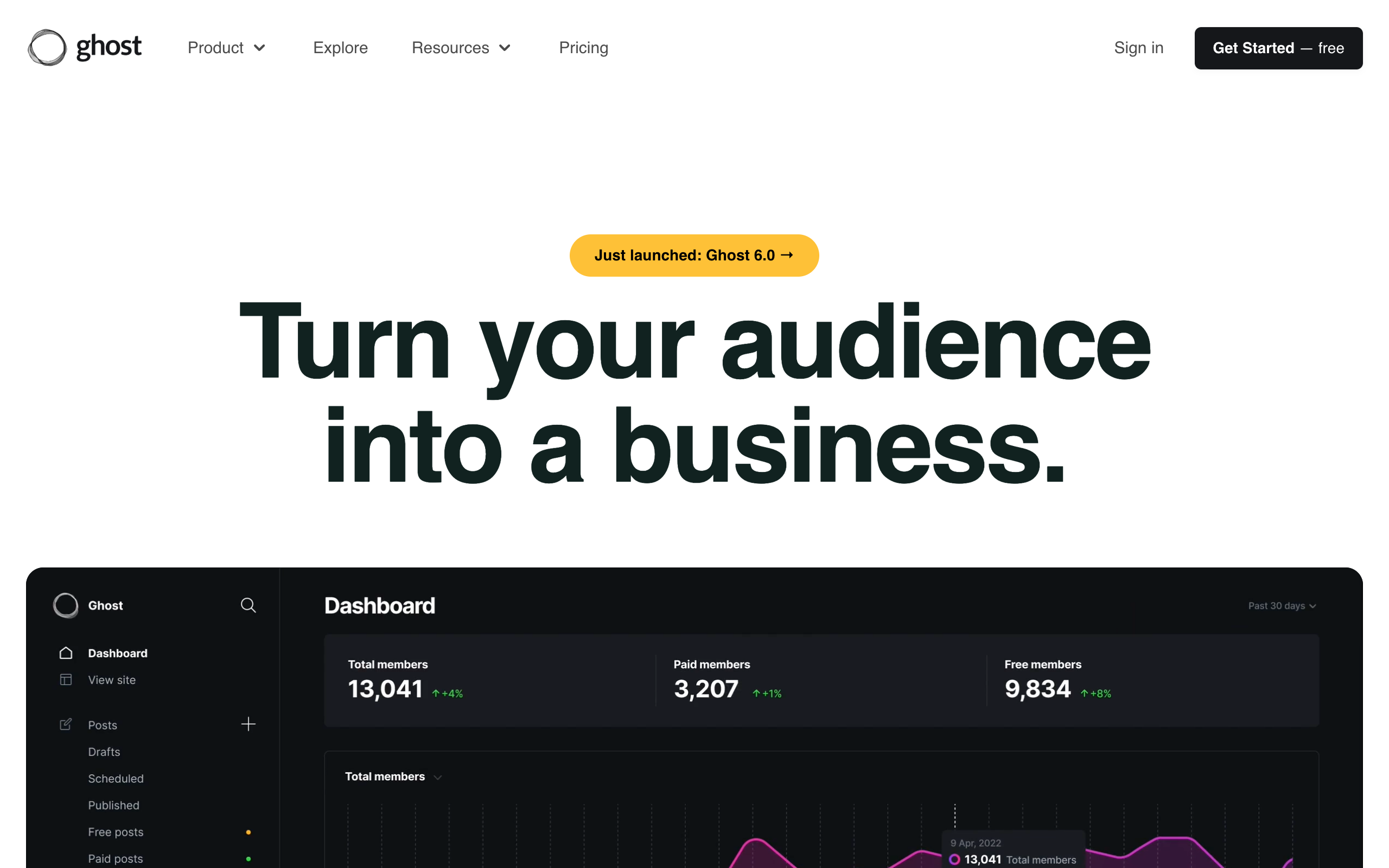
Ghost matches beehiiv’s 0% cut of membership revenue, and unlike beehiiv, you can self-host it entirely for free, owning every byte of infrastructure and every dollar of member revenue beyond payment processing. Ghost(Pro) managed hosting starts at $18 a month billed yearly for 1,000 members on the Starter plan, with Publisher at $29 a month adding custom themes, verified on ghost.org in July 2026.
What Ghost does not give you is a demand-generation layer. There is no ad network connecting you to sponsors and no recommendation marketplace bringing you referred subscribers; growth and sponsor outreach are entirely on you. For a technical operator who already has an audience and wants to own the monetization infrastructure outright, that trade is worth making. For someone starting from zero who needs help finding both readers and sponsors, it is a harder road than beehiiv’s built-in marketplaces.
- Verdict: the best 0%-fee option for operators who want full technical ownership and already know how to generate their own demand. See the direct comparison in beehiiv vs Ghost.
Fee percentage matters, but so does whether the platform actively helps you find the people who will pay it. Test the difference yourself with a free beehiiv publication, no card required to try the ad network and Boosts settings.
4. Kit: best for selling digital products alongside a newsletter
Kit takes a different monetization angle entirely: rather than optimizing the newsletter subscription itself, it optimizes selling digital products, courses, templates, and coaching directly to your list through native commerce tools. Paid newsletter subscriptions cost 0% platform fee, but product sales through Kit’s commerce tool carry a transaction fee on top of standard Stripe processing, so check current rates against your margins before committing to that channel specifically.
Growth-side monetization is thinner than beehiiv’s: the Creator Network offers paid recommendations, but there is no native ad marketplace connecting you with sponsors and no referral-milestone program built in. The free Newsletter plan covers up to 10,000 subscribers with one basic automation; paid plans start at $33 a month for Creator.
- Verdict: the strongest choice if your monetization plan centers on selling products rather than the subscription or sponsorships. Full comparison in beehiiv vs Kit.
5. Patreon: monetizes community and access, not the email itself
Patreon is worth including in this ranking because plenty of newsletter writers use it as their paid layer instead of a native subscription tool, especially those who also publish podcasts, video, or a members-only community alongside the writing. Patreon is free to start and takes 10% of creator earnings plus payment processing, currency conversion, and payout fees, verified on Patreon’s pricing page in July 2026. In exchange, you get membership tiers, one-time payments, direct messaging, and exportable email lists, but email itself is a secondary feature bolted onto a membership platform, not the core product the way it is on beehiiv, Substack, or Ghost.
The honest read: if your monetized product is genuinely a community (chats, tiered access, behind-the-scenes content across multiple formats), Patreon’s fee buys you infrastructure a pure newsletter platform does not have. If your monetized product is specifically the newsletter, the email itself, Patreon’s 10% cut buys you less than a purpose-built newsletter platform’s equivalent fee would, and the email tooling on Patreon is noticeably thinner than on any dedicated newsletter platform in this comparison: no automations to speak of, minimal segmentation, and no SEO-indexable archive for your posts to compound in search over time. See the direct matchup in beehiiv vs Patreon before choosing between the two.
- Verdict: a strong choice for multi-format creators building a paid community; a weaker choice for a writer whose product is specifically the newsletter.
6. Buttondown: cheapest way to test paid subscriptions, priced à la carte
Buttondown is the smallest platform on this list, and its monetization model reflects that: a free plan to 100 subscribers, a base price that scales with active subscriber count rather than billing dead emails, and paid subscriptions sold as a separate $9 a month add-on rather than a built-in feature, alongside other à la carte add-ons like analytics and RSS-to-email, with automations at $29 a month, verified on buttondown.com in July 2026.
For a small list testing whether paid subscriptions work at all, the total monthly cost stays low. Stack multiple add-ons as your needs grow, though, and the minimalism premium adds up, and there is no ad network or referral marketplace to help you find either paying subscribers or sponsors.
- Verdict: the cheapest real test of paid subscriptions for a small, technically comfortable list; not built for scaling monetization beyond that test.
Which platform should you use to monetize your newsletter?
- Want every monetization channel (subscriptions, ads, referral revenue) in one product with 0% subscription fees: beehiiv.
- Testing whether anyone will pay at all, starting from zero readers: Substack, and plan your exit once revenue passes the beehiiv breakeven point.
- Want full technical ownership and already have your own audience and sponsor relationships: Ghost.
- Monetization plan centers on courses, templates, or coaching sold to the list: Kit.
- Building a paid community with multi-format content, not primarily email: Patreon.
- Small technical list, want the cheapest possible test of paid subscriptions: Buttondown.
One number worth internalizing before you pick: the platform’s cut is not a one-time cost, it is a permanent tax rate on every dollar your newsletter ever earns through that channel. A percentage-based fee (Substack, Patreon) grows in absolute dollars alongside your success. A flat platform fee (beehiiv, Ghost) does not. Choose accordingly, and read my broader guide to newsletter monetization strategies if subscriptions are only one piece of the plan.
Frequently asked questions
What is the best platform to monetize a newsletter? beehiiv, because it is the only platform combining 0% fees on paid subscriptions with a native ad network and a referral marketplace (Boosts), giving you three built-in revenue channels instead of one.
Does Substack or beehiiv make more sense for monetization? beehiiv, once your paid subscription revenue passes roughly $430 a month, since Substack’s 10% cut then costs more than beehiiv’s flat Scale plan fee. Substack remains simpler for testing paid subscriptions from zero with no existing audience.
Can I monetize a newsletter without charging for subscriptions? Yes, and for many newsletters this pays more. Sponsorships and ads are the largest revenue source for most mid-sized newsletters, and beehiiv’s built-in ad network and Boosts marketplace are the only tools in this comparison that actively generate that demand for you rather than leaving it entirely up to cold outreach.
How much does Patreon take compared to a newsletter platform? Patreon takes 10% of creator earnings plus payment processing and payout fees. beehiiv and Ghost both take 0% of subscription or membership revenue, charging a flat platform fee instead.
What percentage of newsletter revenue should I expect a platform to keep? It ranges from 0% (beehiiv Scale and above, Ghost) to 10% (Substack, Patreon) plus payment processing fees of roughly 2.9% plus $0.30 per transaction on most platforms, regardless of the platform’s own cut.
Should I run paid subscriptions, ads, or both? Both, if the platform supports it well. Paid subscriptions build predictable recurring revenue but usually convert only a small slice of your free readers. Sponsorships and ads monetize the rest of your audience without asking them to pay anything, which is why beehiiv’s combination of 0%-fee subscriptions and a built-in ad network tends to out-earn a subscriptions-only platform at a comparable list size.
The bottom line
Monetizing a newsletter is not one decision, it is at least three: which fee structure you accept, how many revenue channels the platform actively supports, and whether the platform helps you find buyers or leaves that job entirely to you. beehiiv wins this comparison because it is the only platform answering all three questions well at once: a 0% fee, three native revenue channels, and marketplaces that actively bring both subscribers and sponsors to your door. Every other platform on this list wins a narrower situation, whether that is Substack’s zero-friction start, Ghost’s full ownership, Kit’s product commerce, or Patreon’s community layer, but none of them stack all three monetization advantages the way beehiiv does. Pick the platform that fits how you already plan to make money, not the one with the most familiar name, and revisit the decision once your revenue crosses the fee breakeven points laid out above.
Start a free beehiiv publication and turn on the referral program on your very next send. Free to 2,500 subscribers, no card required, and the monetization tools are the same ones a $50,000-a-year newsletter is using today.
Pricing captured from vendor pricing pages, July 2026. Plans change, so confirm current details before you buy.


