

Most people googling “beehiiv alternatives” don’t actually have a beehiiv problem. They have a $43-a-month problem, or an automation problem, or a “my whole business lives on someone else’s platform” feeling they can’t shake. Those are three different problems with three different answers.
So here’s the honest version up front: the best beehiiv alternatives in 2026 are Kit if you need deep automation, Ghost if you want open-source ownership of a paid publication, Substack if you want built-in discovery, MailerLite if you want the lowest bill, Brevo if you need email plus SMS in one tool, Moosend if you run a store, and Mailchimp if you’re already living inside its SMB ecosystem. And for a large share of newsletter operators, the correct move after reading all seven is to stay exactly where you are.
I run publications on beehiiv, and I’ve set up live test accounts on every platform in this list to check what the marketing pages don’t tell you. I’ll tell you where each one genuinely beats beehiiv, where it loses, what it costs at prices I pulled from the live pricing pages this month, and how painful the migration actually is. Then I’ll make the case nobody writing “top 10 alternatives” listicles wants to make: when leaving is a mistake.
Disclosure: some links in this post are affiliate links. If you sign up through them, we may earn a commission at no extra cost to you. That never changes our verdict.
The 7 best beehiiv alternatives at a glance

Before the detail, here is the whole decision in one table. Prices are the entry paid tier at small list sizes, on annual billing where vendors offer it, captured from live pricing pages in July 2026.
| Platform | Beats beehiiv at | Loses to beehiiv at | Entry paid price | Free plan |
|---|---|---|---|---|
| Kit | Visual automations, tagging, creator commerce | Growth tools, price at 1,000+ subs | $33/mo (1,000 subs) | Up to 10,000 subs, 1 basic automation |
| Ghost | Ownership, memberships, full website | Growth network, email-first workflow | $18/mo (1,000 members, yearly) | None hosted (self-host is free software) |
| Substack | Discovery, Notes, zero upfront cost | Automation, analytics, 10% fee on paid subs | $0 + 10% of paid revenue | Everything free, forever |
| MailerLite | Price, landing pages, ease of use | Newsletter growth features, monetization | $10.80/mo (500 subs, yearly) | 250 subs, 2,500 emails/mo |
| Brevo | Email + SMS + WhatsApp, volume-based pricing | Everything newsletter-specific | $8.08/mo (5,000 emails, yearly) | Yes, with daily send cap |
| Moosend | Budget ecommerce automation | Newsletter identity, referral growth | $7/mo (500 contacts, yearly) | 30-day trial only |
| Mailchimp | SMB integrations, multichannel journeys | Price fairness, creator features | $13/mo (500 contacts) | 250 contacts, 500 sends/mo |
For context on what you would be leaving: beehiiv’s free Launch plan covers up to 2,500 subscribers with unlimited sends and a custom domain, Scale starts at $43 per month and steps up with list size, and Max starts at $96 per month. beehiiv takes 0% of your paid subscription revenue on paid plans. I break down every tier in my beehiiv pricing guide, and the full platform verdict lives in my beehiiv review.
When does leaving beehiiv actually make sense?
Leaving beehiiv makes sense in exactly four situations: automation beyond its ceiling, ecommerce revenue, a small list on a tight budget, or a hard requirement to own your infrastructure. I want to be precise here, because a Reddit thread complaining about the editor isn’t a migration strategy. Moving platforms costs you a weekend minimum, some deliverability turbulence while the new domain warms up, and every automation rebuilt by hand. That price is only worth paying in four cases.
You need automation beehiiv cannot express. beehiiv’s automations handle the standard newsletter flows fine: welcome sequences, re-engagement, polls-triggered branches. But if your business runs on behavior-based logic, think “tag everyone who clicked the pricing link, wait three days, branch by whether they visited the sales page, then move them into a different pipeline,” you’ll hit the ceiling. That ceiling is exactly where Kit and Brevo live.
Your revenue is ecommerce, not the newsletter itself. beehiiv monetizes attention: ads, Boosts, paid subscriptions. It has no cart abandonment triggers, no product recommendation engine, no order-based segmentation. If you send emails to sell physical or ecommerce products, Moosend, Brevo, or Mailchimp fit the actual job.
Your list is small and Scale feels expensive. The free Launch plan is generous at 2,500 subscribers, but the jump to $43 per month stings when you have 3,000 subscribers and no revenue yet. MailerLite at $10.80 per month is the honest budget answer, with trade-offs I’ll spell out below.
You want to own the infrastructure. beehiiv is a hosted platform. If the thought of any company controlling your archive, your URLs, and your reader relationships keeps you up at night, Ghost is the only name on this list that fully solves it, because you can run the software yourself.
One complaint that didn’t make the list: discovery. beehiiv’s recommendation network and Boosts are the closest thing to Substack’s flywheel outside Substack itself, and unlike Substack, beehiiv pays you cash for recommending. If growth is your complaint, switching is usually the wrong fix. More on that at the end.
1. Kit: the beehiiv alternative for serious automation
Kit, which is what ConvertKit renamed itself to in 2024, is where I point anyone whose newsletter is really a front end for selling digital products. The visual automation builder is the best in the creator space, full stop. You drag conditions, actions, and delays onto a canvas, and the logic you imagine is the logic you get. Tagging is granular down to individual link clicks, and the commerce features let you sell a course or paid newsletter without bolting on another tool.
Where it beats beehiiv: automation depth, subscriber tagging, A/B testing on content (Pro plan), and a mature ecosystem of integrations built over a decade. The Creator Network also does paid and free recommendations, so you aren’t giving up cross-promotion entirely.
Where it loses: growth mechanics and price. There’s no equivalent of Boosts paying you cash to recommend other newsletters, no ad network selling your placements for you, and the website layer is landing pages rather than a real SEO-indexable publication. On price, the free Newsletter plan covers a headline-grabbing 10,000 subscribers, but read the fine print I confirmed on Kit’s live pricing page: it includes exactly one basic automation. The whole point of Kit is automations, so treat the free tier as a demo. Real usage means Creator at $33 per month or Pro at $66 per month at 1,000 subscribers, both stepping up with list size. beehiiv’s Scale tier starts at $43 and reprices as your list grows too, so before assuming either side is cheaper at scale, run both calculators at your real subscriber count. In my checks, Kit’s curve climbed faster at every tier I compared.
Migration effort: moderate. Subscriber CSV export from beehiiv and import into Kit takes an evening, including rebuilding your welcome sequence. What doesn’t transfer is your post archive as a website; Kit isn’t built to host one, so your old posts need a separate home. I put the two head to head in detail in beehiiv vs Kit if this is your shortlist.
2. Ghost: the open-source beehiiv alternative for ownership
Ghost is the philosophical opposite of every other tool here, and that is its entire appeal. It is open-source software first and a hosted service second. You can pay Ghost(Pro) to run it, or you can put it on a $6 VPS and owe nobody anything forever. Either way, Ghost takes 0% of your membership revenue, the same stance beehiiv takes and the opposite of Substack’s 10%.
What you get that beehiiv does not offer: a genuinely excellent publication website. Ghost is a real CMS with themes, custom routing, and a decade of SEO reputation. If your ambition is “The Verge for my niche, funded by memberships,” Ghost is the strongest foundation on this list. The editor is also, in my hands-on testing, the cleanest writing surface of any platform here. It gets out of your way in a manner beehiiv’s block editor, which still has its clunky moments, does not.
What you give up is nearly everything beehiiv built its name on. No referral program, no Boosts, no ad network, no recommendation marketplace, thinner email analytics, and automation that barely exists beyond a welcome email. Ghost assumes you’ll bring your own growth. On cost, Ghost(Pro) priced out at $18 per month billed yearly for the Starter plan at the default 1,000-member setting when I checked; smaller lists price lower. And here’s the detail the pricing table buries, which I only caught by expanding the full plan comparison: Starter locks you out of custom themes, the feature many people come to Ghost for. Publisher at $29 per month billed yearly is where those unlock.
Migration effort: the heaviest on this list if you want your archive to move too. Subscribers export fine via CSV. Posts have no one-click beehiiv importer, so you’re looking at manual reposting or scripting against the APIs. Budget a real weekend, not an evening.
3. Substack: the beehiiv alternative if discovery is everything

Substack is not really a beehiiv alternative. It is a different bet, and that’s my honest read after watching writers on both platforms for years. beehiiv bets you’ll grow through infrastructure you control: referrals, SEO, ads, cross-promos. Substack bets you’ll grow through its network: the app, Notes, recommendations from other writers, and the “reader subscribes to five publications at once” flywheel. If you write opinion, essays, or analysis, and your growth plan is “be discovered,” that network is genuinely powerful, and no other platform on this list has anything like it.
The costs are just as clear. Substack charges nothing upfront and takes 10% of paid subscription revenue plus Stripe fees, a number I re-confirmed on Substack’s own creator pages this month. Run that against beehiiv’s 0% take: at $10,000 a year of paid subscriptions, Substack keeps $1,000, every single year, which is roughly two years of beehiiv Scale at its entry price. The tooling gap is wider still. No A/B testing, no real automation beyond a welcome email, shallow analytics, no custom email designs. And the discovery network cuts both ways: your growth depends on an algorithm and a recommendation web you don’t control and can’t take with you.
Migration effort: trivially easy in, easy out. CSV import, paste your old posts if you want them, done in an afternoon. The thing that does not migrate, in either direction, is network position. Leave Substack and your recommendation traffic dies at the door; that lock-in is the real price of the free platform. I wrote a full breakdown in beehiiv vs Substack, because this specific fork is where most writers agonize.
4. MailerLite: the budget beehiiv alternative
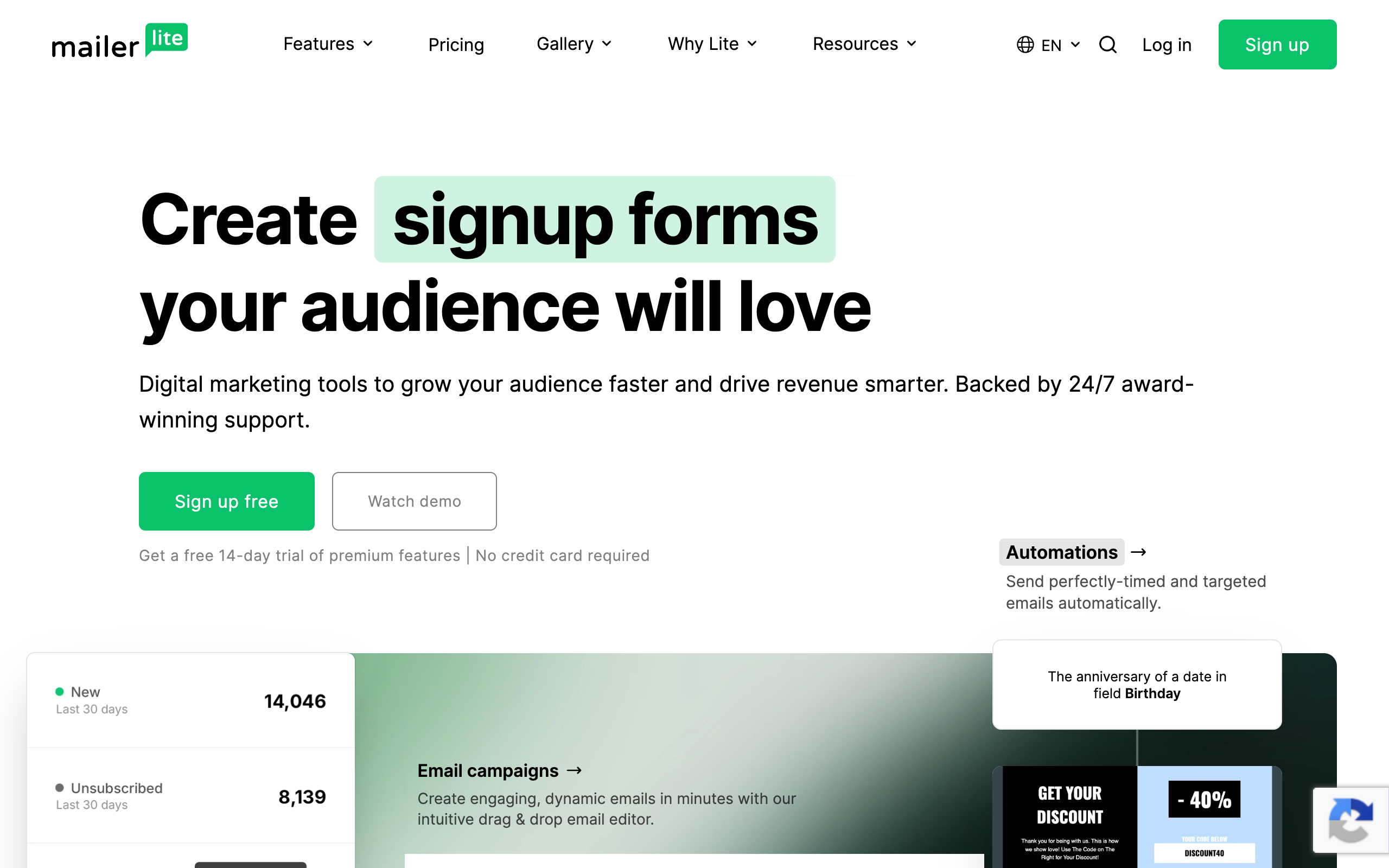
MailerLite is what I recommend when someone says “I love beehiiv but I can’t justify $43 a month yet,” and means it. The Comfort plan runs $10.80 per month billed yearly for 500 subscribers with 5,000 monthly emails, and per the plan comparison on MailerLite’s live pricing page it includes 50 active automations and multivariate testing, features beehiiv reserves for paid tiers. The editor is friendly, the landing page builder is better than a budget tool has any right to have, and support answers around the clock.
One thing other roundups keep getting wrong: MailerLite’s free plan is far smaller than its reputation. As of the live pricing page this month, free covers just 250 subscribers and 2,500 emails per month, and if you exceed 250, sending locks until you upgrade. Compare free tiers honestly and beehiiv’s 2,500-subscriber Launch plan is ten times larger, which makes “switch to MailerLite to save money” true only once you’re actually paying. Below 2,500 subscribers, beehiiv is the cheaper platform at $0.
Where MailerLite loses: it’s an email marketing tool wearing a newsletter costume. No referral program, no ad network, no Boosts, no recommendation network, and the paid newsletter feature is functional rather than a business model. One speed bump worth planning around, because I hit it myself: MailerLite manually reviews every new sender profile before your first send. Budget a waiting day into your migration weekend instead of discovering it Sunday night. Annoying for a day, then quietly good for everyone’s inbox placement.
Migration effort: light. CSV out of beehiiv, CSV in, rebuild one welcome automation, point your domain. The account approval wait is the only real delay.
5. Brevo: the all-in-one alternative when email is only half the job
Brevo, the platform formerly known as Sendinblue, is on this list for one structural reason: it prices by email volume, not by contact count. The Starter plan runs $8.08 per month billed yearly and includes 5,000 emails per month. Every contact-billed platform on this list, beehiiv included, charges you for subscribers who exist. Brevo charges you for emails you send. Be honest about the math, though: 5,000 emails means one full send to a 5,000-person list, so a 20,000-contact list stays under $10 only if you email targeted segments rather than blasting everyone monthly. Even then, the inversion is real. Contact-billed platforms charge you every month just to store those 20,000 people; Brevo stores them free and bills the sends.
The second reason: channels. Brevo does email, SMS, WhatsApp campaigns, live chat, and push from one dashboard, with marketing automation and A/B testing unlocking on the Standard plan at $16.17 per month billed yearly. For a local business or a DTC brand where the newsletter is one channel among four, that consolidation is the whole pitch.
Now the loss column, and it’s long if you’re a pure newsletter operator. No referral program, no recommendations, no ad marketplace, no paid subscriptions, no newsletter website. The email editor is built for campaigns and promotions, not for a beautiful weekly essay. Brevo replaces beehiiv the way a Swiss Army knife replaces a chef’s knife: more tools, less craft. If your reading of this article started with “I need SMS and email together,” start with Brevo’s free plan and see whether the workflow fits before paying anything; the free tier sends with a daily cap, which is enough to judge the editor and automation builder honestly.
Migration effort: light on contacts, moderate on everything else. CSV import is painless. Your beehiiv posts and any paid subscription setup have no equivalent to migrate into.
6. Moosend: the budget ecommerce alternative
Moosend is the cheapest credible paid platform on this list at around $7 per month billed yearly for 500 contacts, with unlimited sends, and it’s now owned by Constant Contact, which the company confirms in its own site footer. That acquisition matters: it means the budget pricing sits on grown-up infrastructure, and it also means Moosend’s roadmap now serves a bigger corporate strategy, which is worth knowing before you commit.
Its real identity is ecommerce email on a budget. Cart abandonment workflows, AI product recommendations, purchase and product-view triggers, weather-based and location-based sends, all at a price where Klaviyo does not even pick up the phone. A detail I appreciated from the pricing FAQ: Moosend bills unique email addresses once, even if the same subscriber sits in five lists. Plenty of platforms, Mailchimp most famously, have charged people for duplicates and unsubscribes over the years, so a vendor putting “you are only billed once” in writing is quietly refreshing.
Two honest caveats. First, there’s no permanent free plan, only a 30-day trial, so beehiiv wins the $0 conversation outright. Second, nothing about Moosend is built for the newsletter-as-a-business model: no referral growth, no recommendation network, no paid subscriptions, no publication website. It replaces beehiiv only when your emails exist to sell products. If that is you, take the 30-day Moosend trial, wire up one cart abandonment flow against your store, and judge it on that single automation. That test tells you more than any comparison table.
Migration effort: light. CSV in, connect your store, rebuild flows. An evening if your automations are simple, a weekend if they are not.
7. Mailchimp: the SMB default, for better and worse
Mailchimp is the platform your accountant has heard of, and there are real reasons it became the default for small business: a deep integration directory, journey builder automations up to 200 steps on the Standard plan per its live pricing page, solid reporting, and a brand every client trusts. If your newsletter is one arm of a small business that also runs a website, a CRM, and a POS, Mailchimp’s ecosystem gravity is legitimate.
But I’ll be straight with you, because the pricing has quietly gotten worse for years. The free plan is now 250 contacts and 500 sends per month, numbers I verified on the live pricing page this month; that’s a tenth of beehiiv’s free subscriber allowance. Essentials starts at $13 per month for 500 contacts and climbs with your contact count, and Mailchimp has long counted unsubscribed and non-subscribed contacts toward your billable audience, a policy that has burned enough people to fill years of forum threads. Meanwhile the creator-economy features beehiiv leads with, referral programs, recommendations, an ad network, paid subscriptions with 0% take, simply don’t exist here. For a pure newsletter operator, moving from beehiiv to Mailchimp is a downgrade wearing a bigger logo. For an SMB consolidating tools, it can still be the pragmatic call. I compare them head to head in beehiiv vs Mailchimp.
Migration effort: light for contacts, none for content. Mailchimp will host campaign archives but is not a publication platform, so your beehiiv site’s SEO value stays behind.
How painful is migrating off beehiiv, really?
Migrating off beehiiv is easier than the horror stories suggest, with one asterisk. The portable parts are genuinely portable: beehiiv exports your full subscriber list as CSV from the audience settings, every platform above imports CSV, and your custom domain moves with a DNS change. Plan for these instead:
- Automations rebuild from zero. No platform imports another platform’s logic. Screenshot every flow before you cancel.
- Your post archive is the sticky part. beehiiv posts live on a beehiiv-generated site. Ghost and Substack can house content; Kit, MailerLite, Brevo, Moosend, and Mailchimp are not publications, so those posts and their search rankings need a separate plan.
- Deliverability dips before it recovers. New sending infrastructure means inbox providers re-learn to trust you. Send consistently to your most engaged segment for the first two weeks.
- Boost and ad revenue stops the day you leave. If beehiiv’s monetization network pays you anything, price that loss into the comparison. A cheaper platform that costs you, say, $200 a month in lost Boosts is not cheaper.
When is beehiiv still the right answer?
beehiiv is still the most complete platform in 2026 for a newsletter that is itself the business: no alternative combines a referral program, a recommendation network that pays you, an ad marketplace, a 0% cut of paid subscriptions, and an SEO-indexable website in one product. That’s the paragraph most “alternatives” posts skip, because it doesn’t help them sell you a migration.
Every alternative above replaces one or two parts of that machine and amputates the rest. Kit out-automates beehiiv and gives up the growth engine. Substack out-discovers it and takes 10% forever. MailerLite undercuts it and drops the business model. Call that fanboying if you like, but it’s simply what the feature matrices say when you lay them side by side, which is exactly what I did for this article.
The people who should stay, or come back: anyone under 2,500 subscribers, because Launch is free and the alternatives’ free plans are a tenth the size. Anyone earning from Boosts or the ad network, because no alternative replaces that revenue. Anyone whose growth strategy leans on referrals and recommendations. And anyone who read the four leave-conditions at the top of this article and didn’t see themselves in a single one.
If that describes you, the cheapest way to settle this costs an evening, not another comparison post. I would start a free beehiiv publication, load your list, and send one real issue. The free plan covers 2,500 subscribers with unlimited sends and a custom domain, so the experiment costs you time, not a dollar.
Frequently asked questions about beehiiv alternatives
What is the best beehiiv alternative overall? Kit, for the largest group of switchers. The people who genuinely outgrow beehiiv usually outgrow its automation, and Kit’s visual automation builder and tagging are the strongest in the creator space. If your reason for leaving is ownership rather than automation, Ghost is the better answer; if it is budget, MailerLite.
What is the cheapest beehiiv alternative? Under 2,500 subscribers, nothing beats beehiiv’s own free Launch plan; MailerLite’s free tier stops at 250 subscribers and Mailchimp’s at 250 contacts. Once you are paying, Moosend at $7 per month and MailerLite at $10.80 per month (both billed yearly, small lists) are the honest budget picks, and Brevo at $8.08 per month wins for big lists you email rarely, because it bills by send volume rather than contacts.
Should I switch from beehiiv to Substack? Only if discovery is your bottleneck and you write the kind of opinion or analysis content Substack’s network rewards. You gain Notes, the app, and recommendations; you give up automation, A/B testing, deep analytics, and 10% of paid subscription revenue forever, versus beehiiv’s 0% take. Writers with an existing audience usually lose in that trade.
Is there an open-source alternative to beehiiv? Ghost is the one that matters. The software is free to self-host apart from your server, Ghost(Pro) hosting starts at $18 per month billed yearly at 1,000 members, and Ghost takes no cut of membership revenue. The trade-off is that you inherit growth: Ghost ships nothing comparable to beehiiv’s referral program, Boosts, or ad network.
How do I move my subscribers off beehiiv? Export your subscriber list as a CSV from beehiiv’s audience settings, then import it into the new platform; every tool in this article accepts CSV imports. Rebuild your automations manually, repoint your custom domain’s DNS, and send to your most engaged segment first while the new infrastructure warms up.
Is beehiiv better than Mailchimp for newsletters? For a newsletter as a business, yes, and it is not close: beehiiv’s free plan covers 2,500 subscribers to Mailchimp’s 250 contacts, and Mailchimp has no referral program, recommendation network, ad marketplace, or 0% paid subscriptions. Mailchimp wins when the newsletter is one channel inside a small business that needs its integration ecosystem.
The bottom line
Strip the feature tables away and the decision compresses to one question: is your newsletter the business, or is email a channel for some other business? If email is a channel, pick the specialist: Kit for automation-driven creator funnels, Brevo for multichannel SMB marketing, Moosend for ecommerce on a budget, Mailchimp for ecosystem gravity, MailerLite for the lowest bill, Ghost for owned publishing, Substack for network discovery.
But if the newsletter is the business, the honest conclusion of a 4,000-word alternatives article is that the alternatives are all missing pieces of the machine you need. My own default after all this testing is boring: I stay on beehiiv, and I’d only move for one of the four exit conditions above, with Kit as the first door I’d try. I compare platforms in this space constantly, and the pattern that keeps repeating is this: people leave beehiiv over a single frustration, spend a month rebuilding, and discover the grass was a different shade of the same green, minus their Boost revenue.
So run the cheap experiment before the expensive one. Open a free beehiiv account, publish one issue, and test the growth tools against whatever you’re using now. If it doesn’t earn its place, every platform above will still be here, and now you’ll be choosing from evidence instead of listicles.
Pricing captured from beehiiv, Kit, Ghost, Substack, MailerLite, Brevo, Moosend, and Mailchimp live pricing pages, July 2026. Plans and numbers change; confirm current details before you buy.


