

Nobody googles “convertkit alternatives” because they are happy. You type that search after your renewal email lands and the number is bigger than last year, or after the 2024 rebrand to “Kit,” or after the tenth time the editor fought you on a simple layout. I have run newsletters on Kit and on most of the platforms below, so let me save you the weekends I spent sorting this out.
Here is the answer up front. The best ConvertKit (Kit) alternative in 2026 is beehiiv for anyone whose main product is a newsletter: it gives you 2,500 free subscribers, built-in growth tools Kit never shipped, and takes 0% of your paid subscription revenue. MailerLite is the pick if you want the cheapest all-round replacement, Brevo if your list is huge but quiet, Ghost if you sell memberships, and Substack only if you want zero setup and can stomach the 10% cut. The rest of this guide is the evidence, the real prices, and the honest cases where staying on Kit is the smarter move.
Disclosure: some links in this post are affiliate links. If you sign up through them, we may earn a commission at no extra cost to you. That never changes our verdict.
Why are people leaving ConvertKit (Kit) in 2026?
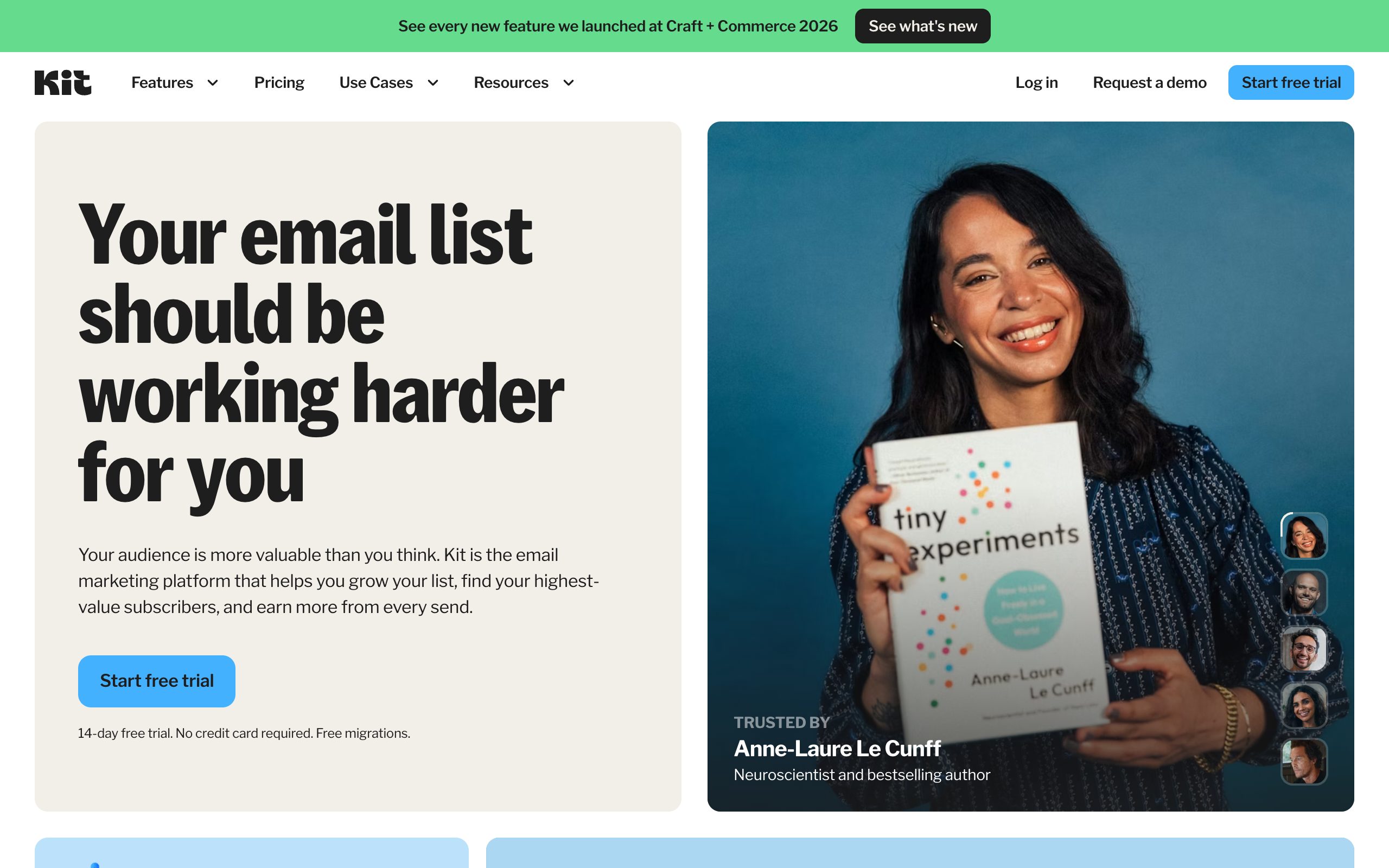
Kit is not a bad product. Let me say that clearly before I spend four thousand words helping you leave it. Its visual automation builder is still one of the best in the business, and the 2024 move to a free plan covering 10,000 subscribers was genuinely generous. But four complaints come up again and again, in my own experience and in the r/Newsletters and creator Slack threads that fill up every time Kit renewal emails go out, and they are all structural rather than fixable with a support ticket.
1. The price climbs with every subscriber you add. Kit charges by list size. The Creator plan starts at $33 per month billed annually for 1,000 subscribers ($39 month to month), and Pro starts at $66 per month annually ($79 monthly), per Kit’s live pricing page in July 2026. Those entry numbers look reasonable. The problem is the slider: every growth milestone you celebrate raises your bill, whether or not those new subscribers earn you anything yet. You are paying a success tax on an asset that has not monetized.
2. The 2024 rebrand created real uncertainty. ConvertKit became Kit in late 2024, repositioning from “email tool” to “operating system for creators.” Some of that was good (the 10,000-subscriber free plan arrived with it). But the free plan caps you at one basic automation, which means the famous automation engine, the whole reason to choose Kit, sits behind the paywall exactly when your list gets big enough to need it. That pricing shape tells you who the free plan is really for: it is a funnel, not a home.
3. The editor still thinks in broadcasts, not publications. Kit’s email editor is built for a creator sending a sales sequence, not a publisher producing a daily or weekly edition. There is no native concept of a post archive that doubles as an SEO asset, no referral program, no cross-promotion network. If your newsletter is the product rather than the marketing channel for a product, you are using a hammer to drive screws.
4. Monetization tools stop at digital products. Kit Commerce handles selling an ebook or a course tier well. But sponsorships, paid recommendations, and ad marketplaces, the three ways most media-style newsletters actually earn, simply do not exist inside Kit. You end up duct-taping spreadsheets and DMs to a platform that was never designed for that economy.
If none of those four hit a nerve, skip to the section near the end called “When you should stay on Kit,” because leaving a working system has real costs too. If at least two of them made you nod, keep reading.
If your newsletter is the product, you can test the top pick on this list without spending anything. If it were my list, I would start a free beehiiv publication tonight and import my Kit export before the weekend. The free plan covers 2,500 subscribers on your own custom domain, so you can run both platforms side by side before you commit.
How I ranked these ConvertKit alternatives
I set up test publications and campaigns on each platform below, imported the same subscriber CSV, rebuilt the same welcome automation, and sent real emails. No platform made this list from a feature page alone. I scored four things: how well it replaces what Kit actually does for you, what it truly costs at 1,000 and at 10,000 subscribers, how painful the migration is on a scale of an afternoon to a lost weekend, and where it beats Kit outright rather than merely matching it. Pricing was captured from each vendor’s live pricing page in July 2026 unless noted otherwise.
The 7 best ConvertKit (Kit) alternatives in 2026
1. beehiiv: the best Kit alternative for newsletter-first creators
beehiiv was built in 2021 by former Morning Brew growth engineers, and it shows in every screen. Where Kit treats your newsletter as one channel among many, beehiiv treats it as the business. That single difference in worldview explains almost everything else on this list.
Here is what you gain the day you switch. Every post you publish becomes a web page on your own domain that Google can index, so your archive compounds into an SEO asset instead of dying in inboxes. A referral program is built in, no Zapier, no third-party tool, so your readers can grow your list for you. Boosts let other newsletters pay you to recommend them (and vice versa), which is the closest thing this industry has to passive acquisition. An ad network connects sponsors to your publication once you have the audience. And if you charge for subscriptions, beehiiv takes 0% of that revenue on paid plans, a direct shot at Substack’s 10% and a structural advantage over Kit, which was never built for paid newsletters at all.
The pricing, from beehiiv’s live pricing page in July 2026: the free Launch plan covers up to 2,500 subscribers with unlimited sends and a custom domain, which is the most generous genuinely usable free tier in this market. Scale starts at $43 per month billed annually ($49 monthly) at the entry subscriber tier and unlocks automations, the referral program, Boosts, the ad network, and 0% take rate, scaling with list size up to 100,000 subscribers. Max starts at $96 per month annually and removes beehiiv branding, adds up to 10 publications, and unlocks priority support. I break the tiers down line by line in our beehiiv pricing guide.
Now the honest part, because a list that only praises its number one pick is an ad. beehiiv’s automation builder is functional but shallower than Kit’s. If you run intricate branching sequences with tag-based conditional logic, you will notice the downgrade, and I would not pretend otherwise. The editor still throws the occasional small bug, deliverability on the free plan rides shared sending infrastructure, and the subscriber-tier pricing means your bill steps up in chunks as your list crosses thresholds. None of these were dealbreakers in my testing, but you should walk in with open eyes. My full hands-on beehiiv review covers each wart in detail.
Migration effort: low. Export your subscribers from Kit as a CSV, import into beehiiv, and map your tags to segments. My test import of a tagged list took under an hour including DNS setup for the custom domain. Automations must be rebuilt by hand, so budget an afternoon if you have several.
Choose beehiiv over Kit if: your newsletter is the product, you want growth mechanics built into the platform, or you plan to monetize with sponsorships or paid subscriptions. Stay away if: your business runs on deep automation funnels for selling courses, because that is the one battle Kit still wins. For the head-to-head on that exact question, see our full beehiiv vs Kit comparison.
2. MailerLite: the best cheap all-rounder
MailerLite is what I recommend when someone says “I like what Kit does, I just refuse to pay Kit prices as my list grows.” It covers the same core ground: clean email editor, solid visual automations, landing pages, forms, and digital product sales, at consistently lower prices per subscriber tier.
The automations deserve a specific mention because this is where most budget tools fall apart. MailerLite’s builder handles multi-step sequences with conditions and triggers well enough that I rebuilt a Kit welcome funnel in it without hitting a wall. It is not as elegant as Kit’s canvas, but the logic gets there.
One warning before you trust an older review of MailerLite: the plans changed. As of its live pricing page in July 2026, the free plan covers just 250 subscribers with 2,500 monthly emails (it was famously 1,000 subscribers for years), and paid plans now run in Comfort and Power tiers starting at $12 and $25 per month respectively, scaling with list size. The free plan is now a trial rather than a home, but the paid tiers still undercut Kit meaningfully at every list size I checked.
The migration itself is the easy part: CSV out of Kit, CSV in, rebuild your automations. MailerLite’s import tolerated my messy tag columns better than most tools I tested. My verdict is simple. If your honest reason for leaving Kit is the bill, and you never planned to monetize the newsletter itself, MailerLite is where I would send you, and you can stop reading at the comparison table. Just know that referrals, boosts, and ad networks do not exist here; this is a cheaper Kit, not a different species.
3. Brevo: the best alternative for big lists that send rarely
Brevo (formerly Sendinblue) breaks the pricing model that makes Kit expensive, and for the right person this one difference is worth the whole migration. Kit charges you for how many subscribers you store. Brevo charges you for how many emails you send. If you have 20,000 subscribers and email them once or twice a month, that inversion can cut your bill dramatically.
As of mid-2026, Brevo’s free plan allows around 300 emails per day to an unlimited number of stored contacts, with paid marketing plans starting at roughly $9 per month based on send volume. Brevo’s pricing page is rendered dynamically so I could not capture exact live figures the way I did for Kit and beehiiv; treat these as directional and check the current calculator before you buy.
Beyond the pricing model, Brevo is a broader marketing platform than Kit: transactional email, SMS, WhatsApp campaigns, a built-in CRM, and marketing automation live under one roof. That breadth is also its weakness for creators. The interface feels like business software, not a writing tool, and there is nothing newsletter-native here: no archive pages, no referral mechanics, no monetization rails. In my testing, campaign setup took noticeably more clicks than Kit or beehiiv.
Migration effort: low to medium. Contact import is easy; expect to spend time re-creating segments, and note that new Brevo accounts go through a sending-reputation warmup that can throttle your first big sends.
Choose Brevo if you have a large list, a low sending frequency, or you also need transactional email and SMS in one bill. You can start on Brevo’s free plan and test the send-based pricing against your actual volume before moving anything permanently. Skip it if you send multiple times a week to your whole list, because send-based pricing then works against you.
4. Ghost: the best alternative for membership businesses
Ghost is the one platform on this list that beats beehiiv at something important: full ownership. It is open-source software that publishes a fast website, a newsletter, and a paid membership program from a single interface, and it takes 0% of your membership revenue. You connect your own Stripe account, and payments flow directly to you.
Per Ghost’s live pricing page in July 2026, Ghost(Pro) hosting runs $18 per month for the Starter plan at 1,000 members and $29 per month for Publisher at 1,000 members, which adds custom themes, three staff users, and paid subscription tiers; prices scale with member count, and smaller lists start lower. If you are technical, you can also self-host Ghost for the cost of a small server, which makes it the only true zero-lock-in option in this entire article. That matters more than people think: every other platform here can change its pricing or rules tomorrow, and your only recourse is another migration.
The trade-offs are real. Ghost has few growth tools (no referral program, no cross-promotion network), its email analytics are thinner than beehiiv’s, and its automation is nearly nonexistent compared to Kit. Ghost assumes you will bring the audience; it just refuses to tax it.
Migration effort: medium. Subscriber CSV import is simple, but if you sell paid products on Kit you will be rebuilding your offer as Ghost membership tiers, and content migration to Ghost’s editor takes time if you want your archive on your new site.
Choose Ghost if paid memberships are your model and you want maximum ownership. Skip it if you want marketing automation or plug-and-play growth mechanics.
5. Substack: the zero-setup option with a 10% asterisk
I will be blunt, because you deserve one clear opinion here: Substack is the easiest platform on this list to start on and the most expensive one to succeed on. It costs nothing upfront, the editor is pleasant, and the Notes feed plus recommendation network can genuinely surface your writing to new readers, which no other platform here does as well.
Then you turn on paid subscriptions, and Substack keeps 10% of your revenue, plus Stripe’s processing fees, forever. Substack’s own materials confirm writers keep 90% minus credit card fees, as of July 2026. On a newsletter earning $2,000 a month, that is $2,400 a year, enough to pay for more than four full years of beehiiv Scale at its $516 annual price, and Substack charges it again every year, scaling up with your success. There is no cap.
The deeper issue for someone leaving Kit specifically: Substack has no automation at all. No welcome sequences with logic, no tagging, no A/B testing, no real segmentation, thin analytics. You would be trading Kit’s best feature for a discovery network and an easy editor. For some writers, pure writers with no funnel, that trade makes sense. For anyone running an actual email operation, it is a downgrade in three directions at once. We wrote up the escape routes in our guide to Substack alternatives, and most of them apply in reverse if you are considering moving in.
Migration effort: very low. CSV in, write, publish. That ease is the product.
6. Moosend: the budget automation pick
Moosend is the least famous name on this list, and it survives on one merit: surprisingly capable marketing automation at a price that undercuts nearly everyone. The visual workflow builder handles triggers, conditions, and branches that get you closer to Kit’s automation depth than MailerLite does, and unlimited email sends come standard on paid plans.
Moosend’s pricing page uses a live calculator rather than fixed public tiers, so exact figures depend on your list size; as of mid-2026, Pro pricing for small lists starts in the single digits per month, with a 30-day free trial (no credit card) covering up to 1,000 contacts and unlimited sends. There is no permanent free plan, which is worth knowing before you commit your testing time.
What you give up is polish and ecosystem. Fewer integrations than Kit, no newsletter-native features, a template library that feels a generation behind, and a brand small enough that you should think about longevity before making it your forever home. I treat Moosend as the pragmatic choice for automation-heavy senders on a tight budget rather than a platform to build an identity on. The 30-day trial is long enough to rebuild your core Kit automations and see whether the builder covers your logic before you pay anything.
Migration effort: low. CSV import plus automation rebuild, same as MailerLite.
7. Mailchimp: the familiar name I would mostly avoid
Mailchimp is on this list because you will compare it anyway, and I would rather arm you than pretend it does not exist. For a creator leaving Kit, Mailchimp usually solves the wrong problem. It is built for small-business and ecommerce marketing, and its pricing has quietly become some of the least creator-friendly in the industry.
From Mailchimp’s live pricing page in July 2026: the free plan now caps at 250 contacts and 500 sends per month, Essentials starts at $13 per month and Standard at $20 per month at 500 contacts, and Premium runs $350 per month. Two structural gotchas bite harder than the sticker prices. Mailchimp counts unsubscribed and non-subscribed contacts toward your billable total, so you pay for people you can no longer email unless you regularly clean house. And Essentials caps automations at four flow steps, which means the plan most switchers would buy cannot rebuild a typical Kit welcome sequence.
Where Mailchimp legitimately wins: ecommerce integrations, customer journeys tied to purchase data, and multichannel campaigns. If your “newsletter” is really the marketing arm of a store, Mailchimp belongs on your shortlist. If you are a creator or publisher, it is the weakest fit on this page.
Migration effort: low for contacts, medium for automations given the flow-step limits.
ConvertKit alternatives compared: pricing and best use
| Platform | Free plan | Paid entry price | Cut of paid subs | Best for |
|---|---|---|---|---|
| beehiiv | 2,500 subscribers, unlimited sends, custom domain | $43/mo annual (Scale) | 0% on paid plans | Newsletter-first creators and media operators |
| MailerLite | 250 subscribers, 2,500 emails/mo | $12/mo (Comfort) | n/a | Cheapest all-round Kit replacement |
| Brevo | ~300 emails/day, unlimited contacts | ~$9/mo (send-based) | n/a | Big lists with low send frequency |
| Ghost | None (self-host possible) | $18/mo at 1,000 members | 0% | Membership and publication businesses |
| Substack | Everything free | $0 | 10% + Stripe fees | Pure writers who want discovery, not tooling |
| Moosend | 30-day trial only | Single digits/mo for small lists | n/a | Automation depth on a tight budget |
| Mailchimp | 250 contacts, 500 sends/mo | $13/mo (Essentials) | n/a | Ecommerce and small-business marketing |
| Kit (baseline) | 10,000 subscribers, 1 basic automation | $33/mo annual (Creator) | n/a (commerce fees apply) | Automation-heavy creator funnels |
Prices captured from each vendor’s live pricing page in July 2026 at entry subscriber tiers, annual billing where offered; Brevo and Moosend figures are directional as of mid-2026 (see footer note).
Which ConvertKit alternative should you choose?
Rankings are averages, and you are not an average. Match your situation instead:
- Your newsletter is the business (you want growth, sponsorships, or paid subs): beehiiv, and it is not close. The referral program, Boosts, and 0% take rate compound in a way no generic email tool matches.
- You mainly want Kit for less money: MailerLite. Same job, smaller bill, fewer surprises.
- Huge list, occasional sends: Brevo’s send-based pricing turns your quiet list from a liability into a discount.
- Memberships are the model and ownership matters: Ghost, with your own Stripe account and zero platform tax.
- You just want to write and be discovered: Substack, with eyes open about the 10%.
- Deep automations, minimal budget: Moosend.
- Your list exists to sell physical products: Mailchimp, reluctantly.
If you are weighing the whole market beyond Kit refugees specifically, our roundup of the best newsletter platforms in 2026 compares these tools from a blank-slate starting point.
Still torn between two options? Run the cheapest experiment in this article: I would import my Kit list into a free beehiiv publication tonight and send the next three editions from both platforms. Your open rates, your writing speed, and your stress level will pick a winner faster than any comparison table, mine included.
When should you stay on ConvertKit (Kit)?
An honest alternatives guide has to include this section, because migration has costs that never show up on pricing pages: rebuilt automations, re-warmed sending domains, broken integrations, and a week of your attention. Stay on Kit if any of these describe you.
Your revenue runs through complex automations. If your business is evergreen funnels, tag-based segmentation, launch sequences with conditional branches, and integrations with course platforms, Kit remains the best tool on this page for that job. Nothing here matches its automation canvas at creator-friendly prices. Moving would mean rebuilding your money machine on a platform with fewer parts.
You are under 10,000 subscribers and barely automate. Kit’s free plan covers you at zero dollars. The single-automation limit stings, but if you have not hit it, you have no financial reason to move. Migrate when the constraint is real, not theoretical.
The Creator Network is feeding you. Kit’s recommendation network genuinely drives subscribers for some publications. If you are one of them, measure what you would lose before chasing beehiiv’s Boosts, which pay you but require an audience to activate.
You sell digital products through Kit Commerce and it works. Working payment plumbing is worth a lot. Do not migrate a functioning checkout because a listicle told you to.
The pattern behind all four: Kit is a funnel tool that happens to send newsletters. If you use it as a funnel tool, stay. If you have been bending it into a publishing platform, that is exactly the strain this list exists to fix.
How to migrate off Kit without losing subscribers
Whichever platform you pick, the move follows the same five steps. Each one is on this list because skipping it costs someone their deliverability or their segmentation every single week; the order matters as much as the steps.
- Export everything, not just emails. In Kit, export your subscriber CSV including tags and custom fields. Export each segment separately if your new platform imports lists one at a time; rebuilding segmentation from a single flat file is the step people underestimate most.
- Set up your sending domain before you import. Configure your custom domain and authentication (SPF, DKIM, DMARC) on the new platform first, and send test emails to seed accounts at Gmail and Outlook. Sending your first real edition from an unauthenticated domain is how migrations end up in spam folders.
- Import, then map tags to the new system. beehiiv and MailerLite use segments where Kit uses tags. Do the mapping deliberately; a sloppy import here haunts every send afterward.
- Rebuild your welcome automation before announcing anything. New subscribers should never land in a dead zone. This is the one automation worth perfecting on day one.
- Run both platforms in parallel for two or three sends. Keep Kit alive for a couple of weeks. Compare deliverability and opens on the same content, then cancel from a position of evidence rather than hope.
Paid subscriptions are the special case: if you charge money on Kit or Substack, plan the Stripe side separately, and expect some manual work moving active subscriptions. Budget a weekend for a simple list and a full week of part-time attention if you have automations and paid products.
Frequently asked questions
What is the best ConvertKit alternative in 2026? For newsletter-first creators, beehiiv is the best ConvertKit (Kit) alternative in 2026: a free plan to 2,500 subscribers, built-in referral and cross-promotion tools, and 0% platform fee on paid subscriptions. For general email marketing on a budget, MailerLite is the strongest pick, and Ghost leads for paid membership businesses.
Is beehiiv better than Kit? beehiiv is better than Kit for publishing and growing a newsletter; Kit is better for automation-driven selling. beehiiv wins on web archive, referrals, Boosts, ad network, and monetization without a revenue cut, while Kit wins on sequences, tagging logic, and course-platform integrations. Our detailed beehiiv vs Kit breakdown settles it use case by use case.
Why did ConvertKit change its name to Kit? ConvertKit rebranded to Kit in late 2024, repositioning as a broader “operating system” for creators and introducing a free plan covering up to 10,000 subscribers. The product did not fundamentally change with the name, but the free plan’s one-automation limit made the platform’s paywall placement more visible to growing creators.
What is the cheapest ConvertKit alternative? On list price, MailerLite (paid plans from $12 per month as of July 2026) and Moosend (single-digit entry pricing for small lists as of mid-2026) are the cheapest credible replacements. But cheapest depends on your shape: with a large, low-frequency list, Brevo’s send-based pricing can beat both, and under 2,500 subscribers beehiiv’s free plan costs nothing at all.
Can I migrate from Kit without losing my subscribers? Yes. Every platform in this guide imports a standard CSV export from Kit, including tags and custom fields. You will not lose subscribers, but you will lose automations, which must be rebuilt manually, and you should authenticate your sending domain before the first send to protect deliverability.
Should I switch from Kit to Substack? For most Kit users, no. Substack trades away automations, segmentation, and A/B testing entirely, and takes 10% of any paid-subscription revenue plus processing fees. The switch only makes sense if radical simplicity and Substack’s discovery network matter more to you than tooling; writers who monetize seriously usually end up happier on beehiiv or Ghost, both of which take 0%.
The bottom line
Remember why you searched this in the first place: the bill that grows faster than the business, or the platform that treats your publication like a marketing channel. Both problems have the same shape, a funnel tool being asked to do a publisher’s job, and the fix is to match the tool to the job. Kit for funnels. MailerLite for Kit-on-a-budget. Ghost for memberships. Brevo for big quiet lists. And for the plurality of people reading this, the ones whose newsletter is the point, beehiiv, which is the only platform here that gets structurally better for you as your list grows instead of structurally more expensive.
You do not have to take a ranked list on faith, and you should not. Open a free beehiiv account, import your Kit export, and publish one edition. It costs nothing up to 2,500 subscribers, your list stays yours either way, and one real send will tell you more than every alternatives article on the internet.
Pricing captured from Kit, beehiiv, MailerLite, Ghost, Mailchimp, and Substack live pricing pages, July 2026. Brevo and Moosend publish dynamic pricing calculators, so their figures are stated as of mid-2026 and are directional. Plans and prices change; confirm current details on each vendor’s site before you buy.


