
Mailchimp used to be the default answer to “what email tool should I use,” back when that question did not distinguish between a store sending abandoned-cart flows and a writer sending a weekly essay. In 2026 that default has quietly broken. I spent time inside a live Mailchimp account, built a free-plan test list, walked the automation builder, and read through the exact policy language on what counts toward your contact limit, because that last detail turns out to matter more than any feature comparison.
This review is aimed specifically at the newsletter and creator use case, not the ecommerce one, because those two audiences get very different experiences from the same product. If you are choosing Mailchimp to run a store, most of what follows still applies to your billing, but the verdict at the end is written for someone deciding whether to write and grow a newsletter here.
Disclosure: some links in this post are affiliate links. If you sign up through them, we may earn a commission at no extra cost to you. That never changes our verdict.
The 30-second verdict
Mailchimp is a capable, general-purpose email marketing tool that was not built for newsletter operators, and it shows the moment you compare it against platforms that were. It has no referral program, no recommendation network, no ad marketplace, and a free tier capped at just 250 contacts, the smallest free allowance of any major platform I have tested in this category. Where it does shine is journeys and integrations: if you run a Shopify store or need a marketing automation tool that plugs into dozens of other apps, Mailchimp is still genuinely strong.
For a newsletter whose business is the newsletter itself, though, Mailchimp is the wrong tool wearing a familiar name. I rate it 3 out of 5 for the newsletter use case specifically; it would score higher for ecommerce marketing, which is a different review. For the platform I keep coming back to on the newsletter-first side of that comparison, see our full beehiiv review.
If you are deciding between Mailchimp and a newsletter-first platform, the fastest way to feel the difference is to try both. Start a free beehiiv publication and compare the editor and growth tools directly against your Mailchimp account. The free plan runs to 2,500 subscribers with no card required.
What is Mailchimp, and who was it actually built for?
Mailchimp launched in 2001 as an email marketing tool for small businesses, long before “newsletter platform” was a category anyone talked about separately from “email marketing software.” Intuit acquired the company in 2021 for a reported $12 billion, and the product since then has leaned further into the small-business marketing suite direction: SMS, CRM features, social ads management, and deep ecommerce integrations with Shopify, WooCommerce, and similar platforms.
That heritage explains everything about how the product feels today. Mailchimp’s mental model is “contacts” and “campaigns,” the language of marketing databases, not “subscribers” and “issues,” the language of publishing. Its strongest features (journeys, predictive segmentation, multivariate testing) are built for a business sending promotional and transactional email to a customer list, not a writer building a relationship with an audience one issue at a time.
Who is Mailchimp actually for in 2026?
The cleanest way I found to test this: does your list exist because people bought something from you, or because they chose to keep reading you? If the answer is “bought something,” Mailchimp’s automation and ecommerce integrations are a legitimate strength, and you should probably stay. If the answer is “chose to keep reading,” you are shopping in the wrong aisle, and every feature comparison below will explain why.
What does setting up a free Mailchimp account actually feel like?
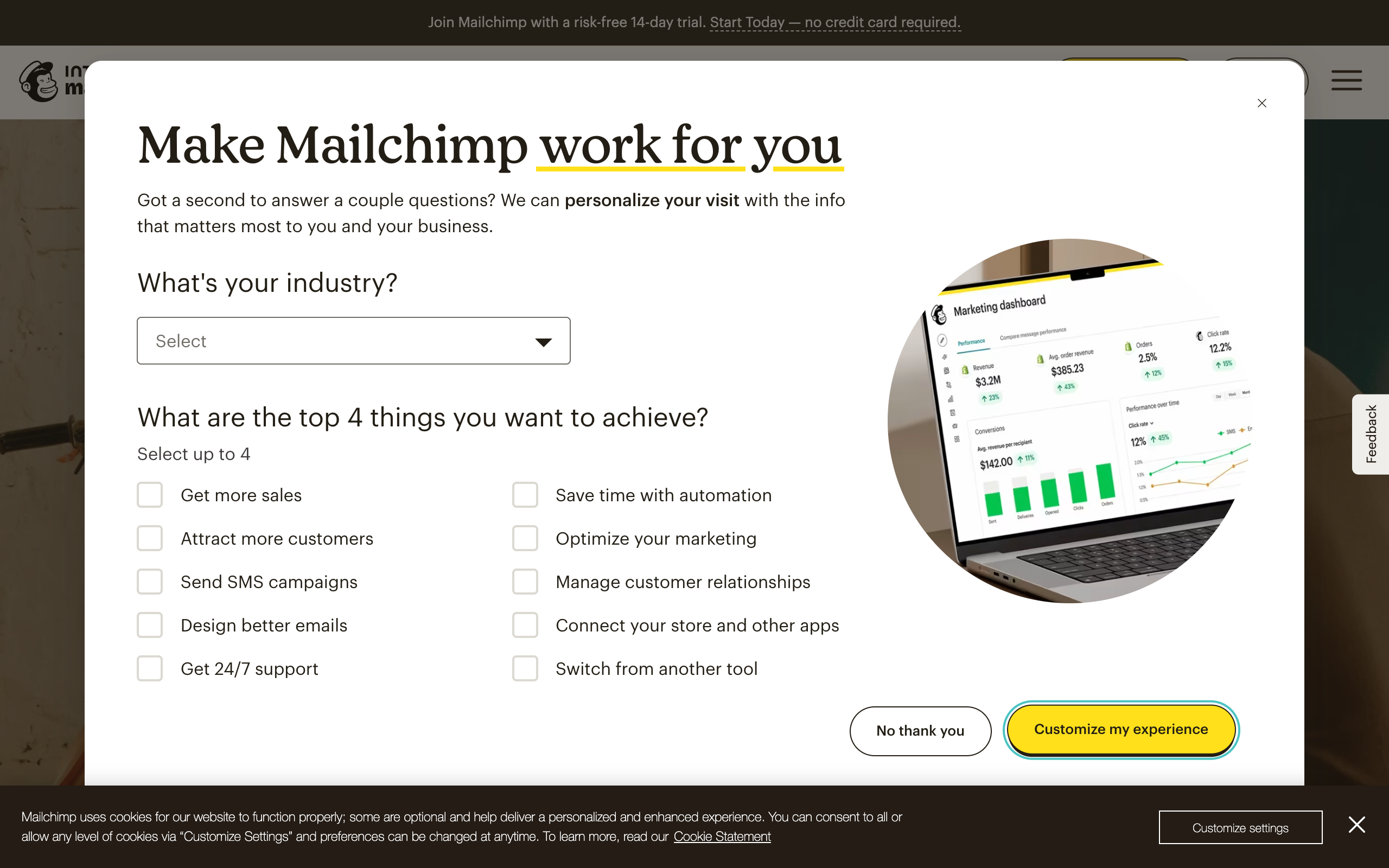
I created a fresh account on the free plan to see the onboarding path a new newsletter operator actually walks through, rather than relying on old memories of the product. The signup itself is fast: connect a domain or use a Mailchimp-hosted one, pick a template, and you are in the campaign editor within a few minutes. The drag-and-drop email builder is genuinely pleasant to use and has not really changed in spirit in years, which is either comforting or dated depending on your taste.
Where the friction shows up is the very next step: setting up an “audience.” Mailchimp’s audience model asks you to define tags, groups, and segments up front, in a way that feels built for a marketing team mapping out a CRM, not a writer who just wants to hit send. Newer newsletter-first tools skip almost all of that setup and get you to a blank editor in one click. Mailchimp’s extra structure pays off later if you actually use segmentation, but it is a heavier first hour than most competitors in this category.
The other thing I noticed immediately: the free plan’s 250-contact cap is visible everywhere in the UI, with usage bars and upgrade prompts appearing well before you are anywhere close to the limit. That is standard freemium design, but combined with how small the free ceiling actually is, it means a new Mailchimp newsletter sees upgrade pressure earlier in its life than one built on a platform with a larger free tier.
Where Mailchimp genuinely holds up
It would be dishonest to write this review as a pure teardown. Mailchimp survives in a crowded market because parts of it are still very good.
Journeys and marketing automation are mature
The Standard plan and above include a visual automation builder (Mailchimp calls these “Journeys”) that supports branching logic, delays, and triggers off a wide range of events: a purchase, a link click, a date field, an abandoned cart. Standard supports up to 200 automated workflows, which is genuinely more headroom than most newsletter-focused platforms offer at any tier. If your business runs on if-this-then-that logic across a customer lifecycle, Mailchimp’s automation depth holds up well against dedicated standalone automation tools, and building one of these workflows does not require a developer or a separate integration platform.
Integrations are still the widest in the category
Mailchimp connects to an enormous range of ecommerce platforms, CRMs, and other marketing tools out of the box. If your stack already includes Shopify, WooCommerce, Salesforce, or a dozen other common business tools, Mailchimp’s prebuilt integrations save real setup time that a newer, narrower platform simply has not built yet.
Multivariate testing on the Premium plan
Most platforms in this category stop at basic A/B subject-line testing. Mailchimp’s Premium plan supports true multivariate testing, letting you test combinations of subject line, content, and send time simultaneously. For a large marketing team optimizing at scale, that is a real capability gap versus the competition.
SMS and multichannel reach
Mailchimp also supports SMS marketing as an add-on channel alongside email, letting a Standard or Premium account run text-message campaigns and automations from the same audience data used for email. Very few newsletter-first platforms offer this natively; it is another example of Mailchimp’s small-business marketing-suite roots showing up as a genuine advantage for anyone who wants one dashboard for both channels rather than stitching together two separate tools.
Where Mailchimp falls short for a newsletter
Here is where the newsletter-specific gap becomes obvious, in the order I think matters most.
The free tier caps out at 250 contacts
This is the number that surprises people who have not checked recently: Mailchimp’s free plan is capped at 250 contacts, with a maximum of 500 sends per month or 250 per day. That is a fraction of what competing platforms offer for free. beehiiv’s free tier runs to 2,500 subscribers with unlimited sends. Kit’s free tier runs to 10,000 subscribers. Mailchimp’s 250-contact ceiling means most newsletters outgrow the free plan within their first few weeks of real growth, not months.
Unsubscribed contacts still count toward your limit
This is the detail that catches people off guard, and it is confirmed directly in Mailchimp’s own help documentation: unsubscribed contacts count toward your monthly contact limit and your bill. Cleaned and archived contacts do not count, which means the workaround is to actively archive unsubscribes rather than let them sit in your account. But by default, a growing list that accumulates unsubscribes over time is paying to store people who can no longer be emailed, unless you manage that cleanup yourself. No newsletter-first platform I have reviewed in this category charges for unsubscribed contacts this way.
No referral program, no recommendation network, no ad marketplace
Mailchimp has nothing resembling beehiiv’s Boosts marketplace, referral milestones, or built-in ad network. If growth is supposed to come from anywhere other than your own paid ads or existing audience, Mailchimp offers no native mechanism for it. For a newsletter operator, this is arguably the single biggest gap versus purpose-built platforms, because organic growth tooling is precisely the thing a newsletter-first tool is designed around.
No SEO-friendly website or public archive built for growth
Mailchimp campaigns are not designed to live as indexable web pages the way beehiiv or Ghost posts are. There is a basic campaign archive, but it was never built with search visibility as a goal, and it shows: it rarely ranks. If part of your growth strategy depends on old issues compounding organic search traffic over time, Mailchimp gives you almost nothing to work with here.
Pricing climbs with your list, regardless of engagement
Contact-based pricing is standard across the industry, but Mailchimp’s version stings more than most because of the unsubscribe-counting policy above. A newsletter that has been running for two years and accumulated a normal amount of churn is paying for contacts it should have shed, unless someone is actively archiving them on a schedule. That is an operational tax most competing platforms do not impose.
The unsubscribe-counting policy alone is worth testing against an alternative before you commit a growing list to Mailchimp. beehiiv’s free Launch plan covers up to 2,500 subscribers with none of that contact-hygiene tax, and importing your list to compare takes an afternoon, not a migration project.
What does Mailchimp cost in 2026?
Numbers below are pulled directly from Mailchimp’s live pricing page, monthly billing, at the lowest contact tier (0-500 contacts). Every plan’s price increases as your contact count grows past that starting tier.
| Plan | Starting price | What you actually get |
|---|---|---|
| Free | $0 | 250 contacts, up to 500 sends/month (250/day), 1 audience, 1 seat, basic templates |
| Essentials | From $13/mo | 3 audiences, 3 seats, 2 roles, A/B testing, monthly send limit at roughly 10x your contact count |
| Standard | From $20/mo | 5 audiences, 5 seats, up to 200 automated workflows (Journeys), dynamic content, popup forms, send limit around 12x contacts |
| Premium | From $350/mo | Unlimited audiences and seats, predictive segmentation, multivariate testing, priority phone support, dedicated onboarding, send limit around 15x contacts |
All three paid tiers get a 15% discount for accounts with 10,000 or more contacts during the first 12 months, and there is a 14-day free trial on paid plans. Nonprofits are eligible for an additional discount as well. The jump from Standard to Premium, from roughly $20 to $350 a month, is the steepest tier jump of any platform in this comparison, and it exists because Premium is really priced for enterprise marketing teams, not for a newsletter that wants a bit more automation.
Every one of those starting prices is tied to the lowest contact tier only. As your list crosses 500, 1,000, 2,500, and higher bands, the price for the same plan climbs, and because of the unsubscribe-counting policy above, that climb can happen faster than your actual engaged audience grows. We break down exact dollar figures at common list sizes, plus a side-by-side against beehiiv’s flat subscriber-tier pricing, in the dedicated Mailchimp pricing guide and in beehiiv’s pricing breakdown.
How is Mailchimp’s support and deliverability in practice?
Support quality follows the plan tier closely. Free and Essentials users work primarily through email support and the (extensive) help documentation; phone support does not appear until Premium. That is a common pattern across the industry, but worth knowing before you assume a paid plan buys you a human on the phone quickly, because on Essentials and Standard it mostly does not.
Deliverability in my testing was solid at the major inbox providers, which is not surprising given Mailchimp’s scale and two decades of sender-reputation management. The platform also enforces stricter list-hygiene and spam-compliance checks during onboarding than some newer competitors, which can feel like friction in the moment but generally protects your sender reputation over time. If you have imported a list from elsewhere, expect a verification step before you can send broadly, which is standard practice and not unique to Mailchimp.
How does Mailchimp compare to beehiiv, Kit, and Substack?
The short version of each comparison, since the full breakdowns deserve their own posts.
Mailchimp vs beehiiv is barely a contest for a pure newsletter. beehiiv’s free tier alone (2,500 subscribers, unlimited sends) beats Mailchimp’s paid Essentials plan on generosity, and beehiiv adds a referral program, Boosts marketplace, ad network, and SEO-indexable website that Mailchimp has no equivalent for. Mailchimp wins only if ecommerce automation is your actual priority. Full comparison in beehiiv vs Mailchimp.
Mailchimp vs Kit comes down to audience type. Kit’s free tier runs to 10,000 subscribers and its automation and tagging are built specifically for creators selling digital products, with a lighter learning curve than Mailchimp’s Journeys builder. Mailchimp still wins on raw integration breadth if your stack is ecommerce-heavy.
Mailchimp vs Substack is really a different question entirely: Substack has no contact-based pricing at all, charging 10% of paid subscription revenue instead, while Mailchimp has no paid-subscription paywall feature at all. They solve different problems and rarely compete for the same buyer. If you are choosing between the two, the decision is really “do I want a percentage fee or a contact-based bill,” which our Substack pricing breakdown covers from the other direction.
For the full field, including where each platform actually wins, see our ranking of the best newsletter platforms and the detailed Mailchimp pricing breakdown if you want every tier and contact-count scenario modeled out.
Who should NOT use Mailchimp for a newsletter?
- Anyone whose growth depends on organic and referral mechanics. No referral program, no recommendation network, no ad marketplace. If those are core to your growth plan, Mailchimp offers nothing to build on.
- Writers who want their archive to rank on Google. Mailchimp’s campaign pages were not built for SEO and it shows in how rarely they surface in search results.
- Anyone starting small who wants real free-tier runway. 250 contacts is a narrow starting point compared to competitors offering thousands of free subscribers.
- Paid-subscription newsletters. Mailchimp has no native paywall or paid-subscription feature at all, so if charging readers is part of your plan, look elsewhere entirely.
If any of those describe you, our guide to Mailchimp alternatives breaks down the best pick for each scenario.
Who should still use Mailchimp?
If you run an ecommerce store and your email program is mostly transactional and promotional (order confirmations, abandoned-cart recovery, seasonal sale blasts), Mailchimp’s automation depth and integration breadth are still a legitimate strength, and switching away from it purely because a newsletter blog told you to would be the wrong move. The tool fits the job it was actually built for; it just is not that job for most people reading a newsletter-platform review.
Frequently asked questions
Is Mailchimp good for newsletters in 2026? It is workable but not purpose-built. Mailchimp lacks a referral program, recommendation network, ad marketplace, and SEO-friendly public archive, all of which newsletter-first platforms like beehiiv include. It remains strong for ecommerce and general marketing automation.
Is Mailchimp free? The free plan is capped at 250 contacts with up to 500 sends per month (250 per day), the smallest free allowance among major platforms in this category. Most growing newsletters outgrow it quickly.
Does Mailchimp charge for unsubscribed contacts? Yes. Mailchimp’s own help documentation confirms unsubscribed contacts count toward your monthly contact limit and billing. Cleaned and archived contacts do not count, so actively archiving unsubscribes is the only way to avoid paying for them.
Is Mailchimp better than beehiiv for a newsletter? For a pure newsletter, no. beehiiv’s free tier is more generous, and it includes growth tooling (referral program, Boosts, ad network, SEO website) that Mailchimp does not have. Mailchimp is the stronger choice specifically for ecommerce-heavy email marketing.
Can I sell paid subscriptions on Mailchimp? No, Mailchimp has no native reader-paywall or paid-subscription feature. If monetizing through paid subscriptions is part of your plan, look at beehiiv, Substack, or Ghost instead.
How much does Mailchimp cost for a growing list? Pricing scales with contact count starting from $13/month (Essentials) at the lowest tier, climbing as your list grows, with steep jumps between tiers, particularly the move to Premium at $350/month. See our full Mailchimp pricing guide for exact numbers at common list sizes.
The bottom line: my verdict after testing it
Mailchimp is not a bad product. It is a mature, deeply integrated marketing automation tool that happens to also send newsletters, built by a company that has spent two decades optimizing for ecommerce and general small-business marketing rather than the creator-newsletter category that exploded after it had already picked its lane. That history is not a flaw; it is just a mismatch for a specific, growing kind of buyer.
If your list exists because people bought something, Mailchimp still earns its subscription. If your list exists because people chose to keep reading you, the missing growth tooling, the narrow free tier, and the unsubscribe-counting policy add up to real friction that a newsletter-first platform simply does not have. I rate it 3 out of 5 for the newsletter use case: solid engineering, wrong focus for this specific job.
Try the newsletter-first alternative for free before you commit a growing list to contact-based pricing. beehiiv’s Launch plan runs to 2,500 subscribers with no card required, and importing your Mailchimp audience takes one afternoon.
Pricing captured from vendor pricing pages, July 2026. Plans change, so confirm current details before you buy.


