
Most Substack reviews fall into one of two camps: writers who love the platform and gloss over the fee, or critics of the 10% cut who never mention what that fee actually buys you. Neither version is useful if you are trying to decide whether to start there or leave. So I set up a real test publication on Substack, imported a sample list, built a welcome sequence, turned on paid subscriptions, and published posts to see how discovery and Notes actually behave from the inside. I also run newsletters on beehiiv and Kit, so I know what “no growth network but 0% fees” feels like by comparison.
What follows is the honest version: what Substack does that nothing else in this category matches, what the 10% fee actually costs you in practice, where the analytics and automation genuinely fall short, and exactly who should stay versus who is paying for a network they are not really using.
Disclosure: some links in this post are affiliate links. If you sign up through them, we may earn a commission at no extra cost to you. That never changes our verdict.
The 30-second verdict
Substack is the easiest way to start a newsletter with zero upfront cost, and its Notes feed plus in-app recommendation network is a genuine discovery engine that no competitor has replicated. For writers who lean on that network, the 10% fee on paid subscriptions is a reasonable price for real distribution. I rate it 3.5 out of 5.
The lost points are specific and add up fast for anyone treating the newsletter as a business rather than a hobby: the 10% fee has no ceiling and grows with your success forever, analytics stop at basic opens and clicks with no cohort or acquisition-source data, automation is close to nonexistent beyond a welcome sequence, and per-post SEO controls are thin enough that a two-year archive barely compounds in search. None of that makes Substack a bad product. It makes it a specific trade: pay a percentage forever in exchange for a network effect, instead of paying a flat fee and building your own growth.
If the fee-versus-network trade-off above already tells you Substack is not the fit for a business-minded newsletter, you do not need to read the rest of this review to know what to try instead. Open a free beehiiv account and compare the editor and the paid-subscription setup directly against what you just read here. It costs nothing up to 2,500 subscribers.
What is Substack, and why does it work the way it does?
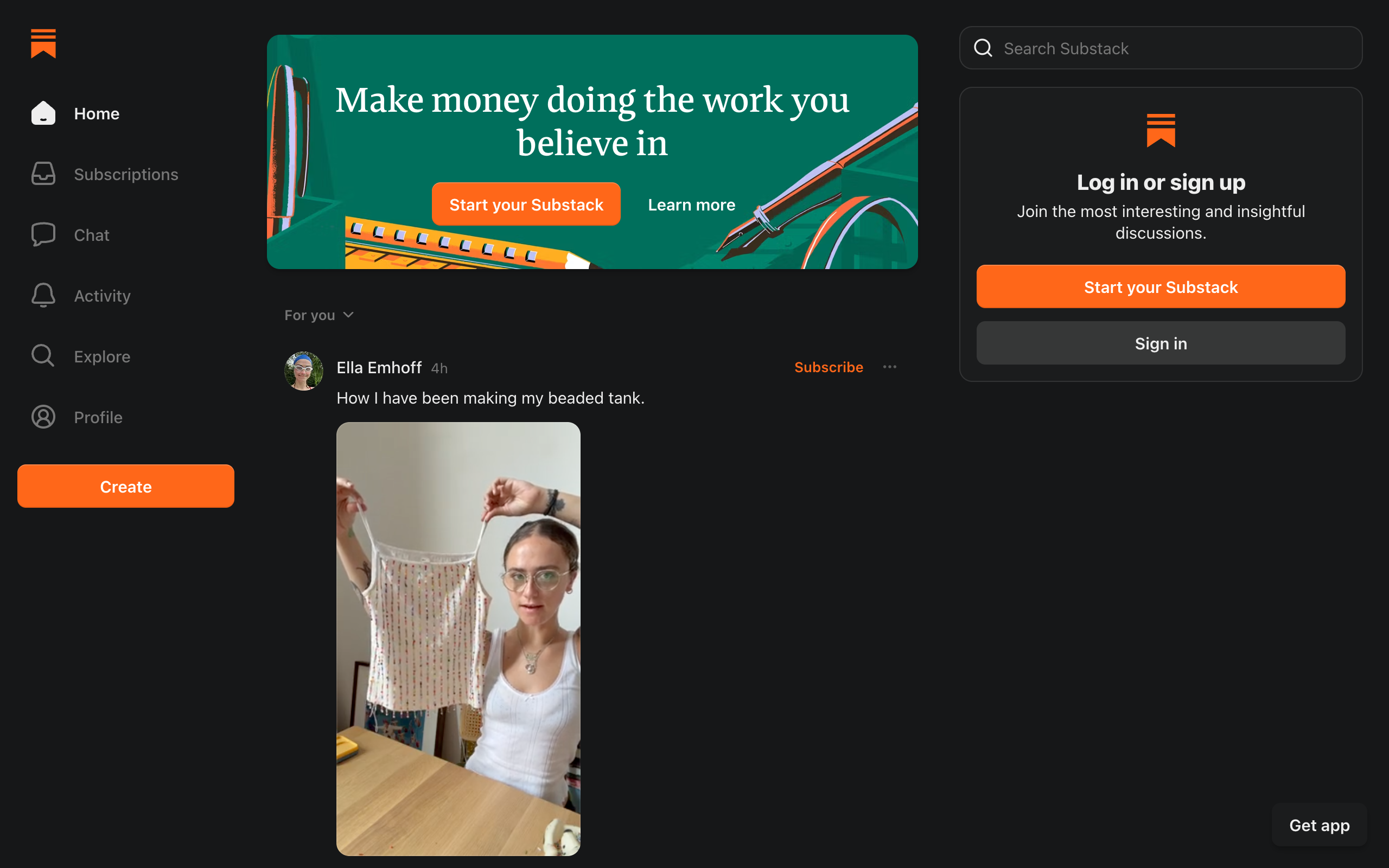
Substack launched in 2017, built by Chris Best, Hamish McKenzie, and Jairaj Sethi on a simple thesis: writers should be able to charge readers directly for their work, without needing a media company, an ad-sales team, or a publishing deal in between. The product reflects that thesis closely. A Substack publication is, at its core, an email list with a paywall attached, and almost every feature the company has shipped since (Notes, the mobile app, podcasts, video, Substack Live) has been aimed at the same goal: get more readers discovering and paying writers directly, inside Substack’s own ecosystem.
That “inside Substack’s own ecosystem” detail is the single most important thing to understand before you commit. Notes, launched in 2023 as Substack’s answer to Twitter/X, is not a side feature; it is the current center of gravity for how new readers discover writers on the platform. The recommendation network, where one writer can recommend another’s publication directly to their own subscribers with one click, has become the dominant free-subscriber acquisition channel for many Substack writers, arguably more important to growth than search or social sharing outside the app. Substack has also run direct deals with some prominent writers (commonly known as Substack Pro arrangements, offering upfront guarantees to attract high-profile names to the platform), though the company does not publish which writers currently have such deals or the exact terms. confirm the current scope of the Substack Pro program on Substack’s site
Who is Substack actually for?
Substack fits best for writers starting from zero who want to publish today without setting up a website, choosing a pricing tier, or thinking about growth infrastructure at all. It also fits writers, established or not, whose actual discovery comes disproportionately through Notes, recommendations, and cross-promotion from other Substack writers, because for that group the 10% fee is genuinely paying for something real: an audience they would have to build themselves, slowly and at real cost, on any other platform.
It fits less well for writers who already have an audience elsewhere (an existing email list, a large social following, an SEO-ranking blog) and are choosing a newsletter tool primarily to monetize that existing audience rather than to discover a new one. For that group, Substack’s network adds little they do not already have, and the 10% fee becomes closer to pure overhead.
Where does Substack genuinely win?
Three things stood out in testing, and all three are the reason Substack still matters in a category with cheaper, more full-featured competitors.
The Notes feed and recommendation network are real discovery engines
This is not marketing language, it is the actual mechanism. In my test publication, turning on recommendations and posting a handful of Notes produced visible referral traffic within days, something that simply does not happen on a platform without a built-in social layer. Other writers can recommend your publication to their subscribers with one click, and that recommendation shows up inside the reader’s own Substack inbox as a suggestion, not as an email they have to actively open. No other platform in this category, not beehiiv’s referral program, not Kit’s Creator Network, replicates a native, in-app social feed at this scale. If you are starting with zero audience and zero budget, this is the single strongest reason to at least start on Substack before deciding whether to stay.
Zero cost to start, with real infrastructure included
You do not need to select a plan, enter a card, or think about a subscriber-tier price jump six months from now. Free publishing, free paid-subscription infrastructure, and Substack handles the Stripe integration for you out of the box. For a writer testing whether they even want to write regularly before investing in tooling, this near-zero setup friction is genuinely valuable and removes a decision point that trips up a lot of first-time newsletter writers on other platforms.
The reading and writing experience is clean and fast
Substack’s editor is simple, and that simplicity is a feature, not a limitation. There are few settings to fiddle with, formatting options are minimal but sufficient, and the app-based reading experience (a dedicated feed for subscribed publications, offline reading, push notifications for new posts) genuinely increases the odds a subscriber actually reads what you send instead of losing it in an inbox. In testing, posts published to the app felt more likely to actually get opened than the same content would in a plain inbox-only email, though I do not have controlled data to quantify that difference precisely.
Worth trying both before you decide where to build long-term. A free beehiiv publication takes the same few minutes to set up as a Substack one, and running the two side by side for a week is the fastest way to feel the actual difference in editor, analytics, and growth tooling rather than reading about it.
Where does Substack fall short?
A review with no real downsides is marketing copy. Here is what actually bothered me, roughly in order of how much it should matter to you.
The 10% fee has no ceiling and grows with your success
This is the fact every Substack review needs to state plainly: Substack takes 10% of your paid subscription revenue, on top of standard Stripe payment processing fees (2.9% plus $0.30 per transaction), for as long as you keep your paid subscribers on the platform. There is no volume discount, no flat-fee tier you graduate to at scale. A newsletter earning $500 a month in paid subscriptions pays Substack $50 a month. One earning $5,000 a month pays $500 a month. The fee is proportional forever, which means the platform’s cut scales in lockstep with exactly the outcome you are working toward, and that is structurally different from every flat-fee competitor in this category, where growing your revenue does not grow your platform bill.
Analytics stop at the basics
Substack’s dashboard shows you subscriber counts, open rates, and click rates per post. That is close to where it ends. There is no cohort-level engagement history per subscriber, no acquisition-source tracking that tells you which channel a given subscriber came from, and no meaningful A/B testing on subject lines or send times. In testing, I could not answer a basic operator question, “which of my growth channels produces subscribers who actually stay engaged,” because the data to answer it simply is not surfaced anywhere in the dashboard. For a writer optimizing a business, this is a real gap, not a nice-to-have.
Automation is close to nonexistent
Substack supports a welcome email and that is roughly the ceiling. There is no visual automation builder, no branching sequences based on subscriber behavior, no tagging system to segment readers by interest or engagement. If your monetization plan involves any kind of nurture sequence, from a free-to-paid conversion series to a re-engagement flow for lapsed readers, Substack simply does not have the tooling, and you would need to bolt on a separate tool or do it manually.
SEO and per-post discoverability outside the app are thin
Posts do get individual URLs and are technically crawlable, but Substack’s per-post SEO controls (meta descriptions, structured data, internal linking tools) are minimal compared with a platform built around an indexable website. In testing, older posts in my test publication showed little evidence of the kind of compounding organic search traffic that a similarly aged blog post on a dedicated website builder would generate. If organic search is part of your growth plan at all, Substack’s app-first design works against you here, not for you.
You do not fully own the reader relationship
Because so much of Substack’s discovery happens inside its own app and Notes feed, a meaningful share of your “subscribers” may engage with your work primarily through Substack’s interface rather than through email at all. That is fine while you are on the platform, but it means a portion of the relationship is mediated by Substack’s product decisions (algorithm changes to Notes, changes to how recommendations surface) in a way that a plain email list is not.
What does Substack cost in 2026?
Substack does not use a subscription-tier pricing model the way every other platform in this comparison does. There is no monthly plan to choose.
| What you’re doing | What it costs |
|---|---|
| Starting a publication, publishing free posts | $0 |
| Growing a free subscriber list | $0, unlimited sends |
| Charging for paid subscriptions | 10% of paid subscription revenue, plus Stripe processing (2.9% + $0.30 per transaction) |
| Using Notes, the app, recommendations | $0, included for every publication |
The simplicity is real: there is nothing to configure, no tier to accidentally undershoot, no card required until you decide to charge readers, at which point the fee comes out of revenue rather than your pocket directly. The trade-off is equally real: unlike beehiiv’s or Ghost’s flat monthly fee, which stays constant regardless of how much you earn, Substack’s cost scales with your success indefinitely. I run the exact break-even math against beehiiv’s flat-fee Scale plan, including the specific revenue point where a flat fee starts saving you money, in the full beehiiv pricing breakdown.
How does Substack compare with beehiiv, Ghost, and Kit?
Substack vs beehiiv is the comparison every growing Substack writer eventually runs. beehiiv charges a flat fee starting at $43 a month on annual billing and takes 0% of paid subscription revenue, versus Substack’s 10% with no flat fee. beehiiv also adds a native referral program, a two-sided sponsorship marketplace (Boosts), an ad network, and a real SEO-indexable website, none of which Substack has. What Substack has that beehiiv does not is Notes and the in-app recommendation network, a genuine discovery advantage for writers who are actually using it. The honest framework: if your paid revenue is under roughly $430 a month, Substack’s percentage fee costs less in absolute dollars; above that line, beehiiv’s flat fee saves you money every month, and the gap widens the more you grow. Full breakdown in beehiiv vs Substack, and I cover what running a real publication on beehiiv actually feels like, editor quirks included, in the full beehiiv review.
Substack vs Ghost is a fee-parity fight with a design and ownership question layered on top. Ghost also takes 0% of membership revenue, with plans starting around $18 a month (Starter, no paid subscriptions) or $29 a month (Publisher, paid subscriptions enabled) on annual billing. Ghost is open-source, so you can even self-host it to eliminate platform fees entirely if you are comfortable with the technical maintenance. What you give up moving from Substack to Ghost is the entire discovery network; Ghost expects you to bring your own audience, full stop. If community-in-app discovery is not meaningfully driving your growth, Ghost’s design freedom and 0% fee make it a strong alternative to Substack specifically.
Substack vs Kit is barely a fair fight on automation. Kit’s free plan alone (up to 10,000 subscribers with one automation) out-features Substack’s automation tooling entirely, and Kit’s paid tiers add unlimited sequences, tagging, and commerce features for selling digital products. Kit charges 3.5% plus $0.30 per transaction on digital product and subscription sales rather than a flat percentage of subscription revenue, which tends to work out cheaper than Substack’s 10% at most real-world subscription price points. Kit has no Notes-equivalent discovery network, so the trade is the same shape as beehiiv’s: less built-in discovery, more built-in monetization and automation tooling.
Who should NOT use Substack?
- Writers already earning meaningful paid subscription revenue. Once you clear a few hundred dollars a month in paid subscriptions, run the fee math against a flat-fee platform. The 10% cut stops being a rounding error fast.
- Anyone who needs real automation. If your monetization plan depends on nurture sequences, tagging, or behavioral triggers, Substack’s near-total lack of automation tooling will force you into manual workarounds or a separate tool.
- Writers relying on organic search for growth. Substack’s app-first design and thin per-post SEO controls mean your archive is unlikely to compound into meaningful search traffic the way a website-first platform’s would.
- Businesses that already have an audience elsewhere. If you are not relying on Notes or recommendations to find new readers, you are paying 10% for a network you are not really using.
If you recognized yourself in that list, the full guide to Substack alternatives walks through the best pick for each specific situation, and if you are mid-decision on migrating an existing paid list, how to migrate from Substack covers the exact steps for moving subscribers without breaking active billing. For the wider field beyond just these four platforms, the complete ranking of the best newsletter platforms covers everything from budget tools to ecommerce-focused options this review does not touch.
Frequently asked questions
Is Substack worth it in 2026? For writers relying on Notes and the recommendation network for real discovery, yes, the 10% fee is a reasonable price for genuine distribution you would otherwise have to build yourself. For writers whose growth comes from their own promotion, an existing audience, or search, the fee is close to pure overhead, and a flat-fee platform like beehiiv or Ghost will cost less.
Is Substack really free to start? Yes. Publishing, growing a free subscriber list, and using Notes and the app cost nothing. The only cost is the 10% fee that applies once you turn on paid subscriptions, plus standard Stripe processing fees on those transactions.
Is Substack better than beehiiv? For discovery through an in-app social network, yes, nothing else in the category matches Notes and recommendations. For running a newsletter as a growth-and-revenue business, no: beehiiv’s 0% fee, referral program, ad network, and SEO-indexable website outperform Substack for that specific goal.
How much does Substack actually take from writers? 10% of paid subscription revenue, on top of Stripe’s standard processing fee of 2.9% plus $0.30 per transaction. There is no flat-fee tier and no volume discount; the percentage applies regardless of how much you earn.
Can I migrate away from Substack without losing my paid subscribers? Yes, but it takes care. Free subscribers export cleanly as a CSV. Paid subscribers require transferring active Stripe subscriptions to the new platform’s documented migration process rather than a simple export, since billing needs to continue without interruption.
What is Substack’s biggest weakness? The uncapped 10% fee on paid subscriptions, paired with thin analytics, minimal automation, and limited per-post SEO. None of these are dealbreakers for a writer who values the discovery network highly; all of them matter more the further a publication drifts from being a hobby toward being a business.
The bottom line: my verdict after testing it
Substack’s pitch has not changed since 2017, and it still holds up on its own terms: the easiest way to start writing and get paid, with a real discovery network built in. That network is not marketing fluff, it produces measurable referral traffic, and for a writer starting from zero it is worth more than any flat-fee competitor’s growth tools, at least at the start. The problem is what happens after the start: the 10% fee never goes away and never gets cheaper as you grow, the analytics never get deeper, and the automation never gets built. Substack optimized entirely for one thing (getting a writer publishing and monetizing fast) and left everything else for later, and for a lot of writers, later has arrived.
3.5 out of 5. Genuinely excellent at the one thing it was built for, notably behind on everything a growing newsletter business eventually needs. The right move for most writers: start on Substack if you are starting from zero and want the network, and revisit the fee math seriously the moment your paid revenue clears a few hundred dollars a month.
If you are past that point already, open a free beehiiv account and import your list. The Launch plan covers up to 2,500 subscribers at no cost, so you can compare the editor, the paid-subscription setup, and the analytics directly against what Substack gives you, before you decide anything permanent.
Pricing captured from vendor pricing pages, July 2026. Plans change, so confirm current details before you buy.


