

Dust just raised a Series B, which tells you something about where the “build AI agents over your company’s data” category is headed: real money is betting that companies want to construct their own AI assistants rather than buy one off the shelf. Viktor is betting the opposite, that most people don’t want to build anything, they want a coworker who already knows how. Both bets are reasonable. They’re just not the same product, and conflating them is how you end up disappointed with whichever one you pick first.
I dug into Dust’s live pricing and feature set and ran Viktor against real Slack tasks for this comparison. What follows is the direct match-up: what Dust genuinely does well as a builder platform, where Viktor’s ready-made model wins on speed and simplicity, real pricing for both, and who should actually pick which.
Disclosure: some links in this post are affiliate links. If you sign up through them, we may earn a commission at no extra cost to you. That never changes our verdict.
The 30-second verdict
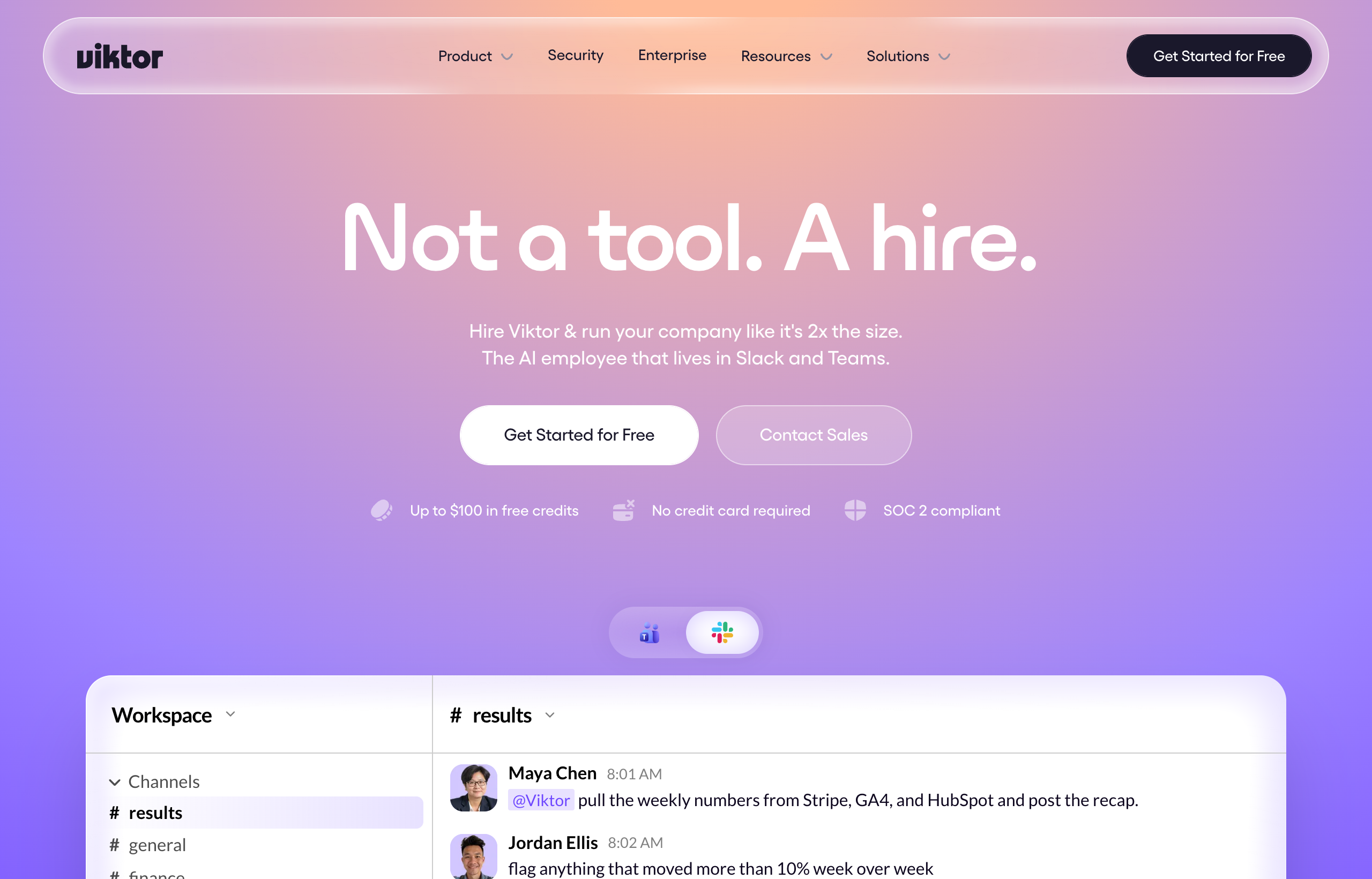
Dust is a platform for building custom AI agents and assistants over your company’s own data and tools, with per-seat pricing, 20-plus frontier models, and multi-agent orchestration on schedules and triggers, best suited to a team that wants to design and govern its own AI stack. Viktor is a ready-made AI employee that lives in Slack and Microsoft Teams and executes tasks the moment you describe them, with no agent design step required. If your team wants to build custom assistants tied to your company knowledge base, with per-seat pricing you can plan against, Dust’s model is genuinely strong. If you want something that behaves like a competent hire from day one without anyone on your team becoming an “agent builder,” Viktor gets there faster.
- Dust is a build-your-own agent platform: you create custom assistants, connect data sources, and orchestrate multi-agent workflows. Viktor is a single, pre-configured agent you talk to directly in Slack.
- Dust prices per seat (Free, Pro at around $24/seat/month, Max at around $120/seat/month, billed yearly). Viktor prices per workspace, not per seat, with credit tiers starting around $50 a month regardless of headcount.
- Dust is built around company data: connectors, “Spaces” for data segmentation, and search/query/extract across your knowledge base. Viktor is built around task execution: it pulls data from connected tools and produces a finished deliverable.
- Dust’s setup, like any builder, takes real configuration time. Viktor’s setup is closer to minutes: install it into Slack, connect a tool, describe a task.
- Both are fair, honest products aimed at different jobs. Dust wants to be the platform your company’s AI runs on. Viktor wants to be the employee your team hands work to.
If you want to feel the difference instead of reading about it, I’d hand one real task to Viktor first, since there’s no setup required to try it. Start with the free $100 in trial credits and see how far a ready-made agent gets you before you invest in building a custom one.
What Dust and Viktor actually are
Dust is a Paris-based platform, backed through a recently announced Series B, built around what it calls “the economics of multiplayer AI”: you build custom agents with specific skills, knowledge, and tools, connect them to your company’s data sources (Slack, Notion, GitHub, Drive, and 20-plus more, plus any tool via MCP), and orchestrate multi-agent workflows on schedules and event-driven triggers. It supports more than 20 frontier models across OpenAI, Anthropic, Google, Mistral, and DeepSeek, chosen per agent, and includes “Frames,” interactive dashboards and apps agents can produce, along with “Pods,” collaborative workspaces with shared context. Dust’s own marketing leans on the idea of an “AI Operator,” someone inside a company who builds and runs AI tooling for their team, which tells you plainly who its core user is meant to be.
Viktor takes a different starting position entirely. There’s no canvas, no agent-design phase, no choosing which model powers which step. You add it to a Slack or Microsoft Teams channel and talk to it like a new hire: it connects to more than 3,200 tools (Stripe, Notion, Google Ads, Meta Ads, HubSpot, Salesforce, Linear, Jira, GitHub, Google Drive, and more), pulls data, writes code and opens pull requests, builds and deploys web apps with database and auth, assembles reports and dashboards, and schedules recurring work, then reports back in the same thread. Viktor’s bet is that the “build a custom AI Operator role inside your company” step is exactly the part most teams don’t want to own.
Who is each one actually built for
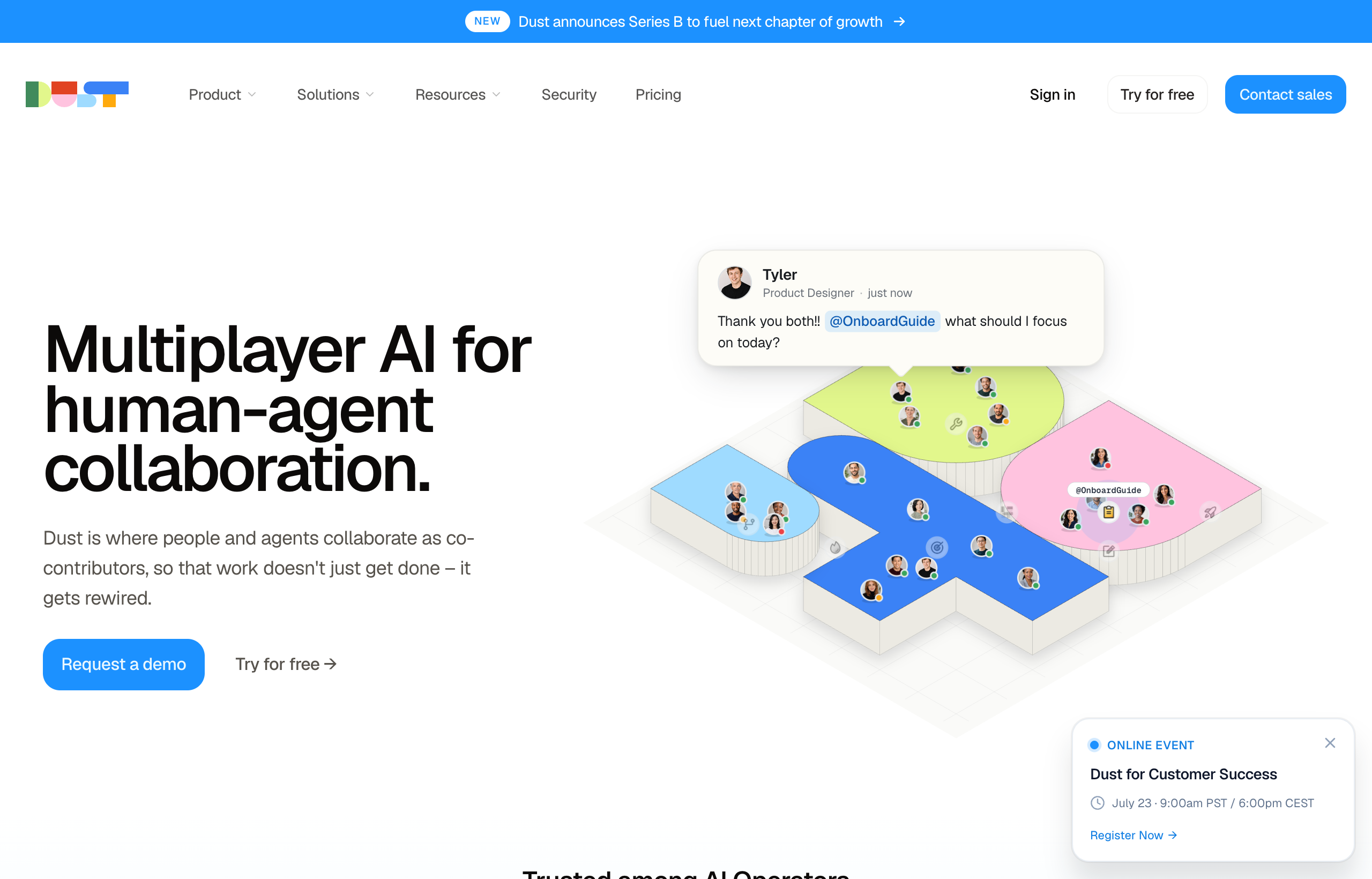
Dust’s ideal customer already has, or is becoming, an internal AI Operator: someone technical enough to design agents with real access to company knowledge, who will maintain and expand that library over time as a genuine platform investment. If you deleted your Dust workspace tomorrow, you’d lose a set of custom assistants your team built and tuned.
Viktor’s ideal customer is a founder, marketer, ops lead, or engineer who has a task today and doesn’t want to become an AI Operator to get it done. If you deleted Viktor tomorrow, you’d lose a working relationship with something that behaved like a teammate, not an internal platform you engineered.
| Category | Dust | Viktor |
|---|---|---|
| Core model | Build-your-own AI agents/assistants over company data | Pre-built AI employee, chat interface inside Slack/Teams |
| Setup time to first useful result | Real configuration time: connect data sources, design an agent | Minutes: install, connect a tool, describe a task |
| Where you work | Dust’s own web app, plus a Chrome Extension and Slack/Notion/GitHub connectors | Slack or Microsoft Teams, where your team already works |
| Model choice | 20+ frontier models, chosen per agent (GPT, Claude, Gemini, Mistral, DeepSeek) | Handled internally; you’re not choosing a model per task |
| Pricing structure | Per seat (Free, Pro, Max, Enterprise) | Per workspace, credit-based, not per seat |
| Multi-agent orchestration | Native, with scheduled and event-driven triggers | Single agent handles the full task itself |
| Company-data connectors | 20+ native connectors, plus MCP; core product focus | 3,200+ tool integrations focused on task execution, not knowledge search |
| Entry pricing | Free (500 lifetime credits); Pro ~$24/seat/mo | ~$50/mo for 20,000 workspace-wide credits; $100 free trial credits |
| Best fit | Teams building custom assistants over their own knowledge base | Anyone who wants a task done without building anything |
Where Dust genuinely wins
Credit where it’s due: Dust’s per-seat pricing is refreshingly transparent, and its model choice, 20-plus frontier models available per agent, is a real differentiator if your team has opinions about which model handles which kind of task. Its connector model, with “Spaces” for segmenting data and permissions, is aimed squarely at companies that need to build AI tooling over sensitive internal knowledge with actual governance around who can see what, and its SOC 2 Type II certification, SSO support, and audit logs (all present at Business tier and above) are the kind of concrete security posture an IT or security team can actually evaluate, not just take on faith.
The scheduled and event-driven multi-agent orchestration is also a genuine strength worth naming fairly. If a workflow benefits from multiple specialized agents triggered by different events, a new ticket, a scheduled report, a Slack mention, Dust lets you design that as an inspectable, governed system, which matters once more than a handful of people depend on the output.
Where Viktor wins
The flip side is the same trade you’ll find in most build-versus-buy comparisons: Dust gives you the parts, Viktor gives you the finished thing. When I tested Viktor against a task I’d normally hand to a junior analyst, pulling a cross-channel ad spend summary and formatting it as a short report, it executed the whole chain, connect, pull, format, deliver, without me first having to decide which model to use, which data source to connect it to, or how to structure the agent’s instructions. That’s the entire value proposition: you skip the “become an AI Operator” step because the operator already exists.
Viktor also stays inside the channel your team already lives in. Dust’s agents run primarily inside Dust’s own app (with a Chrome Extension and some native connectors extending that reach), which means someone has to go check on them there. Viktor’s output lands in the same Slack thread you asked the question in, so there’s no second tool to open and no separate login to remember. For a team without a dedicated AI Operator role, that’s the difference between adopting a coworker and adopting a platform.
Before you commit engineering time to building a custom Dust agent, it’s worth testing whether a ready-made one already covers the job. Try Viktor’s $100 in free trial credits on the exact task you were about to design an agent for.
What do they actually cost in 2026?
Per Dust’s live pricing page, the Business plan is priced per seat with three seat types: Free ($0, 500 credits, lifetime, best for occasional users), Pro ($30 a month, or $24 a month billed yearly, with 8,000 credits a month, aimed at most team members), and Max ($150 a month, or $120 a month billed yearly, with 40,000 credits a month, aimed at power users running complex automations or deep research). Admins mix and match seat types across a workspace and can reassign them as usage changes. Enterprise is custom, adding unlimited connectors and MCP servers, workspace-pooled credits and volume pricing, SCIM, audit logs, custom data retention, single-tenant deployment, and a dedicated CSM.
Per Viktor’s live pricing page, the free trial gives $100 in credits with no card required, and credits never expire. Team plans are workspace-wide rather than per-seat: 20,000 credits runs around $50 a month, scaling through 30,000 ($75), 40,000 ($100), and 80,000 ($200), with small-company tiers from roughly 125,000 to 2,000,000 credits priced between about $300 and $5,000 a month, and 300,000 credits at around $750 a month reported as the most popular tier. Enterprise moves into custom pricing, with reported tiers in the $35,000 to $50,000-a-month range at the highest usage bands.
| Plan | Dust | Viktor |
|---|---|---|
| Free / trial | Free seat: $0, 500 credits, lifetime | $100 in credits, no card required, never expire |
| Entry paid tier | Pro: ~$24/seat/mo (yearly), 8,000 credits/seat/mo | ~$50/mo for 20,000 workspace-wide credits |
| Higher tier | Max: ~$120/seat/mo (yearly), 40,000 credits/seat/mo | ~$750/mo for 300,000 credits (most popular small-company tier) |
| Enterprise | Custom, “talk to sales” | Custom, reported tiers around $35,000-$50,000/mo at the top end |
| Pricing basis | Per seat, credits reset monthly, don’t roll over | Per workspace, credits don’t expire |
The practical read: Dust’s per-seat model means your bill scales directly with headcount, predictable if your team size is stable, expensive if you add a lot of Max seats for power users. Viktor’s workspace-wide model means your bill scales with usage instead of headcount, which can be cheaper for a small, high-usage team and more unpredictable if usage spikes unexpectedly.
The honest weaknesses (both sides)
Dust’s real weakness is the same one every builder platform shares: someone has to design, connect, and maintain the agents, and that’s real ongoing work, not a one-time setup. Its per-seat pricing, while transparent, can also get expensive quickly for a team that wants several people running Max-tier, tool-heavy workflows regularly, since each of those seats runs $120 a month on its own. And because Dust is fundamentally a builder, if what you actually wanted was a finished result without configuring an agent first, you’re paying for a platform you have to activate yourself.
Viktor’s honest weakness is the one worth repeating in every fair review: credit-based, workspace-wide billing is genuinely less predictable than a flat per-seat number. Real users have reported burning through $200 in credits within the first two days of exploring, or landing well above the $50 headline once real usage kicks in, sometimes $500 or more a month, because credits track actual model and tool cost rather than a flat fee. Viktor also isn’t a builder; if your team wants to design a custom, governed multi-agent system tied tightly to your company’s data with per-seat cost predictability, Dust’s model gives you structural control Viktor doesn’t offer.
Who should pick Dust over Viktor
- Teams with an AI Operator, someone whose role includes building and maintaining custom AI tooling for the company.
- Organizations that need per-seat cost predictability and want to plan spend against a known headcount rather than variable usage.
- Companies building AI assistants deeply tied to internal knowledge, where Dust’s connector and “Spaces” permission model matters.
- Teams that want model choice, picking a specific frontier model per agent based on cost or capability trade-offs.
Who should pick Viktor over Dust
- Teams without a dedicated AI Operator who need work done without anyone taking on that role.
- Anyone who wants to stay inside Slack or Teams instead of adopting a separate platform.
- Small, high-usage teams where a workspace-wide credit pool beats paying for individual Max seats.
- People who want to test a real task today rather than plan a build project first.
Frequently asked questions
Is Dust or Viktor easier to set up?
Viktor, clearly. There’s no agent design step: connect it to Slack or Teams and describe a task. Dust requires building an agent first, choosing a model, connecting data sources, and configuring instructions.
Which is cheaper, Dust or Viktor?
It depends on your team size and usage pattern. Dust’s per-seat pricing (Free, then around $24 or $120 per seat monthly) is predictable against headcount. Viktor’s workspace-wide credits (from around $50 a month) can be cheaper for a small, high-usage team but scale with actual usage rather than seat count, which is less predictable.
Can Dust do what Viktor does?
You can build a Dust agent that approximates a specific Viktor workflow, connected to the right data sources and tools, but you have to design and maintain it. Viktor ships that execution capability pre-built, with no design phase.
Does Viktor replace the need for a platform like Dust?
For most day-to-day task execution, yes. If your company genuinely needs a governed, multi-agent system built over internal knowledge with per-seat cost control, Dust’s platform model gives you structure Viktor isn’t built to provide.
Is Dust good for non-technical teams?
It’s more approachable than raw code, and its seat-based free tier makes it easy to try, but designing a genuinely useful custom agent still benefits from someone comfortable thinking like a builder. A non-technical team that wants results without that process will get there faster with Viktor.
The bottom line
This comparison comes down to the same question every build-versus-buy decision does: do you want to construct the tool, or do you want to use one that’s already built. Dust is honestly strong at the first job, giving a team with real technical appetite the connectors, model choice, and governed multi-agent orchestration to build custom AI assistants over their own company data, priced predictably per seat. Viktor is honestly strong at the second, showing up ready to execute in the Slack channel you already use, with no design phase and workspace-wide pricing that doesn’t punish you for adding people.
My actual recommendation: don’t start building a custom Dust agent for a task you haven’t tried handing to a ready-made one yet. If Viktor gets it done, you’ve saved yourself a build project. If it doesn’t, you’ll know exactly what you need Dust to do instead of guessing at the design.
Try Viktor with the free $100 in credits on one real task this week. It costs nothing to find out whether you needed to build a custom AI Operator role at all.
Pricing captured from vendor pricing pages, July 2026. Plans change, so confirm current details before you buy.


