

Here is a question I got from a reader last month that sums up why this comparison gets confused so often: “We just bought Glean, do we still need something like Viktor?” The honest answer is that the question itself reveals a mismatch. Glean and Viktor are not really fighting for the same budget line, even though they both show up when you search for “AI for my company’s Slack.” One finds things. The other does things. Confusing the two is the single most common mistake I see teams make when they shortlist AI tools for 2026. This piece pairs with our full Viktor review and our full Glean review if you want the deep dive on either tool alone; here we are putting them side by side.
Disclosure: some links in this post are affiliate links. If you sign up through them, we may earn a commission at no extra cost to you. That never changes our verdict.
30-second verdict
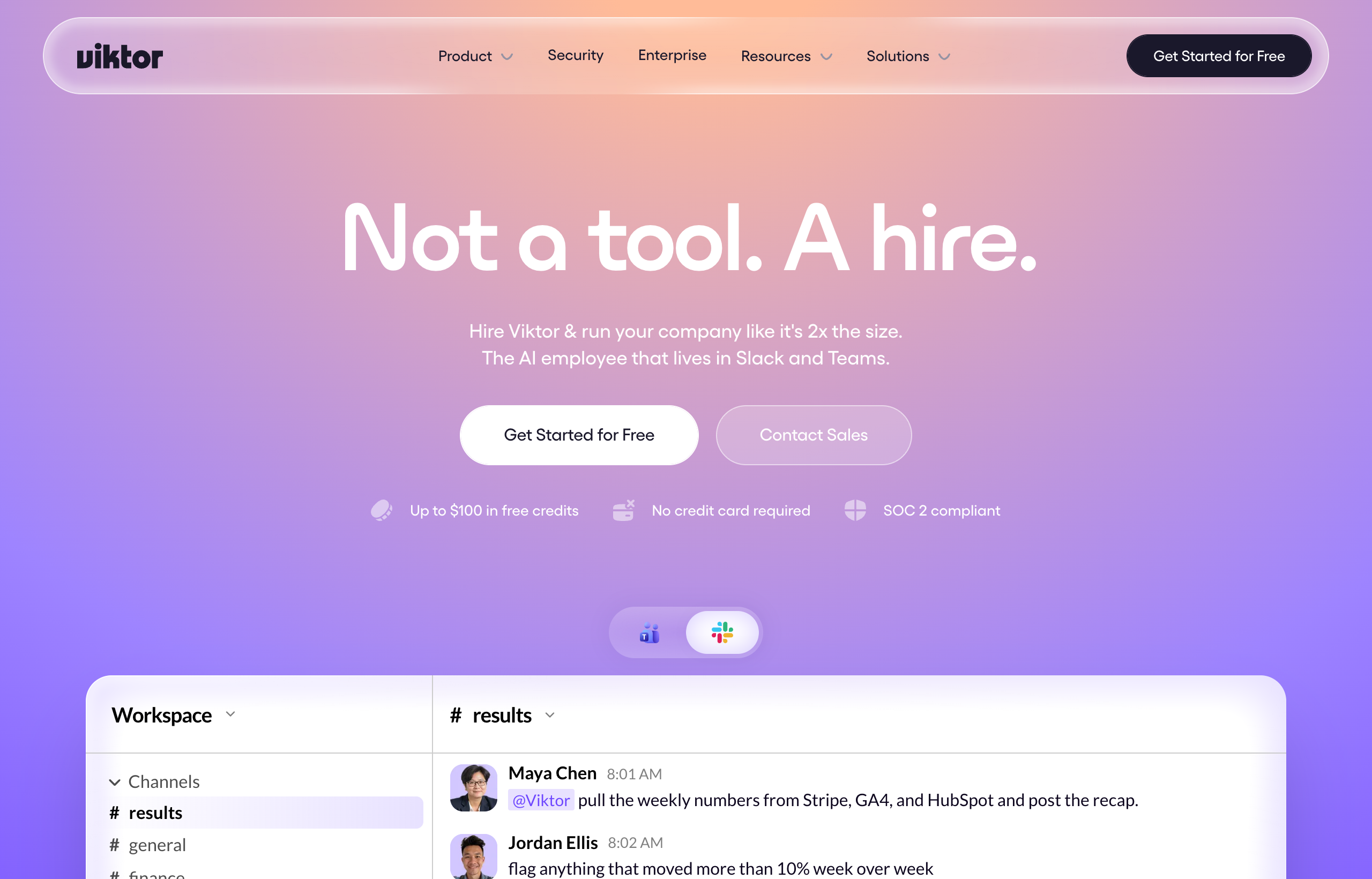
Glean is an enterprise search and assistant platform: it indexes everything your company knows across 250-plus connectors and answers questions with cited sources, which is genuinely excellent if your problem is “we can’t find anything.” Viktor is a Slack and Microsoft Teams-native AI employee: you brief it on a task and it goes and executes end to end, pulling from 3,200-plus integrations, building the deliverable, and handing it back. If your team’s real bottleneck is people spending hours hunting for the right document, Glean wins that job. If the bottleneck is that someone still has to do the work once the information is found, Viktor is built for exactly that, and it is the tool we recommend starting with for most small and mid-size teams.
| Viktor | Glean | |
|---|---|---|
| Core job | Executes multi-step tasks and produces deliverables | Finds and answers questions from company knowledge |
| Where it lives | Slack, Microsoft Teams | Web app, browser extension, Slack |
| Integrations | 3,200+ (Stripe, HubSpot, Salesforce, Google Ads, Meta Ads, GitHub, and more) | 250+ connectors to company knowledge sources |
| Output | Reports, spreadsheets, deployed apps, pull requests, scheduled automations | Answers with cited sources, search results, summarized context |
| Pricing | Free trial ($100 credits), then workspace credit pool from around $50/mo | Not public, sales-led, demo required |
| Best for | Teams that want tasks executed, not just information surfaced | Large orgs where knowledge is scattered and findability is the bottleneck |
What Glean genuinely does well
It would be unfair, and inaccurate, to wave Glean off as “just search.” Its real strength is combining enterprise search with an assistant layer and a graph of how your company actually works, connecting to more than 250 data sources so an employee can ask a plain-language question and get an answer with the specific document, ticket, or message it came from, rather than a list of links to click through themselves. For a company with years of institutional knowledge scattered across Confluence, Slack, Drive, Salesforce, and a dozen other tools, that is a meaningful productivity unlock, and Glean’s enterprise customers report real time saved, particularly in onboarding and cross-team research where the hard part has always been knowing where to look.
Glean also offers Agent Builder and Agent Orchestration features that go beyond pure search, letting companies build agents grounded in that same indexed knowledge. That pushes it closer to the execution side of the spectrum than a pure search tool, and it is fair to note Glean is trying to move in Viktor’s direction, just from a search-first starting point rather than an execution-first one. Glean’s security posture, SOC 2 compliance, and enterprise controls are also built for large, regulated organizations from the ground up, which matters if you are a company with strict data governance requirements.
What Viktor does that Glean does not
Viktor’s job starts where Glean’s answer ends. Ask Glean “what was our Q3 churn rate and why,” and it will find and cite the relevant reports and Slack threads where people discussed it. Ask Viktor the same underlying question framed as a task, “pull our Q3 churn numbers from Stripe and HubSpot, compare against Q2, and put together a one-page summary with the top three drivers,” and Viktor goes and does that work, connecting to Stripe and HubSpot directly, pulling the actual numbers rather than a document that mentions them, and returning a finished deliverable, not a set of search results you still have to assemble yourself.
That is the core distinction worth sitting with: Glean answers “what do we know,” Viktor answers “get this done.” Viktor also proposes its own follow-up automations once it notices a pattern in what you are asking, and it can build and deploy small web apps with a database and login, write code and open pull requests, and schedule recurring tasks, none of which is Glean’s job to do.
If your team keeps saying “someone should pull this together” and then nobody does, that is the exact gap Viktor closes. I would start with Viktor’s free trial, $100 in credits, no card required, and hand it the next “someone should do this” task that comes up in your Slack.
A day-in-the-life comparison
Picture a Monday morning at a 40-person company running both tools, which some larger teams genuinely do. A new hire in marketing needs to understand what the company already tried for a past product launch. They open Glean, type a plain-language question, and within seconds get an answer pulled from the actual planning docs, the Slack thread where the team debated the messaging, and the post-launch retro notes, each one cited so the new hire can click through and read the source themselves. That is Glean doing exactly what it is built for: turning three tools and eighteen months of scattered context into one answer.
Later that same morning, the head of growth needs a competitive ad spend report pulled together before a leadership meeting at noon. They open the Slack channel where Viktor lives and describe the task: pull the last 30 days of Google Ads and Meta Ads spend, cross-reference with the Stripe revenue for the same campaigns, and put together a one-pager with the numbers that matter. Viktor goes and does it, connecting to each tool directly, and returns a finished document twenty minutes later, not a set of links to the raw dashboards. Glean could have helped that same person find a similar report from a previous quarter if one existed. It could not have pulled fresh numbers from Google Ads and Meta Ads and assembled a new one. That is the boundary between the two tools in practice, not in theory.
Can you use both together?
Some larger organizations do run Glean and an execution-focused tool side by side, and it is a reasonable setup: Glean as the system employees ask “what do we already know,” and something like Viktor as the system they hand actual tasks to once they have the context. For a smaller team without the budget or need for an enterprise search layer, though, that is likely overkill, and the practical move is to start with whichever bottleneck is actually costing you time this quarter. If you are still weighing the full list of options on either side rather than just these two, our Glean alternatives and Viktor alternatives roundups cover the wider field, and our best AI agents in 2026 list places both tools in the broader context of where the agent category is heading.
Pricing: a real difference, not just a number
Viktor’s pricing is public and workspace-wide: a free trial with $100 in credits to start, then credit tiers scaling with usage rather than headcount, around $50 a month for a starter tier of 20,000 credits, up to $75 for 30,000 and $100 for 40,000, with larger tiers for bigger teams. Because the whole Slack workspace draws from one pool, adding a person to the channel does not automatically raise the bill.
Glean does not publish pricing. It is a sales-led enterprise product gated behind a demo, which tells you something about who it is built for: large organizations with a procurement process, not a team that wants to swipe a card and start today. That is not a criticism by itself, plenty of legitimate enterprise software works this way, but it does mean you cannot budget for Glean the way you can for Viktor without first going through a sales conversation, and third-party estimates of Glean’s enterprise contracts commonly put the cost well above what a small or mid-size team would pay for a self-serve tool like Viktor. If your company is small enough to want a same-day answer to “how much will this cost me,” that alone may settle the decision.
Setup time: a bigger gap than people expect
Glean’s setup, to be fair to it, is not trivial. Rolling it out properly means connecting your company’s various tools, letting it index everything, and often working with Glean’s team to tune permissions so employees only see search results from documents they are actually allowed to access. For a large organization that is a worthwhile investment, and Glean’s team supports it as part of the enterprise relationship. But it is a project measured in weeks, not an afternoon, and it starts after a sales and demo process, not before.
Viktor’s setup, by contrast, is closer to adding a Slack app: you connect the specific tools you want it to use (Stripe, Google Ads, whatever is relevant to the first task you give it) and start talking to it in the channel. There is no indexing phase to wait through and no permissions project to plan, because Viktor is not building a searchable index of everything, it is pulling live data for the specific task in front of it. That difference in time-to-first-value is often the deciding factor for smaller teams choosing between the two, even before pricing enters the conversation.
Honest weaknesses on both sides
Glean’s biggest weakness for a smaller company is exactly its enterprise-first design: no public pricing, a sales cycle before you can even try it, and a feature set built for organizations with hundreds of employees and genuinely scattered knowledge. If you are a 15-person startup, Glean is likely more infrastructure than your knowledge-sprawl problem actually requires, and you will spend a sales cycle getting access to something a smaller, faster tool could have solved in an afternoon.
Viktor’s honest weakness is the flip side of its flexibility: credit-based billing is genuinely less predictable than a flat subscription. Real users have reported burning through a meaningful chunk of a monthly credit allotment in the first couple of days when several heavy tasks land at once, quick lookups run maybe 50 to 100 credits while a full research-and-build task can run 2,000 to 5,000, and the effective monthly cost can land noticeably above the $50 headline figure once real usage kicks in. It is also a conversational tool, not a search index; if what you need is genuinely broad findability across years of scattered company knowledge with a proper enterprise graph behind it, that is closer to Glean’s specialty than Viktor’s. It is also worth being honest that neither tool removes the need for judgment: Glean can surface the wrong context if permissions or indexing were set up loosely, and Viktor can execute a task competently but still land the wrong outcome if the brief it was given was vague. Both work best when a person reviews the first few outputs closely before trusting either one to run unsupervised.
What the naming confusion says about the category
Part of why this comparison gets asked so often is that both companies use similar language, “AI assistant,” “agent,” “grounded in your company’s context,” and vendors have every incentive to blur the line since “AI for work” is a bigger addressable market than “enterprise search” or “task automation” alone. Glean has pushed into agent territory with Agent Builder and Agent Orchestration, letting customers build agents on top of its search foundation. Viktor, from the other direction, includes research and lookup as part of how it completes tasks, since it often needs to pull context before it can act. That overlap is real and growing, but it does not erase the difference in what each product was built to be excellent at first: Glean started as search and is extending toward action; Viktor started as an executing employee and pulls in research as a means to an end, not the end itself. When evaluating either one, ask what its core engineering effort has been optimized for over its history, not just what the current feature list includes.
Who should pick Glean instead
- Large organizations (typically hundreds of employees or more) where the daily pain is people not being able to find existing answers, not a shortage of people to act on them.
- Companies with strict compliance and data governance requirements that need enterprise-grade search controls and an established procurement relationship.
- Teams that already have execution covered (through other tools or headcount) and specifically need a system of record for institutional knowledge.
Who should pick Viktor
- Small to mid-size teams that want tasks executed, not just information surfaced, and want to start today without a sales cycle.
- Founders and ops leads juggling reporting, research, and recurring busywork who want it handled inside the Slack channel they already use.
- Companies that want pricing that scales with actual usage rather than a fixed per-seat or enterprise contract.
My honest take after using both: do not choose based on the category label. Ask which problem you actually have this month, people not finding answers, or answers sitting there with nobody executing on them, and pick accordingly. If it is the second one, try Viktor this week and see what it hands back.
FAQ
Is Viktor a Glean competitor?
Only partially. They overlap in that both connect to company tools and answer questions, but Glean is built for enterprise search and knowledge findability while Viktor is built to execute multi-step tasks end to end. Most teams evaluating both actually have different underlying needs once they define the problem precisely.
Does Glean do anything Viktor can’t?
Yes. Glean’s enterprise search and knowledge graph, built specifically for findability across 250-plus connectors with source citations, is deeper than what Viktor offers for that specific job, since search is not Viktor’s primary function.
Does Viktor do anything Glean can’t?
Yes. Viktor executes tasks end to end, connecting to tools like Stripe, Google Ads, and GitHub to pull data, build deliverables (reports, spreadsheets, deployed apps, pull requests), and schedule recurring automations, which goes beyond Glean’s search-and-answer model.
Why doesn’t Glean publish its pricing?
Glean sells to enterprise organizations through a sales-led process with custom contracts, which is common for enterprise software but means you cannot get a self-serve price the way you can with Viktor’s public credit tiers.
Can a small company use Glean?
Technically yes, but Glean is built and priced for larger organizations with a procurement process, so smaller teams often find the sales cycle and likely cost disproportionate to their actual knowledge-sprawl problem compared to a self-serve tool.


