

Of everything on the “AI coworker” side of this whole category, OpenClaw is the one I get asked about most by technical readers, because it is philosophically the closest thing to Viktor: an agent you talk to like a coworker, not a chatbot you open to draft text. The difference that actually matters, once you get past the surface similarity, is who owns the thing once it’s running. OpenClaw is yours, self-hosted, open source, your infrastructure. Viktor is a managed employee living in a channel you already use. Both are legitimate answers to “I want an AI that does the work, not one that talks about it.” They are not the same answer.
Disclosure: some links in this post are affiliate links. If you sign up through them, we may earn a commission at no extra cost to you. That never changes our verdict.
30-second verdict
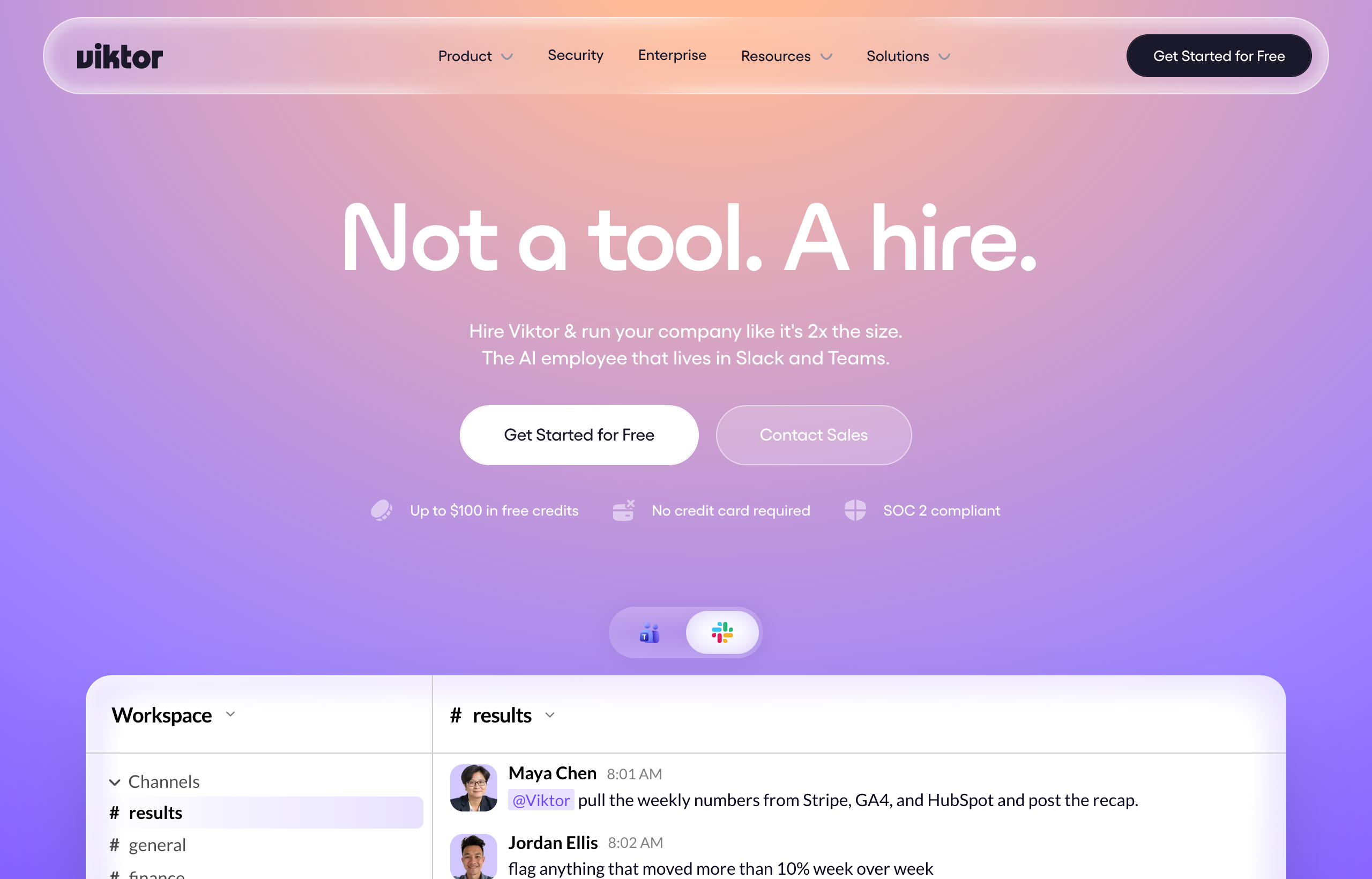
OpenClaw is an open-source, self-hosted AI coworker built by Peter Steinberger, running locally or on your own infrastructure, and reaching you across more than 29 messaging channels including Slack, WhatsApp, Telegram, and iMessage. It genuinely executes: browsing, filing, running shell commands, remembering context. Viktor is a managed AI employee purpose-built for Slack and Microsoft Teams, connecting to more than 3,200 real business tools like Stripe, Salesforce, and Google Ads to execute company work and deliver it where your team already talks. If you want full control, no vendor lock-in, and are comfortable owning infrastructure, OpenClaw. If you want a business-ready coworker running today with the widest integration surface into your actual company tools and no setup burden, Viktor. Neither is a worse version of the other; they are built for different owners.
If you’d rather see this decided on your own real task than another spec sheet, start with Viktor’s free $100 in credits, no card required, and hand it something that needs your actual company data this week.
What OpenClaw actually is
OpenClaw is an open-source personal AI assistant that runs locally on your machine or on infrastructure you control, rather than a closed cloud product. It was created by Peter Steinberger and is built around genuine autonomy: it has full system access (with sandboxing options if you want it), can browse and control a web browser for real tasks, reads and writes files, executes shell commands, and remembers your preferences, projects, and the people around you from one conversation to the next. You reach it through whichever of its more than 29 supported messaging channels you prefer, Slack included, alongside WhatsApp, Telegram, Discord, iMessage, Signal, and others, which is a genuinely broader “chat where you are” surface than most tools in this category attempt. A community-run marketplace called ClawHub lets users install or build custom skills and plugins, extending what it can do beyond the built-in feature set.
Because the core software is open source and free, the ongoing cost is not a subscription fee to OpenClaw itself but the infrastructure and API usage you provide it, your own server or cloud instance if self-hosting, plus the underlying model’s API costs (it can be connected to Claude or GPT-class models). Managed hosting options exist for people who don’t want to run their own server, with reported pricing starting in the neighborhood of $29 a month for a cloud-hosted version that removes the need for local Docker sandboxing, though that is a third-party or community offering rather than an official OpenClaw plan, so treat it as directional.
What Viktor actually is

Viktor is a managed AI employee that lives directly inside a Slack channel or a Microsoft Teams chat. Instead of you provisioning infrastructure or picking a model provider, you sign up and start briefing it immediately: you describe an outcome, and it connects to whichever of its 3,200-plus integrations the task needs, Stripe, Notion, Google Ads, Meta Ads, HubSpot, Salesforce, Linear, Jira, GitHub, Google Drive among them, pulls the actual data, and returns a finished deliverable. That might be a report or spreadsheet, a small deployed web app with a working database and login, a pull request against your repo, or a scheduled recurring task it sets up and then runs on its own.
Pricing is credit-based and workspace-wide rather than per seat: a free trial with $100 in credits, no card required, then paid tiers starting around $50 a month for 20,000 credits and scaling up from there, with the whole Slack or Teams workspace drawing from one shared pool rather than each person needing their own allocation.
Viktor vs OpenClaw at a glance
| Category | OpenClaw | Viktor |
|---|---|---|
| Ownership model | Open source, self-hosted (or community-managed cloud) | Managed SaaS product |
| Where it lives | 29+ channels: Slack, WhatsApp, Telegram, Discord, iMessage, Signal, and more | Slack and Microsoft Teams specifically |
| Integrations | Community-built via ClawHub, plus Gmail, GitHub, Obsidian, browser control, and more | 3,200+ named business integrations (Stripe, Salesforce, HubSpot, Google Ads, and more) |
| Setup | Requires installing and configuring your own instance, or a community-hosted option | Connect your Slack/Teams workspace and the specific tools you need; no infrastructure to run |
| Cost model | Free software; you pay for infrastructure and model API usage (or a managed hosting fee) | Credit-based, workspace-pooled, paid tiers from around $50/mo |
| Best for | Technical users and teams who want full control and no vendor lock-in | Business teams that want a ready employee working today inside real business tools |
Where OpenClaw genuinely wins
- No vendor lock-in. The software is free and open source, you own the deployment, and you can swap the underlying model provider if you want. Nobody can change your pricing or shut down your access to the tool itself.
- Broader personal-channel reach. Reaching you across 29-plus channels, including personal ones like WhatsApp and iMessage, is genuinely wider than Viktor’s Slack-and-Teams focus, which matters if you want one assistant across both work and personal messaging.
- Full system access and transparency. Because it’s open source, you can inspect exactly what it does and how, which matters to technical users and security-conscious teams who don’t want a black box handling shell commands and file access.
- Community-extensible via ClawHub. If a skill you need doesn’t exist yet, you or someone in the community can build it, rather than waiting on a vendor’s roadmap.
Where Viktor genuinely wins
- Zero infrastructure to own or maintain. There is no server to patch, no sandboxing to configure, no model API key to manage. You connect your workspace and start briefing it the same day.
- 3,200-plus named business integrations. OpenClaw’s integrations lean toward personal productivity (email, calendar, files, browser) and whatever the community has built; Viktor’s integration list is purpose-built around business systems, Stripe, Salesforce, Google Ads, Meta Ads, Linear, Jira, at a scale no self-hosted or community-driven tool matches today.
- Built for a whole team, not one user’s machine. Viktor’s workspace-wide credit pool and Slack/Teams-native design mean an entire team is working with the same coworker in the same channel. OpenClaw’s default model is closer to a personal assistant running on one person’s infrastructure, which asks more coordination to turn into a genuinely shared team resource.
- Transparent, published, self-serve pricing. Viktor’s credit tiers are public on its pricing page. OpenClaw’s own software is free, but the realistic all-in cost, infrastructure, model API usage, and any managed hosting, is scattered across multiple third parties rather than one clear number, which makes it harder to budget precisely before you start.
The honest way to settle this for your own situation: try both on the same real task. Start with Viktor’s free trial, $100 in credits, no card required, and compare what it took to get a business task done against what OpenClaw’s setup would have asked of you.
The honest weaknesses of each
OpenClaw’s real weakness is the setup and maintenance burden. Being open source and self-hosted is a feature for a technical user and a real obstacle for a non-technical team; someone has to install it, keep it updated, manage API keys and costs for whichever model it’s connected to, and take responsibility for its security since it has broad system access by design. Its integration list, while genuinely extensible through ClawHub, does not natively cover deep business systems like Salesforce or Google Ads the way a purpose-built business tool does, so using it for company-level work often means someone building or wiring up that integration first. And because pricing is not one clean number, budgeting the true cost (server, model API usage, time to maintain) takes real effort to estimate honestly.
Viktor’s honest weakness, in the same spirit, is credit-based billing that is genuinely less predictable than a flat subscription: quick tasks run roughly 100 to a few hundred credits, a full project can run 2,000 to 5,000, and real active teams commonly land closer to $300 to $750 a month once genuine usage kicks in, well above the $50 headline figure. It is also a managed product, so you are trusting a vendor with your workflow and your integration access rather than owning the deployment yourself, which some security-conscious or open-source-first teams will weigh as a real downside regardless of how well the product performs. Neither weakness is disqualifying on its own; both are real tradeoffs worth planning for rather than discovering later.
Setup experience: a real difference in time to first value
Getting OpenClaw running means installing it (via npm or from source, on macOS, Linux, or Windows), configuring sandboxing if you want it, connecting a model provider, and wiring up the specific channels and integrations you actually want it to use. For a developer or a technically comfortable power user, that’s an evening’s project, not a big lift, and the payoff is a tool you fully control. For a non-technical team, it’s a meaningfully bigger ask, and realistically means someone technical owns the setup and ongoing maintenance on the team’s behalf.
Getting Viktor running means connecting your Slack or Teams workspace and authorizing the specific integrations your first task needs, a process closer to installing any other Slack app. There’s no server to provision and no model to configure, because that’s Viktor’s job to handle behind the scenes. The tradeoff for that convenience is exactly what it sounds like: less control over the underlying infrastructure and model choice in exchange for not having to own any of it.
A closer look: the same task, two different owners
To make the ownership distinction less abstract, picture the same task run through both: “every Monday, pull our new signups from the last week, check them against our CRM for duplicates, and post a short summary in the team channel.” Setting this up on OpenClaw means installing the tool on a machine or server that stays running, connecting it to Slack as one of its channels, wiring up whatever integration or custom ClawHub skill talks to your CRM (building one yourself if it doesn’t exist), and testing the automation until it runs cleanly on schedule. That is a genuinely doable weekend project for someone comfortable with code and infrastructure, and once it’s built, it is fully yours, no subscription, no vendor who could change the terms later.
Setting up the same thing on Viktor means opening the Slack channel, describing the task in plain language, and authorizing the CRM connection if it’s one of the 3,200-plus already supported. Viktor sets up the recurring schedule itself as part of handling the request, and it runs from there without anyone maintaining a server. The tradeoff is exactly what you’d expect: less time and no infrastructure to own, in exchange for depending on a vendor’s uptime, pricing, and continued support of that integration going forward.
Neither path is wrong. A team with an engineer who already enjoys owning tools like this will find OpenClaw’s version genuinely satisfying and cheaper over a long enough time horizon, especially once the same infrastructure gets reused for a second and third automation. A team without that person, or one that would rather spend the time on the actual business problem than on maintaining the tool that solves it, will get to the same working automation faster and with less risk through Viktor, at the cost of an ongoing credit-based bill instead of a mostly fixed infrastructure cost.
Who should pick OpenClaw
- Technical users and small technical teams who want full control over their AI coworker’s infrastructure, model choice, and data, with zero vendor lock-in.
- Anyone who wants one assistant reachable across both personal channels (WhatsApp, iMessage) and work channels (Slack), not just a work-specific tool.
- Privacy-conscious users who want to self-host rather than route company or personal data through a third-party managed service.
- Developers comfortable maintaining their own deployment and willing to trade setup time for long-term control and lower direct software cost.
Who should pick Viktor
- Business teams that want a coworker working inside real company systems, Stripe, Salesforce, Google Ads, GitHub, today, without anyone provisioning infrastructure first.
- Non-technical teams that don’t have (or don’t want to dedicate) someone to own an open-source deployment’s setup and maintenance.
- Teams that need the whole group working with the same shared coworker in one Slack or Teams channel rather than a tool tied to one person’s machine.
- Anyone who wants a single, published, self-serve price to budget against rather than assembling infrastructure and API costs from multiple sources.
If Viktor sounds like the fit for your team specifically, the fastest way to know for sure is to try it on this week’s real work. Get Viktor’s free $100 in credits here, no card required.
For more context, see our full Viktor review, our Viktor alternatives roundup which places OpenClaw alongside Lindy, Sintra, and Relevance AI, and our best AI employee tools of 2026 list for the wider category.
FAQ
Is OpenClaw free?
The core OpenClaw software is free and open source. Your actual cost is the infrastructure you run it on (or a third-party managed hosting option, reportedly from around $29 a month) plus the API usage of whichever underlying AI model you connect it to.
Is OpenClaw as good as Viktor for business tasks?
It depends on the task. For personal productivity and general autonomous execution across many channels, OpenClaw is genuinely capable. For deep business tool integration, connecting to Stripe, Salesforce, or Google Ads and executing multi-step company work, Viktor’s 3,200-plus purpose-built integrations go further out of the box.
Do I need to be technical to use OpenClaw?
Some technical comfort helps significantly. Installing, configuring sandboxing, connecting a model provider, and maintaining the deployment over time is a real setup and maintenance responsibility compared with a managed product like Viktor.
Can OpenClaw and Viktor be used together?
There’s no official integration between the two, but some technical teams do run both: OpenClaw for personal and cross-channel autonomy, Viktor for shared team business work inside Slack or Teams. They are not mutually exclusive.
Which is more secure, OpenClaw or Viktor?
They represent different security models rather than a clear better-or-worse. OpenClaw’s open-source, self-hosted design means you control your data and can audit exactly what it does, but you are also responsible for securing it yourself. Viktor is a managed service, so you are trusting a vendor’s security posture in exchange for not having to build or maintain it.


