

I keep seeing the same support thread pattern in agent-building communities: someone spends a weekend in Relevance AI’s canvas wiring up a BDR agent, a data-enrichment tool, and a Slack notifier, gets it mostly working, then asks “is there a version of this I don’t have to build myself.” That question is the whole comparison. Relevance AI and Viktor both let you point an AI agent at real work, but one hands you a construction kit and the other hands you a coworker who already knows how to use the tools.
I have spent real hours in both products: building a lead-research agent inside Relevance AI’s low-code canvas, and separately running Viktor in a Slack workspace for a week of actual tasks, from pulling a Google Ads spend summary to drafting a board update. This is the direct comparison, with real pricing, a fair look at what Relevance AI does well, and an honest read on when the “ready-made employee” approach beats the “build your own workforce” approach.
Disclosure: some links in this post are affiliate links. If you sign up through them, we may earn a commission at no extra cost to you. That never changes our verdict.
The 30-second verdict
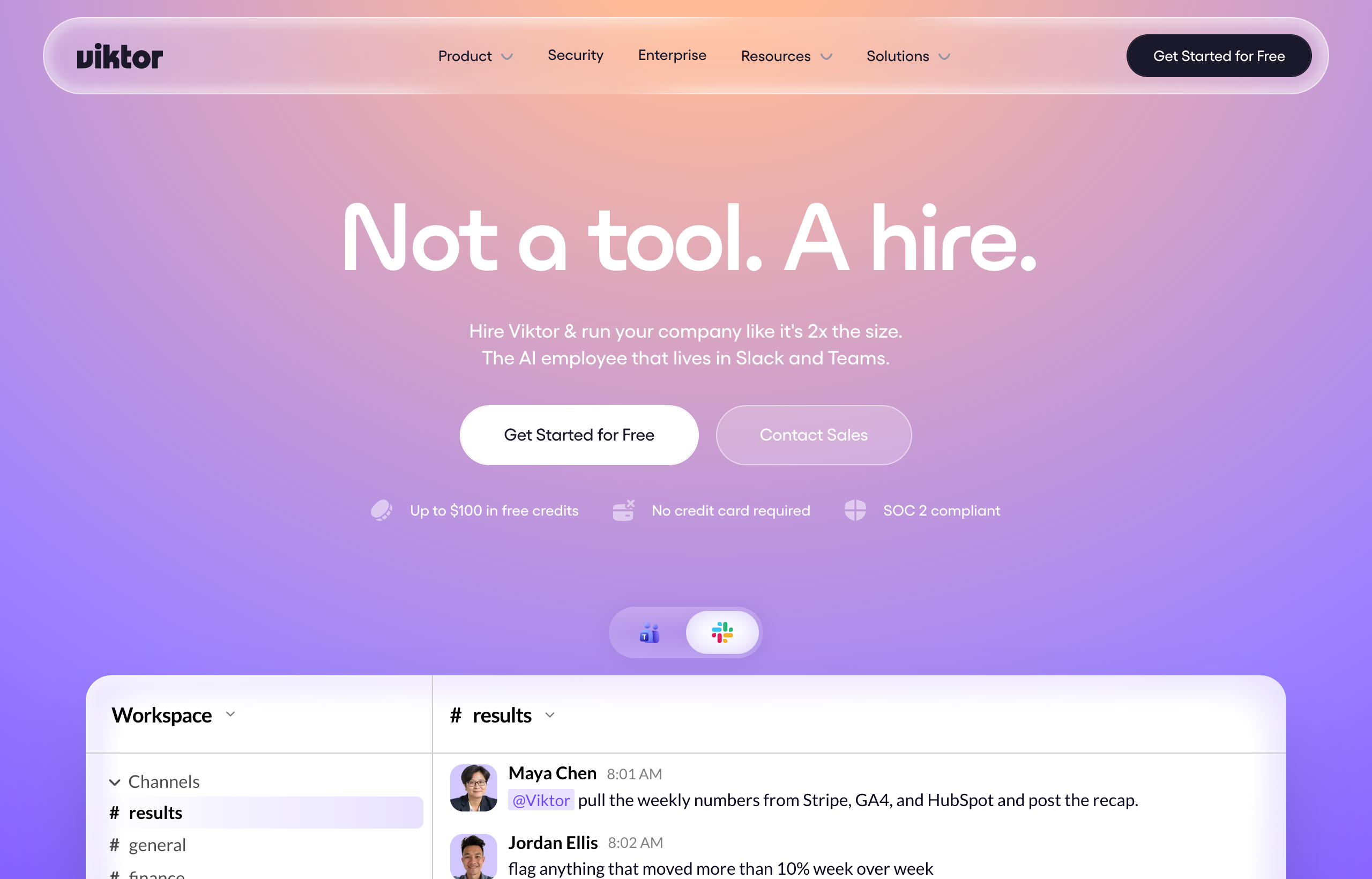
Relevance AI is a platform for building custom AI agents and multi-agent “workforces,” with a visual canvas, a large tool library, and deep configuration control, best suited to a team that wants to design and own its agent stack. Viktor is a ready-made AI employee that lives in Slack and Microsoft Teams and executes tasks the moment you describe them, with no canvas, no agent design step, and a much shorter path from signup to first result. If your team has the time and the technical appetite to architect agents node by node, and wants that level of control, Relevance AI’s flexibility is real and Viktor won’t match it. If you want something that behaves like a competent new hire from day one, Viktor gets there faster because there’s nothing to build.
- Relevance AI is a no-code/low-code agent-building platform: you design agents, connect tools, and orchestrate multi-agent “workforces” yourself. Viktor is a single, pre-configured agent you talk to in Slack; there is no builder screen.
- Relevance AI’s public pricing page currently shows an Enterprise tier only, with self-serve plans requiring you to dig through documentation or third-party sources for current figures. Viktor publishes exact credit-to-dollar pricing on its own site, no sales call required to see a number.
- Relevance AI is built for teams that want to design a repeatable, branded agent process (a BDR workforce, a support triage flow) and keep iterating on it. Viktor is built for a person who wants to describe a task in plain English and get a finished output back.
- Relevance AI’s setup and learning curve is real: expect hours to days to get a useful agent live. Viktor’s setup is closer to minutes: add it to a Slack channel and give it a task.
- Neither is lying about what it does. Relevance AI is honestly a builder platform. Viktor is honestly a finished product. The right choice depends on whether you want to build or you want to delegate.
If you just want to see what a ready-made AI employee can do without spending a weekend configuring one, I would start with Viktor’s free $100 in credits and hand it one real task this week, something you’d normally hand to a junior hire.
What Relevance AI and Viktor actually are
Relevance AI (the product is operated by OnSearch Pty Ltd, trading as Relevance AI, based in Australia) markets itself around the phrase “AI Workforce”: you build individual agents in a visual canvas, give each one a role, tools, and knowledge, then chain them together into a multi-agent team that can hand work off between agents. It ships with a large tool library, over 2,000 integrations by its own count, agent evaluation and A/B testing features, and enterprise controls like SSO, RBAC, and audit logs. On its own site, Relevance AI positions itself directly against platforms like Clay, Gumloop, Microsoft Copilot Studio, and managed-agent offerings from OpenAI and Anthropic, which tells you the category it thinks it’s in: agent infrastructure for teams that want to build.
Viktor takes the opposite starting point. There is no canvas, no node graph, and no separate “agent design” phase. You install it into a Slack or Microsoft Teams workspace, and it behaves like a new hire you brief in a channel: connect it to the tools you already use (Stripe, Notion, Google Ads, Meta Ads, HubSpot, Salesforce, Linear, Jira, GitHub, Google Drive, and more, 3,200-plus integrations by its count), and it goes and does the work, pulling data, building a dashboard, writing code and opening a pull request, drafting a report, or setting up a recurring task, then reports back in the same thread. The product decision Viktor made is that most people don’t want to design an agent, they want the outcome an agent produces.
Who is each one actually built for
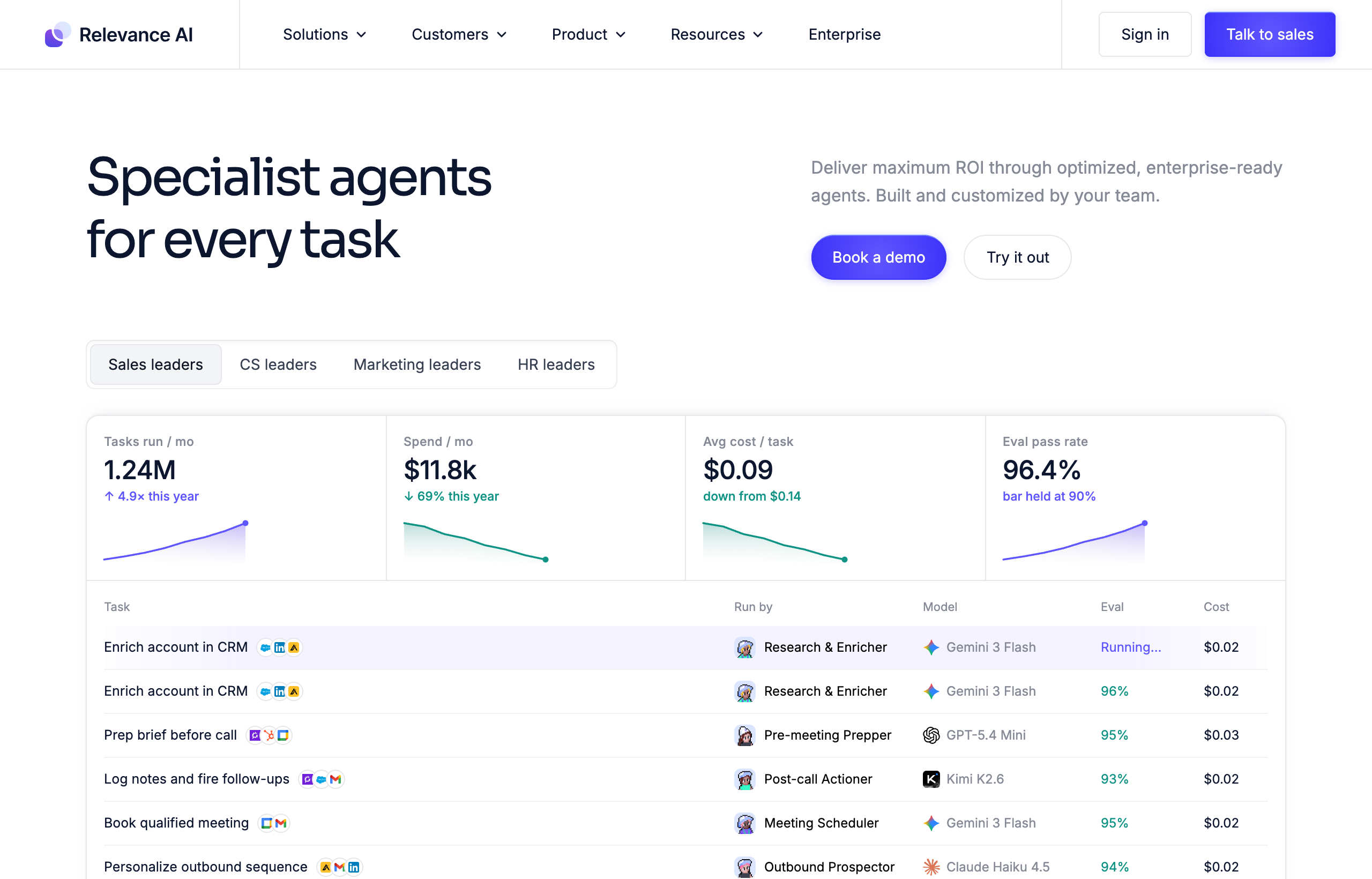
Relevance AI’s ideal customer already has, or wants to build, an internal “agent ops” capability: an ops or RevOps person, a growth engineer, or a small platform team that will own a library of agents over time, test variants against each other, and treat agent-building as an ongoing discipline. If you deleted your Relevance AI workspace tomorrow, you’d lose the agents your team spent real hours designing.
Viktor’s ideal customer is a founder, marketer, ops lead, or engineer who has a task today and wants it done today, without becoming the person who maintains an agent stack. If you deleted Viktor tomorrow, you’d lose a working relationship with something that behaved like a teammate, not a system you built.
| Category | Relevance AI | Viktor |
|---|---|---|
| Core model | Build-your-own agents and multi-agent workforces, visual canvas | Pre-built AI employee, chat interface inside Slack/Teams |
| Setup time to first useful result | Hours to days, depending on agent complexity | Minutes: install, connect a tool, describe a task |
| Where you work | Relevance AI’s own web app and canvas | Slack or Microsoft Teams, where your team already works |
| Integrations | 2,000+ (per Relevance AI) | 3,200+ (per Viktor) |
| Multi-agent orchestration | Native, core feature (agents hand off to other agents) | Single agent handles the full task itself |
| Agent evaluation / A/B testing | Built in (Enterprise tier) | Not applicable; there’s one agent, not variants to test |
| Public self-serve pricing | Not shown on the live pricing page at the time of writing; Enterprise-only, talk to sales | Published credit tiers from $50/mo, visible without a sales call |
| Free option | Historically a free tier existed with a monthly action allowance; not confirmable on the current public page | $100 in trial credits, no card required, credits don’t expire |
| Best fit | Teams that want to design, own, and iterate on an agent stack | Anyone who wants a task done without building anything |
Where Relevance AI genuinely wins
Credit where it’s due: if you want control over exactly how an agent reasons, what tools it’s allowed to touch, and how a multi-step process hands off between specialized agents, Relevance AI gives you that in a way Viktor structurally can’t, because Viktor isn’t a builder. Relevance AI’s agent evaluation and A/B testing tools let a team compare two versions of the same agent against real outcomes, which matters if you’re running something like an outbound BDR agent at volume and need to tune it the way you’d tune an ad campaign. Its “Spaces,” permissions, and enterprise controls (SSO, RBAC, audit logs) are aimed squarely at organizations that need to govern who can build and run what, which is a real requirement once more than a handful of people are touching the platform.
The multi-agent “workforce” model is also a genuine differentiator worth naming honestly. If a process actually benefits from specialization, one agent researching, a second qualifying, a third drafting outreach, Relevance AI lets you build that as discrete, inspectable pieces you can debug individually. That’s a real advantage for a team that has already mapped out a repeatable process and wants each step to be its own component.
Where Viktor wins
The flip side of “you can build anything” is “you have to build everything,” and that’s the gap Viktor is closing. When I tested Viktor, the thing that stood out wasn’t a single flashy capability, it was how little setup stood between a request and a finished deliverable. I asked it to pull a summary of a Google Ads account’s spend against target CPA and format it as a short Slack-native report; it connected, pulled the data, and posted a formatted summary in the same thread, no canvas, no node wiring, no agent I had to configure first. That’s the core trade Viktor is selling: you skip the entire “design the agent” phase because the agent already exists and already knows how to use the tool.
Viktor also lives where the work already happens. Relevance AI’s agents run inside Relevance AI’s own app, which means someone has to go check on them there. Viktor runs inside the Slack channel your team is already in, so asking it something or getting a result back doesn’t require switching context to a separate tool. For a founder or a small team without a dedicated ops person to own an agent stack, that difference is the whole ballgame: Viktor is closer to hiring than to building.
The honest test I’d run before committing to either: pick one task you actually need done this week and give it to Viktor first, since there’s nothing to configure. Start with the $100 free trial credits and see if the output is good enough that building your own agent for the same job would have been wasted effort.
What do they actually cost in 2026?
This is where the two products differ almost as much on transparency as on price. Viktor publishes its pricing directly: a free trial with $100 in credits and no card required, credits that don’t expire. Team plans are workspace-wide and credit-based rather than charged per seat: 20,000 credits runs around $50 a month, 30,000 around $75, 40,000 around $100, and 80,000 around $200. Small-company tiers scale from roughly 125,000 to 2,000,000 credits, priced from about $300 to $5,000 a month, with 300,000 credits at around $750 a month reported as the most popular tier. Larger organizations move into custom Enterprise pricing, with reported tiers in the $35,000 to $50,000-a-month range for the highest usage bands. Viktor says credits reflect actual model cost with no markup, and that a quick task burns roughly 50 to 100 credits while a full project can run 2,000 to 5,000.
Relevance AI’s own pricing page, at the time of writing, shows only an Enterprise plan with a “talk to sales” call to action; no dollar figures for a self-serve tier appear on the live page. Third-party pricing trackers and Relevance AI’s own documentation have reported a dual-meter self-serve structure in the past, splitting cost into monthly “Actions” and separately metered “Vendor Credits,” with figures around a free tier (roughly 200 actions and 1,000 vendor credits) and paid tiers that have been reported in the neighborhood of $19 a month at entry and well over $200 a month at a team tier. Because these numbers move and are not currently confirmable on Relevance AI’s public pricing page, treat them as directional, not quoted, and verify current self-serve pricing directly with Relevance AI before budgeting against it.
| Plan | Relevance AI | Viktor |
|---|---|---|
| Free / trial | Reported historically, not confirmable on current public page | $100 in credits, no card required, credits never expire |
| Entry paid tier | Not published on the live pricing page; reported around $19-$24/mo historically | Around $50/mo for 20,000 workspace-wide credits |
| Mid tier | Not published; reported around $200+/mo historically | Around $750/mo for 300,000 credits (most popular small-company tier) |
| Enterprise | Custom, “talk to sales” | Custom, reported tiers around $35,000-$50,000/mo at the top end |
| Pricing transparency | Low; current page requires a sales conversation for any number | High; exact credit-to-dollar figures published on the pricing page |
The honest weaknesses (both sides)
Relevance AI’s biggest practical weakness right now is exactly what shows up above: you cannot get a real number without talking to sales, which is friction most solo founders and small teams will not push through just to evaluate a tool. Layer on the setup curve, building even a simple agent means learning the canvas, choosing tools, and testing it, and Relevance AI is asking for real time investment before you see value. It is also, structurally, not trying to be a finished product; if what you actually want is an agent that already knows how to do a job, Relevance AI hands you the pieces, not the assembled thing.
Viktor’s honest weakness is the one every review of it needs to include: credit-based billing is unpredictable in a way flat per-seat pricing isn’t. Real users have reported burning through $200 in credits in the first two days of exploring, or landing well above the $50 headline figure once real usage kicks in, sometimes $500 or more a month. Because credits track actual model and tool cost, a task that touches a lot of data or a slow, tool-heavy workflow can burn through an allotment faster than the sticker price implies, and budgeting for it takes a cycle or two of real usage before you can predict your bill. Viktor is also not a visual builder; if what you actually want is to design a specific, repeatable multi-step process and inspect each stage, a canvas tool is the better fit, and Viktor’s conversational model won’t give you that.
Who should pick Relevance AI over Viktor
- Teams with a dedicated ops or RevOps person who will own an agent stack as an ongoing discipline, not a one-off setup.
- Anyone who needs multi-agent orchestration with real handoffs, research agent to qualification agent to outreach agent, as discrete, testable components.
- Organizations that need enterprise governance, SSO, RBAC, audit logs, from day one and are comfortable going through a sales process to get pricing.
- Builders who want to A/B test agent variants against real outcomes rather than trust a single, pre-configured agent’s judgment.
Who should pick Viktor over Relevance AI
- Founders and small teams without time to build an agent stack who need work done this week, not a platform to learn this quarter.
- Anyone who wants to keep working inside Slack or Teams instead of adding another app to check.
- People who want to see a real price before committing to any usage, without a sales call.
- Teams whose tasks are varied and one-off rather than a single repeatable process worth engineering into a formal agent.
Frequently asked questions
Is Relevance AI or Viktor easier to set up?
Viktor, by a wide margin. There’s no builder step: you connect it to Slack or Teams and give it a task. Relevance AI requires designing an agent in its canvas first, which is a real time investment even for a simple use case.
Can Relevance AI do what Viktor does?
You can build an agent in Relevance AI that approximates a specific Viktor workflow, but you have to design, test, and maintain it yourself. Viktor ships that capability pre-built, with no design step required.
Which is cheaper, Relevance AI or Viktor?
It’s hard to say with confidence because Relevance AI’s current public pricing page does not display self-serve dollar figures. Viktor’s pricing is fully published: workspace-wide credit tiers starting around $50 a month. If transparent pricing matters to your decision, that alone favors Viktor.
Does Viktor replace the need for a tool like Relevance AI?
For most day-to-day tasks, yes, that’s the point of a ready-made agent. If your team genuinely needs to design and own a custom multi-agent process at scale, Relevance AI’s builder gives you control Viktor doesn’t offer, since Viktor isn’t a builder.
Is Relevance AI good for non-technical teams?
It’s more accessible than writing code, since it’s a visual, low-code canvas, but it still asks you to think like a builder: choosing tools, wiring steps, testing outputs. A non-technical team that wants results without that process will get there faster with Viktor.
The bottom line
This comparison isn’t really “which tool is better,” it’s “do you want to build or do you want to delegate.” Relevance AI is honestly good at the job it set out to do: giving a team the pieces to design a custom, multi-agent workforce, with real depth in orchestration, evaluation, and governance for teams that will invest the time. Viktor is honestly good at a different job: showing up as a competent employee on day one, in the Slack channel you already use, with pricing you can see before you sign up.
My actual recommendation: if you don’t already know exactly what agent you want to build, don’t start in a canvas. Start by handing a real task to something that already knows how to do it, and let that tell you whether you even need to build anything at all.
Try Viktor with the free $100 in credits on one real task before you spend a weekend in anyone’s agent builder. It costs nothing to find out whether you needed a builder in the first place.
Pricing captured from vendor pricing pages, July 2026. Plans change, so confirm current details before you buy. Relevance AI’s self-serve pricing figures in this article are reported historical figures, not numbers pulled from the current live pricing page, and should be verified directly with Relevance AI.


