

I put both of these on the same Tuesday: Sintra open in one browser tab with its roster of cartoon avatars, Viktor sitting quietly in a Slack channel called #ai-employee. Same task for both: pull last month’s ad spend across two accounts, flag anything that overspent, and draft a one-page summary. Sintra’s data helper, Dexter, needed the numbers uploaded as a CSV before it would touch them. Viktor asked which two ad accounts, connected to both, and came back forty minutes later with the summary and a spreadsheet link. That gap, “helper that works with what you hand it” versus “employee that goes and gets it,” is basically the whole story of this comparison.
Disclosure: some links in this post are affiliate links. If you sign up through them, we may earn a commission at no extra cost to you. That never changes our verdict.
Short answer
Sintra is a cheap, friendly dashboard of role-based chatbots (Soshie for social, Emmie for email, Dexter for data, and nine others) that live inside Sintra’s own app. It is good at drafting and brainstorming and it is genuinely affordable. Viktor is a single, general-purpose AI employee that lives inside Slack or Microsoft Teams, connects to 3,200+ real tools, and executes multi-step work end to end instead of handing you a draft to finish. If you want a low-cost content assistant, Sintra is a reasonable pick. If you want something that actually goes into your systems and finishes the job, Viktor is built for that.
If you’re on the fence, I would not take my word for it either way. Start Viktor with the free $100 in credits (no card needed) and give it one task you’d normally hand to a person: try Viktor here.
What Sintra actually is
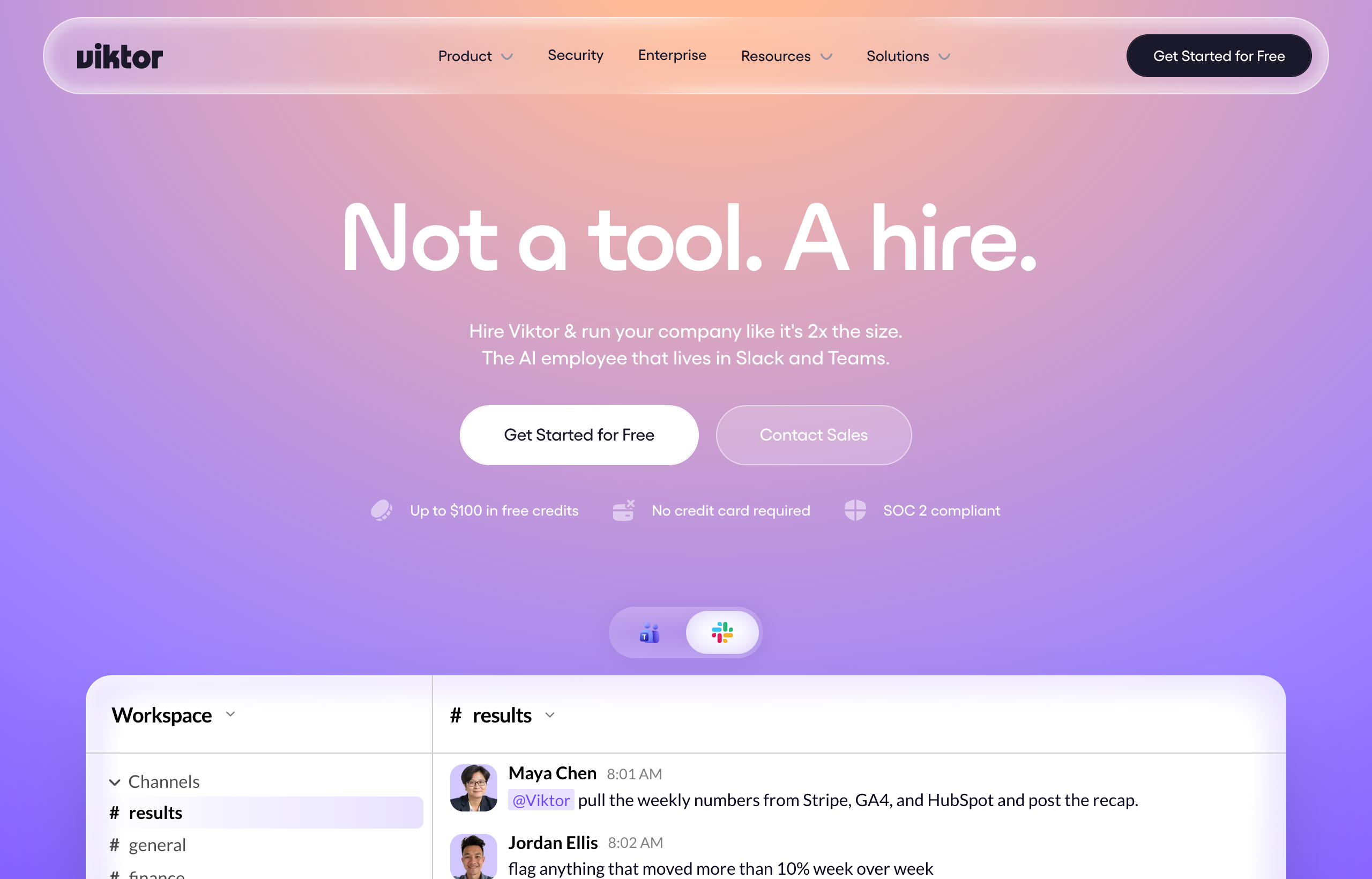
Sintra sells you a team, or at least the illusion of one. Log in and you get a dashboard of twelve named “AI helpers,” each with a face and a job title: Soshie (social media), Cassie (customer support), Dexter (data analyst), Buddy (business strategist), Emmie (email marketing), Gigi (personal growth coach), Scouty (recruiter), Penn (copywriter), Commet (ecommerce), Milli (sales), Seomi (SEO), and Vizzy (executive assistant). You pick a helper, open a chat with it, and it does the thing its title suggests, mostly by generating text, plans, or short pieces of content inside Sintra’s own interface.
It is a smart product decision for a certain buyer. Naming the bots and giving them personalities makes an intimidating category (AI agents) feel approachable to someone who has never used one. The 15+ integrations cover common marketing tools, and the “Brain” feature lets you feed Sintra context about your business so the helpers sound less generic over time. For a solo founder who wants help drafting social captions, email sequences, and customer replies without learning a new platform, Sintra is not a bad front door into AI-assisted work.
What Viktor actually is
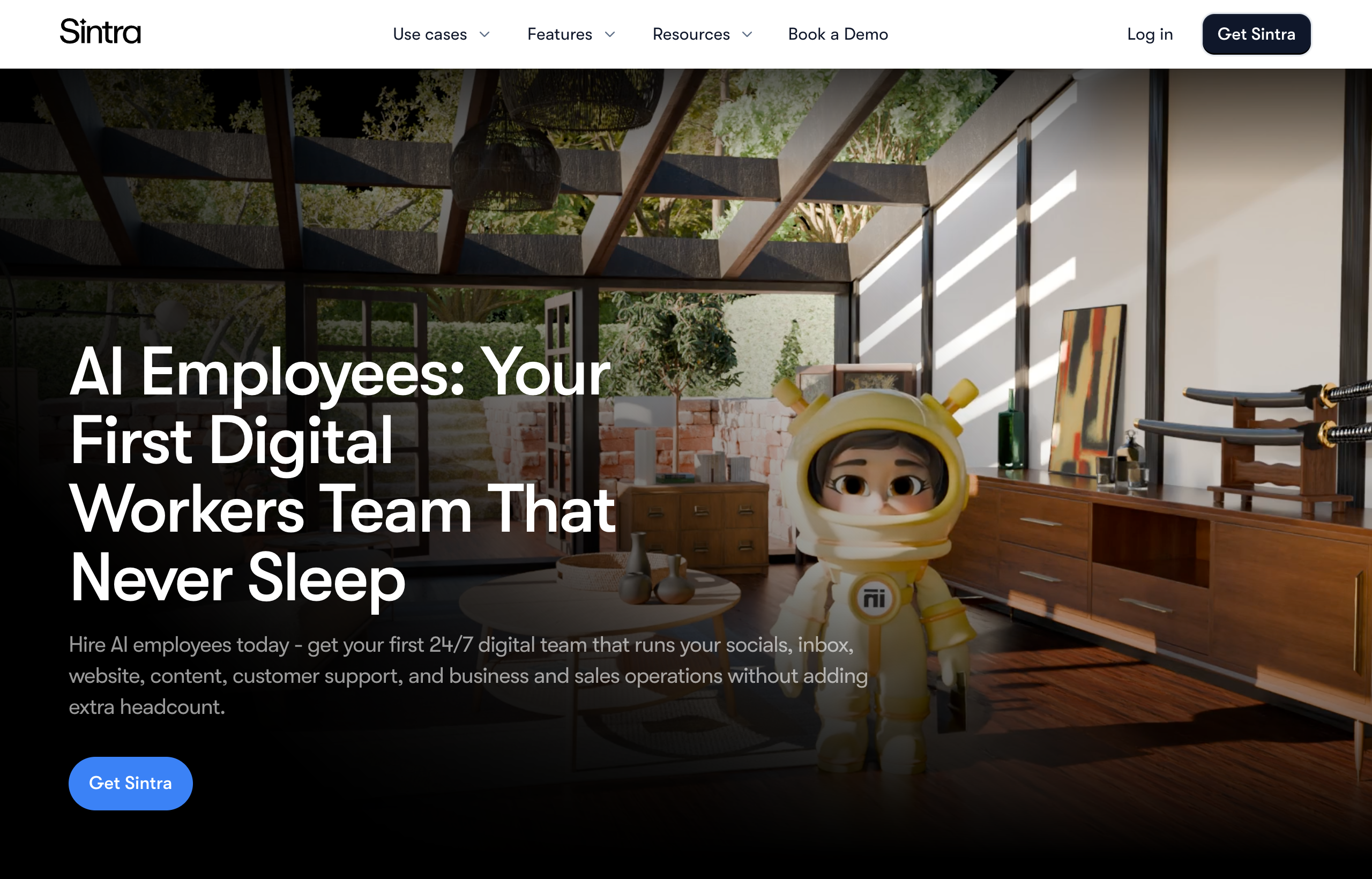
Viktor is not a dashboard you visit. It is an AI employee that sits in a Slack channel (or Teams) and you talk to it the way you’d talk to a new hire: “pull the Google Ads numbers for Q2, compare against last quarter, and put together a one-pager for the board deck.” Viktor connects to your actual tools (Stripe, Notion, HubSpot, Salesforce, Google Ads, Meta Ads, GitHub, Google Drive, and over 3,200 more through its integration layer), goes and does the multi-step work, and comes back with a finished output: a spreadsheet, a deployed web app with a working database, a pull request, a report, a scheduled recurring job. You are not copying its output into another tool. It works inside the tools you already run your business on.
The distinction that matters here: Sintra’s helpers mostly generate content for you to use elsewhere. Viktor executes the task inside your actual stack and hands you a finished artifact. That is the difference between a chatbot with a job title and an employee.
Sintra vs Viktor at a glance
| Category | Sintra | Viktor |
|---|---|---|
| What it is | Roster of 12 role-based AI chat helpers in one dashboard | One general AI employee inside Slack/Teams |
| Where you work | Sintra’s own web app | Slack or Microsoft Teams, where your team already talks |
| Core behavior | Drafts content, answers, and plans per helper | Executes multi-step tasks end to end across connected tools |
| Integrations | 15+ named integrations | 3,200+ tools (Stripe, HubSpot, Salesforce, GitHub, Google Ads, Meta Ads, Notion, Drive, and more) |
| Can it build things | Drafts and copy, not deployed software | Builds and deploys web apps with database and auth, opens GitHub pull requests |
| Pricing model | Flat subscription with a monthly credit cap for “advanced actions” | Credit-based, workspace-wide, no per-seat charge |
| Entry price | Around $48.50/mo for the full 12-helper bundle at the current discount (list price around $97/mo) | Around $50/mo for 20,000 credits, or free trial with $100 in credits, no card |
| Best for | Solo founders wanting cheap content drafting help | Teams that want a coworker who executes inside real systems |
Pricing: what you actually pay
Sintra’s pricing page leans hard on urgency discounting, which is worth knowing before you buy. The month-to-month “Sintra X” bundle (all 12 helpers) lists at around $97/month, but the page shows a standing discount that brings it to roughly $48.50/month if you pay monthly, and cheaper again on quarterly or annual terms (I saw figures near $23.60/month and $15.60/month respectively on longer commitments, though Sintra changes these promos often, so treat the exact numbers as approximate at the time of writing). All tiers include 250 monthly credits, which cover the “advanced” actions certain helpers perform; day-to-day chat is not credit-limited the same way. You can also buy a single helper on its own for around $39/month if you only need, say, the copywriter or the SEO bot. There’s a 14-day money-back guarantee, which makes it low-risk to test.
Viktor’s pricing works differently because it is not selling seats, it is selling compute. The free trial gives you $100 in credits with no card required, and those credits do not expire, so you can genuinely put it through a real task before paying anything. Paid team plans start around $50/month for 20,000 credits, $75 for 30,000, $100 for 40,000, and $200 for 80,000. Above that, small-company tiers run roughly $300 to $5,000/month for 125,000 up to 2 million credits (the 300,000-credit tier at around $750/month is the one Viktor calls out as most popular), and there are larger medium-business and enterprise tiers above that, including custom enterprise contracts in the $35,000 to $50,000/month range for the biggest deployments. Credits are shared across your whole workspace, not billed per seat, and reset monthly.
Here’s the part most comparison posts skip: Viktor’s credit model is unpredictable in a way a flat Sintra subscription is not. A quick task might burn 50 to 100 credits, but a full project, the kind of thing that would take a human analyst half a day, can burn 2,000 to 5,000 credits in one go. I have seen real users report burning through $200 in the first two days of a trial because they let Viktor loose on several ambitious builds at once, and effective monthly spend for active teams often lands well above the $50 headline number, sometimes north of $500/month once you’re actually using it for real work. Sintra’s flat price is easier to budget. Viktor’s price scales with how much real output you’re asking for, which is fairer if you use it lightly and expensive if you don’t watch it.
Where Sintra genuinely wins
- Price predictability. A flat monthly fee with a fixed credit cap is easier to budget than usage-based pricing, especially for a solo operator watching every dollar.
- Approachability. Named helpers with clear job titles lower the intimidation factor for someone who has never used an AI agent before.
- Breadth of drafting help in one place. Twelve roles covering social, email, support, SEO, and copy means you are not juggling twelve separate subscriptions for basic content drafting.
- Low risk to try. The 14-day money-back guarantee and the ability to buy a single helper for around $39/month make it cheap to test one use case before committing further.
Where Viktor genuinely wins
- It executes, not just drafts. Viktor pulls real data from your connected tools, does the multi-step work, and hands you a finished output rather than a first draft you still need to assemble.
- It lives where your team already works. Slack and Teams mean no new dashboard to check, no separate login habit to build for the whole company.
- Integration depth. 3,200+ connections versus 15+ is not a small gap. If your workflow touches Salesforce, Linear, Jira, or your own internal tools, Sintra likely cannot reach them.
- It builds real things. Deployed web apps with working databases, GitHub pull requests, scheduled recurring automations. None of that is in Sintra’s toolkit.
- No per-seat pricing. A whole team can use Viktor from a shared credit pool instead of paying per person.
The honest weaknesses of each
Sintra’s weakness is depth. The helpers are conversational content generators bound to Sintra’s own dashboard. They cannot reach into Salesforce, cannot deploy anything, cannot open a pull request, and cannot run a scheduled job against your live systems. If your business need is “draft me some copy,” that’s fine. If your need is “go do this task across three systems and tell me when it’s done,” Sintra is not built for that, and no amount of clever prompting changes it. You are also locked to a separate app; nothing shows up where your team already talks.
Viktor’s weakness is billing predictability, and I want to be direct about it because most sponsored reviews soften this. Credit-based pricing means your bill can spike fast if you hand Viktor several big projects in the same week. The “around $50/month” headline is real for light use, but it is not what an actively-using team typically pays. You also need to brief it reasonably well; Viktor is a coworker you talk to, not a drag-and-drop canvas, so if you want to visually design a rigid, repeatable workflow node by node, a tool like Zapier or n8n fits that shape better. And for a true one-person operation that just wants occasional chat help, Viktor is more employee than you need.
How I actually tested this
To keep the comparison fair, I ran the same three briefs through both tools over the course of a week rather than judging off a single demo task. The first was the ad spend summary I mentioned at the top. The second was drafting a week of social captions for a product launch, territory that should favor Sintra’s Soshie helper if anything does. The third was setting up a recurring weekly report that pulls a specific number and emails it to a manager without anyone re-running it by hand.
On the social captions, Sintra actually held its own. Soshie’s drafts needed light editing but were a real time-saver, and once I fed the Brain feature more context about our brand voice, the second batch was noticeably better than the first. Viktor produced captions too, competent but not obviously better, since caption writing is squarely inside what a good chatbot already does well. Sintra’s dashboard interface was also faster to navigate for this specific task since everything sits in one screen.
The gap opened wide on the other two tasks. Sintra couldn’t set up the recurring report at all; there’s no scheduling or automation layer that reaches into an external system on a timer. Viktor set it up in one message and the report has run every Monday since without me touching it. That’s the pattern worth remembering: for content generation the two tools are closer than the marketing suggests, but for anything that needs to run on its own against real data, only one of them can actually do it.
Onboarding and setup experience
Sintra’s onboarding is quick because there’s not much to connect. Sign up, pick a helper, start chatting, and you’re producing output within minutes. That simplicity is a real advantage if you want to be productive on day one with zero setup friction. Viktor’s onboarding takes a bit longer up front because you’re authorizing it against real tools (your Slack workspace, then whichever of the 3,200+ integrations you actually need, Google Ads, Notion, GitHub, whatever your stack includes), which means a short permissions and connection step before it can do useful work. In practice this added maybe twenty minutes the first day, and after that the ongoing experience was faster than Sintra’s because I never had to leave Slack to use it.
A worked cost example
To make the pricing section concrete: a small team drafting content a few times a week and occasionally asking Viktor to pull a report might land in the 20,000 to 30,000 credit range, roughly $50 to $75/month, close to what Sintra’s discounted bundle costs. A team that also asks Viktor to build and maintain something, a dashboard, a recurring automation, an internal tool, will burn credits faster and should budget closer to the 80,000 to 300,000 credit tiers, roughly $200 to $750/month. Sintra’s cost stays flat no matter which of those two teams you are, which is either a feature or a limitation depending on how much real work you’re asking for.
Who should pick Sintra instead
If you are a solo founder or a very small team whose main need is drafting, social captions, email copy, SEO outlines, customer support replies, and you want one flat, low monthly bill with no surprises, Sintra’s bundle is a reasonable, inexpensive tool. It is also a fine on-ramp if AI agents feel unfamiliar and you want a friendlier interface before trying something more powerful. Read our full Sintra AI review for the detailed pros and cons, and see our Sintra AI alternatives roundup if you want other options at a similar price point.
My verdict
After running both on the same real tasks, I keep coming back to the same distinction: Sintra gives you helpers, Viktor gives you an employee. If your workload is mostly content drafting and you want the cheapest possible entry point, Sintra’s flat pricing and friendly interface earn their keep. But the moment your work involves pulling live data from real systems, building something that needs to actually get deployed, or running a recurring process without you babysitting it, Sintra hits a wall that Viktor simply doesn’t have. For most teams past the solo-founder stage, that gap is worth the less predictable bill.
The way I tested this fairly: I gave both tools the exact same brief and watched what came back. If you want to run that same test, start with Viktor’s free $100 in credits and hand it one task Sintra would have to punt on.
For the full breakdown of Viktor on its own, see our complete Viktor review, our Viktor pricing guide that decodes the credit model in detail, and our best AI employee tools of 2026 roundup for how Viktor stacks up against the wider field.
If cost predictability is your main worry, don’t guess, run the trial and watch the credit meter on a real task before you commit to a paid tier: start free with Viktor.
FAQ
Is Sintra AI or Viktor cheaper?
Sintra’s flat bundle is cheaper on paper, around $48.50/month at the current discount for all 12 helpers, versus Viktor’s roughly $50/month starting tier. But Sintra’s price is fixed regardless of use, while Viktor’s scales with how much real work you ask it to do. Light Viktor use can cost less than Sintra; heavy use of both tools will usually cost more on Viktor because it is actually completing more work per dollar spent, not just chatting.
Can Sintra do what Viktor does?
Not really. Sintra’s helpers draft content and answer questions inside Sintra’s dashboard. Viktor connects to 3,200+ real tools, pulls live data, builds and deploys software, and runs scheduled automations. They overlap on basic content generation but diverge sharply on execution.
Does Viktor replace Sintra entirely?
For most teams past the solo-founder stage, yes, because Viktor’s Slack-native execution covers content drafting plus everything Sintra cannot do. If your only need is cheap social and email drafting and you want the lowest possible bill, Sintra alone may still suffice.
Which tool is easier for a beginner?
Sintra is friendlier for someone who has never touched an AI agent, thanks to its named helpers and simple dashboard. Viktor has a slightly steeper learning curve because you need to brief it like a new employee, but most users find that curve short since you are just talking in Slack.
Does Viktor integrate with the same marketing tools as Sintra?
Yes, and considerably more. Viktor covers the common marketing and ecommerce tools Sintra supports plus CRM, engineering, and finance systems like Salesforce, GitHub, Linear, Jira, and Stripe that Sintra’s 15+ integrations don’t reach.


