
beehiiv wins for anyone building a newsletter as a growth business in 2026: it ships a native referral program, the Boosts marketplace, an ad network, and an SEO-indexable website inside one subscription, and it takes 0% of paid subscription revenue. AWeber wins for small businesses and solo marketers who just need a reliable, simple autoresponder for a mailing list, without the newsletter-as-a-media-company ambitions. If you want your list to compound through referrals and discovery, pick beehiiv. If you want the cheapest, most no-frills way to send a weekly email to a modest list, AWeber still does that job fine.
Disclosure: some links in this post are affiliate links. If you sign up through them, we may earn a commission at no extra cost to you. That never changes our verdict.
Key takeaways
- beehiiv’s Scale plan starts at $43/month (annual billing) and includes a referral program, Boosts, an ad network, and 0% fees on paid subscriptions. AWeber’s comparable Plus plan starts at $19.99/month (annual) for 500 subscribers but has none of that growth tooling.
- AWeber has a genuinely free forever plan up to 500 subscribers with 3,000 sends a month. beehiiv’s free Launch plan goes further, up to 2,500 subscribers with unlimited sends, but withholds automations and the growth features.
- beehiiv publishes every post to an SEO-indexable website by default. AWeber is built around sending emails and landing pages, not a public, crawlable archive.
- AWeber has been operating since 1998 and its pricing scales by subscriber count on every tier, including the free one only going up to 500. beehiiv’s free tier is 5x more generous by subscriber count.
- Neither platform takes a cut of what you earn directly through email, but only beehiiv is built to also monetize the audience itself through ads, Boosts payouts, and paid subscriptions.
What is beehiiv, and what is AWeber?

beehiiv is a newsletter platform launched in 2021 by Tyler Denk, an early Morning Brew growth employee, built around the idea that a newsletter is a media business, not a list of email addresses. It bundles an email sender, a website builder whose posts get indexed by Google, a referral and recommendation network, an ad marketplace called Boosts, and monetization tools like paid subscriptions and digital products, all inside one login.
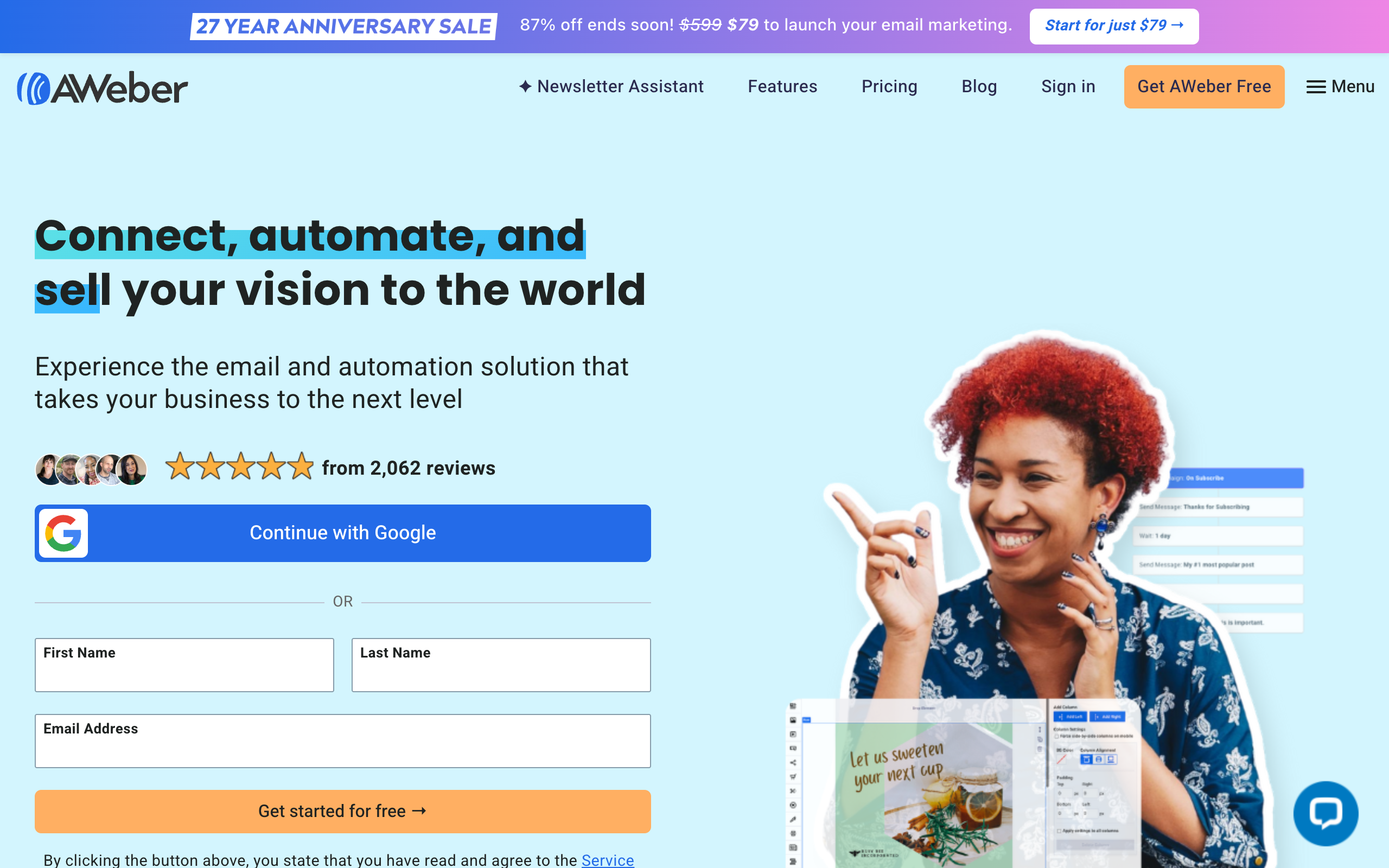
AWeber is one of the oldest names in email marketing. Tom Kulzer founded it in 1998, which makes it roughly old enough to have outlived several generations of “email marketing killer” startups. It built its reputation as a straightforward autoresponder: you write a sequence, subscribers get it in order, and the whole thing runs on rails. Over the years AWeber added landing pages, basic automation, and AI writing tools, but the core product is still what it always was, a dependable way to send scheduled and triggered emails to a list.
The two tools were never really built for the same job, which is exactly why the comparison is useful. beehiiv is trying to be Substack plus a growth team. AWeber is trying to be the email tool that never breaks and never confuses you.
Who each platform is actually for
Here is the fast filter. If your newsletter is the product, the thing people subscribe to and share and that you might eventually sell ads or subscriptions against, you are beehiiv’s customer. If you run a small business, a local service, a coaching practice, or a modest content site and the email list is a supporting channel rather than the main event, AWeber’s simplicity starts to look like a feature instead of a limitation.
I would also flag a third group: people just starting out with almost no list and no budget. AWeber’s free plan is real and durable at 500 subscribers, and it has existed in some form for over a decade, so it is a low-risk place to learn email basics. beehiiv’s free plan is bigger by subscriber count, but the platform is clearly designed to get you to upgrade once you have traction, since the referral program and Boosts, the features that actually move the needle on growth, sit behind the paid Scale plan.
If you already know your newsletter is going to be the main thing, not a side channel, the fastest way to find out if beehiiv fits is to start a free publication and send one real issue. It runs to 2,500 subscribers with no card required, so testing it costs an evening, not a commitment.
How do beehiiv and AWeber compare feature by feature?
| Feature | beehiiv | AWeber |
|---|---|---|
| Founded | 2021, by ex-Morning Brew growth lead Tyler Denk | 1998, by Tom Kulzer |
| Core identity | Newsletter growth and monetization platform | Email autoresponder and list-management tool |
| Free plan | Up to 2,500 subscribers, unlimited sends, custom domain, website | Up to 500 subscribers, 3,000 sends/month, AWeber branding on emails |
| Referral program | Native, milestone-based, on Scale plan and above | Not available |
| Growth marketplace | Boosts, a two-sided paid recommendation network | Not available |
| Ad network | Built-in, connects publishers to sponsors directly | Not available |
| Public website / SEO archive | Every post publishes to an indexable website by default | Landing pages only, no public post archive built for search |
| Paid subscriptions | Native, 0% platform fee on Scale and above | Not a supported monetization model |
| Automation depth | Moderate: triggers, branching, delays | Moderate: classic autoresponder sequences plus tag-based triggers |
| Landing pages | Basic, tied to the publication | Dedicated builder, a historically strong AWeber feature |
| Entry paid price | $43/mo (Scale, annual billing, up to 2,500 subs) | $19.99/mo (Plus, annual billing, 500 subs) |
Where does beehiiv clearly win?
The growth engine AWeber simply does not have
This is the whole ballgame. beehiiv’s referral program lets you set milestones (share with 5 friends, unlock a bonus) and every email automatically carries each reader’s unique link, the exact mechanic Morning Brew used to compound its own list before Denk productized it. Boosts is a marketplace where newsletters with budget pay to acquire subscribers and newsletters with audience earn money recommending others, gated on engagement rather than raw signups so it does not collapse into junk traffic. AWeber has no equivalent to either. If you want that kind of growth loop on AWeber, you are duct-taping a third-party tool onto it and paying for it separately, and even then you will not get anything like Boosts, because Boosts only works because beehiiv operates the marketplace between publishers.
A website that actually ranks in Google
Every beehiiv post is a crawlable page on your own domain with editable meta titles and descriptions. Two years of posting gives you a couple hundred indexed pages quietly pulling in search traffic. AWeber’s landing page builder is genuinely good for a single opt-in page or a sales page, but it was never built to be a growing, ranking content archive, and the platform does not treat your past emails as public web content at all by default. If organic growth from search is any part of your plan, this single difference does more work than any editor feature on either side.
Monetization architecture built for creators, not just marketers
beehiiv treats the audience itself as the asset to monetize, through paid subscriptions at 0% platform fee, the ad network, and Boosts payouts. AWeber was built for businesses that make money outside the inbox, a course, a service, a product, and the email list exists to support that sale. Neither approach is wrong, but they solve different problems. If part of your plan is eventually charging for a premium tier of your newsletter or running sponsorships, AWeber has no rails for that at all; you would need to bolt on Stripe and a paywall plugin yourself.
Where does AWeber still hold up?
Simplicity and a genuinely long track record
AWeber has been running email campaigns since before Gmail existed. That kind of longevity is not nothing: the deliverability infrastructure is mature, support has had decades to build documentation for every edge case, and the product philosophy has stayed consistent instead of chasing every new feature trend. For a small business owner who wants to set up a welcome sequence once and mostly forget about it, that stability is worth something beehiiv, as a five-year-old platform still shipping fast and still hitting the occasional editor bug, cannot fully match yet.
The landing page builder is a real strength
AWeber’s landing page tool predates most of its competitors’ equivalents and it shows. It is drag-and-drop, has a decent template library, and integrates cleanly with the automation and list system without feeling bolted on. If lead-generation landing pages are a bigger part of your workflow than newsletter publishing, this is a point in AWeber’s favor.
Done-For-You is a real option for people who do not want to build anything
AWeber’s Done For You plan, $20/month on top of a setup fee, gets you a branded template, a welcome series, weekly content handling, and a completed setup within 7 days. beehiiv has no comparable white-glove tier; you are expected to set the publication up yourself, which most newsletter operators want anyway, but it is a real gap for someone who genuinely does not want to touch software at all.
Predictable, moderate pricing at small list sizes
At 500 to 1,000 subscribers, AWeber’s Lite and Plus plans are cheaper than beehiiv’s Scale plan, and the free tier, while capped lower, has none of beehiiv’s soft nudge toward upgrading since the core sending and automation features are already unlocked for free. If your list is small and staying small, and you have no interest in referral programs or an ad network, you are paying beehiiv for growth tooling you will not use.
Worth testing before you decide either way: open a free beehiiv publication and compare the editor and workflow directly against your AWeber account. Both are free to try at small list sizes, so the real comparison costs you nothing but an afternoon.
The onboarding experience feels generationally different
Sign up for both on the same afternoon and the gap is obvious within ten minutes. AWeber’s dashboard still carries the visual language of an older SaaS product: dense menus, a slightly cluttered sidebar, and a workflow that assumes you already know what an autoresponder sequence is supposed to look like. It is not bad, exactly, it is just clearly built by and for people who have been doing email marketing for a while. beehiiv’s onboarding walks you through picking a publication name, choosing a template, and sending a first welcome email in a flow that feels closer to setting up a Notion workspace than configuring marketing software. Neither is objectively wrong. If you have used AWeber before, or any classic ESP, the interface will feel familiar and fast. If you are starting from zero, beehiiv’s newer design gets you to your first send with fewer stops.
Where AWeber pulls ahead is depth once you are past onboarding. The automation builder, while visually dated, exposes more granular trigger conditions than beehiiv’s simpler system, things like tag-based branching built from years of small-business use cases (abandoned signup, purchase tag, engagement score). beehiiv’s automation trades some of that depth for speed of setup, which tracks with its overall philosophy: get you publishing and growing fast, rather than let you build an intricate rule engine.
What does each platform cost in 2026?
Numbers below are from beehiiv’s and AWeber’s live pricing pages, captured July 2026, all shown on annual billing unless noted.
| Plan | beehiiv | AWeber |
|---|---|---|
| Free | $0, up to 2,500 subscribers, unlimited sends, custom domain, website | $0 (Free plan), up to 500 subscribers, 3,000 sends/month, AWeber branding |
| Entry paid tier | Scale, from $43/mo ($517/yr), up to 100,000 subscribers, referral program, Boosts, ad network, 0% fee on paid subs | Lite, from $12.49/mo, 500 subscribers, 1 list, 3 automations, 3 landing pages |
| Mid tier | No separate mid tier; Scale covers this range | Plus, from $19.99/mo, 500 subscribers, unlimited automations, landing pages, and lists, priority support |
| Top tier | Max, from $96/mo ($1,151/yr), branding removed, up to 10 publications, sponsorship storefront | Done For You, $20/mo plus setup fee, fully managed onboarding |
| Enterprise | Custom, 100k+ subscribers, dedicated IPs, Send API, SSO | Pricing scales by subscriber tier up to 100,000+ on Plus |
The comparison flips depending on list size and ambition. At 500 subscribers with no growth features needed, AWeber Lite at roughly $12.49/month beats beehiiv’s paid tier on price, though beehiiv’s free plan at that size still costs nothing and includes more sends. Once you cross into wanting a referral program, an ad network, or 0% fees on paid subscriptions, AWeber has no equivalent tier at any price, because it simply does not build those features. That is the real comparison: it is not that one platform is expensive and the other cheap, it is that they charge for different things entirely.
Can you migrate from AWeber to beehiiv?
Yes, and the mechanics are what you would expect. You export your subscriber list as a CSV from AWeber, including tags if you use them, and import it into a new beehiiv publication. The subscriber data itself, emails, names, custom fields, moves over cleanly in most cases. What does not move automatically is your AWeber automation logic; beehiiv’s automation builder uses a different trigger and branching model, so plan to rebuild welcome sequences and any tag-based flows by hand rather than expecting a one-click transfer. Budget a couple of hours for a small list, longer if you have a complex tagging system built up over years, which is common for AWeber accounts given how long some of them have been running.
One thing worth doing before you migrate anything: send a re-engagement email from AWeber first and prune anyone who does not open it. beehiiv’s Scale plan pricing steps up by subscriber tier, so importing a bloated list of years-old dead addresses costs you real money on day one. I would rather you find that out from me than from your first invoice.
Who should choose beehiiv over AWeber?
- Anyone whose newsletter is the primary product, not a supporting channel for a separate business.
- Writers and media operators who want organic growth from a real, indexable website, not just email opens.
- Creators planning to monetize through paid subscriptions, sponsorships, or an ad network, where beehiiv’s 0% fee and built-in ad marketplace do real work.
- Anyone who wants referral-driven growth without stitching together three separate tools to get it.
Who should stick with AWeber, or choose it fresh?
- Small businesses and solo operators who need a dependable autoresponder and nothing more ambitious than that.
- Anyone who leans heavily on landing pages as a lead-gen tool, where AWeber’s builder is a genuine strength.
- People who want a truly hands-off setup and are willing to pay for AWeber’s Done For You service.
- Lists under 1,000 subscribers with no plans to add referral programs, an ad network, or paid subscriptions any time soon.
A small aside here: I have talked to more than one AWeber user who has been on the platform for over a decade and has genuinely never had a reason to switch. That is not a knock on beehiiv. It just means the “best” platform question always depends on whether your ambitions for the newsletter have grown past what got you started.
How does this compare with beehiiv vs other platforms?
AWeber is the legacy-autoresponder comparison. If you are also weighing beehiiv against a general marketing tool with a bigger feature set, read my beehiiv vs Mailchimp breakdown. If your actual competitor in your head is Substack’s discovery network rather than an email tool at all, the fee math is a different conversation, covered in my full beehiiv review. And if you want the complete list of AWeber’s own alternatives beyond just beehiiv, including tools built specifically for AWeber’s small-business audience, see my AWeber alternatives guide, or my dedicated AWeber review for the deeper dive on where it still earns its keep. For the widest view of the category, start with my ranking of the best newsletter platforms in 2026, and if pricing tiers are the deciding factor for you, the full beehiiv pricing breakdown walks through every subscriber threshold.
Frequently asked questions
Is beehiiv better than AWeber? For a newsletter you intend to grow through referrals, search, and monetization, yes: beehiiv’s referral program, Boosts marketplace, ad network, and SEO-indexable website have no AWeber equivalent. For a small business that just needs dependable list emails and strong landing pages, AWeber remains a solid, cheaper choice at small list sizes.
Is AWeber still worth using in 2026? Yes, for the audience it targets. AWeber’s free plan is genuinely free forever up to 500 subscribers, its landing page builder is mature, and its deliverability track record benefits from having operated since 1998. It is simply not building the growth and monetization features that define modern newsletter platforms like beehiiv.
Does AWeber have a free plan like beehiiv? Yes, but it is smaller. AWeber’s free plan covers up to 500 subscribers and 3,000 sends per month with AWeber branding included. beehiiv’s free Launch plan covers up to 2,500 subscribers with unlimited sends and a custom domain, though beehiiv’s growth features stay behind the paid Scale plan.
Can I migrate my AWeber list to beehiiv? Yes. Export your subscriber list as a CSV from AWeber and import it into beehiiv. Subscriber data transfers cleanly, but automation sequences and tag-based logic need to be rebuilt manually since the two platforms use different automation systems.
Does AWeber take a cut of my revenue like Substack does? No. AWeber charges a flat subscription fee based on list size and does not take a percentage of anything you earn. It also has no built-in paid subscription feature, so if you want to charge readers directly, you would need to connect Stripe and a separate paywall tool yourself, unlike beehiiv where paid subscriptions are native at 0% fee.
Which platform has better deliverability, beehiiv or AWeber? Both send from shared IP pools at their standard tiers and both report solid inbox placement in practice. AWeber’s decades of sending history give it a mature reputation with mailbox providers. beehiiv’s infrastructure is newer but has scaled quickly and is actively managed; neither platform offers dedicated IPs outside their top Enterprise-level tiers.
The bottom line
Strip away the feature lists and this comparison is really about what decade of email marketing you are buying into. AWeber is the tool that proved the autoresponder model works and has spent 28 years refining that one job. beehiiv is the tool built for the newsletter-as-media-business model that did not really exist as a category until Substack and Morning Brew made it obvious. Neither approach is obsolete. But if your ambition for the newsletter goes beyond “send emails reliably” into “build an audience that grows itself,” AWeber has no answer for that, and beehiiv was built for nothing else.
My honest take: start where your ambition actually is today, not where you hope it will be in two years, because both platforms are cheap enough at small list sizes that switching later costs you an afternoon, not a disaster.
Start a free beehiiv publication if growth tooling is what you are missing right now. It is free to 2,500 subscribers, no card required, and you will know within two sends whether the workflow fits better than what you have.
Pricing captured from vendor pricing pages, July 2026. Plans change, so confirm current details before you buy.


