

AWeber has been around since 1998, one of the very first email marketing tools most small businesses ever used, and it has survived nearly three decades of competitors by staying quietly reliable rather than chasing every new trend. That reputation is both its biggest asset and the reason people skip past it when they are picking a newsletter platform in 2026. I set up a test account, ran a subscriber list through the automation builder, tried the AI subject line assistant, and pushed a campaign through to see whether “reliable but old-school” is still an accurate description or whether AWeber has actually kept pace.
Short version: AWeber is a solid, unglamorous email marketing tool with an unusually generous free plan and genuinely good deliverability, but it was built for small-business email blasts, not for growing a newsletter as a media business. If you want dependable sends and do not need audience-growth features, it holds up well. If growth is the whole point, you will feel the gap fast.
Disclosure: some links in this post are affiliate links. If you sign up through them, we may earn a commission at no extra cost to you. That never changes our verdict.
The 30-second verdict
AWeber is worth it in 2026 for small businesses and solo senders who want dependable email delivery, a genuinely usable free plan, and simple automation, but it is not built for newsletter operators who need growth tools like referrals, discovery, or an ad marketplace. The free plan covers up to 500 subscribers and 3,000 emails a month with no time limit and includes automations, landing pages, and the AI subject line assistant. Paid plans start at $15 a month for the Lite tier at 500 subscribers, or about $12.50 a month billed annually.
I rate it 3.5 out of 5. Deliverability and ease of use are real strengths, and AWeber’s free plan is more generous than most. But the platform has no newsletter-specific growth engine, the design templates feel dated next to newer tools, and its pricing climbs steeply as your list grows past the entry tiers.
Key takeaways
- AWeber is a small-business email tool with strong deliverability and a genuinely free plan (500 subscribers, 3,000 emails/month), not a newsletter growth platform.
- Paid plans start at Lite, $15/mo billed monthly (about $12.50/mo annual) for 500 subscribers, scaling up as your list grows.
- Plus, from $30/mo billed monthly, removes AWeber branding and adds unlimited landing pages, automations, and users.
- There is no referral program, recommendation network, or ad marketplace, the tools that platforms built for newsletter growth ship natively.
- For an audience-growth-first alternative, see my full beehiiv review, which covers the referral and Boosts tooling AWeber does not have.
Before you commit either way, it costs nothing to see the difference yourself. Open a free beehiiv publication and send one real issue alongside your AWeber trial. Free to 2,500 subscribers, no card required.
What is AWeber, and why has it lasted this long?
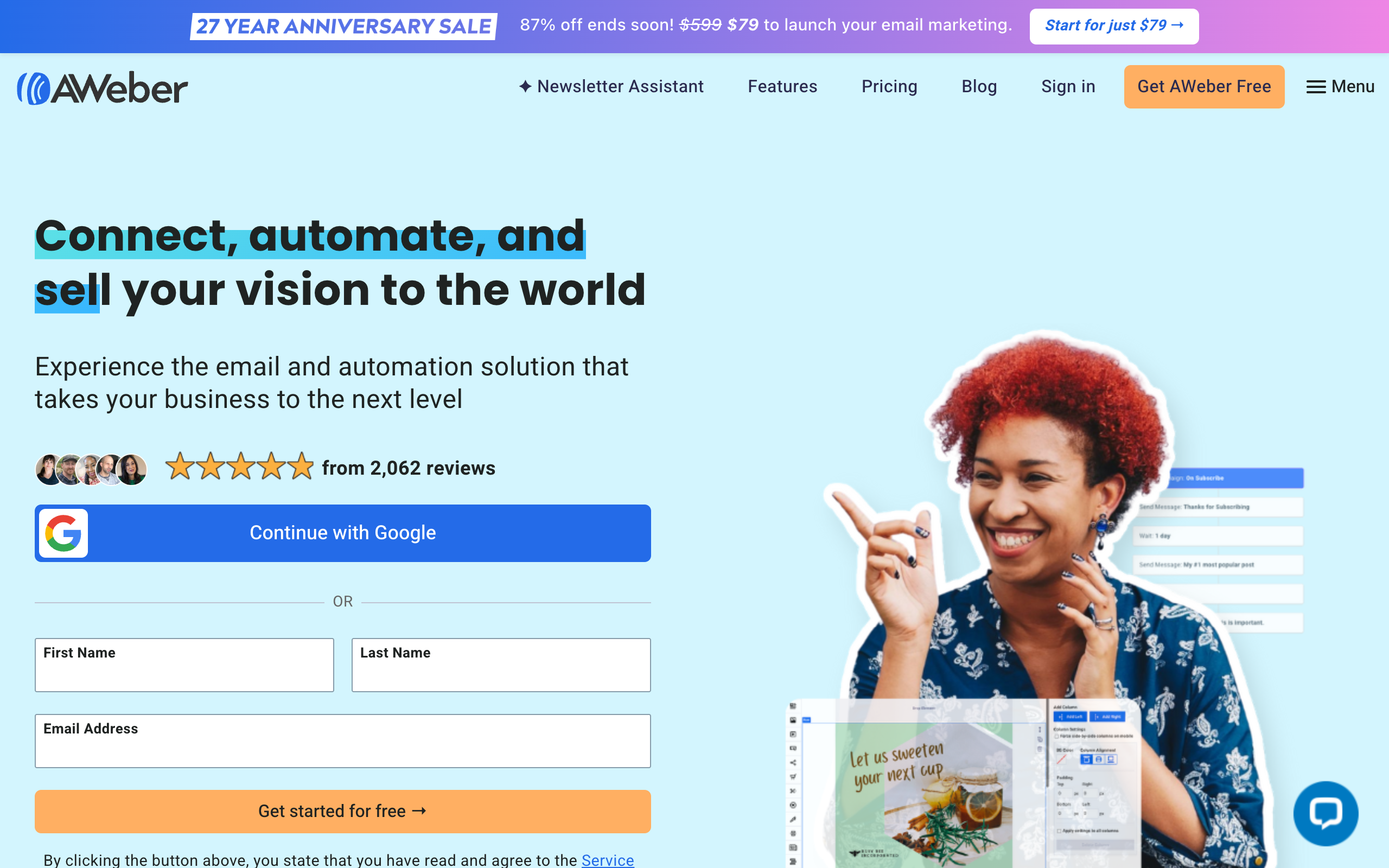
AWeber launched in 1998 as one of the first dedicated email marketing tools available to small businesses, well before “content marketing” or “newsletter operator” were terms anyone used. It built its reputation on two unglamorous things: emails that actually land in the inbox, and a support team that answers the phone. Neither of those sound exciting in a pitch deck, but they are exactly the reasons a lot of small businesses have quietly stayed on AWeber for a decade or more without ever considering switching.
The company has added modern features over time (automation, landing pages, an AI subject line assistant, a “Done For You” service where AWeber’s team builds your setup for you) but the core product philosophy has not changed: it is built for a small business that wants to send a newsletter, an announcement, or a promotion reliably, not for a media company trying to compound audience growth. That distinction runs through every part of the product.
In practice, AWeber is three things: an email sending and automation platform, a landing page builder, and, on the Done For You plan, a concierge setup service where AWeber’s team builds your first campaign for you within a week. It does not attempt to be a website, a discovery network, or a monetization platform the way newer newsletter-first tools do.
Who is AWeber actually for?
The people AWeber genuinely serves well: small businesses that need to send a regular email newsletter or promotion and want it to just work, solo consultants and coaches who send occasional updates to a client list, and anyone who values 24/7 human support and above-average deliverability more than growth features. If you have used a flashier tool before and gotten annoyed by bugs or downtime, AWeber’s unglamorous reliability is a real selling point.
If you are trying to build a media business around a newsletter, meaning subscriber growth and audience monetization are your actual product, AWeber will not help you get there. There is no referral program, no recommendation network connecting you to other newsletters, and no ad marketplace bringing sponsors to you. You would be doing 100% of the growth work manually, the same as you would on any generic email tool.
Where AWeber genuinely wins
Testing the platform, the strengths clustered around dependability rather than features you would show off. That is a legitimate value proposition, just a narrow one.
Deliverability is genuinely strong
In my test sends, everything landed in the primary inbox at the major providers without needing extra configuration beyond the standard domain authentication setup. AWeber has spent almost three decades managing sender reputation, and it shows in day-to-day use. For a small business where a missed newsletter means a missed sale, this matters more than any editor feature, and it is the single most-cited reason long-time AWeber customers give for not switching.
The free plan is unusually complete
AWeber’s free plan covers up to 500 subscribers and 3,000 emails a month with no expiration date, and unlike a lot of “free trials” dressed up as free plans, it includes the full automation builder, the Smart Designer email template tool, sign-up forms, landing pages, and even the AI subject line assistant. You also keep access to 24/7 phone, email, and chat support on the free plan, which is genuinely rare; most competitors reserve human support for paying customers. If you are starting from zero and want to test real automation without paying anything, this is one of the better free tiers in the category.
The AI subject line assistant is a fast, practical win
Rather than a full AI writing suite, AWeber’s AI tool focuses narrowly on subject lines, generating multiple options from a short prompt describing your email. In testing it produced usable, on-topic variants quickly, and because the scope is narrow, the output needed less editing than broader AI content generators tend to require. It is a small feature, but it is one that saves real time on every single send.
Done For You removes the setup barrier entirely
The Done For You plan is unusual in this category: for $20 a month billed annually plus a $79 one-time setup fee, AWeber’s team builds your branded email template, two landing pages, and a first round of newsletter drafts within seven days, then gives you 30 days of unlimited edits to dial it in. For someone who is intimidated by the technical side of starting a newsletter and just wants it built for them once, this is a genuinely useful on-ramp that no competitor in this list offers in the same form.
Everything above is worth testing against a growth-first alternative before you decide. My honest suggestion: open a free beehiiv publication and send your next newsletter from it instead of your current tool. You will feel within two sends whether you actually need the growth tooling or whether AWeber’s simplicity is enough.
Where AWeber falls short (the honest list)
A review with no downsides is an ad. Here is what actually got in the way during testing, roughly in order of how much it should bother a newsletter operator specifically.
Zero newsletter growth tooling
This is the gap that matters most for anyone comparing AWeber to a newsletter-first platform. No referral program, no recommendation network, no ad marketplace connecting you to sponsors. If your business model depends on the list compounding through discovery, AWeber offers nothing structural to make that happen; you are running growth entirely outside the platform, the same as you would on any 2010-era email tool.
Design templates feel dated
The email and landing page templates get the job done but look visibly older than what creator-focused competitors ship today. The Smart Designer tool, which auto-generates a template from your website’s branding, is a clever idea and works reasonably well, but the baseline design library underneath it has not kept pace with more modern editors. If your newsletter’s visual polish is part of your brand, budget time to customize rather than relying on the defaults.
No public, SEO-indexable archive
Unlike newsletter-first platforms, AWeber does not give every plan a public website where past issues become crawlable, rankable pages. There is a landing page builder, but it is built for opt-in pages and simple sites, not as a publishing archive optimized to compound organic search traffic the way a dedicated newsletter platform’s website does. If organic growth from old issues is part of your plan, this is a real structural gap.
Pricing climbs fast at scale
The entry prices are reasonable: Lite starts at $15 a month for 500 subscribers, or about $12.50 a month billed annually. But AWeber’s tiers are subscriber-based, and by 100,000 subscribers, Lite scales up to $600 a month and Plus scales up to $750 a month. That is a steep curve if you expect meaningful list growth, and past a certain size AWeber directs you to contact sales rather than showing pricing at all. Model your cost at the list size you expect in a year, not the size you have today.
Plus plan carries a transaction fee
AWeber’s Plus plan applies a 0.6% transaction fee on commerce features like paid newsletters or product sales processed through the platform. It is a small percentage, but it is a cost most competitors at this price point do not charge, and it is easy to miss if you are only comparing the headline monthly price between tools.
What does AWeber cost in 2026?
Numbers below are from AWeber’s live pricing page at the 500-subscriber tier, captured July 2026.
| Plan | Price (500 subscribers) | What you actually get |
|---|---|---|
| Free | $0 | Up to 500 subscribers, 3,000 emails/month, full automation builder, Smart Designer, sign-up forms, AI subject line assistant, 24/7 human support |
| Lite | $15/mo (about $12.50/mo billed annually) | 3 landing pages, 3 email automations, 1 email list, 3 users, basic analytics, RSS-to-email, AWeber branding included |
| Plus | $30/mo (about $20/mo billed annually) | Unlimited landing pages, automations, email lists, and users, advanced analytics, behavioral automation, AI subject line assistant, branding removed, 0.6% transaction fee on commerce features |
| Done For You | $20/mo billed annually plus $79 one-time setup | AWeber’s team builds a branded template, 2 landing pages, and your first newsletter drafts within 7 days, plus 30 days of unlimited edits |
The read on each tier, briefly. Free is one of the more complete free plans in the category, since it includes the real automation builder and human support, not a stripped-down demo. Lite is fine if you only need one list and basic automation, but the 3-automation cap and visible branding will frustrate anyone doing real segmentation. Plus is where AWeber becomes a serious tool, unlocking unlimited automations and removing branding, and it is the tier most small businesses that outgrow free should budget for. Done For You is a genuinely different offer: it is not really a self-serve plan at all, it is a setup service for people who want the platform built for them once and then want to run it themselves. Both Lite and Plus scale up steeply by 100,000 subscribers (Lite to $600/mo, Plus to $750/mo), so model your future list size before choosing between them.
How does AWeber compare with beehiiv, Mailchimp, and Kit?
AWeber vs beehiiv is a reliability-versus-growth question. AWeber wins on deliverability track record and the completeness of its free plan; beehiiv wins on everything related to actually growing the list, with a built-in referral program, the Boosts marketplace, an ad network, and an SEO-indexable website on every publication, plus 0% fees on paid subscriptions where AWeber’s Plus plan charges 0.6% on commerce features. If your list size is basically fixed and you just need dependable sends, AWeber is enough. If growth is the goal, beehiiv’s tooling does structural work AWeber cannot, and its plans are laid out in detail in my beehiiv pricing breakdown. Full head-to-head in beehiiv vs AWeber, and the wider field in my ranking of the best newsletter platforms.
AWeber vs Mailchimp is a fight between two small-business email veterans. Mailchimp has a much larger integration ecosystem and stronger e-commerce features for online stores, but its free plan has shrunk over the years to 500 contacts and 1,000 sends a month with tighter limits than AWeber’s free tier. AWeber’s deliverability reputation and human support on every plan, including free, are its clearest edges. Neither has newsletter growth tooling.
AWeber vs Kit is really a question of audience. Kit (formerly ConvertKit) is built specifically for creators selling digital products, with deeper tagging, a commerce layer, and a free tier to 10,000 subscribers, far above AWeber’s 500. AWeber counters with better-tested deliverability and the Done For You setup service, which Kit does not offer. If you are a creator selling courses or products, Kit’s focus usually wins; if you are a small business that just needs dependable sends, AWeber holds up fine. For more angles on this decision, my guide to AWeber alternatives walks through several specific use cases.
Who should NOT use AWeber?
Saving you a wrong purchase is worth more than an affiliate click, so here is who should look elsewhere.
- Newsletter operators focused on audience growth. No referral program, no recommendation network, no ad marketplace. If growth is your main problem, AWeber gives you nothing structural to solve it with.
- Writers who want their archive to compound in search. There is no free, SEO-optimized publishing website shipped with every plan the way newsletter-first platforms provide.
- Anyone who wants a modern, opinionated design system. AWeber’s templates are functional but visibly dated, and you will spend real time customizing them to look current.
- Fast-growing creators planning to scale past 25,000 subscribers soon. AWeber’s pricing curve gets steep at scale, and its growth tooling does not scale with it the way a platform built for growth does.
If you recognized yourself in that list, my guide to the best newsletter platform for beginners covers several tools better suited to growth from a standing start, and my roundup of the best email marketing software compares AWeber against the wider field if you need e-commerce-grade features instead.
Frequently asked questions
Is AWeber worth it in 2026? Yes, for small businesses and solo senders who want dependable delivery and a genuinely complete free plan (500 subscribers, 3,000 emails a month, full automation, human support). It is not worth it for newsletter operators specifically seeking audience-growth tools, since AWeber has no referral program, recommendation network, or ad marketplace.
Does AWeber have a free plan? Yes, and it is unusually complete: up to 500 subscribers, 3,000 emails a month, no time limit, the full automation builder, the Smart Designer template tool, sign-up forms, the AI subject line assistant, and 24/7 phone, email, and chat support.
Is AWeber good for deliverability? Yes, this is one of AWeber’s clearest strengths. Nearly three decades of managing sender reputation shows in day-to-day use, and in testing, sends landed in the primary inbox at major providers without extra configuration beyond standard domain authentication.
Is AWeber better than Mailchimp? Neither has newsletter-specific growth tools, so the comparison comes down to fit. AWeber’s free plan is more generous and its deliverability reputation is stronger; Mailchimp has a larger integration ecosystem and deeper e-commerce features for online stores.
How much does AWeber cost for 500 subscribers? Lite starts at $15 a month billed monthly, or about $12.50 a month billed annually. Plus, which removes AWeber branding and unlocks unlimited automations, starts at $30 a month billed monthly, or roughly $20 a month billed annually.
Can I migrate away from AWeber easily? Yes. Subscriber lists export as a standard CSV from any plan, and every major competitor, including beehiiv, Kit, and Mailchimp, accepts CSV import. As with most migrations, automations and forms typically need to be rebuilt by hand on the new platform.
The bottom line: my verdict after testing it
AWeber’s pitch has not changed much in almost thirty years, and that is the point: send reliably, answer the phone when something breaks, and do not overcomplicate it. In 2026 that pitch still holds up better than you would expect. Deliverability was solid in every test send, the free plan is one of the more complete ones in the category, and the Done For You option is a genuinely useful on-ramp for someone who does not want to build anything themselves.
What AWeber has not done is evolve into a growth platform. There is no referral system, no recommendation network, no ad marketplace, and no publishing website that turns old issues into search traffic. For a small business sending a monthly update to an existing customer list, none of that matters. For someone trying to build a newsletter into a media business from scratch, it matters quite a lot, and no amount of deliverability reputation substitutes for tools that actively bring you new subscribers.
My rating: 3.5 out of 5. Reliable, well-supported, and honestly priced for what it is. Just be clear-eyed about what it is: an email sending tool with a long track record, not a newsletter growth engine.
If growth tooling is the piece you are missing, it costs nothing to check what it feels like. Start a free beehiiv publication, import a small test list, and send one issue. Free to 2,500 subscribers, no card required, and you will know within two sends whether the built-in referral and Boosts tools are worth switching for.
Pricing captured from vendor pricing pages, July 2026. Plans change, so confirm current details before you buy.


