
AWeber launched in 1998, which makes it older than Google. That history is not a knock, the platform is stable, deliverability is solid, and its free plan is genuinely one of the most generous in the category. But 1998 is also why AWeber’s product still feels, in places, like it was designed for a different era of email: campaign-first sending rather than growth-first publishing, an automation builder that covers the basics without much sophistication, and nothing resembling a referral program or a recommendation network. The best modern AWeber alternative in 2026 is beehiiv for anyone whose newsletter is the actual product, because it was built around the growth mechanics AWeber never added, and Kit for anyone whose real need is deeper, tag-based automation.
Disclosure: some links in this post are affiliate links. If you sign up through them, we may earn a commission at no extra cost to you. That never changes our verdict.
Key takeaways
- AWeber’s free plan is unusually strong: 500 subscribers, 3,000 emails a month, full automation, landing pages, and forms, with no time limit. Few competitors match that on a free tier.
- What AWeber lacks entirely is a growth mechanism: no referral program, no recommendation marketplace, no SEO-indexable website the way beehiiv or Ghost offer.
- beehiiv is the strongest modern alternative for newsletter operators who want built-in growth tools; Kit wins for tag-based automation and digital product sales.
- AWeber’s paid tiers (Lite from $12.49/month, Plus from $19.99/month at 500 subscribers) scale to $210 and $250/month respectively by 25,000 subscribers, a steeper climb than some newer competitors.
- Migrating off AWeber is low-friction: every alternative here accepts a CSV export of your list, though automations and landing pages need manual rebuilding.
If growth tools are the actual gap, the fastest way to feel the difference is to open a free beehiiv publication and import your AWeber list into it. The free Launch plan covers 2,500 subscribers with no card required, so you can run the referral program for a real send before deciding anything.
Why look for a modern alternative to AWeber?
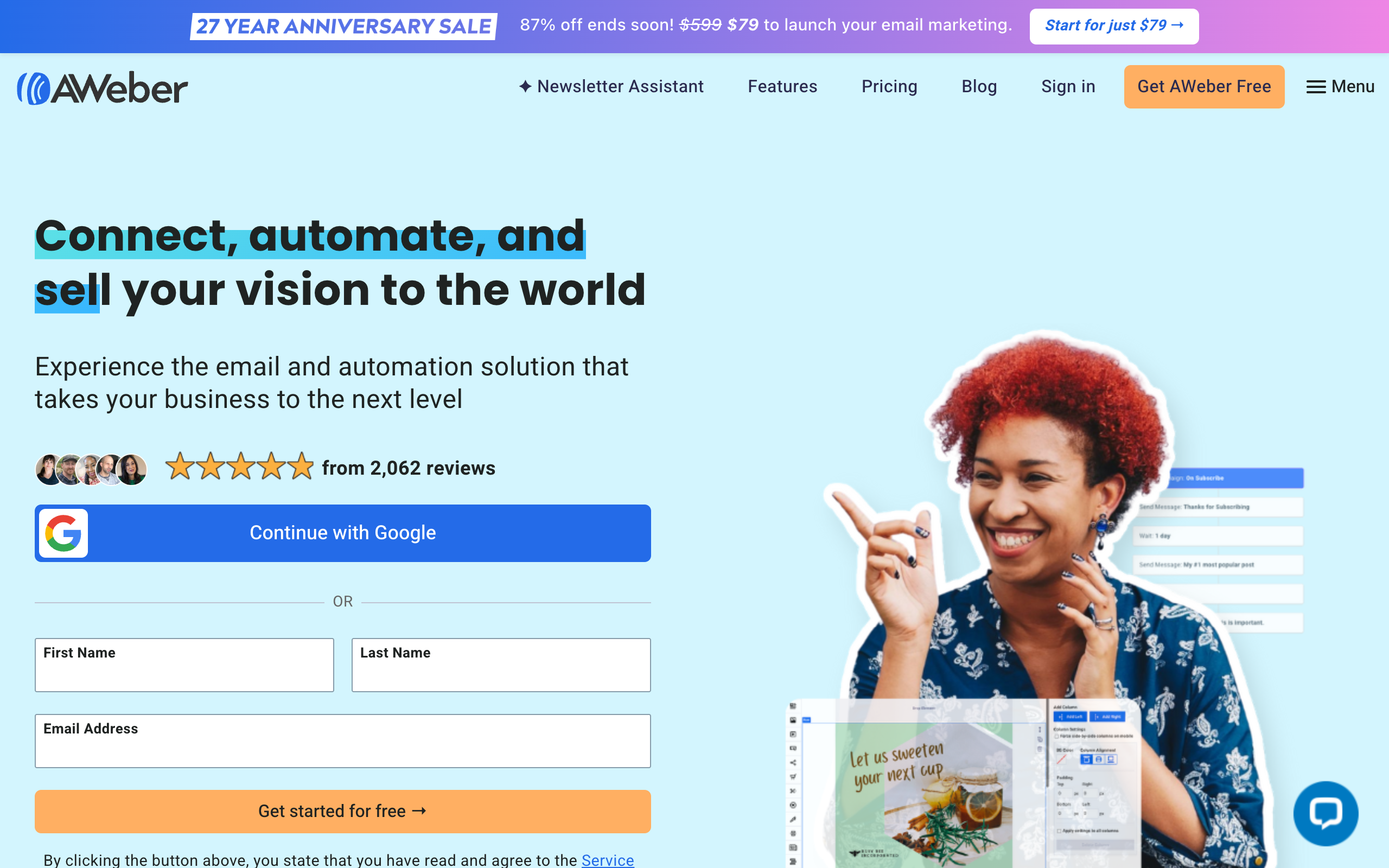
AWeber has quietly stayed relevant for over two decades by being reliable rather than flashy, and reliability still counts for something: deliverability is consistently solid, support is available around the clock even on paid plans, and the free tier, 500 subscribers with 3,000 emails a month and full automation included, is more generous than most 2026-era competitors offer for nothing. That is the real reason AWeber keeps showing up on “best free” lists years after most people assumed it had been replaced by newer tools.
The complaint that actually shows up in creator communities is narrower than “AWeber is bad.” It is “AWeber has no way to help me grow.” There is no referral program that rewards subscribers for sharing your newsletter. There is no recommendation marketplace connecting you with other newsletters in your niche the way beehiiv’s Boosts does. There is no built-in path to monetizing through sponsorships beyond manually pitching advertisers yourself. And the editor, while functional, does not have the design polish that newer entrants like Flodesk or beehiiv ship by default. Worth saying directly: if all you need is reliable sends and a real free plan, none of that matters and AWeber remains a solid, boring, dependable choice. The gap only matters once growth becomes the actual bottleneck.
How we evaluated these AWeber alternatives
Pricing for every platform below was pulled from each vendor’s live pricing page in July 2026, including AWeber’s own tiered subscriber pricing rather than just the advertised entry price, because the jump from 500 to 25,000 subscribers tells a very different story than the homepage number. Beyond price, we weighed whether each platform has any built-in growth mechanism, how deep automation goes past a welcome sequence, how generous the free plan genuinely is without a card on file, and how much design polish the editor carries out of the box, since that is one area where AWeber has historically lagged the newer entrants on this list.
How does AWeber’s pricing actually scale with your list?
AWeber’s homepage number is the price at 500 subscribers. That number moves a lot as your list grows, and the curve is worth seeing in full before you assume AWeber stays cheap forever.
| Subscribers | Lite (annual billing) | Plus (annual billing) |
|---|---|---|
| 500 | $12.49/mo | $19.99/mo |
| 2,500 | $35/mo | $55/mo |
| 5,000 | $60/mo | $90/mo |
| 10,000 | $100/mo | $135/mo |
| 25,000 | $210/mo | $250/mo |
Read that table straight and a pattern jumps out: Lite goes from $12.49 to $210 a month, a nearly 17-times increase, as your list scales from 500 to 25,000 subscribers. That is not unusual for the category (Constant Contact and Mailchimp climb just as steeply), but it does mean the “AWeber is the cheap option” reputation, earned back when the free and entry tiers were the whole story, stops being true the moment your newsletter actually succeeds. Plus adds sales tracking (with a 0.6% transaction fee) and unlimited automations, lists, and users at every tier, which is worth the roughly $40 to $50 monthly premium over Lite if you are running more than a basic welcome sequence.
The best AWeber alternatives at a glance
| Platform | Best for | Starting price | Standout feature AWeber lacks |
|---|---|---|---|
| beehiiv | Newsletter operators focused on growth | Free to 2,500 subs; Scale from $43/mo (annual) | Referral program, Boosts marketplace, indexable website |
| Kit | Tag-based automation, digital product sales | Free to 10,000 subs; Creator $33/mo | Visual automation depth |
| MailerLite | Budget-friendly with a modern editor | Free to 250 subs; Comfort from ~$12/mo | AI writing assistant, cleaner UI |
| Mailchimp | Small businesses in a broader ecosystem | Free to 250 contacts; Essentials from $13/mo | Deep third-party integrations |
| GetResponse | All-in-one with webinars and courses | Free to 500 contacts; Starter $19/mo | Course platform, webinar hosting |
| Brevo | Email plus SMS on a low budget | Free forever; Starter from $9/mo | Native SMS bundled in |
| Moosend | Simple, cheap automation | Pro from $9/mo (500 subs) | Unlimited emails on every paid tier |
| Constant Contact | Events, nonprofits, local business | Lite from $12/mo (500 contacts) | Event marketing and RSVP tools |
| ActiveCampaign | Complex, CRM-heavy automation | Starter from $15/mo (1,000 contacts) | Native CRM, predictive sending |
What are the 9 best modern alternatives to AWeber?
Ordered by who should look first, not alphabetically. For the wider category view, see our ranking of the best newsletter platforms and, if you are just getting started, the best newsletter platform for beginners.
1. beehiiv, best overall modern alternative for growth
beehiiv is the clearest answer to “what does AWeber not have.” Built by a team out of Morning Brew’s growth playbook, it ships a native referral program, the Boosts recommendation marketplace where other newsletters pay to send you subscribers, an internal ad network, and an SEO-indexable website for every post, none of which AWeber offers at any price. The free Launch plan covers 2,500 subscribers with unlimited sends and a custom domain, five times AWeber’s free-tier subscriber cap. Scale, from $43/month on annual billing, takes 0% of your paid subscription revenue and unlocks the full growth toolkit. The trade-off: AWeber’s automation, while simple, is rock solid and has been for two decades; beehiiv’s automation builder is functional but shallower than what dedicated automation tools offer, a gap we cover in the full beehiiv review and the direct beehiiv vs AWeber comparison, with tier-by-tier pricing in our beehiiv pricing guide.
2. Kit, best for tag-based automation and digital product sales
Kit, the platform formerly named ConvertKit, is where AWeber users land when the actual complaint is automation depth rather than growth tools. The free Newsletter plan runs to 10,000 subscribers with one basic automation and built-in digital product sales. Paid Creator starts at $33/month for 1,000 subscribers and unlocks unlimited visual automations with branching logic based on clicks, tags, and time delays, meaningfully deeper than AWeber’s three-automation cap on its Lite plan. Kit’s growth tooling (a Creator Network, paid recommendations) is thinner than beehiiv’s, so pick this specifically for the automation and commerce layer, not for audience growth.
3. MailerLite, best budget pick with a genuinely modern editor
MailerLite is the closest thing to “AWeber but built in the last five years” on this list. The free plan covers 250 subscribers with 2,500 monthly sends and three active automations. Comfort, the mid tier, starts around $10.80/month on annual billing and adds an AI writing assistant, 50 active automations, and multivariate testing, features AWeber does not offer at any price point. The editor feels noticeably more current than AWeber’s, with cleaner blocks and faster load times in our testing. What you lose moving from AWeber is that unusually strong free tier; MailerLite’s free plan caps at 250 subscribers versus AWeber’s 500.
4. Mailchimp, best if you need a broader integration ecosystem
Mailchimp is the pick when your reason for leaving AWeber has nothing to do with newsletters specifically and everything to do with needing one dashboard that talks to your store, your ads, and your CRM. The free plan covers 250 contacts and 500 sends a month. Essentials starts at $13/month and Standard at $20/month, scaling by contact count after 12 months, with Standard unlocking up to 200 automation flows. Mailchimp has no referral program and no recommendation network, so if growth tooling was your actual complaint about AWeber, Mailchimp will not fix it either; it solves a different problem.
5. GetResponse, best if you want webinars and courses bundled in
GetResponse goes the opposite direction from AWeber: instead of staying focused on email, it bundles in a full course platform, webinar hosting for up to 100 attendees on the Creator plan, and sales funnel tools. The free plan covers 500 contacts (matching AWeber) but with no automation at all, a real step down from AWeber’s automation-included free tier. Starter begins at $19/month for 1,000 contacts. If AWeber’s limitation was “I need to host a webinar and I am tired of connecting a separate tool,” GetResponse solves that specific problem; if not, you are paying for a lot of infrastructure you will not touch.
6. Brevo, best for bundling email with SMS at a low price
Brevo (formerly Sendinblue) prices by emails sent rather than contacts stored, an approach that can work heavily in your favor if you have a large but infrequently-emailed list. The free plan is genuinely free forever, storing up to 100,000 contacts and sending around 300 emails a day, well beyond AWeber’s free-tier cap. Starter begins at $9/month for 5,000 emails, and Business at $18/month adds landing pages and unlimited automation. The standout feature is native SMS marketing bundled into the same account, something AWeber does not offer without a third-party integration. If you already text your list alongside email, Brevo’s combined email and SMS platform is worth checking specifically for that reason.
7. Moosend, best simple, cheap automation alternative
Moosend is a lesser-known name that deserves more attention from AWeber refugees than it gets, mostly because its pricing model is refreshingly simple: pay based on subscriber count, send unlimited emails at every paid tier, no separate send caps to track. Pro starts at $9/month for 500 subscribers, cheaper than AWeber’s equivalent Lite tier, with unlimited campaigns, automation, landing pages, and no branding on paid plans. There is a 30-day free trial with no card required, longer than most competitors offer. What Moosend lacks is brand recognition and a large integration marketplace, so if you rely heavily on niche third-party app connections, verify Moosend supports them before committing. Their pricing details are worth a direct look at Moosend’s plans if budget is the deciding factor.
8. Constant Contact, best for events, nonprofits, and local business
Constant Contact has carved out a specific niche: organizations that send fewer, higher-stakes emails tied to events, fundraisers, or local promotions rather than a weekly editorial newsletter. Lite starts at $12/month for 500 contacts, Standard at $35/month, and Premium at $80/month, with pricing climbing steeply as your list grows, roughly $425/month by 25,000 contacts. There is no free plan, only a trial, a real step down from AWeber’s generous free tier. Its event and RSVP tools are genuinely stronger than anything on this list, which is the entire reason to choose it over AWeber if that is your actual use case.
9. ActiveCampaign, best for complex, CRM-heavy automation
If AWeber’s three-automation cap on Lite felt like a wall you kept hitting, ActiveCampaign is built for exactly the workflows AWeber was never designed to handle. Starter begins at $15/month for 1,000 contacts (annual billing) with a built-in CRM layer, and Plus at $49/month adds predictive sending and unlimited automation actions. There is no free plan, only a 14-day trial. ActiveCampaign is genuine overkill for a simple weekly newsletter and genuinely necessary if you are running lead scoring and multi-step nurture sequences through email, a use case AWeber’s automation builder was never built to serve.
Before committing to any tool here, it costs nothing to compare the growth side directly. Start a free beehiiv publication, turn on the recommendation network, and see what built-in growth tooling feels like next to AWeber’s current feature set. You can run this test alongside your existing AWeber account before touching your live list.
Which AWeber alternative should you actually choose?
Start with what AWeber is actually failing to do for you, because that answer points directly at the right pick. If the newsletter has stalled and growth is the wall, beehiiv is the clear move, nothing else here ships a referral program and recommendation marketplace out of the box. If automation logic is the wall, either Kit (for tagging and digital products) or ActiveCampaign (for CRM-level complexity) solves it, depending on how much CRM machinery you actually need. If price is the wall and your needs are simple, Moosend or MailerLite both undercut AWeber’s paid tiers while keeping real automation. And if none of that resonates and you are mostly happy, just annoyed at the interface feeling dated, honestly, staying on AWeber’s generous free plan while you decide is a perfectly reasonable non-decision. Nobody loses money sitting on a free 500-subscriber plan for another month.
One more filter worth applying before you switch anything: check whether the actual problem is AWeber, or whether it is that you have never turned on the automations AWeber already gives you. In our testing, a surprising number of “AWeber isn’t working for me” complaints traced back to a welcome sequence that was never built, not a platform limitation. If you have not set up at least one automated welcome email and one re-engagement sequence inside AWeber, do that first. It costs nothing, takes under an hour, and will tell you honestly whether the platform is the bottleneck or the workflow is.
If it turns out the platform genuinely is the bottleneck, the decision usually comes down to one more practical question: how painful is the migration going to be? For a list under a few thousand subscribers with no complex automations, moving to beehiiv, Kit, or MailerLite is typically a same-afternoon project: export the CSV, import it, rebuild the welcome sequence, and send your next issue from the new tool. For a list with dozens of tagged segments and multi-step automations built up over years, budget a full week and consider whether a migration specialist (several of these platforms, including GetResponse and Kit, offer free migration help on paid tiers) is worth the time saved.
Nobody switches email platforms for fun. It is disruptive, subscribers occasionally get lost in the shuffle, and the first send from a new tool always feels riskier than it should. That friction is real, and it is still usually smaller than the cost of staying somewhere that cannot grow your list for another two years.
Frequently asked questions
What is a good modern alternative to AWeber? beehiiv is the strongest pick for newsletter operators who want built-in growth tools (referral program, recommendation marketplace, indexable website), none of which AWeber offers. Kit is the better pick for deeper, tag-based automation and digital product sales.
Is AWeber’s free plan still good in 2026? Yes. It covers 500 subscribers and 3,000 emails a month with full automation, landing pages, and forms included, no time limit and no card required, more generous than most 2026-era free plans, including GetResponse’s.
Why does AWeber feel outdated compared to newer tools? AWeber launched in 1998 and has prioritized reliability over redesign. It has no referral program, no recommendation network, and a simpler automation builder than newer entrants like Kit or ActiveCampaign, gaps that show up specifically once growth or complex automation becomes the priority.
Can I migrate my AWeber list to another platform? Yes. Every alternative covered accepts a standard CSV export of subscriber emails and names. Automations, landing pages, and forms do not transfer automatically and need to be rebuilt manually in the new tool.
Is beehiiv cheaper than AWeber? At the free tier, beehiiv is more generous, covering 2,500 subscribers versus AWeber’s 500. On paid plans, beehiiv Scale starts at $43/month versus AWeber Plus at roughly $20/month at 500 subscribers, though AWeber’s price climbs to $250/month by 25,000 subscribers, close to beehiiv’s Max tier at similar list sizes.
What is the cheapest AWeber alternative? Moosend’s Pro plan starts at $9/month for 500 subscribers with unlimited emails and automation included, undercutting AWeber’s equivalent Lite tier. Brevo’s free-forever plan, covering up to 100,000 contacts at low send volume, is the cheapest option of all if your list is large but infrequently emailed.
The bottom line
AWeber is not a trap or a bad decision, it is simply a tool built for a job that has partly changed underneath it. Reliable sends and a genuinely usable free plan still matter, and AWeber delivers both. What it never built was a way to help your list grow on its own, and in 2026 that gap is exactly what separates a newsletter that plateaus at a few hundred subscribers from one that compounds. If that gap is your actual problem, no amount of loyalty to a platform that has served you well for years fixes it. The tool has to change.
Open a free beehiiv account and send your next issue from there instead of AWeber. Free to 2,500 subscribers, no card required, and you will know within two sends whether the growth tools change anything for you.
Pricing captured from vendor pricing pages, July 2026. Plans change, so confirm current details before you buy.


