
Kit’s Creator plan is $33 a month for 1,000 subscribers. Grow that list the way every newsletter operator wants to, and by 10,000 subscribers you are paying around $139 a month for the same feature set, roughly a four-times increase for the identical plan. Keep growing to 25,000 and it climbs past $199 a month, with Creator Pro running higher still. That is the actual reason most people search for a Kit alternative in 2026: not the editor, not the automation builder, both of which are genuinely good, but a subscriber-tiered pricing model that taxes you harder the more successful your newsletter becomes. beehiiv is the strongest alternative if that subscriber tax is your real complaint, because its 0% fee on paid subscriptions and flatter growth tooling mean success stops costing you proportionally more every month.
Disclosure: some links in this post are affiliate links. If you sign up through them, we may earn a commission at no extra cost to you. That never changes our verdict.
Key takeaways
- Kit’s Creator plan runs $33/month at 1,000 subscribers (annual billing) but climbs to roughly $139/month at 10,000 and $199/month at 25,000, a steep curve most people do not see until they hit it.
- Kit’s free plan is genuinely generous (10,000 subscribers) but caps you at one basic automation, so the real product sits behind the paid tiers exactly when your list is big enough to need it.
- beehiiv takes 0% of paid subscription revenue and its Scale plan pricing, while still subscriber-tiered, climbs less steeply relative to what it unlocks (referral program, Boosts marketplace, ad network) at each tier.
- MailerLite is the cheapest like-for-like replacement if automation depth and Kit’s price curve are both problems; Substack removes subscriber-count pricing entirely in exchange for a 10% revenue cut once you monetize.
- This guide focuses specifically on the pricing curve. For a fuller feature-by-feature breakdown of every ConvertKit alternative, see our companion guide to ConvertKit alternatives.
If the subscriber tax is the actual problem, the fastest way to see the difference is to open a free beehiiv publication and import your Kit list into it. The free Launch plan covers 2,500 subscribers with no card required, so you can compare how the bill grows on both platforms before committing to either.
How steep is Kit’s pricing curve, really?
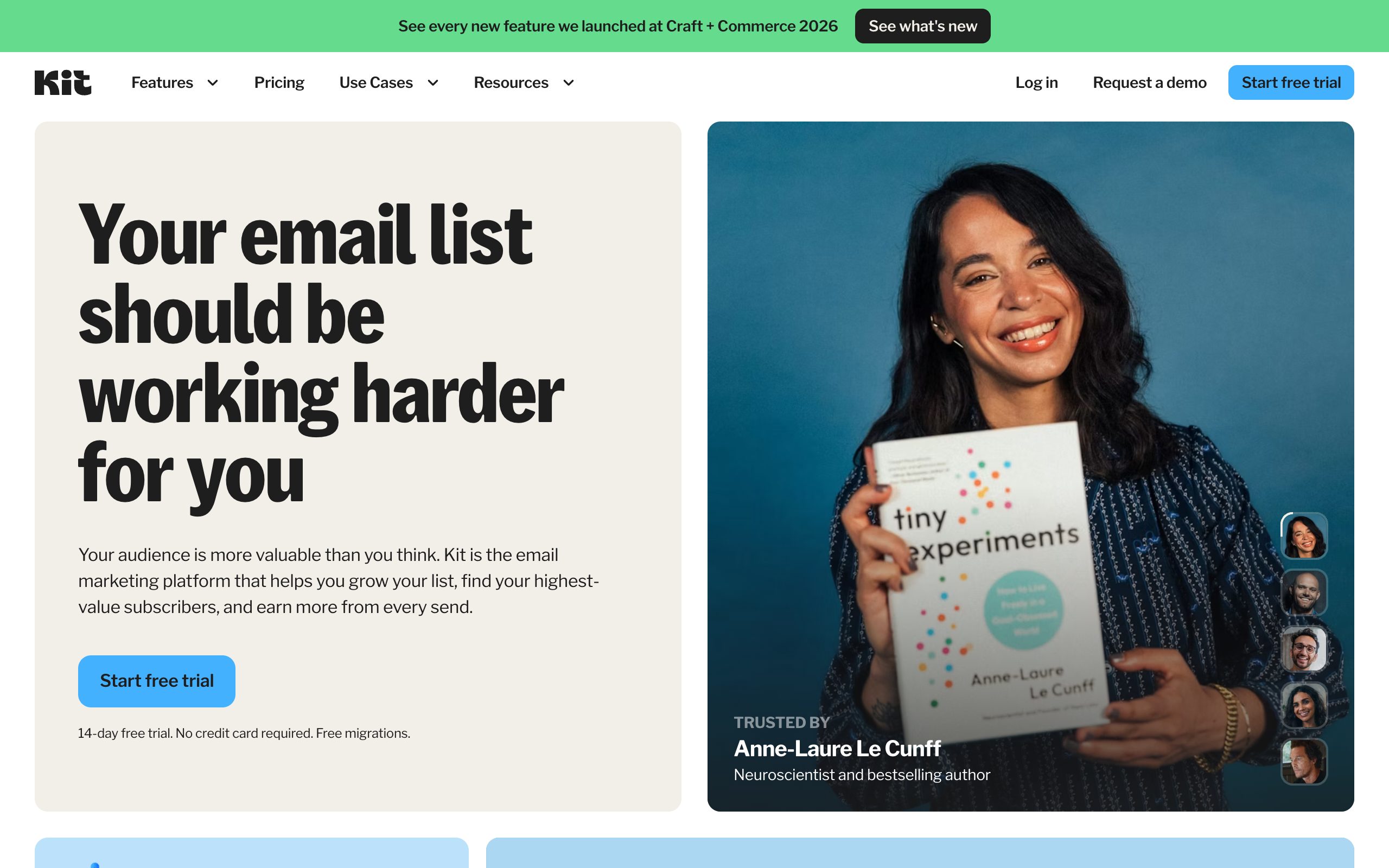
This is the table that should exist on Kit’s own pricing page and does not, because Kit’s live page renders subscriber-tier pricing through a JavaScript slider rather than a static chart. Pulled together from Kit’s published tier data and cross-checked against multiple independent pricing trackers as of mid-2026 (confirm your exact tier at kit.com/pricing before committing, since Kit updates these bands periodically):
| Subscribers | Creator (monthly billing) | Creator Pro (monthly billing) | Increase from 1,000 subs |
|---|---|---|---|
| 1,000 | $39/mo | $79/mo | baseline |
| 3,000 | $59/mo | ~$99/mo | +51% |
| 5,000 | $89/mo | $139/mo | +128% |
| 10,000 | $139/mo | ~$189/mo | +256% |
| 25,000 | $199/mo | $279/mo | +410% |
Read the last column and the shape of the problem is obvious. Growing your list from 1,000 to 25,000 subscribers, the exact outcome every Kit user is chasing, means your bill grows by roughly 410% on Creator alone. Annual billing softens this by about 16%, but the curve shape stays the same. None of this makes Kit’s automation worse. It means the tool gets structurally more expensive at the precise moment your newsletter is working, which is a strange incentive to build a pricing model around.
Why does Kit price this way, and is that actually unusual?
Subscriber-tiered pricing is not a Kit invention. AWeber, Mailchimp, Constant Contact, and MailerLite all charge more as your contact count rises, and in isolation that is a defensible model: more subscribers means more infrastructure cost for the platform. What sets Kit’s curve apart is the size of the jump relative to what actually changes for you as the customer. Moving from 1,000 to 10,000 subscribers on Creator does not unlock a single new feature. You get the same automations, the same tagging, the same landing pages, just at a price roughly 3.5 times higher. Compare that with beehiiv, where crossing into a higher subscriber tier on Scale still leaves the referral program, Boosts, and 0% fee structure intact throughout, so at least the growth tooling that helped you reach that subscriber count keeps paying you back. The tier breakdown for that comparison lives in our beehiiv pricing guide.
One thing worth saying honestly: Kit’s free plan, covering 10,000 subscribers, is genuinely one of the most generous in the category, and if you never plan to run more than one basic automation, you may never feel this curve at all. The tax only bites once you need Creator or Pro-level automation and your list is also growing, which describes a lot of the newsletter operators searching for this exact article.
How we evaluated these Kit alternatives
Every price below was pulled from each vendor’s live pricing page in July 2026. Beyond the entry price, we specifically modeled what each platform costs at 1,000 and 10,000 subscribers, since that comparison is the entire point of this guide, and we weighed whether a platform’s growth tooling (referral programs, recommendation networks, ad marketplaces) scales with you or stays flat regardless of tier, the way beehiiv’s does. Automation depth and free-plan generosity were also scored, but the subscriber-cost curve was the deciding factor in the ranking below.
Kit alternatives at a glance: cost at 1,000 vs. 10,000 subscribers
| Platform | Price at 1,000 subs | Price at ~10,000 subs | Increase |
|---|---|---|---|
| Kit (Creator) | $33/mo (annual) | ~$139/mo | ~4.2x |
| beehiiv (Scale) | $43/mo (annual) | Scales by tier to 100k; see pricing guide | Moderate |
| MailerLite (Comfort) | ~$12/mo (annual, at low tier) | ~$55-75/mo (est., confirm at checkout) | Moderate |
| AWeber (Plus) | $19.99/mo (annual) | $135/mo | ~6.8x |
| Mailchimp (Standard) | $20/mo (entry) | Scales by tier after 12 months | Moderate to steep |
| Substack | $0 platform fee | $0 platform fee (10% of paid revenue) | Flat (revenue-based, not list-based) |
What are the 8 best alternatives to Kit for the pricing-conscious?
Ranked by how directly each one solves the subscriber-tax problem, not alphabetically. For the wider category view beyond just Kit’s orbit, our ranking of the best newsletter platforms covers all of these plus a few tools that did not make this pricing-focused cut.
1. beehiiv, best for growth tooling that scales with you instead of against you
beehiiv is the clearest answer to Kit’s core problem because its growth toolkit does not disappear or shrink as your list grows, it is what got you there. The free Launch plan covers 2,500 subscribers with unlimited sends, already more than double Kit’s free plan gives you in raw sending capability at the same tier, though Kit’s free plan technically covers more total subscribers (10,000) with one automation. Scale, from $43/month on annual billing, includes a native referral program, the Boosts recommendation marketplace, an ad network, and 0% fees on paid subscriptions, all of which keep working at every subscriber tier rather than being features you eventually pay more to keep. The honest trade-off: beehiiv’s automation builder is functional but shallower than Kit’s tag-based branching logic, so if complex funnel automation is what you actually use Kit for daily, expect a step down there. Full breakdown in our beehiiv review and the direct beehiiv vs Kit comparison.
2. MailerLite, best cheapest like-for-like automation replacement
MailerLite is the pick if the honest answer to “why are you leaving Kit” is simply the bill, and you never needed Kit’s growth network anyway. The free plan covers 250 subscribers with 2,500 monthly sends and three active automations. Comfort, the mid tier, starts around $10.80/month on annual billing and adds 50 active automations and an AI writing assistant, undercutting Kit’s Creator plan meaningfully at every list size we checked, particularly past 5,000 subscribers where Kit’s curve steepens hardest. What you give up: MailerLite’s automation canvas is competent but not as elegant as Kit’s, and there is no digital commerce layer as developed as Kit Commerce.
3. AWeber, best free plan if you are starting over below 500 subscribers
AWeber will not solve Kit’s pricing curve at scale (its Plus plan actually climbs steeper in percentage terms, from $19.99 at 500 subscribers to $135 at 10,000, over 6 times), but its free plan is worth naming here because it includes full automation, not the single-automation limit Kit’s free tier imposes. If you are rebuilding a list from zero and want real automation without a card on file from day one, AWeber’s 500-subscriber free plan gives you more functional access than Kit’s free tier does at the same size, even though Kit’s free ceiling is higher overall.
4. Substack, best if you want to remove subscriber-count pricing entirely
Substack sidesteps Kit’s entire pricing model by charging nothing based on list size, ever. Publishing is free at any subscriber count, and Substack only takes a cut, 10% of paid subscription revenue plus Stripe’s processing fees, once you monetize. For a newsletter that is not yet earning through paid subscriptions, this means literally $0 in platform fees no matter how large the free list grows, a real answer to Kit’s subscriber tax. The trade-off is steep in the other direction: almost no automation, thin design customization, and once you do monetize, that 10% cut becomes expensive fast, crossing what beehiiv Scale would cost once paid revenue passes roughly $430 a month.
5. Ghost, best for creators who want to own the platform instead of renting a tier
Ghost breaks Kit’s pricing logic differently: it is open-source, takes 0% of membership revenue, and Ghost(Pro) hosting starts around $9 to $18 a month on the Starter tier before scaling by member count (as of mid-2026, confirm current tiers at ghost.org/pricing). If you are technical enough to self-host, Ghost removes subscriber-tier pricing almost entirely, capped only by your own server cost. What you lose moving from Kit is the tagging and automation depth Kit is known for; Ghost’s automation is close to nonexistent by comparison, so this is a trade of automation for ownership, not a like-for-like replacement.
6. Mailchimp, best if you need broader integrations despite the tier climb
Mailchimp does not solve the subscriber-tax problem either, its Standard plan also scales by contact count after the first 12 months, but it earns a spot for people whose actual complaint about Kit is the narrow creator-focused feature set rather than price specifically. The free plan covers 250 contacts, thinner than Kit’s free tier. Essentials starts at $13/month and Standard at $20/month, unlocking up to 200 automation flows and AI features. Choose this only if ecosystem breadth (Shopify, ad platforms, broader integrations) matters more to you than escaping Kit’s pricing curve, because on pricing alone this is a lateral move at best.
7. ActiveCampaign, best if you need deeper automation and can absorb the cost
ActiveCampaign goes the opposite direction from “solve the price problem”: Starter begins at $15/month for 1,000 contacts (annual billing), competitive with Kit at that tier, but Plus at $49/month and Pro at $79/month add automation depth, a native CRM, and predictive sending that genuinely exceed what Kit offers. There is no free plan, only a 14-day trial. This is the pick specifically for people who read the subscriber-tax argument above and thought “that’s not actually my problem, I need more automation power, not less cost,” because ActiveCampaign answers that question rather than the pricing one.
8. Brevo, best if your list is large but you send infrequently
Brevo inverts Kit’s entire pricing logic by charging for emails sent rather than subscribers stored, which can work dramatically in your favor if you have a large list you email once or twice a month rather than weekly. The free plan is genuinely free forever, storing up to 100,000 contacts and sending around 300 emails a day, a ceiling Kit’s free plan does not offer at all past 10,000 stored subscribers. Starter begins at $9/month for 5,000 emails. If your list has grown past what Kit charges comfortably for but your actual sending frequency is low, Brevo’s send-based pricing is worth running the math on specifically for that reason.
Before switching anything, it costs nothing to model your actual future bill. Open a free beehiiv publication, import your Kit list, and compare what beehiiv’s Scale tier would cost you at your projected subscriber count in a year against Kit’s curve above. Free to 2,500 subscribers, no card required.
Which Kit alternative actually fixes the pricing problem for you?
Run the math before you decide anything based on feelings about the editor. If your list is growing fast and you expect to cross 10,000 subscribers within the year, model Kit’s roughly $139/month Creator cost against beehiiv Scale, MailerLite Comfort, and AWeber Plus at that same size, using the numbers in the tables above, and pick whichever curve you can actually live with two years from now, not just today. If you are nowhere near that scale yet and the whole conversation feels premature, it might genuinely be premature. Kit’s free plan to 10,000 subscribers is a real asset; do not abandon it for a hypothetical bill you may not hit for years.
Here is a worked example to make the abstraction concrete. Say your newsletter has 1,000 subscribers today and you have a realistic plan to reach 10,000 within 18 months, a genuinely good outcome for most creators. On Kit’s Creator plan, your monthly bill moves from roughly $33 to roughly $139 over that period, an extra $106 a month, or about $1,272 a year, by the time you hit that milestone, with no new feature unlocking to justify the jump. On beehiiv’s Scale plan over the same growth path, you start at $43 a month and the tier increases follow a comparable subscriber curve, but every dollar of that increase keeps paying for the referral program and Boosts marketplace that likely helped you reach 10,000 subscribers in the first place, rather than buying nothing new. On MailerLite’s Comfort tier, the same growth path lands you somewhere in the $55 to $75 a month range by 10,000 subscribers (confirm your exact tier at checkout, since MailerLite’s published bands shift periodically), the cheapest of the three but also the thinnest on growth tooling. None of these numbers should be the only input into your decision. But running your actual projected subscriber count against all three curves, rather than comparing today’s price alone, is the single most useful five minutes you can spend before switching anything.
If price turns out not to be your real complaint once you run the numbers, and it sometimes is not, go read our fuller ConvertKit alternatives guide, which ranks the same field of tools on migration effort, automation depth, and creator-fit rather than the pricing curve alone. The two guides are meant to be read together: this one tells you what the bill will actually look like at scale, that one tells you whether the switch is worth the hassle beyond the money.
Frequently asked questions
Why does Kit get so expensive as my subscriber list grows? Kit prices its Creator and Creator Pro plans in subscriber tiers, and the jump is steep: roughly $33/month at 1,000 subscribers (annual billing) climbs to around $139/month at 10,000 and past $199/month at 25,000, a roughly four-times increase for an identical feature set.
What is the cheapest alternative to Kit? MailerLite undercuts Kit at nearly every subscriber tier, with Comfort starting around $10.80/month on annual billing. Substack removes subscriber-count pricing entirely, charging $0 in platform fees unless you monetize, at which point it takes 10% of paid subscription revenue.
Does beehiiv have the same subscriber-tax problem as Kit? beehiiv’s Scale plan is also subscriber-tiered and does climb as your list grows, but the growth tooling (referral program, Boosts, 0% fee on paid subscriptions) stays intact at every tier, so the price increase buys continued access to the tools that helped you grow rather than the same static feature set Kit offers at every price point.
Is Kit’s free plan still worth using despite the pricing curve? Yes, if you stay within its limits. The free plan covers up to 10,000 subscribers with one basic automation, genuinely generous for list size. The pricing curve only becomes a problem once you need Creator or Pro-level automation on a list that is also actively growing.
How is this guide different from your ConvertKit alternatives article? This guide is built specifically around Kit’s subscriber-tiered pricing curve and what each alternative costs at 1,000 versus 10,000 subscribers. Our companion ConvertKit alternatives guide covers the same field of tools ranked on migration effort, automation depth, and overall creator fit, useful if pricing turns out not to be your only concern.
Should I switch away from Kit if I am under 1,000 subscribers? Probably not purely for pricing reasons. Kit’s free plan and entry Creator tier are competitive at small list sizes, and the steep part of the curve only shows up past 5,000 to 10,000 subscribers. Switching platforms costs time and migration risk that rarely pays off before you actually hit the tiers where the price difference becomes real money.
The bottom line
Kit is not a bad tool, and nothing in this guide argues otherwise. The automation builder is genuinely strong, the free plan is genuinely generous, and plenty of creators will never grow past the subscriber count where the pricing curve starts to hurt. But if you are reading this because a renewal email surprised you, the pattern is structural, not a fluke: Kit’s price grows roughly four times faster than your list does, for the exact same feature set. Whether that is worth it depends entirely on whether the automation you are paying for is doing four times the work too. For most newsletter-first operators, the honest answer is no, and that is the whole case for looking elsewhere.
Open a free beehiiv account and send your next issue from there instead of Kit. Free to 2,500 subscribers, no card required, and you will know within two sends whether the growth tools and the flatter pricing curve change the math for you.
Pricing captured from vendor pricing pages, July 2026. Plans change, so confirm current details before you buy.


