

Most “best AI agents” lists are written by people who have never run a startup on a Tuesday when the investor update is due at 5pm, the ad account is bleeding money, and the only engineer who understands the auth flow is on a plane. I have been that founder. The tools on this list are judged against that reality, not against a demo video.
Disclosure: some links in this post are affiliate links. If you sign up through them, we may earn a commission at no extra cost to you. That never changes our verdict.
30-second verdict
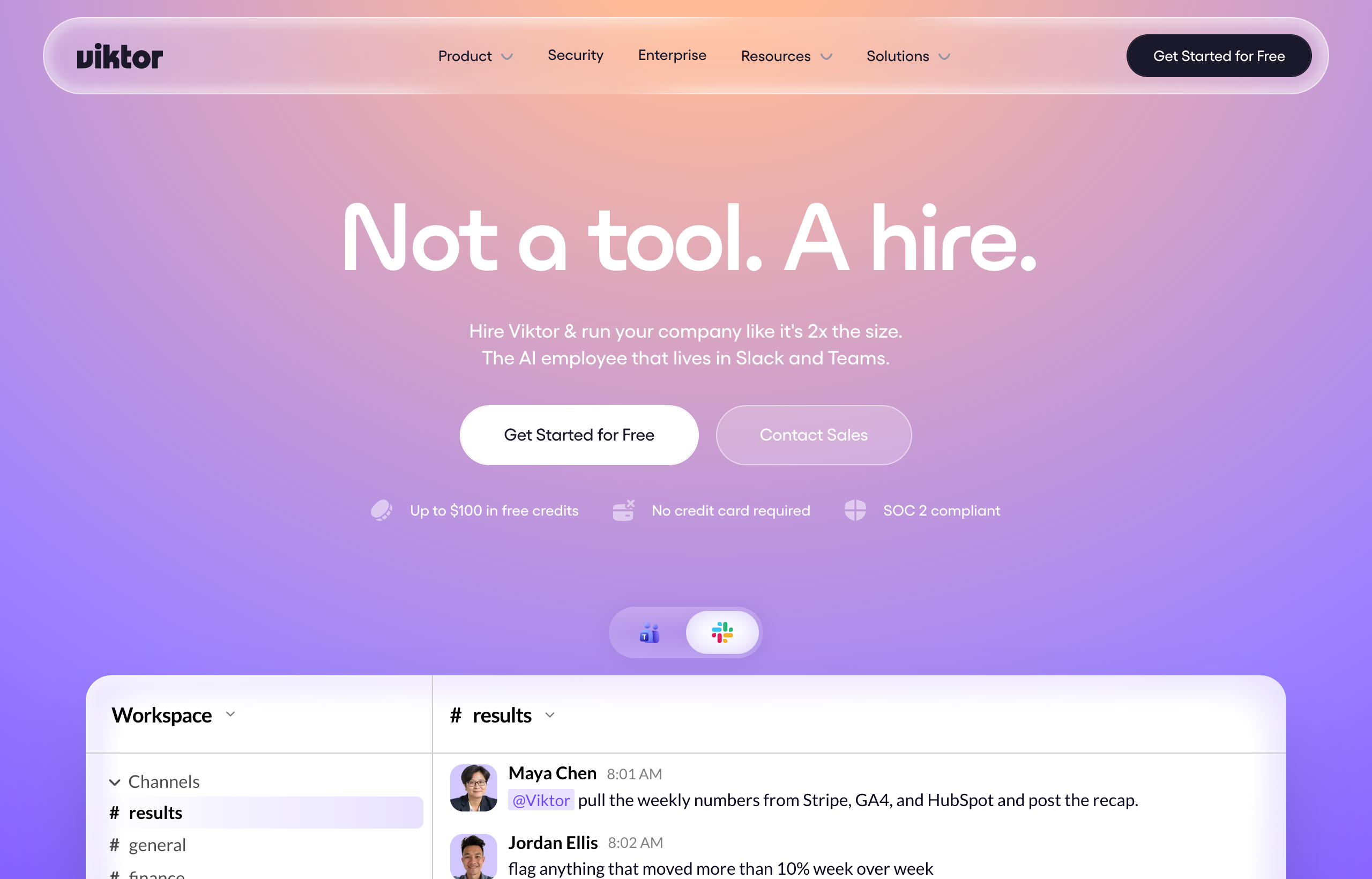
If you run a startup and want one AI that can actually touch your Stripe data, your Google Ads account, your GitHub repo, and your investor deck without you assembling a workflow first, Viktor is the strongest pick in 2026. It lives in Slack or Teams, connects to over 3,200 tools, and does the work instead of describing how you might do it. It is not the cheapest option and its credit-based billing takes a week to learn, but for a small team wearing five hats each, that tradeoff is usually worth it. Below are six other tools worth knowing, each genuinely good at a narrower job.
If you are a founder trying to decide, do not read ten more listicles. Open Viktor, use the $100 in free credits on one real task this week (a competitor teardown, a Stripe revenue summary, a first-draft investor update), and see how far it gets on its own. Start with Viktor here.
How this list was put together
Each tool here was evaluated against the same lens: could a small, resource-constrained team actually put it to work this week without a dedicated ops hire to configure it, and does it genuinely execute rather than just draft a plan for a human to carry out. That bar rules out a lot of impressive-looking tools that require significant setup time before they earn their keep. Pricing was checked against each vendor’s current published pricing page rather than older cached figures, and hedged with “around” where credit-based or usage-based billing makes an exact number moot.
Why startups need something different from a chatbot
A two-person or ten-person company does not have a person for every function. The founder does sales in the morning and reviews a pull request at night. What kills momentum is not lack of ideas, it is the twenty small execution tasks between an idea and a shipped result: pulling numbers into a slide, checking what a competitor’s ad account is running, drafting the outbound sequence, triaging the bug that a beta user just reported.
A chatbot like ChatGPT or Claude will write you a good paragraph about any of those tasks. It will not open your Stripe dashboard, pull the actual MRR number, and drop it into a formatted update. That gap between “explain how to do X” and “log in and do X” is exactly what agentic tools are supposed to close, and in 2026 the tools that close it best are the ones built to plug into your existing stack rather than replace it.
The list
1. Viktor: best overall for a small team doing many jobs
Viktor bills itself as an “AI employee” and, having used it across a few different startup-style tasks, that framing is closer to accurate than most vendor copy. It sits inside a Slack or Microsoft Teams channel. You brief it in plain language the way you would brief a new hire, and it goes and does the work: pulls data from connected tools, writes and ships code (it can open real pull requests), builds and deploys small internal web apps with a working database and login, assembles a report or dashboard, and can propose follow-up automations on its own.
The integration list matters more than it sounds like it should. Viktor connects to Stripe, Notion, Google Ads, Meta Ads, HubSpot, Salesforce, Linear, Jira, GitHub, Google Drive, and a claimed 3,200+ tools beyond those. For a startup, that is the difference between “the AI can help once someone builds a connector” and “the AI can help this afternoon.”
What I actually like: it does not require you to draw a flowchart first. You describe an outcome (“pull last week’s Google and Meta ad spend, compare CAC by channel, flag anything over $80”) and it works out the steps. There is no per-seat pricing, so adding your co-founder or a contractor to the workspace does not cost anything extra, you are just sharing the same credit pool.
What to watch: the billing is credit-based and workspace-wide, and credits burn faster than the $50/month headline number suggests once you use it daily. A quick task runs roughly 50 to 100 credits; a full project can run 2,000 to 5,000. Some users report burning through a starter allotment in the first couple of days if they lean on it hard, so budget a mid-tier plan rather than the entry one if you plan to use it as a daily coworker, not an occasional helper.
Pricing (verify at viktor.com/pricing, subject to change): free trial gives $100 in credits with no card required and the credits do not expire. Paid plans start at 20,000 credits for around $50/month, scaling to 30k/$75, 40k/$100, 80k/$200, and higher small-company tiers from 125k credits ($300) up to 2,000,000 credits ($5,000/month), with the 300,000-credit ($750/month) tier reportedly the most popular among growing teams. Enterprise pricing runs into the tens of thousands per month for large credit pools.
Read the full Viktor review for the hands-on breakdown, see how the credit pricing actually works, or check Viktor alternatives if you want the wider field. If your bottleneck is specifically engineering, Viktor vs Devin goes deeper on that comparison. For the broader category, see our roundup of the best AI agents in 2026.
2. Lindy: best if you want to see the workflow, not just trust it
Lindy is a visual agent builder. You assemble triggers, steps, and conditions on a canvas, which means you can see exactly what an agent will do before it runs, and non-technical teammates can inspect or tweak a flow without touching code. Lindy also has an assistant mode that can text or message you, closer to a personal helper than a coworker.
For a startup, Lindy is a strong pick when you have a handful of repeatable processes (lead qualification, meeting scheduling, inbox triage) that you want locked down and auditable. It is less suited to the open-ended, “figure this out for me” requests that founders throw at Viktor, because you generally need to build the flow first.
3. Zapier Agents: best if you already live in Zapier
Zapier’s agent product extends its existing automation graph with an AI layer that can make judgment calls inside a Zap rather than following a rigid if/then path. If your startup’s ops already run on thousands of Zaps, adding Zapier Agents is the path of least resistance and keeps everything in one bill.
The tradeoff is that Zapier Agents inherits Zapier’s node-by-node mental model. It is excellent at deterministic, trigger-based automation and weaker at the fuzzy, one-off requests (“draft a response to this specific investor’s email using our last three updates”) that a conversational coworker handles more naturally.
4. Devin: best for a startup that needs an extra engineer, not an extra generalist
Devin, from Cognition, is built specifically as an autonomous software engineer: it can pick up a ticket, write the code, run tests, and open a pull request with fairly minimal supervision. If your bottleneck is genuinely engineering throughput and you have a well-scoped backlog, Devin is a sharper tool for that single job than a generalist agent.
It is not trying to write your investor update or audit your ad spend, and it shouldn’t be judged on that. Startups that need both an engineering agent and a business-operations agent sometimes run Devin alongside something like Viktor rather than picking one.
5. Manus: best for open-ended autonomous research and multi-step tasks
Manus positions itself as a general autonomous agent that can plan and execute multi-step tasks with less hand-holding than a typical chat interface, including browsing, writing files, and running code in its own sandbox. It is a reasonable fit for founders who want to hand off a genuinely fuzzy research task (“find and summarize every competitor’s recent pricing change”) and walk away.
Where it differs from Viktor is habitat and integration depth: Manus operates more as a standalone agent environment than as a coworker sitting in the Slack channel your whole team already uses, and it does not carry the same breadth of native business-tool connections (Stripe, HubSpot, Salesforce, and so on).
6. Relevance AI: best if you want to build a custom team of agents
Relevance AI is a platform for assembling your own multi-agent systems rather than a single ready-made employee. If you have specific, recurring workflows and the appetite to configure them (a research agent that hands off to a writing agent that hands off to a QA agent, for example), Relevance gives you the building blocks.
The honest tradeoff: this is a “build it yourself” tool. A two-person startup usually does not have the spare hours to design a custom agent team in month one. Relevance rewards teams that already know exactly what workflow they want to automate.
7. Notion AI: best for teams that live inside Notion docs already
Notion AI is not an autonomous agent in the same sense as the tools above, it is a very good writing and summarizing layer bolted onto your existing docs and databases. For a startup that runs its whole knowledge base in Notion, it is genuinely useful for drafting, summarizing meeting notes, and querying your own docs in natural language.
It stops at the edge of Notion. It will not touch your ad accounts, ship code, or pull live Stripe numbers, so most startups end up using it alongside a true agent rather than instead of one.
Comparison table
| Tool | Best for | Lives in | Starting price | Per-seat? |
|---|---|---|---|---|
| Viktor | Generalist coworker across founder/marketing/eng tasks | Slack, Microsoft Teams | Free trial ($100 credits), then around $50/mo | No, workspace-wide credits |
| Lindy | Visual, auditable workflow automation | Its own dashboard + messaging | Free tier, paid plans vary | Varies by plan |
| Zapier Agents | Teams already deep in Zapier | Zapier | Add-on to existing Zapier plan | Usage-based |
| Devin | Autonomous software engineering | Its own IDE/agent environment | Usage/seat based, contact for current pricing | Typically yes |
| Manus | Open-ended autonomous research tasks | Standalone agent environment | Free tier, paid credit plans | No, credit-based |
| Relevance AI | Custom multi-agent builds | Its own platform | Free tier, paid plans vary | Varies by plan |
| Notion AI | Writing/summarizing inside Notion | Notion | Add-on to Notion plan | Per member |
Honest weaknesses to know before you pick one
None of these are magic, and a review that pretends otherwise is not useful to you. Viktor’s credit system is the single most common complaint in the wild: it is genuinely harder to forecast a monthly bill than with a flat per-seat SaaS price, and heavy daily use can push real spend well past the advertised $50 entry point. It is also a conversational tool, not a visual canvas, so if your team wants to see and edit a flowchart of every automation, Lindy or Zapier Agents will feel more comfortable. Lindy and Zapier Agents, in turn, ask you to build the workflow before it can run, which is friction Viktor mostly skips. Devin and Manus are narrower by design, engineering and open research respectively, so neither replaces a generalist. Relevance AI has the steepest setup curve of the group.
Who should pick something else
If you are a solo founder who mainly wants writing help and the occasional summary, a plain chatbot (ChatGPT or Claude) is cheaper and sufficient, an agent is overkill. If your team already has a mature Zapier setup handling hundreds of deterministic automations, adding Zapier Agents is lower-friction than switching platforms. If engineering throughput is your only real bottleneck, put your budget into Devin before a generalist. And if unpredictable, usage-based billing genuinely does not work for your finance process, a flat per-seat tool will be easier to plan around even if it does less.
How to pilot one of these without wasting a month
The fastest way to know if any of these tools earns its keep is to pick one real, recurring pain point, not a hypothetical one, and run it through the free tier before committing budget. For a founder, that is often the investor update or the weekly metrics pull, something you already do every week so you have a clear baseline to judge the output against. For an ops-heavy team, it might be lead routing or a recurring reporting task that currently eats an afternoon.
Resist the urge to test with a made-up task. A tool that looks impressive on a demo prompt can still fail on the specific, messy way your actual data is structured, your Stripe metadata, your particular HubSpot pipeline stages, your team’s naming conventions. Testing on the real task surfaces that mismatch in week one instead of month three, which matters most for credit-based tools like Viktor, Tasklet, or Manus, where a bad-fit workflow burns real money finding that out the slow way.
My honest take after using a handful of these day to day: start with the free credits on whichever tool you are most curious about, but if you only have time to test one this month, make it Viktor, because it is the only one that will touch your Stripe, ads, and GitHub without you building anything first. Try Viktor’s free trial.
FAQ
What is the best AI agent for an early-stage startup in 2026?
For a small team covering multiple functions, Viktor is the strongest generalist pick because it connects to thousands of tools and executes tasks inside Slack or Teams without requiring a pre-built workflow. Teams with one specific bottleneck, like engineering throughput, are often better served by a specialist tool such as Devin.
Do startups need a separate AI agent for each department?
Not necessarily. A generalist coworker like Viktor can handle founder, marketing, and light engineering tasks from one workspace, which is usually more practical for a small team than running four separate specialist tools. Larger teams with dedicated functions sometimes layer a specialist agent (like Devin for engineering) on top of a generalist one.
Is Viktor cheaper than hiring a part-time assistant?
For most early-stage teams, yes, especially at the entry tiers. But because billing is credit-based rather than a flat monthly seat, actual cost scales with how much you use it, and heavy daily use can land closer to $200 to $500 a month rather than the $50 headline figure. Budget accordingly rather than assuming the lowest tier will cover daily use.
Can these tools replace an early engineering hire?
No. Tools like Devin and Viktor can meaningfully reduce the time a small engineering team spends on routine tickets, code review prep, or internal tooling, but they still need a human engineer to review, merge, and own architecture decisions.
What is the easiest AI agent to set up with no technical background?
Viktor and Manus both aim for minimal setup, you describe the task in plain language rather than configuring nodes. Lindy and Relevance AI require more upfront configuration since they are visual builders, which pays off for repeatable processes but takes longer to get running.


