

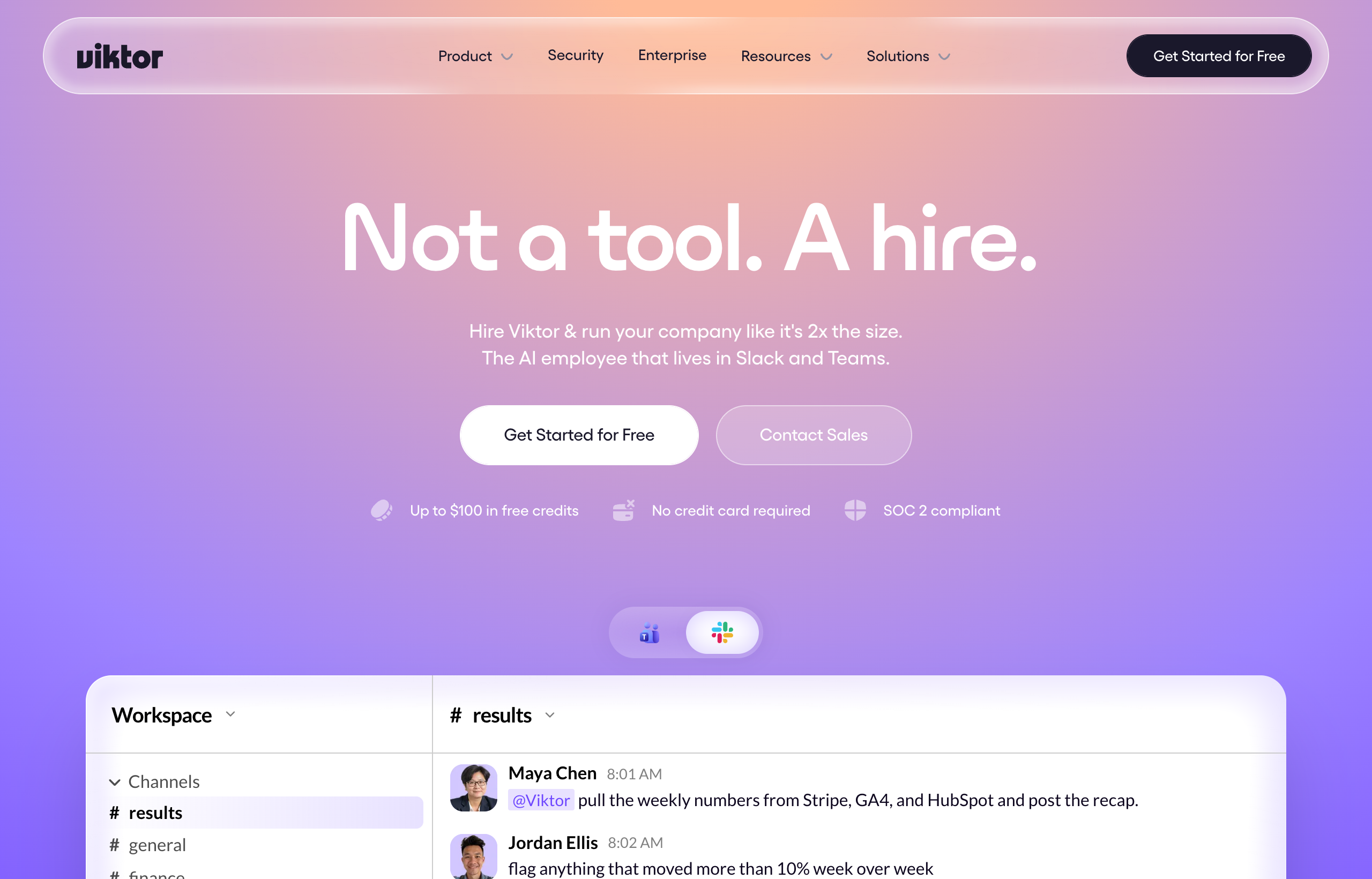
Viktor vs Devin sounds like a coding-tool comparison, and half of it is. Devin, built by Cognition, is an autonomous AI software engineer: point it at a repository and a ticket, and it plans, writes, tests, and submits code changes largely on its own. Viktor also writes code and opens pull requests, which is exactly why people search this comparison, but that is one capability inside a much wider job description. Viktor lives in Slack and Microsoft Teams and is asked to do everything from pulling a metrics dashboard to auditing an ad account to drafting a board update, with engineering work as one lane among several, not the whole road.
I looked at both through the lens of an actual team decision: do you want a specialist engineer or a generalist coworker who can also code. That framing resolves this comparison faster than a feature-by-feature table, though the table is below too, because the details matter once you know which category you are shopping in.
Disclosure: some links in this post are affiliate links. If you sign up through them, we may earn a commission at no extra cost to you. That never changes our verdict.
The 30-second verdict
Pick Devin if engineering output is the whole job. Devin is purpose-built to work inside a codebase: understanding a repo, planning multi-step changes, writing and testing code, and submitting pull requests for review. If your need is “give this to an autonomous engineer and get a PR back,” Devin’s entire product is built around that loop, with plans starting free for light use and scaling into per-seat team pricing.
Pick Viktor if engineering is one job among many, and your team lives in Slack. Viktor writes code and opens PRs too, but it is equally built to pull ad account data, assemble a board deck, triage a lead pipeline, or deploy a small internal tool, all from the same Slack channel, without switching to a separate coding-specific interface. For a broader business function that occasionally touches engineering, Viktor covers more of the actual week.
These are not really substitutes for a dedicated engineering team’s daily driver. Think of Devin as a specialist you assign real engineering tickets to, and Viktor as a generalist coworker whose remit happens to include code.
If most of what you need is “make this happen across our tools, and occasionally write the code for it,” Viktor’s free trial gives you $100 in credits to test that with a real task, no card required.
Viktor vs Devin at a glance
Figures below reflect each company’s live pricing and product pages as of July 2026. Devin’s plans in particular have shifted more than once over the past year, so treat this as a snapshot and verify before budgeting.
| Viktor | Devin | |
|---|---|---|
| Core identity | General AI business employee, lives in Slack/Teams | Autonomous AI software engineer |
| Where you work with it | Slack or Microsoft Teams channel | Devin’s own workspace/IDE-style interface, plus Slack and GitHub integration for triggering and reviewing work |
| Coding capability | Writes code, opens pull requests, deploys small web apps with database and auth, as one capability among several | Core, dedicated capability: repo understanding, multi-step planning, code writing, testing, PR submission |
| Non-coding capability | Dashboards, reports, ad account audits, lead pipeline work, scheduled recurring tasks, cross-tool data pulls | Not the focus; scope is engineering work |
| Free trial / entry tier | $100 in credits, no card required, credits do not expire | Free tier available at the time of writing with light usage quota; Pro from around $20/month |
| Pricing model | Credit-based, workspace-wide, no per-seat charge | Individual per-seat tiers (Free, Pro, Max), plus a Teams plan with a base fee and a per-seat add-on, and custom Enterprise |
| Integrations | 3,200-plus, including finance, sales, ads, and engineering tools | Focused on engineering-workflow tools: GitHub, Slack (for triggering/status), CI systems |
| Best at | Cross-functional execution work where code is sometimes part of the deliverable | Dedicated software engineering tasks: bug fixes, feature implementation, test writing, refactors |
What Devin actually does well
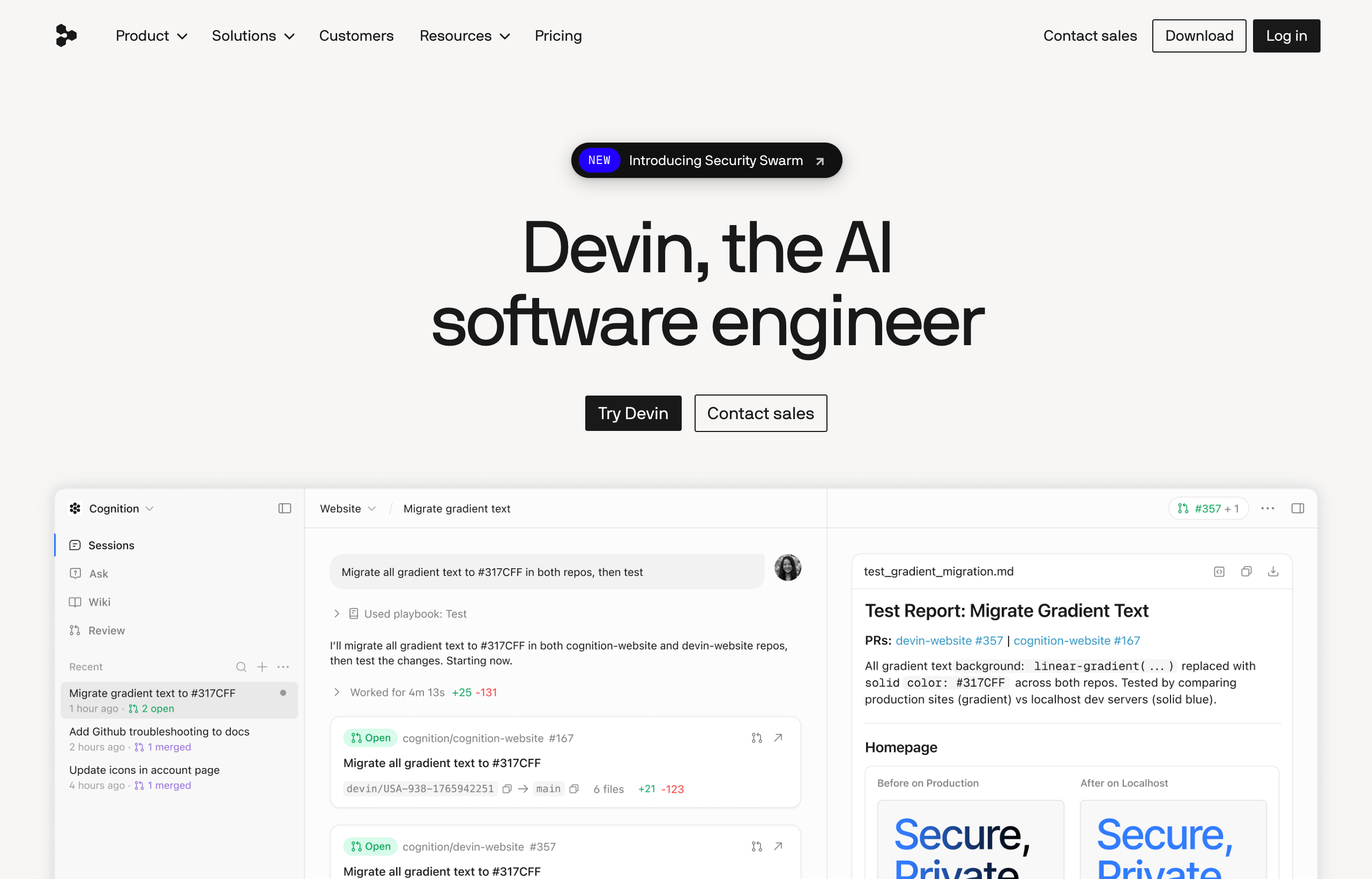
Devin’s reputation as an autonomous engineer is earned, and it is worth being specific about why rather than treating “AI coding tool” as one undifferentiated category.
It plans across multiple steps inside a real codebase, not just single-file edits. Point Devin at a ticket, and it reads the relevant parts of the repository, forms a plan for the change, writes the code, runs it against tests, and iterates when something breaks, largely without a human babysitting each step. That is a meaningfully different capability from an inline code-completion tool or a chatbot that suggests a snippet you paste in yourself.
It is built around the actual engineering review loop. Submitted work shows up as a pull request, the artifact engineers already know how to review, comment on, and merge. There is no translation step between “what the AI did” and “how my team normally ships code.”
Pricing has been restructured into something clearer. Cognition’s public pricing, as of this writing, runs a free tier for light use, a Pro tier around $20/month for individual developers with fuller model access, a Max tier around $200/month for heavier usage, and a Teams tier with an $80/month base plus a per-seat charge for full developers. That is a more conventional, easier-to-reason-about structure than the Agent Compute Unit system Devin was known for at launch, though Cognition’s own materials note the underlying usage-based logic (a unit roughly equal to about 15 minutes of active agent work) still sits behind the self-serve quotas.
Where Devin’s scope runs out
The honest limitation with Devin is not quality, it is scope, and that is by design, not a flaw.
It is an engineer, not a coworker for the rest of the business. Devin does not pull your ad spend, does not draft a board update, does not triage your inbound leads, and is not meant to. If the request has nothing to do with code, Devin is simply not the tool, and no amount of clever prompting changes that.
It lives outside the channels where most non-engineering coordination happens. Even with Slack integration for triggering and status updates, Devin’s real workspace is closer to an IDE than a team chat app. For an engineering team, that is exactly the right shape. For a founder or ops lead who wants one place to ask for anything, it is one more specialized tool in the stack rather than a single coworker.
Per-seat pricing scales with headcount, not with actual usage. The Teams plan’s $80/month base plus a per-developer add-on means the bill grows with how many people have access, not necessarily with how much engineering work is actually getting done. For a small team with occasional coding needs rather than a dedicated engineering org, that structure can be a mismatch.
Where Viktor actually does well against Devin
Viktor is not trying to out-engineer Devin, and a fair comparison should not pretend otherwise. What it offers instead is breadth: the same coworker that opens a pull request can, in the same Slack thread the next hour, pull a competitor pricing audit or assemble a metrics report.
Code is one deliverable among several, not the whole product. Ask Viktor to fix a small bug or spin up an internal tool with a database and auth, and it can do that. Ask it in the next message to cross-reference Stripe revenue against Google Ads spend, and it does that too, from the same interface, without switching tools or context.
It lives exactly where cross-functional coordination already happens. Slack and Microsoft Teams are where the conversation about a task, the stakeholders, and the follow-up questions already live for most companies. That matters more for non-engineering asks than for pure engineering ones, which is exactly the gap between these two tools.
No per-seat charge as the team grows. Viktor’s workspace-wide credit pricing means adding more people who occasionally ask it for something does not multiply the bill the way Devin’s Teams per-seat add-on does. That favors Viktor for a smaller team where engineering is not the majority of the workload.
The honest weaknesses of each
Devin’s honest weakness: it is a specialist tool with a specialist price and scope. If most of your week is not engineering, you are paying for and maintaining a tool that only covers a slice of it, and you still need something else for the rest.
Viktor’s honest weakness: for deep, sustained software engineering work, a dedicated tool built specifically for that loop, with a workspace tuned for repository navigation and review, is likely to outperform a generalist. Viktor’s credit-based pricing is also usage-driven rather than flat, so a team leaning heavily on the coding side specifically should model out whether Devin’s more conventional per-seat pricing ends up cheaper for that specific workload. Quick tasks run a few hundred credits, more complex projects run into the low thousands, and heavy usage can add up faster than the entry price suggests. Our Viktor pricing breakdown walks through the credit math in more detail.
What a typical week looks like on each
Put concretely, on Devin a typical week is engineering-shaped: a backlog of tickets gets assigned, Devin opens a branch, works through the change, runs the test suite, and opens a PR for a human engineer to review and merge, repeated across however many tickets the plan’s usage allows. The unit of work is always code, and the review loop is always GitHub. That focus is exactly why engineering teams reach for it, there is no ambiguity about what “done” looks like for a given ticket.
On Viktor, a typical week is scattered across departments by design. Monday might be a request to pull the weekend’s ad performance into a summary for the growth channel. Wednesday might be a genuine engineering ask, fix a small bug flagged in the bugs channel, opened as a PR the same way Devin would. Friday might be assembling a first draft of the week’s metrics for a founder’s investor update. The unit of work changes shape constantly, which is the entire value proposition and also the entire reason it is harder to benchmark Viktor against a specialist tool on any single axis. You are not comparing coding ability head to head so much as comparing “how much of my actual week does this cover.”
Who should pick Devin over Viktor
- You have a dedicated engineering team and want an autonomous agent purpose-built for the code review and PR workflow.
- Most of the AI-assisted work you need is genuinely software engineering: bug fixes, feature builds, test writing, refactors.
- You want a workspace built around repository navigation rather than a general chat interface.
- Predictable per-seat billing for developers matters more than workspace-wide usage credits.
Who should pick Viktor over Devin
- Engineering is one need among several: marketing, finance, ops, and founder-level tasks matter as much or more.
- Your team coordinates in Slack or Microsoft Teams and you want one coworker to ask for anything, rather than a separate specialized tool per function.
- You need occasional code or a small internal tool built, not a full-time autonomous engineer.
- You want to avoid per-seat pricing as more people across departments start asking the AI for things.
For a wider view of how Viktor stacks up against the field beyond just Devin, see our full Viktor review and our roundup of Viktor alternatives, and if you want the alternatives specifically positioned against Devin, Devin alternatives covers that ground directly. Our best AI agents of 2026 roundup is the place to check both against the rest of the category if neither turns out to be the exact fit.
If the honest answer is “we need code sometimes, but we need a lot of other things too,” try Viktor’s free trial on a real task this week, one deliverable, whatever it is, and see whether one Slack-native coworker actually covers more of your week than a specialist tool would.
What about Manus and other autonomous agents?
It is worth briefly placing this comparison in the wider autonomous-agent landscape, since Devin is not the only “does the whole job on its own” tool getting attention. Manus positions itself as a general autonomous agent rather than an engineering specialist, closer in spirit to Viktor’s breadth than to Devin’s focus, but without the Slack-native, workspace-embedded design that makes Viktor easy to fold into an existing team’s daily coordination. The pattern across this category is consistent: the more general an agent’s claimed scope, the more its real-world usefulness depends on where it lives and how it is briefed, not just on the underlying model. Devin wins on scope specificity. Viktor wins on being embedded exactly where the rest of the team’s work already happens. That is the actual axis this whole comparison turns on, more than any single benchmark either company publishes.
Frequently asked questions
Is Viktor as good as Devin at coding?
For dedicated, sustained software engineering work, Devin is the more specialized tool, built specifically around repository understanding, multi-step planning, and the PR review loop. Viktor can write code and open pull requests as one of its capabilities, and handles smaller engineering tasks well, but it is not positioned to replace a dedicated coding agent for a team’s core engineering workload.
Can Devin do non-engineering tasks like Viktor?
No, Devin’s scope is software engineering. It is not built to pull marketing data, draft reports, or manage cross-tool business workflows the way Viktor is. If you need both engineering and broader business execution, you would need Devin plus a separate tool for the rest, or a generalist like Viktor for everything except the deepest engineering work.
Which is cheaper, Viktor or Devin?
It depends on your usage pattern. Devin’s per-seat pricing (roughly $20/month per individual Pro seat, or a Teams plan with an $80/month base plus a per-developer charge) is predictable if you know your engineering headcount. Viktor’s credit-based, workspace-wide pricing can be cheaper for a small team with light, varied usage, or more expensive for a team running heavy tasks, since cost tracks actual usage rather than seats.
Does Viktor open real pull requests like Devin?
Yes, opening pull requests is listed among Viktor’s core capabilities, alongside writing code and deploying small web apps with a database and authentication. The difference from Devin is that this is one capability inside a broader business-employee remit, not the entire product.
Should a startup use Devin, Viktor, or both?
A startup with a dedicated engineering team and a heavy coding backlog benefits most from Devin as a specialist tool alongside human engineers. A smaller team or a founder who needs execution across marketing, ops, and occasional engineering work is usually better served by Viktor as the single generalist coworker. Larger, better-resourced teams sometimes run both: Devin for the engineering queue, Viktor for everything else in Slack.
The bottom line
Viktor and Devin overlap on exactly one capability, writing code and opening pull requests, and diverge everywhere else. Devin is a specialist built to be excellent at that one thing, with a workspace and pricing model shaped around engineering teams. Viktor is a generalist that happens to be able to do that one thing too, alongside marketing, finance, ops, and founder-level work, from inside the Slack or Teams channel your team already uses.
The right choice is not about which tool is “smarter.” It is about how much of your actual week is engineering versus everything else. Answer that honestly and the rest of this decision makes itself.
Start with Viktor’s free $100 in credits and hand it one real task this week, whether that is a small code fix or a cross-team report. If engineering turns out to be the majority of what you need, Devin’s specialist workspace is worth evaluating directly for that slice of the work.
Pricing and feature details captured from Viktor’s and Cognition’s (Devin’s) live pricing pages, July 2026. Both companies have changed plans and pricing structures more than once in the past year, so confirm current numbers on viktor.com/pricing and devin.ai/pricing before you buy.


