

A friend who runs ops at a 300-person logistics company asked me last month whether Glean was “worth the enterprise price tag.” I didn’t have a clean answer for her on the spot, because the honest response depends entirely on what she meant by worth it. Glean is excellent at one very specific job: making a company’s scattered knowledge findable. It is not built to then go do anything with what it finds. That distinction is the whole review, so I’m going to spend real time on it rather than rehashing the features page.
Disclosure: some links in this post are affiliate links. If you sign up through them, we may earn a commission at no extra cost to you. That never changes our verdict.
Short answer
Glean is an enterprise search and AI assistant platform that indexes a company’s knowledge across 250-plus connectors and answers questions with cited sources, and it is genuinely good at that specific job. It is not an execution tool: it will tell you what your company already knows, but it will not go pull fresh numbers from your ad accounts and build you a report the way an action-first agent will. Pricing is not public and the whole product is sold through an enterprise sales process, so it is realistically a fit for organizations with hundreds of employees and a procurement budget, not a five-person startup that wants to sign up this afternoon.
If what you actually need is a coworker that goes and finishes a task, not just a smarter search bar, I would try Viktor’s free $100 in credits before you sit through a Glean sales call. No card required, and you’ll know within one task whether execution is the gap you’re actually trying to close.
What Glean actually is
Glean describes itself as an AI platform for work that unifies enterprise search, an assistant, and agents on top of a company’s own context. In practice it is built from three connected pieces. Glean Search locates information across whatever systems a company connects, Confluence, Slack, Google Drive, Salesforce, Jira, and dozens more. Glean Assistant sits on top of that index and answers plain-language questions with a cited response instead of a list of links you have to click through one by one. Glean Agents is the newer layer, letting a company build agents grounded in that same indexed knowledge to automate narrower workflows using natural language instructions rather than code.
Underneath all three, Glean builds what it calls an Enterprise Graph, a map of how information, people, content, and systems actually relate to each other inside a specific company, not a generic model of “how companies work.” That graph is what makes a Glean answer feel personalized rather than generic: it knows which team you’re on, which documents you already have access to, and who the actual subject-matter expert on a topic is likely to be, because it can see who wrote and edited the relevant content. Glean Protect, a single-tenant cloud deployment option with permission enforcement and agent action validation, is aimed squarely at the security and compliance requirements that come with selling into large, regulated organizations.
Where Glean genuinely earns its reputation
I want to be fair here before I get to the weaknesses, because a lot of Glean reviews either fawn over it as a category-defining product or dismiss it as an overpriced search bar, and neither is accurate.
Enterprise search over your actual company knowledge
This is the core strength and it is real. Once a company connects its tools and Glean finishes indexing, asking it a plain-language question like “what did we decide about the Q3 pricing change” returns an answer built from the actual planning doc, the Slack thread where the debate happened, and the meeting notes, each cited so you can click through and verify it yourself rather than trusting a summary blind. For a company with years of institutional knowledge scattered across a dozen tools and constant employee turnover, that is a meaningful and measurable productivity unlock, particularly for onboarding new hires who would otherwise spend their first month pinging people to ask “does this already exist somewhere.”
Connector breadth
Glean connects to more than 250 data sources, which covers the overwhelming majority of the tools a mid-size or large company actually runs on. That breadth matters more than it sounds, because a search tool that only indexes half your company’s tools just creates a new place people have to remember not to trust for certain questions. Wide, consistent coverage is what makes “just ask Glean” a habit people actually form instead of a tool they check occasionally.
The assistant layer feels personalized, not generic
Because Glean’s answers are grounded in the Enterprise Graph rather than a generic model, the assistant tends to surface the right internal expert or the right internal precedent rather than a plausible-sounding but ungrounded answer. Ask it who owns a particular integration and it can point to the actual engineer who touched that code most recently, not a guess. That grounding is the meaningful difference between Glean’s assistant and pointing a general chatbot at a pile of exported documents.
Security and compliance built for large organizations from day one
Permission enforcement that respects existing document access controls, single-tenant deployment options, and SOC 2-level compliance posture are not afterthoughts bolted onto a consumer product, they are core to how Glean is built and sold. For a regulated company with a real data governance function, that matters more than almost any feature, and it is a legitimate reason Glean wins enterprise deals that a smaller, faster competitor cannot.
It is expanding into agents, honestly
Glean Agents and its Agent Builder and Agent Orchestration features are a real acknowledgment that search alone leaves value on the table, and Glean is actively pushing toward letting customers build lightweight automations grounded in the same indexed knowledge. Credit where due: this is Glean trying to close the exact gap this review is about to spend a section describing. It is early and it is an extension of a search-first foundation, but it is a genuine direction, not just marketing language.
Worth testing side by side rather than taking either vendor’s word for it: hand the same real task to both and see whether “found the answer” or “got the thing done” is actually what’s costing your team time this month.
Where Glean genuinely falls short
A review with no real downsides is a press release. Here is what actually limits Glean, in order of how much it should factor into your decision.
It is search-first, not action-first
This is the single biggest limitation and it is a design choice, not a bug. Glean answers “what do we already know.” It does not go pull fresh numbers from Stripe, cross-reference them against last quarter’s HubSpot pipeline, and hand you a finished report. Ask Glean about last quarter’s churn and it will find the document where someone already calculated it. It will not calculate this quarter’s number for you. If your team’s actual bottleneck is “we know the answer exists somewhere, someone just has to go do the work of building the new version,” Glean’s search, however excellent, does not touch that problem at all. Its Agent Builder is starting to reach toward this, but it remains an extension bolted onto a search-first foundation rather than the thing Glean was built to do from day one.
Enterprise sales-gated, with a real cost in time
There is no self-serve signup. You request a demo, talk to a sales team, and go through an evaluation and procurement process before you can actually put Glean in front of your employees. For a large organization with an existing vendor evaluation process, that is normal and not a real objection. For a smaller or faster-moving company, it means weeks between “we think we need this” and “our team can actually use it,” which is a real cost even before a dollar changes hands.
No public pricing, which makes budgeting genuinely hard
Glean does not publish per-seat or plan pricing anywhere on its site. Every number you’ll find outside Glean’s own materials comes from third-party estimates and buyer reports rather than an official rate card, so treat any figure, including the ones below, as directional rather than exact. Multiple independent buyer and vendor-comparison sources report an enterprise search license landing somewhere in the neighborhood of $45 to $75 or more per user per month, often with an additional AI or “work AI” add-on layered on top, and a typical minimum enterprise contract around 100 seats, which puts a plausible starting annual contract value in the tens of thousands of dollars before you add implementation, connector setup, and admin overhead. Larger deployments with heavier integration and indexing needs have been reported well into six figures annually. None of that is confirmed by Glean directly, and the only way to get a real number for your company is a sales conversation, which is itself worth factoring into your evaluation timeline.
Setup is a real project, not a weekend
To Glean’s credit, this is not hidden, it is inherent to what enterprise search requires. Connecting your company’s tools, letting the index build, and tuning permissions so employees only see results from documents they’re actually allowed to access is a project measured in weeks, typically run with support from Glean’s implementation team as part of the enterprise relationship. That is a reasonable trade for a large organization solving a genuine knowledge-sprawl problem. It is a mismatch for a team that wants something working by Friday.
What does Glean actually cost?
I want to be direct about the limits of what I can tell you here, because the alternative, inventing a specific number, would be worse than admitting the gap.
| Plan | Reported price range | Notes |
|---|---|---|
| Enterprise Search license | Reportedly around $45 to $75+/user/month | Not published by Glean; figures come from third-party buyer and vendor comparisons |
| Work AI / advanced AI add-on | Reportedly around $15+/user/month on top | Layered on top of the base license, per buyer reports |
| Typical minimum contract | Around 100 seats | Puts a plausible entry annual contract in the tens of thousands of dollars |
| Larger enterprise deployments | Reportedly well into six figures annually | Depends heavily on headcount, connector scope, and implementation needs |
Take every number in that table as “reported,” not “confirmed,” and get a real quote from Glean’s sales team before budgeting against it. What is confirmed directly from Glean’s own site is that pricing is not published and every plan requires a sales conversation, which by itself tells you who the product is realistically built for.
Who Glean is genuinely built for
- Large organizations, typically hundreds of employees or more, where institutional knowledge is genuinely scattered across a dozen-plus tools and the daily pain is people not being able to find what already exists.
- Companies with strict compliance and data governance requirements that need enterprise-grade permission enforcement and an established procurement relationship.
- Organizations that already have execution covered, through other tools, automations, or headcount, and specifically need a system that makes existing knowledge findable and cited.
- Teams onboarding new hires constantly, where “where do I find X” is a recurring, measurable time cost.
Who should look elsewhere
If your company is under fifty people, if you want to start using something this week rather than after a sales cycle, or if your actual bottleneck is that tasks sit undone even after someone finds the right context, Glean is more infrastructure than your problem requires. That last case, tasks sitting undone, is worth sitting with for a second, because it is the exact gap between search and execution that most Glean evaluations skip past.
The action-first alternative: what to use when search finds the answer but nobody executes
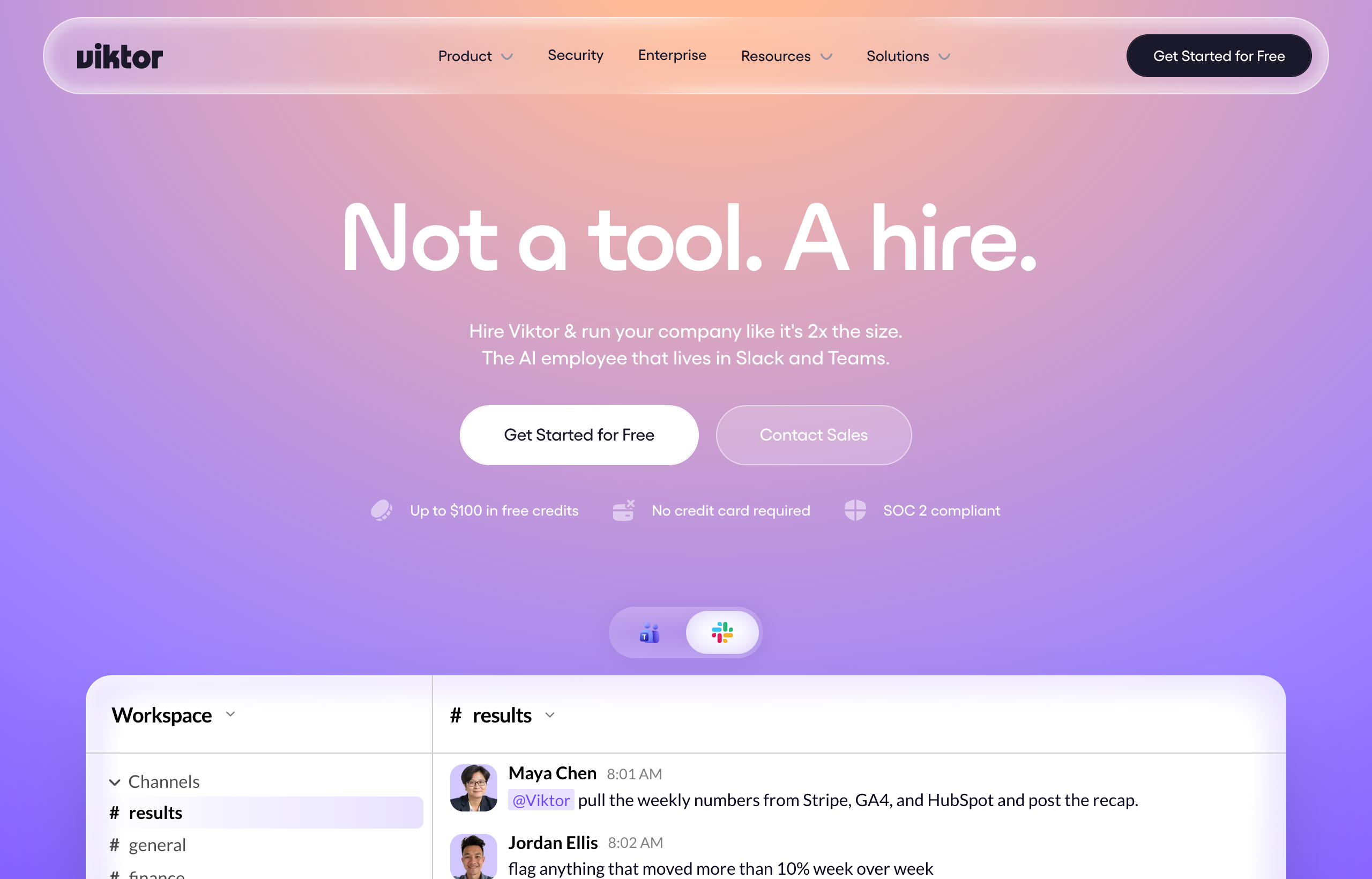
This is where Viktor fits, and it fits a genuinely different job than Glean’s, not a cheaper version of the same job. Viktor lives directly inside Slack or Microsoft Teams, the same place your team already talks, and instead of answering “what do we know,” you brief it on an outcome the way you’d brief a new hire, and it goes and does the work. It connects to more than 3,200 tools, Stripe, Notion, HubSpot, Salesforce, Google Ads, Meta Ads, GitHub, Google Drive, and more, pulls live data directly from them, and returns a finished deliverable: a report, a spreadsheet, a small deployed web app with a working database and login, or a pull request if the task touches code. It also proposes its own follow-up automations once it notices a recurring pattern in what your team keeps asking it to do.
Pricing is public and self-serve, which is itself a meaningful contrast with Glean’s sales-gated model: a free trial with $100 in credits and no card required, then workspace-wide credit tiers starting around $50 a month for 20,000 credits and scaling from there, with no per-seat charge, so adding people to the Slack channel does not automatically raise the bill. The honest tradeoff, in the spirit of not writing an ad: credit-based billing is genuinely less predictable than a flat subscription, and real active teams commonly land closer to $300 to $750 a month once full projects are actually running through it, rather than the $50 headline figure. I break that model down in detail in the full Viktor pricing guide.
If your team’s real problem is “we know what to do, nobody’s actually doing it,” that’s a different tool than Glean solves. Try Viktor’s free trial, hand it a task that’s been sitting on someone’s list for two weeks, and see what comes back.
For the fuller picture, our direct Viktor vs Glean comparison puts both tools side by side on the same tasks, our Glean alternatives roundup covers the wider field including Dust and Relevance AI, and our best AI agents of 2026 list places both search-first and action-first tools in the broader category.
Frequently asked questions
Is Glean worth it for a small company?
Usually not. Glean is built and priced for organizations with hundreds of employees and a procurement process. A smaller team will typically find the sales cycle and likely cost disproportionate to a knowledge-sprawl problem that a lighter, self-serve tool could address faster.
Does Glean actually do anything besides search?
Yes, increasingly. Glean Agents, Agent Builder, and Agent Orchestration let customers build lightweight automations grounded in Glean’s indexed knowledge. That said, it remains a search-first product by design and history, and it does not natively execute multi-step tasks against outside business tools the way an action-first agent does.
How much does Glean cost?
Glean does not publish pricing. Third-party buyer reports commonly cite roughly $45 to $75-plus per user per month for the core license, often with an AI add-on around $15 per user per month on top, and a typical minimum contract around 100 seats. Treat these as directional; only a Glean sales conversation gives you a confirmed number.
Is Glean secure enough for a regulated industry?
It is built with that requirement in mind. Permission enforcement, single-tenant deployment options through Glean Protect, and SOC 2-level compliance posture are core to the product, which is part of why it wins deals with large, regulated organizations.
What should I use instead of Glean if I need tasks done, not just answered?
An action-first AI employee like Viktor, which lives in Slack or Teams and executes multi-step work end to end, pulling data from more than 3,200 tools and returning a finished deliverable rather than a cited answer to search.
The bottom line
Glean does exactly what it says it does, and it does that job well: it makes a large company’s scattered knowledge findable, cited, and personalized to who’s asking. If that is genuinely your bottleneck and you have the size and budget to justify an enterprise sales process, it earns its reputation. But it is not, and does not claim to be, a tool that goes and executes the work once the answer is found. If that gap, someone still has to do the thing, is the one actually costing your team hours every week, that’s a different product entirely.
Start with Viktor’s free $100 in credits, no card required, and hand it one task this week that currently ends with “someone should really pull this together.” You’ll know within a single task which gap you actually have.
Pricing figures for Glean are third-party estimates, not confirmed by Glean directly, since the company does not publish pricing. Confirm current numbers with Glean’s sales team before budgeting. Captured July 2026.


