
The beehiiv versus ActiveCampaign question comes up most often from people who already have a course, a service, or a funnel running, and are wondering whether they should consolidate everything into one tool. I understand the appeal. Running fewer subscriptions is a real win. But I have set up test accounts on both platforms specifically to see whether that consolidation actually works, and the honest answer is that these two tools solve different problems well enough that trying to force one to do both jobs usually means doing one of them badly.
beehiiv is built to grow and monetize a newsletter audience. ActiveCampaign is built to automate a sales and marketing funnel, with a CRM attached. Both send email. That is roughly where the overlap ends. What follows is the honest comparison: where ActiveCampaign’s automation depth genuinely outruns beehiiv, where beehiiv’s growth tooling has no ActiveCampaign equivalent, and which one actually fits the thing you are building.
Disclosure: some links in this post are affiliate links. If you sign up through them, we may earn a commission at no extra cost to you. That never changes our verdict.
The 30-second verdict
beehiiv wins for newsletter growth: a native referral program, a Boosts marketplace, an ad network, and 0% fees on paid subscriptions, all in one subscription starting free. ActiveCampaign wins for deep marketing automation and sales: a visual automation builder with conditional branching most tools do not attempt, a built-in CRM and sales pipeline, predictive sending, and lead scoring, priced from around $15 a month at the entry tier but with no permanent free plan. If your business runs on funnels and a sales process, ActiveCampaign is the stronger tool. If your business is the newsletter itself, beehiiv is built for exactly that and ActiveCampaign’s automation depth will mostly go unused.
- ActiveCampaign has no referral program, no Boosts-style marketplace, and no ad network; it was never built to help you find new subscribers, only to convert and nurture the ones you already have.
- beehiiv has no built-in CRM or sales pipeline; ActiveCampaign’s automation builder goes far deeper into conditional branching, lead scoring, and predictive sending than beehiiv attempts.
- ActiveCampaign has no permanent free plan, only a trial; beehiiv’s free Launch plan covers 2,500 subscribers with unlimited sends, no card required.
- ActiveCampaign’s entry Starter plan limits you to 1 user seat and 5 actions per automation; beehiiv’s automations are simpler by design but unlock at $43/mo alongside the full growth toolkit.
- Neither tool is trying to be the other. ActiveCampaign is a marketing automation and CRM platform that can send a newsletter; beehiiv is a newsletter growth platform that includes basic automation.
If your business is the newsletter and not a funnel underneath it, the fastest way to see the difference is to try it directly. Start a free beehiiv publication and turn on the recommendation network. Free to 2,500 subscribers, no card required.
What are beehiiv and ActiveCampaign, and why do they solve different problems?
beehiiv was founded in 2021 by Tyler Denk, an early Morning Brew employee who built the referral system credited with compounding that newsletter’s growth. Its roadmap is organized around one question: how does a newsletter find, keep, and monetize readers. Everything from the referral program to the Boosts marketplace to the built-in ad network exists to answer that question.
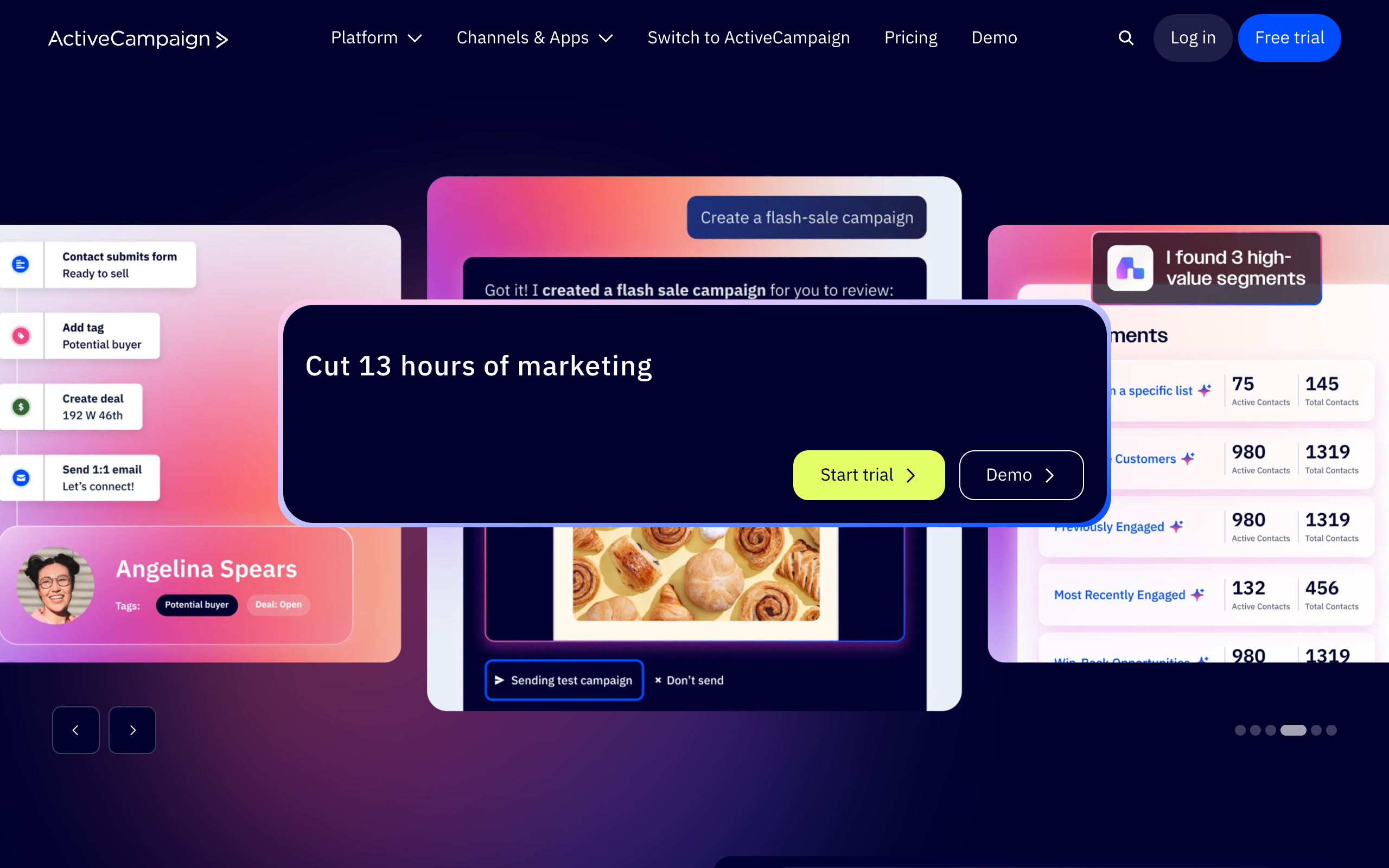
ActiveCampaign launched in 2003 as an email marketing tool and has spent two decades evolving into what it now calls a “customer experience automation” platform: email, SMS, a CRM with a sales pipeline, site and event tracking, and a visual automation builder capable of branching logic most competitors do not attempt. ActiveCampaign’s core customer is a business running a marketing funnel, agencies managing client campaigns, course creators nurturing leads toward a sale, local businesses automating follow-up after a purchase, where the newsletter is one touchpoint inside a larger automated sales process, not the whole business. If you want the fuller picture of what ActiveCampaign does well and where it struggles outside this specific matchup, my ActiveCampaign vs Mailchimp comparison covers its more common head-to-head fight.
The tell is in what each company optimizes its homepage around. beehiiv’s marketing leans on “grow” and “monetize your audience.” ActiveCampaign’s leans on “automate” and “close more deals.” Neither is hiding what it built. The confusion only starts when someone assumes any tool that sends email must be competing with any other tool that sends email.
Who is each platform actually built for?
beehiiv is built for solo writers, media operators, and creators whose audience relationship lives in the inbox, and who monetize primarily through subscriptions, sponsorships, and ads. If you deleted the newsletter tomorrow, the business loses its core channel.
ActiveCampaign is built for businesses running a defined sales process: agencies, course sellers, service businesses, and ecommerce operators who need automated, conditional follow-up sequences tied to a CRM. If your newsletter is really one stage in a longer funnel that ends in a sales call, a course purchase, or a service booking, ActiveCampaign’s automation and CRM layer will do more for your revenue than beehiiv’s growth tools ever will.
| Category | beehiiv | ActiveCampaign |
|---|---|---|
| Core identity | Newsletter growth and monetization platform | Marketing automation and CRM platform |
| Referral program / Boosts / ad network | Native, built into Scale plan | Not available |
| Automation depth | Welcome sequences, basic triggers, light branching | Deep conditional branching, lead scoring, predictive sending |
| Built-in CRM / sales pipeline | Not available | Included on Plus and above |
| Paid subscriptions from readers | Yes, 0% fee on Scale and above | Not a native feature |
| Free plan | 2,500 subscribers, unlimited sends, no card required | No permanent free plan; trial only |
| SEO-indexable website | Included on every plan | Not part of the core product |
| Entry paid price | $43/mo (Scale, annual) | Around $15/mo at entry tier, 1,000 contacts (as of mid-2026) |
Does ActiveCampaign have anything like beehiiv’s growth toolkit?
No. beehiiv’s referral program lets you set milestone rewards, and every send automatically carries the reader’s unique referral link, the same mechanic Morning Brew used to compound its list before it was productized into a checkbox feature. Boosts is a two-sided marketplace where newsletters pay to reach other audiences and earn money recommending each other, often the first dollar a small newsletter makes. beehiiv’s ad network connects publications directly with sponsors looking to book placements, with beehiiv handling billing.
ActiveCampaign has none of this. Its growth-adjacent tools are forms, landing pages (on Plus and above), and site tracking that tells you when a known contact visits your site, useful for triggering a sales follow-up, not for finding new subscribers in the first place. If cold-start audience growth is your bottleneck, ActiveCampaign gives you no mechanism to solve it beyond whatever traffic you already generate elsewhere.
Where does ActiveCampaign genuinely beat beehiiv?
Flip the lens to automation depth, and ActiveCampaign is not close either, in the other direction. Its automation builder supports true conditional branching (if this, then that, else this other thing), multi-step lead scoring that adjusts a contact’s score based on behavior across email, site visits, and CRM stage, and predictive sending that times each individual send for when that specific contact is most likely to open. None of this exists in beehiiv, which keeps its automation builder deliberately simple: welcome sequences, segment-based triggers, basic delays.
The built-in CRM is the bigger structural difference. ActiveCampaign’s sales pipeline (available from the Plus plan up) lets a sales team track deals, assign follow-up tasks, and trigger automations based on pipeline stage, all inside the same platform sending the email. beehiiv has no CRM concept at all; it is not trying to manage a sales process, only a reader relationship. If your newsletter feeds a sales team that needs to track individual leads through a pipeline, ActiveCampaign closes a gap beehiiv was never built to close.
Off-docs observation from testing both: I tried building a re-engagement flow with conditional paths based on click behavior across several past sends. On ActiveCampaign it was tedious but fully possible, branching logic all the way down. On beehiiv I simplified the flow instead, because the builder does not go that deep. If that kind of automation gymnastics is a regular part of your marketing, you will feel the ceiling on beehiiv within your first month.
If your growth bottleneck is finding readers rather than automating a funnel, this is the gap that matters most for you. Try beehiiv’s free plan and put the referral program to work on the problem ActiveCampaign does not solve.
What does each platform cost in 2026?
beehiiv’s numbers are from its live pricing page, captured July 2026. ActiveCampaign prices through an interactive calculator by contact count and does not publish fixed dollar figures on its marketing page, so the entry-tier figures below are approximate; confirm your exact tier at activecampaign.com/pricing since the total shifts with list size and currency.
| Plan | Price | What you get |
|---|---|---|
| beehiiv Launch (Free) | $0 | Up to 2,500 subscribers, unlimited sends, custom domain, website |
| beehiiv Scale | From $43/mo ($517/yr, annual) | Referral program, Boosts, ad network, 0% fee on paid subs, up to 100,000 subscribers |
| beehiiv Max | From $96/mo ($1,151/yr, annual) | Everything in Scale plus no branding, up to 10 publications, sponsorship storefront |
| ActiveCampaign Starter | Around $15/mo at entry tier (as of mid-2026) | 1 user, limited segmentation, 5 automation actions per automation, standard integrations |
| ActiveCampaign Plus | Around $49/mo at entry tier (as of mid-2026) | Standard segmentation, unlimited automation actions, CRM and sales pipeline, landing pages |
| ActiveCampaign Pro | Around $79/mo at entry tier (as of mid-2026) | Advanced segmentation, 3 users, predictive content, attribution tracking, premium ecommerce integrations |
| ActiveCampaign Enterprise | Custom | 5 users, custom objects, SSO, dedicated account team |
The trap in that table is the CRM. ActiveCampaign’s Starter plan, the one most often quoted as “cheap,” does not include the sales pipeline at all, meaning the feature that most distinguishes ActiveCampaign from a plain email tool only shows up once you upgrade to Plus. If the CRM is why you are considering ActiveCampaign, price it starting at Plus, not Starter. beehiiv’s own subscriber-tier pricing has its own step-ups as your list grows past the entry point, which I break down fully in my beehiiv pricing breakdown, but every dollar there maps to features a newsletter operator actually uses, referral, Boosts, ads, rather than CRM tooling a content creator without a sales team will likely never touch.
Can you monetize a newsletter directly through ActiveCampaign?
Not natively. ActiveCampaign has no built-in feature for charging readers a recurring subscription fee for content access; it is built to nurture leads toward a sale you process elsewhere (through an ecommerce integration, a course platform, or a booking tool), not to gate content behind a paywall itself. beehiiv supports native paid subscriptions on Scale and above at 0% platform fee, keeping everything after standard Stripe processing.
If a paid-newsletter tier is part of your plan, even a future one, this gap matters more than any automation feature. You would need to bolt a separate membership tool onto ActiveCampaign to do what beehiiv already does out of the box.
How do the writing and publishing experience compare?
beehiiv’s editor is built specifically for newsletter writing: a Notion-style block editor with slash commands, clean embeds, and a layout that gets a well-formatted issue out the door quickly. Every post also publishes to a real, indexable website by default, so your archive quietly compounds SEO traffic over time without any extra setup. In testing I hit small friction, an image block needing a re-drag, an occasional paste that needed a refresh, but nothing that slowed down actually shipping an issue.
ActiveCampaign’s email editor is a standard drag-and-drop builder, competent but generic, built to produce a marketing email or automated sequence step rather than a long-form reading experience. It does not include a public website or blog layer at all; ActiveCampaign assumes your content lives somewhere else (your own site, a landing page tool, a course platform) and its job is only to email people about it. If a polished, easy writing experience and an SEO-friendly archive matter to how your newsletter grows, beehiiv is the more purpose-built tool. If email is one output among several inside a broader automated campaign, ActiveCampaign’s more generic editor is not a real weakness, since that is not the job it is doing.
Practical detail worth knowing before you commit: ActiveCampaign’s automation builder is powerful enough that some agencies use it to run entire client campaigns without ever touching a CRM outside it. That same power is exactly what makes it feel like overkill for someone whose only goal is “write one good issue a week and get it in front of more people.”
Who should choose ActiveCampaign over beehiiv?
- Agencies and service businesses running client funnels. The automation depth and CRM are built exactly for this, with no beehiiv equivalent.
- Course sellers and coaches with a sales process. If leads move through defined stages before buying, ActiveCampaign’s pipeline and lead scoring will outperform any newsletter-first tool.
- Anyone who needs conditional, branching automation. ActiveCampaign’s builder goes deeper than beehiiv’s by a wide margin.
- Businesses where the newsletter is one channel among several. If email supports a broader sales and marketing operation rather than being the product, ActiveCampaign’s breadth is the better fit.
Who should choose beehiiv over ActiveCampaign?
- Anyone starting a newsletter from zero. The referral program and Boosts marketplace exist specifically to solve the cold-start growth problem ActiveCampaign does not touch.
- Creators planning to monetize through paid subscriptions, ads, or sponsorships. ActiveCampaign cannot process reader payments for content access; beehiiv’s ad network brings sponsor demand directly to you.
- Anyone who wants a real, free starting point. ActiveCampaign has no permanent free plan; beehiiv’s free tier covers 2,500 subscribers with unlimited sends and no card required.
- Publications that want an SEO-indexable website bundled in. beehiiv posts publish as crawlable web pages by default; ActiveCampaign has no publishing layer at all.
If you are weighing the wider field of automation-heavy tools, my guide to ActiveCampaign alternatives and full ranking of the best newsletter platforms cover the options in between these two extremes. I also break down beehiiv’s complete feature set on its own terms in my standalone beehiiv review.
Can you migrate between beehiiv and ActiveCampaign?
Yes, though the migration is rarely symmetric because the two platforms are usually used for different jobs rather than as swaps for each other. Moving from ActiveCampaign to beehiiv means exporting your contact list as a CSV and importing it into beehiiv; any automation logic, especially branching sequences and CRM pipeline stages, does not transfer and needs to be rebuilt from scratch inside beehiiv’s simpler automation builder, so expect to simplify some flows along the way. Moving from beehiiv to ActiveCampaign works in reverse: export your subscriber CSV, import it, then rebuild your welcome sequence, and decide whether you need the CRM turned on from day one or can add it later.
The more common pattern I see in practice is not a migration at all: businesses running beehiiv for the newsletter and its growth engine, with ActiveCampaign (or a similar CRM tool) handling the sales-side automation for leads that convert into paying customers through a separate offer. Running both in parallel, each doing the job it was built for, usually beats forcing one tool to cover both roles.
Frequently asked questions
Is ActiveCampaign good for a newsletter? It can send a newsletter competently, but it has no referral program, no growth marketplace, and no way to charge readers directly for content access, so a pure content newsletter gets automation and CRM tooling it will likely never use while missing the growth features that would actually help it.
Is beehiiv better than ActiveCampaign? For growing and monetizing a content-first newsletter, yes, since beehiiv’s referral program, Boosts marketplace, ad network, and paid subscriptions all target exactly that use case. For running a marketing funnel with a sales team and a CRM, ActiveCampaign is the stronger platform.
Does beehiiv have a CRM like ActiveCampaign? No. beehiiv has no CRM or sales pipeline concept; it manages a reader relationship, not a sales process. If you need to track deals and leads through defined stages, ActiveCampaign or a dedicated CRM alongside beehiiv is necessary.
Does ActiveCampaign have a free plan? No. ActiveCampaign offers a free trial but no permanent free tier. beehiiv’s Launch plan is free indefinitely up to 2,500 subscribers with unlimited sends and no card required.
Can I use ActiveCampaign and beehiiv together? Yes, and this is the more common setup for businesses that need both. Many operators run beehiiv for the newsletter and its growth tools, then use ActiveCampaign separately for automated sales sequences and CRM tracking once a lead converts toward a paid offer.
Which is cheaper, beehiiv or ActiveCampaign? At the very entry tier, ActiveCampaign’s Starter plan (around $15/mo) undercuts beehiiv’s Scale plan ($43/mo), but Starter excludes the CRM and unlimited automation actions that define ActiveCampaign’s value. Once you price in Plus, where the CRM unlocks, the two land closer together, and the comparison becomes about which feature set you actually need rather than which is cheaper.
The bottom line: which should you actually pick?
This comparison resolves fastest when you ask what happens after someone reads your email. If the answer is “they reply, share it, or become a more engaged reader,” you are describing a newsletter, and beehiiv’s referral program, Boosts marketplace, and ad network are built to compound exactly that behavior. If the answer is “they move to the next stage of a funnel, get scored as a lead, and eventually talk to a salesperson,” you are describing a marketing automation problem, and ActiveCampaign’s branching logic and built-in CRM will do more for your revenue than any newsletter growth tool.
My honest recommendation: do not let ActiveCampaign’s deeper feature list talk you into paying for automation gymnastics you will not use if your real bottleneck is finding readers in the first place. Start on beehiiv’s free plan, prove the growth mechanics work for your list, and only reach for ActiveCampaign’s CRM once you have an actual sales process on the other side of the newsletter that needs one. Buying automation depth before you have a funnel to automate is a common way to pay twice for a problem you do not have yet.
Start a free beehiiv publication today, free to 2,500 subscribers with no card required, and let the growth tooling solve the problem ActiveCampaign was never built to solve.
Pricing captured from vendor pricing pages, July 2026. Plans change, so confirm current details before you buy.


