
ActiveCampaign wins on automation depth and its built-in CRM, and it starts cheaper at $15 a month; Mailchimp wins on brand familiarity, design polish, and ecommerce integrations at the entry tier. If your business runs on multi-step sales sequences, lead scoring, and a sales pipeline that needs to talk to your email tool, ActiveCampaign’s automation builder is the more capable engine underneath. If you want a simple, well-known tool to send newsletters and basic campaigns without building out complex logic, Mailchimp’s free plan and gentler learning curve make more sense. If your list is really a newsletter and not a sales funnel, stick around, because neither tool is optimized for that job, and I will explain the better fit near the end.
Disclosure: some links in this post are affiliate links. If you sign up through them, we may earn a commission at no extra cost to you. That never changes our verdict.
Before you dive into automation platforms built for sales funnels, it is worth seeing what a tool built purely for newsletters looks like. I would open a free beehiiv publication and send one issue for comparison. It runs free to 2,500 subscribers with no card required.
Key takeaways
- ActiveCampaign’s Starter plan begins around $15 a month, billed annually, with limited automation actions and standard CRM and ecommerce integrations at entry-level contact counts.
- ActiveCampaign’s Plus plan starts around $49 a month and unlocks unlimited automation actions plus standard segmentation, the tier most serious users end up on.
- Mailchimp’s Free plan covers 250 contacts and 500 sends a month; its Essentials tier starts around $13 a month at entry contact counts.
- ActiveCampaign includes a genuine CRM (deals, pipelines, sales automation) inside its platform; Mailchimp’s CRM features are far lighter and mostly limited to basic contact tagging.
- If your list exists to publish a newsletter rather than run sales sequences, both platforms carry automation and CRM overhead you likely do not need.
What is the real difference between ActiveCampaign and Mailchimp?
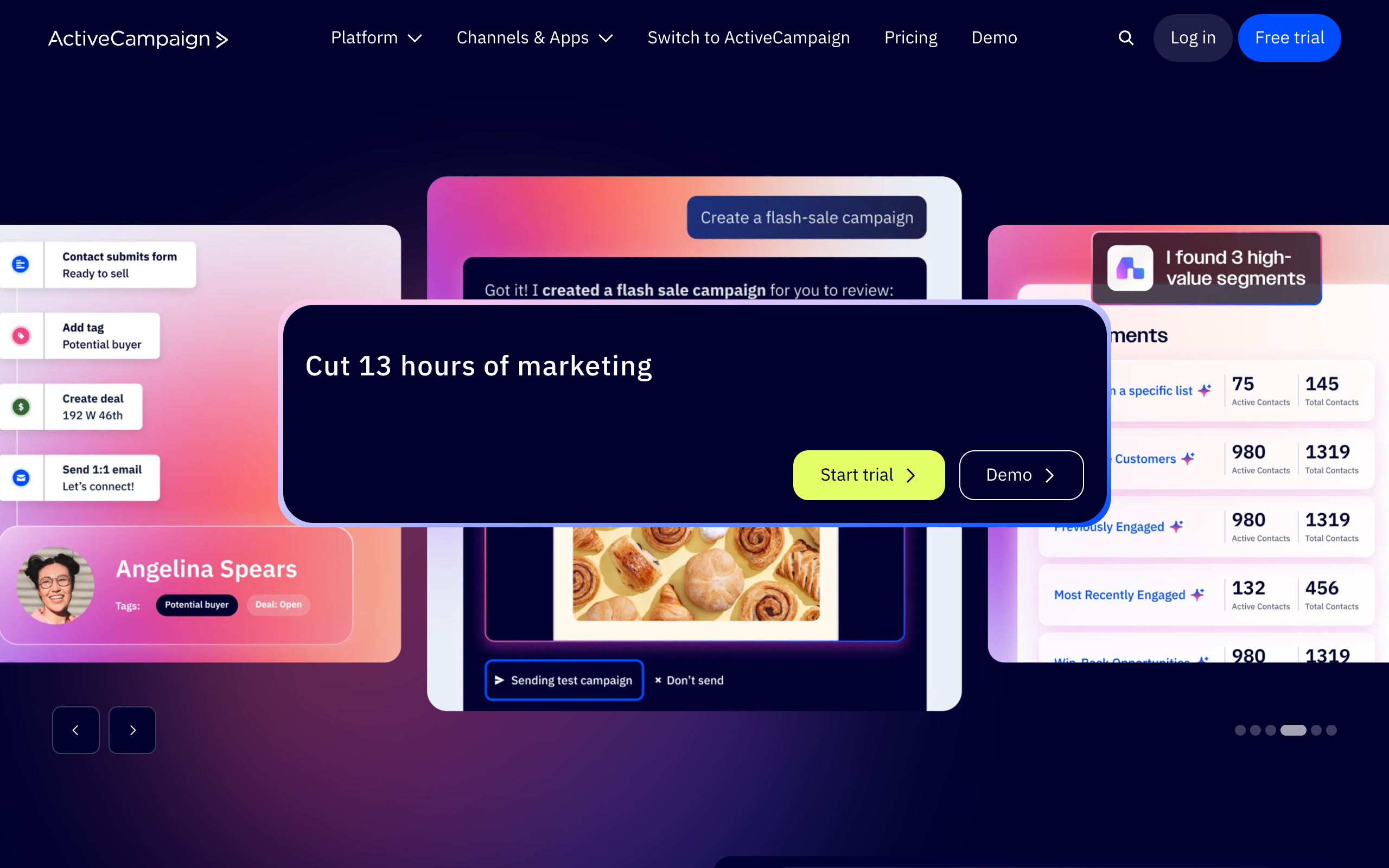
ActiveCampaign was built around the idea that email marketing and sales should not be separate systems. Its “Customer Experience Automation” positioning means the platform ships with a genuine CRM (deal stages, pipeline views, task reminders for sales reps) wired directly into the same automation engine that sends your emails. A lead can fill out a form, get tagged, enter a nurture sequence, and get automatically handed to a sales rep’s pipeline when they hit an engagement threshold, all inside one product. That is the core reason agencies, coaches, and B2B companies with actual sales processes gravitate toward ActiveCampaign over more email-first tools.
Mailchimp’s roots are different. It started as a straightforward email marketing tool and has since added automation, a lightweight CRM layer, and ecommerce integrations, but the sales-pipeline mentality that defines ActiveCampaign was never the foundation. Mailchimp’s “automation” is closer to marketing journeys (welcome series, re-engagement campaigns, post-purchase flows) than to a full sales process. For businesses that sell primarily through a storefront rather than a sales conversation, that distinction rarely matters. For businesses that close deals through calls, demos, or proposals, it matters enormously, and ActiveCampaign’s built-in CRM removes the need for a separate tool like a basic Pipedrive or HubSpot instance.
How do ActiveCampaign and Mailchimp price out?
Here is what each platform actually charges at entry-level contact tiers, based on live pricing pages.
| Plan | Starting price (billed annually) | Key limits | What you get |
|---|---|---|---|
| ActiveCampaign Starter | Around $15/mo | 1 user, 5 actions per automation | Standard CRM and ecommerce integrations, limited segmentation, limited Active Intelligence (AI) tools |
| ActiveCampaign Plus | Around $49/mo | 1 user | Unlimited automation actions, standard segmentation, standard CRM and premium ecommerce integrations, landing pages |
| ActiveCampaign Pro | Around $79/mo | 3 users | Advanced segmentation, premium ecommerce integrations, predictive and conditional content, attribution and conversion tracking |
| ActiveCampaign Enterprise | Around $145/mo | 5 users | Premium segmentation, custom objects, single sign-on, dedicated account team |
| Mailchimp Free | $0 | 250 contacts, 500 sends/mo, 1 seat | Basic templates, popup forms, 1 audience |
| Mailchimp Essentials | Around $13/mo at entry tiers | ~10x contact count in sends, 3 seats | A/B testing, scheduling, basic automation |
| Mailchimp Standard | Around $20/mo at entry tiers | ~12x contact count in sends, 5 seats | Up to 200 automation flows, generative AI, custom templates |
ActiveCampaign’s pricing page does not display fixed dollar amounts by default; instead it runs an interactive calculator where you choose contact count, currency, and channel (email, WhatsApp, or both) before it shows a price. The figures above are the “starts at” prices shown by the calculator at its lowest contact tier, billed annually, in USD. Your actual price at 1,000, 5,000, or 25,000 contacts will differ, sometimes significantly, so run your real list size through ActiveCampaign’s calculator before comparing final costs against Mailchimp’s more straightforwardly published tiers.
The practical read: ActiveCampaign Starter undercuts Mailchimp Essentials slightly at the very bottom of the market, but the plan most ActiveCampaign users actually need is Plus, since Starter caps you at just 5 actions per automation, which is not enough for a real multi-step sequence. Budget for Plus, not Starter, when comparing true cost against Mailchimp’s Essentials or Standard tiers.
Which platform has stronger automation?
ActiveCampaign, without much debate, once you are past its Starter tier. The automation builder supports deeply nested conditional logic, split testing within automations, dynamic content blocks that change based on a contact’s tags or CRM deal stage, and a visual “if this, then that” canvas that professional marketers consistently rank among the most powerful in the category. Reaching a Plus plan removes the automation action cap entirely, so complexity is limited by your imagination and time, not by the software.
Mailchimp’s automation, even on its Standard plan (up to 200 flows), is built around simpler linear or lightly branching journeys: welcome series, abandoned cart, re-engagement, birthday emails. It handles the common ecommerce and newsletter use cases well but was never designed to replicate a full CRM-driven sales sequence with conditional branching based on deal stage or lead score. If your automations need to ask “has this contact reached a specific score threshold, and if so, notify a specific sales rep and move them to a specific pipeline stage,” ActiveCampaign is built for that question and Mailchimp is not.
Does ActiveCampaign’s built-in CRM actually replace a separate sales tool?
For small teams and solo operators, often yes. ActiveCampaign’s CRM covers deal pipelines, task and call reminders, deal-stage automation triggers, and a contact record that unifies email engagement history with sales activity. It will not replace a dedicated enterprise CRM like Salesforce for a large, complex sales organization, but for a coach, agency, or small B2B team selling through a handful of pipeline stages, it genuinely can consolidate what would otherwise be two separate subscriptions (an email tool and a CRM) into one.
Mailchimp has no comparable CRM. Its contact records support tags, notes, and basic ecommerce purchase history, but there is no deal pipeline, no sales-stage automation, and no built-in task management for a sales process. If a sales pipeline is part of how your business actually operates, this is one of the more concrete reasons to lean ActiveCampaign, independent of the email features themselves.
Which is better for ecommerce?
Both platforms integrate with Shopify and WooCommerce, and both support abandoned cart automation, product recommendation blocks, and purchase-based segmentation. Mailchimp’s ecommerce reporting is slightly more mature for pure retail use cases, showing revenue attribution per campaign in a clean dashboard that many small store owners find easier to read at a glance. ActiveCampaign’s ecommerce integrations lean toward combining purchase behavior with its CRM and lead-scoring system, which suits stores that also run a wholesale or B2B sales motion alongside direct-to-consumer sales.
Neither platform matches Klaviyo’s depth for pure ecommerce-first brands. If ecommerce is your only use case and you have no sales-pipeline or complex automation needs, Mailchimp is the simpler, cheaper fit between these two. If your store also runs outbound sales or account-based marketing to wholesale buyers, ActiveCampaign’s CRM integration adds real value Mailchimp cannot match.
Worth flagging for anyone comparing the two on integration breadth generally: Mailchimp connects to over a thousand third-party apps, a legacy of being one of the earliest mainstream email tools with over a decade of partnership building. ActiveCampaign’s own integration marketplace lists over a thousand apps as well, with particular depth in CRM-adjacent categories like Salesforce, Calendly, and Zendesk, reflecting its sales-process orientation. Neither platform will leave you stranded on common integrations like Zapier, Shopify, or WordPress.
How do the editors and templates compare?
Mailchimp’s design tooling is more mature and more design-forward: a larger template library, a content studio for reusable brand assets, and generative AI features rolled out broadly across Standard and above. If visual polish and brand consistency across campaigns matter most, Mailchimp’s editor experience is the more refined of the two.
ActiveCampaign’s editor is functional and has improved significantly in recent product cycles, with a “Campaign Builder” positioned around speed (the company markets 8x faster campaign creation using its AI tools), but it has historically prioritized automation logic over visual design depth. For a marketer choosing based on how enjoyable the day-to-day email design process is, Mailchimp edges ahead. For a marketer choosing based on what happens after the email is designed (the automation and CRM logic wrapped around it), ActiveCampaign edges ahead.
If what you are actually building is a newsletter rather than a sales funnel, none of this automation or CRM machinery is the point. Try a free beehiiv publication and see what a platform built specifically for growing and monetizing a readership feels like.
How does customer support compare?
ActiveCampaign backs every paid plan with live chat and email support, and the company promotes a 30-day money-back guarantee across its plans, positioning support as a competitive differentiator rather than an upsell. Higher tiers (Pro and Enterprise) add a dedicated account team, which matters for larger organizations running complex automation who need a real relationship with someone at the company rather than a rotating support queue.
Mailchimp’s support structure is more tiered by price. Free and Essentials users get limited support access, generally through chat and a knowledge base, while phone support is reserved specifically for the $350-a-month Premium plan. For most small businesses on Mailchimp’s lower tiers, self-service documentation and community forums do a lot of the heavy lifting, which is fine until something breaks during a live campaign send and you need a human quickly.
What do real users complain about on each platform?
The most common ActiveCampaign complaint is the learning curve. The automation builder’s power comes with genuine complexity, and new users frequently report needing several weeks to feel comfortable building anything beyond a basic welcome sequence. The interactive, calculator-based pricing page is also a recurring point of friction, since prospective buyers often want a simple published price table and instead have to configure contact count and currency just to see a number, which can feel like friction before you have even signed up.
The most common Mailchimp complaint, echoed across review platforms for years, is pricing surprises tied to how contacts are counted. Because Mailchimp’s plans have historically counted unsubscribed and cleaned contacts against your limit unless manually archived, users report unexpectedly crossing a pricing tier after what should have been a routine list cleanup. The other recurring theme is that Mailchimp’s more advanced automation and segmentation features, the closest things it has to ActiveCampaign’s strengths, sit behind Standard and Premium, so users who bought Essentials expecting robust automation often find themselves needing to upgrade sooner than planned.
Which has the better free option?
Mailchimp, clearly. Its Free plan runs indefinitely at 250 contacts and 500 sends a month with no expiration date. ActiveCampaign does not offer a permanent free plan; it offers a 14-day free trial of the paid product, after which you need to choose a paid tier to keep using the platform. If a genuinely free, ongoing option matters to you while your list is small, Mailchimp is the only one of the two that offers it.
Who should choose ActiveCampaign?
ActiveCampaign makes the most sense when your business closes deals through a process, not just a checkout page, and you want the tool tracking that process to be the same tool sending the emails that move leads through it.
- Agencies, coaches, and B2B teams that run a sales pipeline and want it wired directly into email automation.
- Businesses with complex, multi-branch automation needs (lead scoring, conditional content, deal-stage triggers).
- Teams that would otherwise pay for a separate CRM tool and want to consolidate into one subscription.
- Anyone comfortable working through an interactive pricing calculator to get an exact quote rather than a fixed table.
Who should choose Mailchimp?
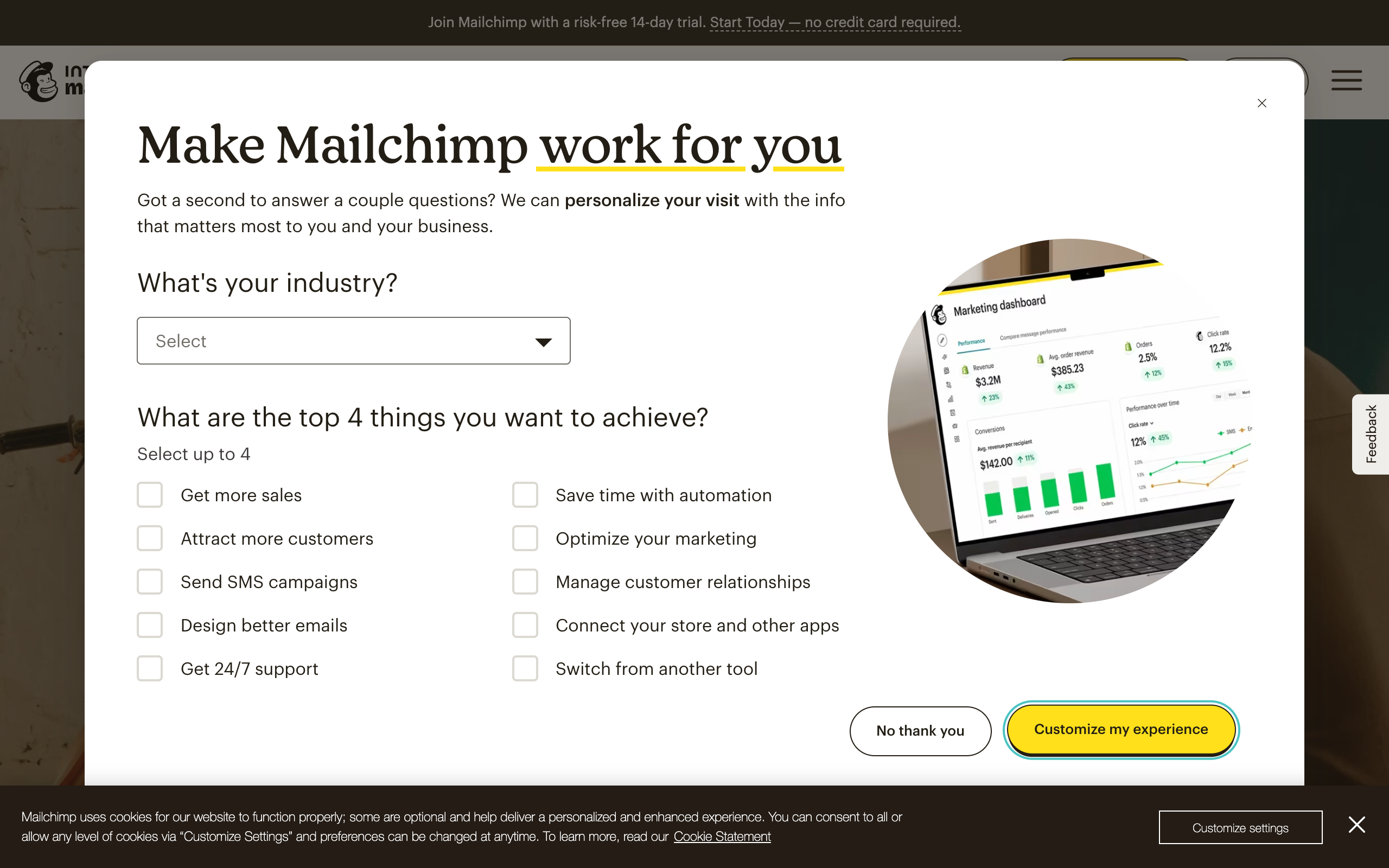
Mailchimp makes more sense when email is a straightforward broadcast and light-automation channel rather than the backbone of a sales process, and when a permanently free entry point matters while your list is still small.
- Small businesses and solo creators who want a permanently free plan while their list is small.
- Teams that prioritize design polish and template variety over automation complexity.
- Retail-focused ecommerce stores without a parallel sales-pipeline or B2B motion.
- Anyone who wants the widest pool of agencies and freelancers already familiar with the platform.
Is there a better option than both for a newsletter?
Strip away the CRM and the sales automation and ask a simpler question: where should a newsletter actually live? Neither ActiveCampaign nor Mailchimp gives your content an SEO-indexable website by default, neither has a native referral program that turns readers into a growth channel, and neither connects you to an ad marketplace where sponsors pay to reach your audience. Both were built to convert leads into customers through automated sequences, which is a different job than growing and monetizing a readership.
beehiiv exists specifically for that gap. Its free Launch plan runs to 2,500 subscribers with unlimited sends and a custom domain, and its Scale plan adds a native referral program, the Boosts marketplace for subscriber growth, and an ad network, all while taking 0% of paid subscription revenue. I cover the full hands-on details in my beehiiv review, and if you want the complete market comparison across every serious platform, my best newsletter platforms ranking covers ActiveCampaign, Mailchimp, and everything newsletter-native besides. For exact costs at your list size, the beehiiv pricing breakdown lays out every tier.
My verdict
This one comes down to whether a sales pipeline is part of your business model. If leads move through stages, get scored, and get handed to a human to close, ActiveCampaign’s built-in CRM and deeper automation are worth the higher starting price and the steeper learning curve. If you are running straightforward campaigns to a list, especially through an ecommerce storefront, without a formal sales process behind it, Mailchimp’s simpler product and permanent free tier are the more sensible fit.
Whichever way you lean, run the actual numbers through each vendor’s calculator at your real contact count before signing an annual contract, since the gap between “starts at” pricing and your real invoice tends to widen faster on ActiveCampaign than on Mailchimp’s more predictable tiers. Read the fuller feature walkthroughs in my ActiveCampaign review and Mailchimp review before signing an annual contract with either. And if what you actually run is a newsletter, not a sales funnel, both of these tools are solving a problem you do not have; my beehiiv vs ActiveCampaign comparison lays out that specific matchup if ActiveCampaign is still on your shortlist.
Start a free beehiiv publication and send your next issue from it instead of your current tool. Free to 2,500 subscribers, no card required, and you will know within two sends whether it fits your actual business better than a sales-automation platform repurposed for content.
Frequently asked questions
Is ActiveCampaign more expensive than Mailchimp? ActiveCampaign’s Starter plan (around $15/mo) is slightly cheaper than Mailchimp’s Essentials (around $13/mo) at the very entry level, but Starter caps automations at 5 actions, which most real users outgrow fast. ActiveCampaign’s Plus plan (around $49/mo), the tier most serious users need, costs more than Mailchimp’s Standard plan (around $20/mo), reflecting its deeper CRM and automation capabilities.
Does Mailchimp have a CRM like ActiveCampaign? Not really. Mailchimp offers basic contact tagging, notes, and purchase history, but no deal pipelines, sales-stage automation, or task management for a sales team. ActiveCampaign’s CRM is a genuine, if lightweight, sales pipeline tool built into the same platform as its email automation.
Which platform is easier to learn? Mailchimp has a gentler learning curve for basic campaign sending and simple automation. ActiveCampaign’s automation builder and CRM require more upfront investment to learn, but reward that investment with significantly more powerful workflows once mastered.
Does ActiveCampaign have a free plan? No. ActiveCampaign offers a 14-day free trial with no credit card required, but there is no permanent free tier. Mailchimp’s Free plan runs indefinitely at 250 contacts and 500 sends a month.
Can I migrate my list and automations between the two platforms? Contact lists migrate easily via CSV export and import on both platforms. Automation logic, CRM pipeline structures, and tags do not transfer automatically and need to be rebuilt manually in the destination platform, which is a meaningfully bigger job moving from ActiveCampaign to Mailchimp than the reverse, given ActiveCampaign’s more complex automation trees.
Is ActiveCampaign good for ecommerce? Yes, with solid Shopify and WooCommerce integrations, though it is not as ecommerce-specialized as Klaviyo. ActiveCampaign’s advantage for ecommerce brands shows up most when a wholesale or B2B sales motion runs alongside direct-to-consumer sales, since the CRM can manage both from one platform.
Does either platform support a paid newsletter or membership? No, not natively. Neither ActiveCampaign nor Mailchimp has a built-in paid subscription feature, a public website for archiving posts, or a referral program for organic growth. Both are automation and campaign tools aimed at converting leads into customers, not publishing platforms aimed at growing a readership, so a business built around a paid newsletter will outgrow either one structurally, not just financially.
Pricing captured from vendor pricing pages, July 2026. Plans change, so confirm current details before you buy.


