

The best free newsletter platform overall in 2026 is beehiiv, whose free Launch plan covers up to 2,500 subscribers with unlimited sends, a custom domain, and a real SEO-indexable website, all at $0 with no credit card required. Kit’s free plan holds more raw subscribers (10,000), Substack is free with genuinely unlimited subscribers, and Brevo’s free plan is the most generous on total contact storage (100,000). None of them is “best” in every dimension, because free plans are not one product, they are seven different companies each deciding what to give away and what to hold back. This guide lists exactly what you actually get on each free tier, verified against live pricing pages, so you can pick based on the limit that matters to your specific list. It is the free-tier-only cut of my broader ranking of the best newsletter platforms, and if you are brand new to all of this, my guide to the best platform for beginners covers ease of use on top of price.
Disclosure: some links in this post are affiliate links. If you sign up through them, we may earn a commission at no extra cost to you. That never changes our verdict.
Key takeaways
- beehiiv’s free plan is the most complete: 2,500 subscribers, unlimited sends, custom domain, and a website that Google can index, all at no cost. It is the best free plan for someone building a real, growing publication.
- Kit’s free plan has the highest subscriber ceiling in this category at 10,000, but it limits you to one basic automation, which matters if your monetization plan depends on funnels.
- Substack is free forever with unlimited subscribers and no monthly bill, but it takes 10% of any paid subscription revenue plus Stripe fees, so “free” only stays free until you start charging readers.
- Brevo’s free plan stores up to 100,000 contacts, more than any other platform here, though it caps you at 300 email sends per day, which suits large-but-low-frequency lists better than a weekly newsletter.
- Every free plan on this list eventually asks you to pay for something: more subscribers, more sends, automations, or removing platform branding. The real evaluation is not “is it free,” it is “what specifically triggers the first bill.”
The 9 best free newsletter platforms, compared
| Platform | Free plan limit | Send limit | What triggers the first bill | Paid plan starts at |
|---|---|---|---|---|
| beehiiv | 2,500 subscribers | Unlimited | Growth tools (referrals, Boosts, ad network) or exceeding 2,500 subscribers | $43/mo |
| Kit | 10,000 subscribers | Unlimited broadcasts | Needing more than 1 automation, or removing Kit branding | $33/mo |
| Substack | Unlimited subscribers | Unlimited | Never bills directly; takes 10% of paid subscription revenue instead | No paid tier, revenue share only |
| Brevo | 100,000 contacts stored | 300 emails/day (~9,000/mo) | Needing more daily sends or removing Brevo branding | $9/mo |
| MailerLite | 250 subscribers | 2,500 emails/mo | Exceeding 250 subscribers or needing more automations | $12/mo |
| Mailchimp | 250 contacts | 500 sends/mo | Exceeding 250 contacts or needing multiple audiences | $13/mo |
| Klaviyo | 250 contacts | 500 sends/mo | Exceeding 250 contacts, common fast for ecommerce lists | Around $20/mo |
| Buttondown | 100 subscribers | 1 email/day fair-use cap | Exceeding 100 subscribers, or wanting tagging, analytics, or paid subs | Scales with subscribers; add-ons from $9/mo |
| Ghost | Unlimited (self-hosted) | Unlimited (your own server) | Wanting managed hosting instead of self-hosting | $18/mo (Ghost Pro Starter) |
Of every free plan in this table, beehiiv’s is the one built for an actual growing publication rather than a stripped-down trial. Open a free beehiiv account and send your first issue today. No card required, 2,500 subscribers included, and nothing about the free plan is a countdown timer in disguise.
How did I evaluate these free plans?
Free newsletter tools tend to get compared as if “free” is a single, comparable feature, and it is not. I checked each platform’s live pricing page in July 2026 and scored the free tier against four questions that actually predict whether it will work for a real newsletter.
- What is the actual subscriber or contact ceiling, and how is it measured? Some platforms count total contacts stored, others count only active/subscribed contacts, and that distinction changes your real runway significantly.
- Is there a send limit separate from the subscriber limit? A free plan can look generous on subscriber count and then quietly cap you at a handful of sends a month, which makes a weekly newsletter impossible.
- What does the free plan withhold, specifically? Automations, custom domains, and analytics depth vary a lot between “free” tiers, and the missing pieces matter more than the headline subscriber number in some cases.
- Does the free plan expire, or is it free forever? Some of the platforms marketed here as “free” are actually time-limited trials in disguise. I flagged every one that is not a genuine forever-free tier.
1. beehiiv: the most complete free newsletter plan

beehiiv’s free Launch plan is built to run a real newsletter, not to demo one. It covers up to 2,500 subscribers with genuinely unlimited sends, no monthly cap that quietly throttles a growing list. You also get a custom domain, a full SEO-indexable website for your posts, and access to the recommendation network, all without a credit card, verified on beehiiv’s live pricing page in July 2026.
What is missing on the free tier, specifically: the referral program, the Boosts marketplace, the ad network, and email automations all require the paid Scale plan, which starts at $43/month ($517/year on annual billing). That is a real and intentional line. beehiiv gives away everything you need to write, send, and be found by search engines for free, and charges only once you want the growth machinery on top. For most people testing whether a newsletter is worth pursuing at all, that free tier is enough runway to find out.
- Free plan (verified July 2026): 2,500 subscribers, unlimited sends, custom domain, SEO-indexable website, recommendation network.
- Verdict: the best free plan for anyone building a real, growing publication rather than testing a demo. Full hands-on details in my beehiiv review, and the complete paid-tier breakdown in beehiiv pricing explained.
2. Kit: the highest free subscriber ceiling
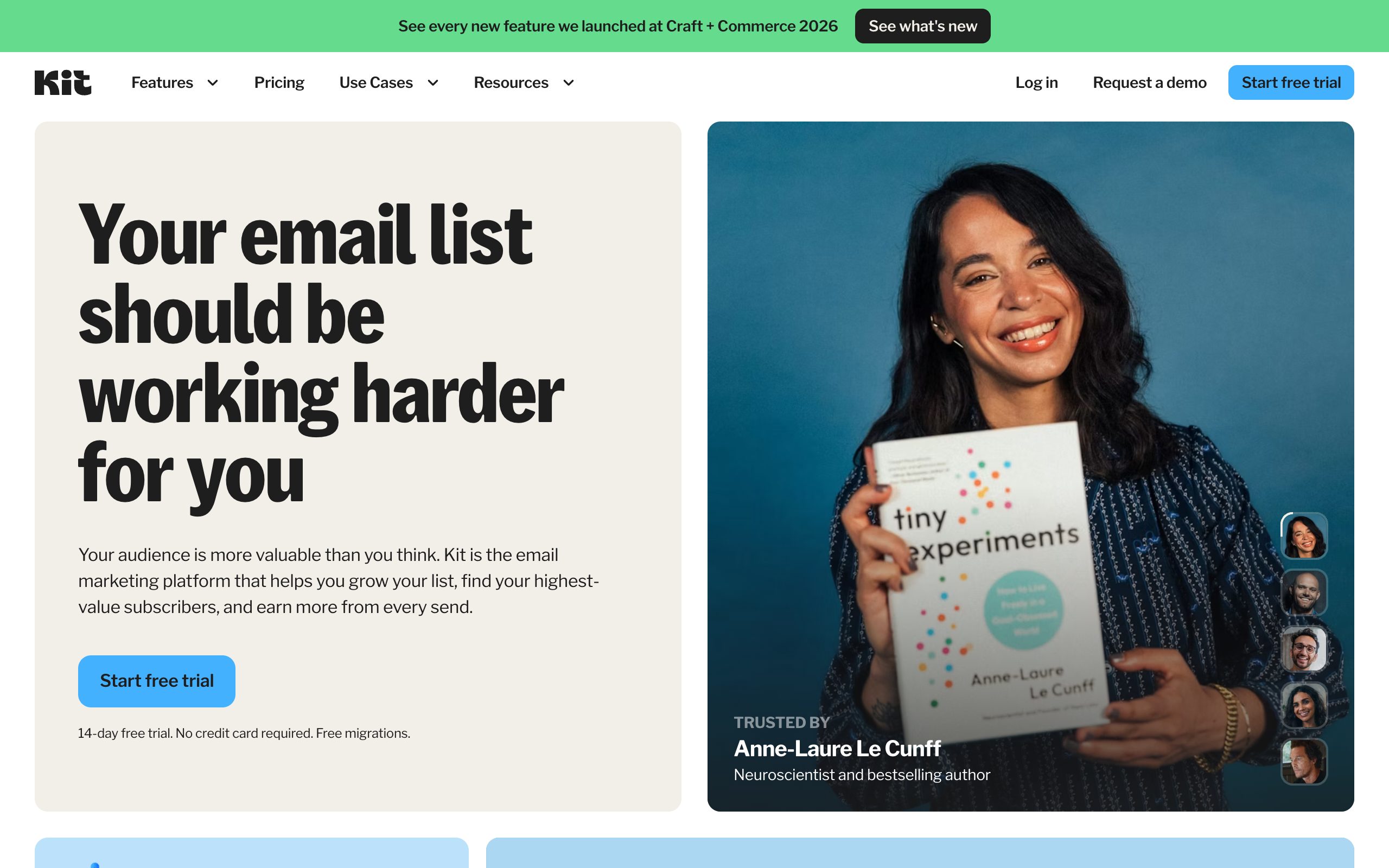
If raw subscriber headcount is the only number you care about, Kit wins outright. The free Newsletter plan covers up to 10,000 subscribers, four times beehiiv’s ceiling, with unlimited email broadcasts, landing pages, and forms, verified on Kit’s pricing page in July 2026. For a beginner or a creator with an existing large list migrating in from somewhere else, that number alone can be the deciding factor.
The catch is depth, not breadth. The free plan includes exactly one basic visual automation, so anything resembling a real welcome sequence or tagging-based funnel requires the paid Creator plan at $33/month. Kit’s free tier is generous on subscriber count and narrow on what you can automate, which is the inverse of beehiiv’s tradeoff.
- Free plan (verified July 2026): 10,000 subscribers, unlimited broadcasts, landing pages, and forms, 1 basic automation.
- Verdict: the best free plan by subscriber count alone, best suited to creators planning to sell digital products once they upgrade.
3. Substack: free forever, no bill until you charge readers
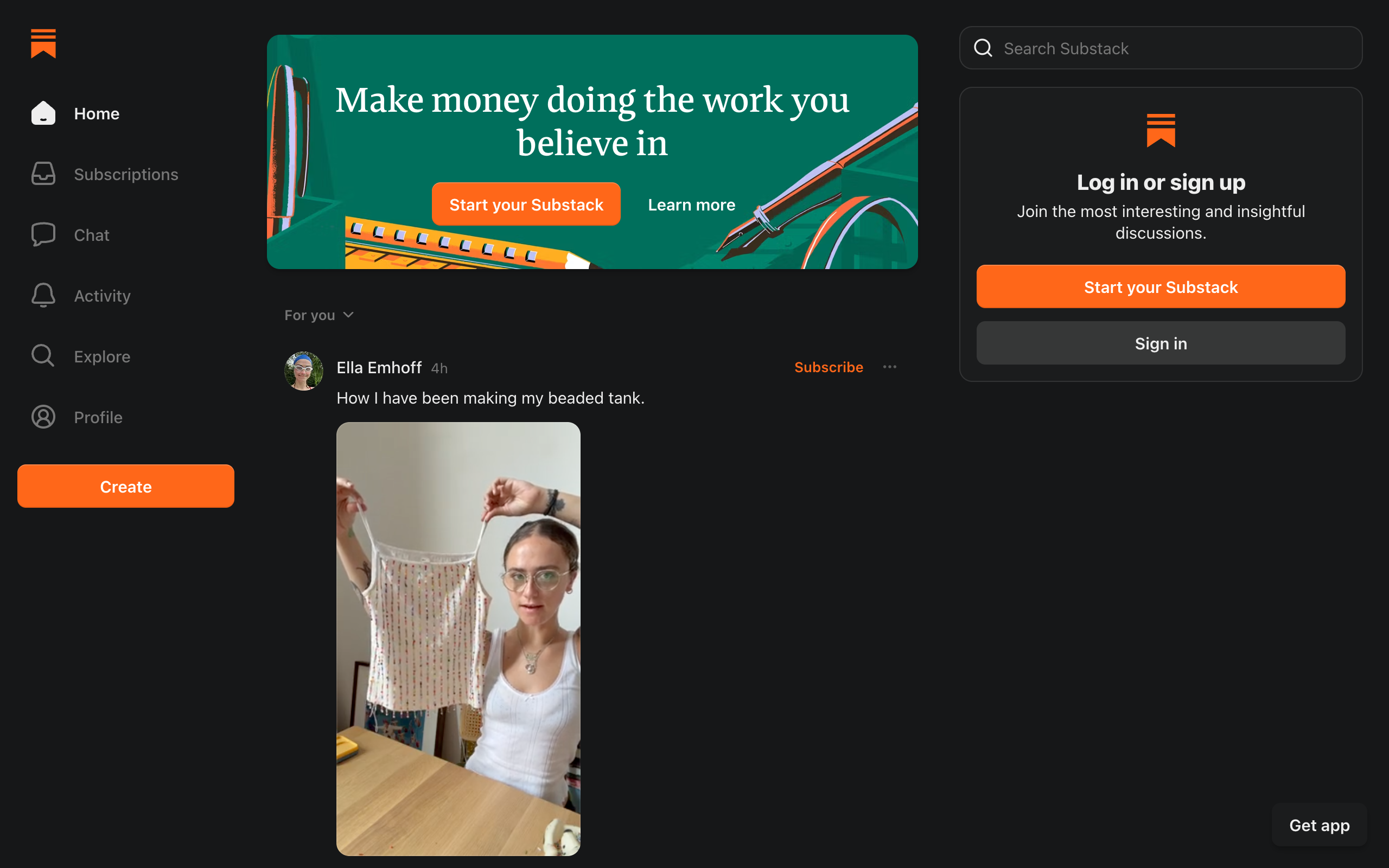
Substack is structurally different from every other platform on this list: there is no paid subscription tier at all. You never hit a subscriber ceiling, a send limit, or a feature wall, because Substack is free with unlimited subscribers, per Substack’s own creator documentation. Instead, Substack makes money by taking 10% of your paid subscription revenue plus Stripe’s processing fees, only if and when you decide to charge readers.
That means Substack is the cheapest option imaginable for a newsletter that never plans to charge for content, and one of the more expensive options once it does. A newsletter earning $1,500 a month in paid subscriptions pays Substack $150 a month indefinitely; the same list on beehiiv’s Scale plan would cost a flat $43 a month with 0% taken from that revenue. I break the exact crossover math down in beehiiv vs Substack.
- Free plan (verified July 2026): unlimited subscribers, unlimited sends, no monthly fee, ever.
- Verdict: the best free option for a newsletter that will never charge readers directly; the most expensive “free” option the moment it does.
4. Brevo: the largest free contact storage
Brevo’s free plan flips the usual free-tier math. Instead of capping total contacts low, it lets you store up to 100,000 contacts at no cost, more than any other platform in this list, and caps you instead on daily sending volume: 300 emails per day, or roughly 9,000 a month, verified on Brevo’s pricing page in July 2026. No credit card is required, and the plan is free forever, not a trial.
That tradeoff makes Brevo’s free plan unusually good for a large but infrequently emailed list (a big customer database you email monthly rather than a subscriber list you email weekly), and less useful for a fast-growing daily or twice-weekly newsletter that will bump into the 300-per-day ceiling quickly as the list scales. Once you outgrow it, Starter plans begin at $9 a month for 5,000 emails a month, one of the lowest paid entry points of any platform here.
- Free plan (verified July 2026): up to 100,000 contacts stored, 300 emails/day, no card required, free forever.
- Verdict: the best free plan for a large, infrequently emailed list; not built for a high-frequency newsletter at scale. Try Brevo’s free plan to see whether the send cadence fits your list.
5. MailerLite: a small but genuinely usable free plan
MailerLite’s free plan covers 250 subscribers and 2,500 emails a month, verified on MailerLite’s pricing page in July 2026, small compared to beehiiv or Kit, but it is a complete, real product rather than a stripped demo: you get the full drag-and-drop editor, basic automations, a landing page, and a website, all included. For a very early newsletter with a tiny list, that completeness matters more than the raw ceiling.
Once you exceed 250 subscribers, the paid Comfort plan starts at $12 a month, one of the cheaper first-paid-tier prices in this comparison, so the jump off the free plan is gentle rather than a shock.
- Free plan (verified July 2026): 250 subscribers, 2,500 emails/month, full editor and automation access.
- Verdict: a complete, not-stripped-down free plan for a very early newsletter, with a cheap and gentle upgrade path.
Free plans are worth comparing on paper, but the only way to know which editor and workflow actually fit how you write is to open one. Create a free beehiiv publication and send a real test issue this week. It costs nothing and takes less time than finishing this article.
6. Mailchimp: the free plan that shrank
Mailchimp‘s free plan is the one most people still expect to be generous, based on its reputation from years ago, and it no longer is. The current free tier covers just 250 contacts and 500 sends a month, verified on Mailchimp’s pricing page in July 2026, a fraction of what long-time users remember. It is workable for a genuinely tiny list, and cramped for almost anything else.
What you do get on the free plan: basic campaign building, a single audience, and one user seat. What you do not get: automation journeys, multiple audiences, or the AI features Mailchimp pushes on paid tiers. Once you exceed 250 contacts, Essentials starts at $13 a month.
- Free plan (verified July 2026): 250 contacts, 500 sends/month, 1 audience, 1 seat.
- Verdict: usable only for a very small list; most people outgrow it faster than they expect. Full comparison in beehiiv vs Mailchimp.
7. Klaviyo: free, but built for ecommerce, not newsletters
Klaviyo’s free plan mirrors Mailchimp’s ceiling almost exactly: 250 contacts and 500 email sends a month, with a small allotment of SMS credits included. For an ecommerce store that also wants abandoned-cart flows and purchase-based segmentation, Klaviyo’s free tier is a legitimate way to test the platform before committing. For a pure content newsletter, it is one of the tightest free plans in this comparison, and Klaviyo’s paid tiers, starting around $20 a month for the next contact bracket, climb faster than most of the platforms here because pricing is built around ecommerce revenue, not newsletter list size.
- Free plan: around 250 contacts, 500 sends/month, small SMS credit included.
- Verdict: skip it for a content newsletter; consider it only if your list doubles as an ecommerce customer database.
8. Buttondown: free, tiny, and genuinely minimal
Buttondown‘s free plan covers your first 100 subscribers, the smallest ceiling in this comparison, verified on Buttondown’s pricing page in July 2026. What you get for that: a clean Markdown editor, a hosted archive, and custom domain sending, with no growth-hacking features cluttering the interface. The free plan also assumes light sending volume; heavier daily sending pushes you toward a paid tier faster than the subscriber count alone would suggest.
Past 100 subscribers, pricing scales with your active list, and specific features (tagging, analytics, paid subscriptions) are $9-a-month add-ons each, so a Buttondown user who wants several of those at once ends up paying more than the base number implies.
- Free plan (verified July 2026): 100 subscribers, core editor and archive included.
- Verdict: the smallest but most genuinely calm free plan here, best for a personal newsletter with a tiny, known audience.
9. Ghost: free if you are willing to self-host
Ghost is open source, which means the platform itself is free with no subscriber ceiling at all, as long as you self-host it on your own server. That is a genuinely unlimited free option, unlike every other entry on this list, but it comes with real technical overhead: server setup, email deliverability configuration, and ongoing maintenance that a non-technical beginner should not underestimate.
For anyone who does not want to manage a server, Ghost(Pro) managed hosting starts at $18 a month ($216 a year) for up to 1,000 members on the Starter plan, verified on ghost.org in July 2026, with 0% taken from membership revenue either way.
- Free plan: unlimited, if self-hosted; requires server setup and technical maintenance.
- Verdict: a real free option only for technical users willing to run their own infrastructure; everyone else should budget for Ghost(Pro).
Free versus cheap: which one should you actually be comparing?
Free and cheap solve different problems, and conflating them leads to the wrong pick more often than any other mistake in this category. A free plan is right when you genuinely do not know yet whether your newsletter will find an audience, and you want to test that with zero financial risk. A cheap paid plan is right once you already know the newsletter is working and you are optimizing cost per subscriber at a list size the free tier cannot hold.
The confusion happens because some “free” platforms are really trials with a countdown (Constant Contact and AWeber, for example, offer no permanent free plan, only 14-day trials), while some genuinely free platforms only look expensive later because their paid tiers scale steeply with list size. If your actual question is which platform costs the least once you are past the free tier and paying real money, that is a different comparison with a different winner; I break down the cheapest entry-level paid plans, and what each one actually costs at 1,000, 5,000, and 10,000 subscribers, in my cheapest newsletter platform guide.
Which free newsletter platform should you actually pick?
- You want the most complete free plan with room to grow: beehiiv, 2,500 subscribers, unlimited sends, website included.
- You have (or expect) a very large list and want the highest free ceiling: Kit, 10,000 subscribers.
- You never plan to charge readers and want zero monthly bill, ever: Substack.
- You have a big contact list but send infrequently: Brevo, 100,000 contacts stored.
- You want a small, complete, no-catch free plan to start tiny: MailerLite.
- You are technical and want a truly unlimited free option: Ghost, self-hosted.
Frequently asked questions
What is the best free newsletter platform? beehiiv offers the most complete free plan: 2,500 subscribers, unlimited sends, a custom domain, and an SEO-indexable website, all at no cost. Kit’s free plan holds more raw subscribers (10,000) but with only one basic automation, and Substack is free forever with unlimited subscribers but takes 10% of paid subscription revenue.
Is beehiiv actually free? Yes, the Launch plan is free up to 2,500 subscribers with unlimited sends and no credit card required. The paid Scale plan, from $43/month, is only needed for growth features like the referral program, Boosts, and automations.
Which free newsletter platform has no subscriber limit? Substack has no subscriber limit and no monthly fee at any list size, though it takes 10% of paid subscription revenue. Ghost is also unlimited if you self-host it yourself, which requires technical setup.
Do free newsletter platforms show ads or branding? Most do, in the form of a “powered by” footer or logo (beehiiv, Kit, Brevo, MailerLite, Buttondown, Mailchimp all include branding on free or entry tiers). Removing that branding typically requires a paid plan.
What is the catch with free newsletter platforms? Each one holds back something different: a subscriber ceiling, a send-volume cap, automation limits, or a revenue share instead of a subscription fee. Reading the specific limit that applies to your list size and sending frequency matters more than trusting the word “free” alone.
Can I run a paid newsletter on a free plan? Only on Substack, which lets you charge subscribers for free (minus its 10% cut). beehiiv, Kit, and Ghost all require a paid platform tier before you can accept paid subscriptions or memberships.
The bottom line
“Free” is not a single feature you can rank platforms on; it is seven different companies deciding what to give away to get you in the door. beehiiv gives away the most complete newsletter product. Kit gives away the most subscriber headroom. Substack gives away everything and takes a cut only when you succeed. None of that is a trick, it just means the right free plan depends on which constraint actually matters for your list: total subscribers, sends per month, or whether you plan to charge anyone at all.
Match the free plan to the constraint you actually have today, not the one you might have in two years, and switch when you outgrow it. Every platform here exports a CSV.
Start a free beehiiv publication and send your first issue this week. Free to 2,500 subscribers, no card required, and the free plan is a real product, not a countdown to a sales call.
Pricing captured from vendor pricing pages, July 2026. Plans change, so confirm current details before you buy.


