

Most “Microsoft Copilot alternatives” searches come from one of two places. Either the per-seat bill just landed and someone did the headcount math out loud in a budget meeting, or a team rolled Copilot out expecting an AI coworker and got a very capable writing assistant embedded in Word and Outlook instead, useful, but not what they pictured when they heard “Copilot.” Both reactions are fair. Copilot is genuinely excellent at what it is built for: drafting and summarizing inside the Microsoft 365 apps your team already has open. It is not built to independently execute a task across Stripe, HubSpot, and GitHub, and it was never trying to be.
I went through five real alternatives here, each assessed on what it actually does well and where it falls short, not a rewritten features list. Viktor tops it for the specific case of wanting execution rather than drafting, but the honest answer for a few readers here is going to be a different tool, and I would rather tell you that now than after you have signed a contract.
Disclosure: some links in this post are affiliate links. If you sign up through them, we may earn a commission at no extra cost to you. That never changes our verdict.
The short answer
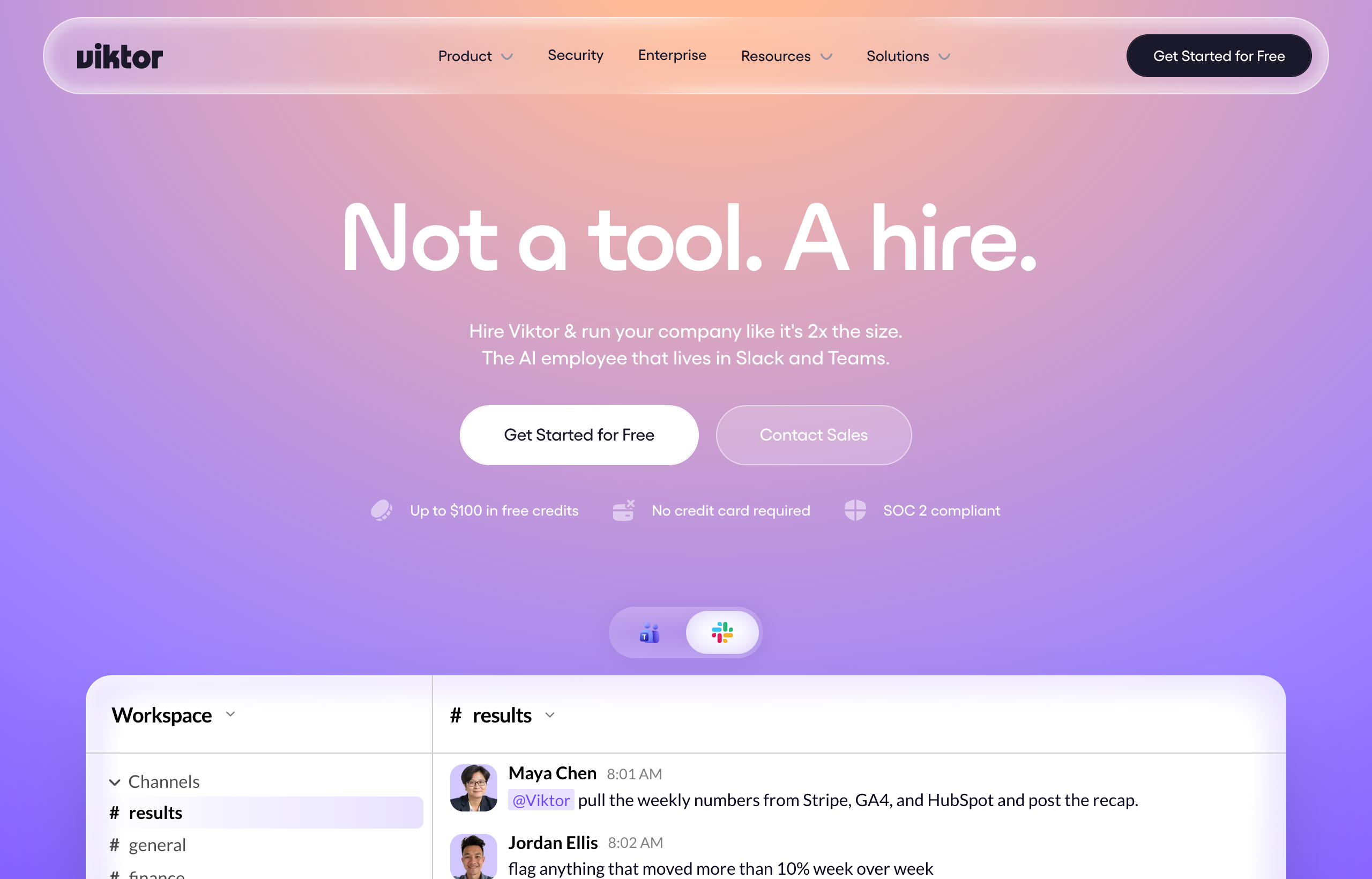
Viktor is the best all-around Copilot alternative if you want an AI teammate that executes across your whole stack, not just inside Microsoft’s apps, and you do not want the bill to scale with every new hire. It lives in Slack or Microsoft Teams, connects to more than 3,200 tools, and is priced by workspace credits rather than per seat. If your need is specifically better AI search over your company’s existing knowledge, Glean is the stronger fit. If your team already lives inside Notion for documentation and wikis, Notion AI is the more natural add. If you want a general-purpose chatbot upgrade without the agentic layer, ChatGPT Enterprise is the safer, simpler pick. And if what appealed to you about Copilot was a personal-assistant feel more than document drafting, Lindy is worth a look. The rest of this article breaks down all five honestly.
If your actual complaint about Copilot is “it drafts, but I still have to go do the work myself,” skip ahead and start Viktor’s free trial with $100 in credits. Give it one task that currently requires pulling data from more than one system and see whether execution beats drafting for your specific job.
Microsoft Copilot alternatives compared at a glance
| Tool | Best for | Interface | Starting price |
|---|---|---|---|
| Viktor | Cross-tool execution from Slack or Teams, no per-seat pricing | Chat in Slack or Microsoft Teams | Around $50/mo (20,000 credits), $100 free trial credits |
| ChatGPT Enterprise | Teams wanting a general-purpose AI upgrade with strong security controls | Standalone chat app, web and desktop | Custom, quote-based per seat; contact OpenAI sales |
| Glean | Enterprise search and assistant over your company’s existing knowledge | Search bar plus assistant, integrated across company apps | Custom, quote-based; typically enterprise-tier budgets |
| Notion AI | Teams already living in Notion for docs, wikis, and project pages | Embedded inside Notion pages and databases | Bundled into Notion Business at around $20/member/month |
| Lindy | Personal-assistant-style automation: inbox, scheduling, meeting notes | Visual builder, plus iMessage/SMS chat with the finished assistant | Around $49.99/month (Plus tier) |
1. Viktor: the best Copilot alternative for cross-tool execution

Viktor is an AI employee that lives inside Slack and Microsoft Teams and does the work rather than drafting a version of it for you to finish. Where Copilot reads the Word doc or Excel sheet you already have open, Viktor goes and gets the information itself, from Stripe, HubSpot, Salesforce, Google Ads, Meta Ads, GitHub, Linear, Jira, and more than 3,200 tools in total, and comes back with a finished result: a reconciled report, a deployed internal tool, a written and opened pull request, a scheduled recurring task.
The pricing model is the other structural difference. Copilot’s Business add-on is per seat, roughly $25 a month per person on top of an existing Microsoft 365 Business license, so the bill grows exactly in step with headcount whether or not everyone actually uses it. Viktor is priced in workspace-wide credits, so a smaller team that uses it heavily can pay a similar or higher amount than a larger team that uses it lightly, but the number is never simply “seats times price.”
Honest weakness: credit-based billing is genuinely harder to predict than a flat per-seat number. The entry tier starts around $50 a month, but a real project can burn 2,000 to 5,000 credits, and an actively-used team commonly lands closer to $300 to $750 a month once work is actually flowing through it. It is also a conversational tool, not something embedded inline in a Word or Excel file, so if what you specifically want is help while typing inside a document, that is not the moment Viktor is built for.
Best for: teams whose real bottleneck is execution across multiple systems, not drafting inside Office files, and who want pricing that does not multiply with every new hire.
Viktor’s free trial gives you $100 in credits that never expire, no card required. That is usually enough to run several real tasks and see the credit math for your own workload before you commit.
2. ChatGPT Enterprise: the safer general-purpose upgrade
ChatGPT Enterprise is the obvious default for a company that wants to give its whole team access to a strong general chatbot with enterprise-grade security, data controls, and admin tooling, without betting on a newer or narrower category of tool. It is not tied to Microsoft’s ecosystem, so it works equally well for a team on Google Workspace, a mixed stack, or anything else, and its writing, reasoning, and coding help holds up well against Copilot’s for general tasks that are not specifically about editing a live Office file.
What it does not do is act as an agent that independently plans and executes multi-step tasks across your business tools the way Viktor does. It has connectors and increasingly capable “agent mode” features for research and browsing tasks, but as a default enterprise deployment, most teams use it the way they used Copilot: as a very good assistant you prompt and then act on yourself, not a coworker you hand a task to and walk away from.
Best for: companies that want one strong, vendor-neutral general AI assistant deployed company-wide with solid admin and security controls, and are not specifically trying to replace document-embedded drafting or agentic execution.
3. Glean: enterprise search built into an assistant
Glean solves a different problem than Copilot solves, and it is worth being precise about which one you actually have. If your pain is “our company’s knowledge is scattered across Slack, Confluence, Google Drive, Salesforce, and a dozen other systems, and nobody can find anything,” Glean’s enterprise search, unified across all of those sources with a permission-aware assistant layered on top, is purpose-built for exactly that. It genuinely finds the right document, the right Slack thread, or the right ticket faster than a person manually searching six different tools.
What Glean is not built to do is execute a task the way Viktor does. It is search and retrieval with an assistant on top, answering questions grounded in what already exists in your systems, rather than going out and doing new work: pulling live data, writing code, building a deployed app. If your actual need is “find the answer,” Glean is the better fit. If your need is “go do the thing,” it is the wrong tool for that job.
Best for: larger organizations with knowledge scattered across many internal systems who need a unified, permission-aware search and assistant layer, not task execution.
4. Notion AI: the right pick if your team already lives in Notion
Notion AI is embedded directly inside Notion’s docs, wikis, and databases, and for a team that already runs its documentation, project tracking, and internal wiki inside Notion, that in-context placement is genuinely valuable in the same way Copilot’s placement inside Word is valuable: no new app, no new tab, help exactly where the writing already happens. It is now bundled into Notion’s Business plan at around $20 per member per month rather than sold as a separate add-on, which simplifies the buying decision if you are already on or considering that tier.
The honest limitation mirrors Copilot’s: Notion AI’s job is to help you write, summarize, and organize inside Notion pages, not to reach outside Notion and execute a task across Stripe, GitHub, or your ad platforms. Notion has started shipping early “Custom Agents” and “Workers” features that move toward more agentic behavior, but as of this writing those are newer, credit-metered additions layered on top of the core writing assistant, not a mature, ready-made cross-tool coworker like Viktor.
Best for: teams whose documentation and knowledge base already live in Notion and want writing and organizing help in that exact context.
5. Lindy: for a personal-assistant feel over document drafting
Lindy is worth including here specifically because some Copilot searchers are not actually looking for better document drafting, they are looking for something that feels more like delegating to a personal assistant: inbox triage, scheduling, meeting notes turned into action items, reachable over iMessage or SMS rather than embedded in a Word file. Lindy’s visual builder lets you wire up exactly that kind of repeatable automation, and its $49.99 a month Plus tier is a flat, predictable price with no usage math.
The tradeoff against both Copilot and Viktor is that Lindy is not built to draft inside Office documents the way Copilot is, and it is not built to execute broad, cross-system business tasks (pulling ad spend, reconciling invoices, writing code) the way Viktor is. It is strongest in a narrower lane: communication and scheduling-shaped work you are willing to configure once on a canvas.
Best for: a solo operator or small team that wants a personal-assistant-style automation for inbox, calendar, and meetings, configured visually rather than conversationally.
What actually pushes people to search for Copilot alternatives
Two patterns show up over and over in this decision. The first is the per-seat math: Copilot’s Business add-on is roughly $25 a person a month on top of a Microsoft 365 subscription you must already own, which means a fifty-person rollout is a real line item whether or not most of those fifty people use it daily. Teams that adopt Copilot broadly and then measure actual usage often find a lot of dormant seats, and that gap is what sends people searching.
The second is a mismatch between what people expect from the word “Copilot” and what the product actually does. “AI copilot for my business” sounds like it should mean an agent that goes and does things. What Microsoft built is a genuinely strong writing and summarizing assistant embedded in Office apps, which is a different and narrower job than “goes and does things across my whole stack.” Neither expectation is wrong, they are just answering different questions, which is exactly why this list includes both drafting-shaped alternatives (Notion AI, ChatGPT Enterprise) and execution-shaped ones (Viktor).
How to actually choose
- Is your pain drafting or execution? If you want better writing and summarizing inside documents you already work in, look at ChatGPT Enterprise or Notion AI depending on which app your team lives in. If you want the AI to go get data and finish the task itself, Viktor is built for that.
- Is your pain finding information or acting on it? If the real problem is that nobody can locate the right document or thread across a sprawling internal system, Glean solves that specific problem better than any tool on this list.
- Does cost need to scale with usage or with headcount? If you have a lot of light users, per-seat pricing (Copilot, ChatGPT Enterprise) can be more predictable. If you have a smaller team doing heavy, real work, workspace-wide credit pricing (Viktor) can end up cheaper and scales with output, not badges.
For the direct head-to-head against the tool that likely sent you here, read our full Viktor vs Microsoft Copilot comparison. Our hands-on Viktor review covers the strengths and the real credit-cost weaknesses in more depth, and if Microsoft Teams specifically, not Office documents, is where your team coordinates, our best AI assistants for Microsoft Teams roundup is the more targeted comparison. The wider best AI agents of 2026 ranking places all of the agentic options against the full category.
If you have read this far, you likely already know whether your problem is drafting or execution. If it is execution, take that exact task to Viktor’s free trial this week and see what comes back.
Frequently asked questions
What is the best alternative to Microsoft Copilot?
Viktor is the best overall alternative for teams that want an AI teammate to execute tasks across tools outside the Microsoft ecosystem, without per-seat pricing. For teams that specifically want better in-document writing help, Notion AI or ChatGPT Enterprise are closer substitutes depending on which app the team already lives in.
Is there a free alternative to Microsoft Copilot?
Viktor offers $100 in non-expiring free trial credits with no card required, enough to run several real tasks before paying anything. ChatGPT and Notion both offer limited free tiers of their AI features, though the fuller capabilities sit behind paid plans.
Why would a team switch from Copilot to Viktor?
The most common reason is wanting execution rather than drafting. Copilot is strong at writing and summarizing inside Word, Excel, PowerPoint, and Outlook, but it does not independently plan and execute multi-step work across third-party tools like Stripe, HubSpot, or GitHub the way Viktor is built to.
Does Copilot work outside Microsoft 365 apps?
Its core strength is inside Microsoft 365 apps and the Microsoft Graph (your Outlook email, your Teams chats, your OneDrive and SharePoint files). Reaching into third-party tools outside that ecosystem is not its core design, which is the gap tools like Viktor and Glean fill in different ways.
Which Copilot alternative is cheapest for a small team?
It depends on usage. Viktor’s entry tier starts around $50 a month workspace-wide, which can be cheaper than paying per seat for a small team if usage stays moderate. Lindy’s flat $49.99 a month Plus tier is also inexpensive for a solo user or very small team focused on personal-assistant-style tasks.
The bottom line
Every tool on this list is a legitimate pick for someone, and the “Microsoft Copilot alternatives” search usually resolves into one of two real questions: do you want better writing help inside a different app, or do you want to stop drafting altogether and have something go do the work. If it is the second, Viktor is the clearest answer, especially once you factor in pricing that scales with usage rather than headcount. If it is the first, Notion AI or ChatGPT Enterprise are the more direct substitutes depending on where your team already writes.
Start Viktor’s free trial, $100 in credits, no card needed, and hand it the task that made you start comparing Copilot alternatives in the first place.
Pricing and feature details reflect each company’s public pages as of July 2026. Plans and prices change, confirm current details on each provider’s site before you buy.


