

The first time I asked Microsoft 365 Copilot to help with a board update, it did exactly what it is built to do: it opened inside PowerPoint, read the Excel tab I already had pinned, and drafted a clean slide from data that was already sitting on my machine. Genuinely useful, zero setup. The first time I asked Viktor for the same thing, I typed one line into a Slack channel, and it went and pulled the numbers itself from Stripe and Google Ads, numbers that were not open in any file on my computer, and came back with a finished summary twenty minutes later. Neither tool is “better” in the abstract. They are answering two different questions: one drafts inside the document you already have open, the other goes and gets the document for you. That difference is the entire Viktor vs Copilot decision, and almost nobody frames it that plainly.
I have used both for real work over the past few weeks, not demo tasks. Copilot for drafting Teams meeting recaps, summarizing long email threads, and building first-pass Excel formulas. Viktor for pulling cross-platform reporting, reconciling data between systems, and shipping small deliverables that used to take a person half a day. This is a straight comparison of what each one is actually for, where the other genuinely wins, and who should pick which.
Disclosure: some links in this post are affiliate links. If you sign up through them, we may earn a commission at no extra cost to you. That never changes our verdict.
The 30-second verdict
Pick Microsoft 365 Copilot if your work happens inside Word, Excel, PowerPoint, Outlook, and Teams, and you want AI assistance embedded directly in those apps. It reads your actual files, your actual calendar, and your actual inbox through the Microsoft Graph, drafts inside the tools your whole company already has open, and requires zero new habits to adopt. If your job is mostly “help me write this and summarize that inside Office,” Copilot is a strong, native fit.
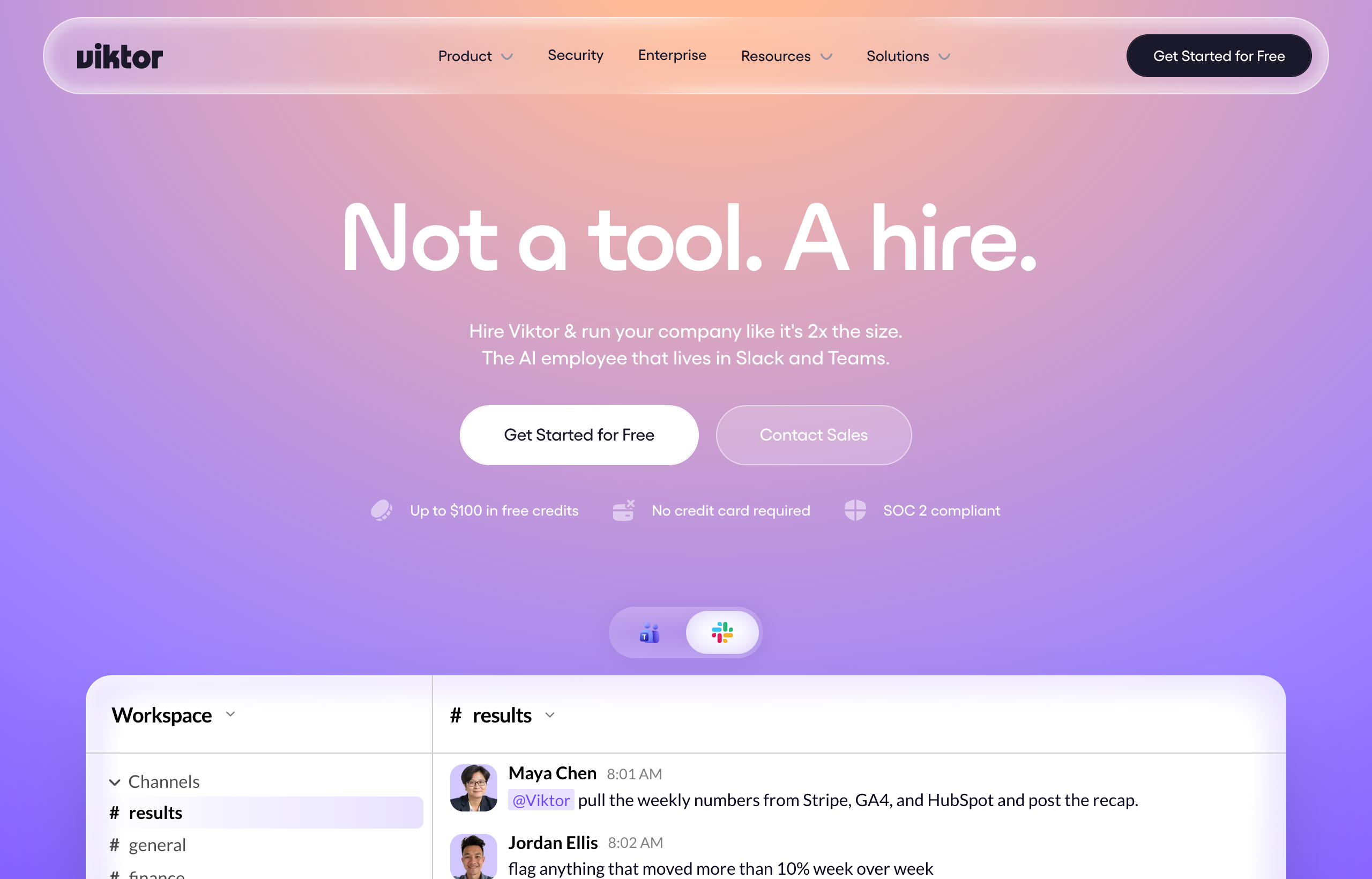
Pick Viktor if you want an AI teammate that executes across your entire stack, not just inside Microsoft’s apps, and you do not want the bill to grow every time you add a person. Viktor lives in Slack or Microsoft Teams, connects to more than 3,200 tools including Stripe, HubSpot, Salesforce, GitHub, Google Ads, and Meta Ads, and does not just draft, it pulls the data, builds the deliverable, and can write code or deploy a small app. It is workspace-priced by credits rather than per seat, so a ten-person team and a thirty-person team on the same tier pay the same amount.
These are not really fighting for the same budget line. A lot of teams end up running both: Copilot for in-document drafting because it is bundled into a license they likely already pay for, and Viktor for the cross-tool execution work that Copilot was never built to do.
If most of your frustration is “I keep asking for something and getting a draft I still have to go execute myself,” start with Viktor’s free $100 in credits and hand it one real task this week, something with a clear finished output like a cross-platform ad spend report. No card required, and the credits do not expire.
Viktor vs Microsoft 365 Copilot at a glance
Prices below are current as of when this was written, pulled from each company’s live pricing pages. Microsoft and Viktor both update pricing periodically, so treat the numbers as directionally correct and check the source pages before you budget against them.
| Viktor | Microsoft 365 Copilot | |
|---|---|---|
| Core interface | Slack or Microsoft Teams channel, you talk to it like a coworker | Embedded directly inside Word, Excel, PowerPoint, Outlook, and Teams |
| How it works | Describe an outcome, it plans and executes across connected tools | Assists inside the document, email, or meeting you already have open |
| Free trial | $100 in credits, no card required, credits do not expire | No free trial for the paid add-on; Copilot Chat’s free tier is limited |
| Entry price | Around $50/month for 20,000 workspace credits | Around $28.20/user/month for Business Standard with Copilot bundled, billed monthly (around $23.50/user/month billed annually) |
| Add-on price | N/A, Viktor is standalone | Around $25.20/user/month billed monthly (around $18/user/month billed annually) as an add-on to an existing Microsoft 365 Business plan you must already own |
| Pricing model | Credit-based, workspace-wide, no per-seat charge | Strictly per-seat, cost scales linearly with headcount |
| Integrations | 3,200-plus, including Stripe, HubSpot, Salesforce, GitHub, Google Ads, Meta Ads, Linear, Jira, Notion, Google Drive | Deep inside the Microsoft 365 ecosystem (Word, Excel, PowerPoint, Outlook, Teams, SharePoint); limited native reach outside Microsoft’s own stack |
| Deliverables | Deployed web apps with database and auth, code and pull requests, dashboards, reports pulled from live data, scheduled recurring tasks | Drafted documents, slide decks, spreadsheet formulas, meeting recaps, email drafts, all inside the native Office file |
| Best at | Cross-tool execution: pull data from several systems, do something with it, ship the result | In-the-flow assistance: writing, summarizing, and formula help inside a file you already have open |
| Lives in | Slack, Microsoft Teams | Word, Excel, PowerPoint, Outlook, Teams, SharePoint, Windows (Copilot key) |
One row explains most of the decision better than any paragraph could: pricing model. Copilot is per seat, so a fifty-person rollout costs roughly fifty times a one-person rollout. Viktor is workspace-wide credits, so the cost tracks how much work the team actually asks for, not how many badges are in the building. Which model is better for you depends entirely on whether your team is small-and-heavy-usage or large-and-light-usage.
What Microsoft 365 Copilot actually does well

Credit where it is due, because a comparison that pretends the incumbent is bad is not being straight with you. Copilot’s genuine advantage is that it is not a separate app you have to remember to open. It is baked into Word, Excel, PowerPoint, Outlook, and Teams, the exact software most white-collar teams already spend their day inside.
Zero-friction adoption. There is no new interface to learn. If your team already knows how to use the Office ribbon, they already know roughly how to use Copilot, it just shows up as a pane inside the app. That single fact makes Copilot one of the easiest AI tools in the entire market to roll out to a non-technical workforce, because “click the Copilot icon in the top corner of the Word doc you already have open” requires almost no training.
It reads your real context through the Microsoft Graph. Copilot has direct access to your actual calendar, your actual email threads, your actual OneDrive and SharePoint files, and your actual Teams chat history, when your organization’s permissions allow it. Ask it to summarize “what did the team decide about the Q3 launch” and it can genuinely pull from the real meeting transcript and the real email thread, not a generic answer. That depth of grounding in your organization’s own Microsoft-hosted data is difficult for any outside tool to match, because that data lives inside Microsoft’s own graph.
It is excellent at first-draft document work. Ask it to turn a rough bullet list into a polished PowerPoint deck, summarize a two-hour Teams meeting into action items, or write an Excel formula you would otherwise have to look up, and it does that job well, quickly, inside the file itself. For the huge amount of daily work that is “draft this,” “summarize that,” or “explain this formula,” Copilot removes real friction without asking anyone to change how they work.
Enterprise-grade compliance by default. Because it runs inside Microsoft’s own tenant and inherits your organization’s existing Microsoft 365 compliance, data residency, and permission boundaries, Copilot is often an easier sell to an enterprise security team than a newer, standalone AI tool. If your compliance review process is built around “does it live inside our existing Microsoft tenant,” Copilot starts several steps ahead of most competitors on that specific axis.
Where Viktor pulls ahead
Copilot’s strength is also its boundary: it is extremely good inside Microsoft’s world and comparatively limited the moment work needs to touch something outside it. That is exactly the gap Viktor is built to close.
It executes across your whole stack, not just Office files
Copilot drafts inside the document you have open. Viktor goes and gets the information from wherever it actually lives, Stripe for revenue, HubSpot or Salesforce for pipeline, Google Ads and Meta Ads for spend, GitHub for code, and does something with it: builds the report, reconciles the numbers, writes the code, opens the pull request. If the task requires touching three different systems that are not all Microsoft products, Copilot’s usefulness drops off fast, while that is exactly the kind of task Viktor is designed around.
No per-seat tax as the team grows
This is the most concrete difference in the table above and it compounds fast. A twenty-person team on Copilot’s Business Standard add-on pays roughly $25 per person per month, which is around $500 a month before anyone has actually used it heavily. The same twenty-person team on Viktor pays for the credits they actually consume, workspace-wide, which means a lightly-used month costs less and a heavily-used month costs more, but it is never simply “multiply the headcount.” For a team that has a handful of heavy users and a lot of occasional ones, that is a materially different economics.
It ships finished deliverables, not just drafts
Copilot’s outputs are drafts you refine: a slide you edit, a formula you check, an email you send after adjusting the tone. Viktor’s outputs are more often finished: a deployed internal tool with a working database, a pull request ready for review, a report already pulled from live data across systems. The gap between “here is a draft” and “here is the finished thing” is the entire value proposition of hiring anyone, human or AI, and it is where Viktor is built to sit.
No mandatory Microsoft 365 license underneath it
Copilot’s Business add-on requires you to already be paying for an existing Microsoft 365 Business Standard or Premium plan, it is layered on top, not standalone for most small business buyers. Viktor has no such prerequisite. You do not need to already be a Microsoft 365 customer, or any particular vendor’s customer, to sign up and start using it.
Honestly, the cleanest way to see this difference is to give both the exact same real task and compare what comes back. Viktor’s free trial gives you $100 in credits with no card required, enough to run that comparison yourself before you commit budget either way.
The honest weaknesses on both sides
A comparison that only lists downsides for one side is not a comparison, it is a sales page. Here is what genuinely bit in testing, on both tools.
Copilot’s real limitations
Its per-seat pricing means cost is tied to headcount, not usage, so a team of people who barely touch it still pays full price for every seat. It requires an existing, often annually-committed Microsoft 365 Business or Enterprise license as a prerequisite for the cheaper add-on tiers, which is a real cost most comparisons leave out of the headline number. And critically, Copilot’s core product is an assistant that helps you write and summarize inside a file, not an agent that independently plans and executes multi-step work across third-party systems. Microsoft does offer agent-building tools through Copilot Studio, but that is a separate, more technical product you build with, not something that shows up and executes for you the way Viktor does out of the box.
Viktor’s real limitations
Credit-based billing is genuinely harder to forecast than a flat per-seat number. The entry tier is around $50 a month, but a full project can burn 2,000 to 5,000 credits, and an actively-used team commonly lands closer to $300 to $750 a month once real work starts flowing through it, well above the headline figure. It is also a coworker you talk to in Slack, not a document editor embedded in the file itself, so if what you specifically want is inline help while writing a PowerPoint deck, Viktor is the wrong shape of tool for that exact moment. I break the credit math down with real numbers in the dedicated Viktor pricing guide.
Who should pick Copilot over Viktor
- Your team’s daily work is genuinely centered on writing and editing inside Word, Excel, PowerPoint, and Outlook, and you want AI help inline in those exact files.
- You are already paying for Microsoft 365 Business or Enterprise licenses and want to extend value from a subscription you already own rather than adopt a new standalone tool.
- Your compliance or IT team requires everything to run inside your existing Microsoft tenant, with no new vendor to onboard.
- Most of your requests are “help me draft or summarize this,” not “go pull this data and build me something with it.”
Who should pick Viktor over Copilot
- Your work regularly touches tools outside the Microsoft ecosystem: Stripe, HubSpot, Salesforce, GitHub, ad platforms, and you want one teammate that can act across all of them.
- You want the AI to finish the task, not hand you a draft you still have to go execute.
- Your team is growing and you do not want the bill to multiply with every new hire.
- You already live in Slack, or in Teams for chat but not for document-centric work, and want an agent that meets you there.
If you are still weighing the wider field rather than just these two, our Microsoft Copilot alternatives guide covers ChatGPT Enterprise, Glean, Notion AI, and Lindy alongside Viktor, and our best AI assistants for Microsoft Teams roundup is the more direct comparison if Teams specifically, not Office documents, is where your team actually coordinates.
Frequently asked questions
Is Viktor better than Microsoft Copilot?
They serve different jobs. Copilot is better if your work is centered on drafting and editing inside Word, Excel, PowerPoint, and Outlook, and you want that help embedded directly in the file. Viktor is better if you need an AI teammate that executes across tools outside Microsoft’s ecosystem, like Stripe, HubSpot, or GitHub, and ships a finished deliverable rather than a draft.
Can Microsoft Copilot do what Viktor does?
Not out of the box. Copilot’s core product drafts and summarizes inside Microsoft 365 apps using your organization’s own Graph data. Independently planning and executing multi-step tasks across third-party tools is closer to what Microsoft’s separate Copilot Studio agent-building product is for, and that requires technical setup rather than showing up ready to execute like Viktor does.
Is Microsoft Copilot cheaper than Viktor?
It depends entirely on team size and usage. Copilot’s add-on runs around $25 per user per month on top of an existing Microsoft 365 Business plan, so a twenty-person team is roughly $500 a month regardless of how much anyone actually uses it. Viktor starts around $50 a month workspace-wide but scales with actual usage, so a small, heavy-usage team can cost more than Copilot while a larger, lighter-usage team can cost less.
Do I need an existing Microsoft 365 subscription to use Copilot?
For the lower-priced Business add-on tier, yes, it requires an existing Microsoft 365 Business Standard or Premium plan. Microsoft also sells Copilot bundled directly into Business Standard and Business Premium plans, and Enterprise customers typically add it on top of an E3 or E5 license, so in every common case there is a Microsoft 365 subscription underneath it.
Does Viktor work inside Microsoft Teams?
Yes. Viktor is native to both Slack and Microsoft Teams, so a team that already uses Teams for chat can run Viktor there without adopting a new communication platform, even while Copilot handles the in-document work inside Word, Excel, and PowerPoint.
The bottom line
Copilot and Viktor are not really competing for the same task. Copilot is the better tool for the moment you are already inside a Word doc, an Excel sheet, or an Outlook email and want help writing or summarizing right there. Viktor is the better tool for the moment you need something pulled from three systems, turned into a finished deliverable, and dropped into a channel without you doing the legwork yourself. A lot of teams end up running both, Copilot because it is bundled into a license they already pay for, Viktor because it closes the execution gap Copilot was never built to close.
If the honest answer is that your bottleneck is execution, not drafting, start Viktor’s free trial with $100 in credits and hand it a task that currently requires pulling data from more than one system. See our full Viktor review for the complete hands-on breakdown, including the real cost of credit-based billing.
Pricing details for Microsoft 365 Copilot and Viktor reflect each company’s live pricing pages, checked July 2026. Both companies change plans and prices, so confirm current numbers at microsoft.com/microsoft-365/copilot and viktor.com/pricing before you budget.


