

Viktor vs Lindy is a comparison most people frame wrong before they even open either tool. They ask “which AI agent is better,” as if the two were competing for the same job. They are not. Lindy is a visual canvas where you drag together triggers, steps, and conditions to build an assistant, then talk to the result over iMessage or SMS. Viktor skips the canvas entirely: you open a Slack channel, describe what you need in plain language, and it goes and does it, pulling from 3,200-plus connected tools without you ever touching a flowchart.
I have run real tasks through both over the past few weeks, not demo tasks, actual work: a weekly investor metrics pull, a lead-routing job, a “check our top five competitors’ pricing pages and flag anything that changed” ask. The pattern that emerged was consistent enough to build a verdict on, and it has almost nothing to do with which tool is “smarter.” It comes down to whether you want to build the automation or just ask for the outcome.
Disclosure: some links in this post are affiliate links. If you sign up through them, we may earn a commission at no extra cost to you. That never changes our verdict.
The 30-second verdict
If you read nothing else, read this.
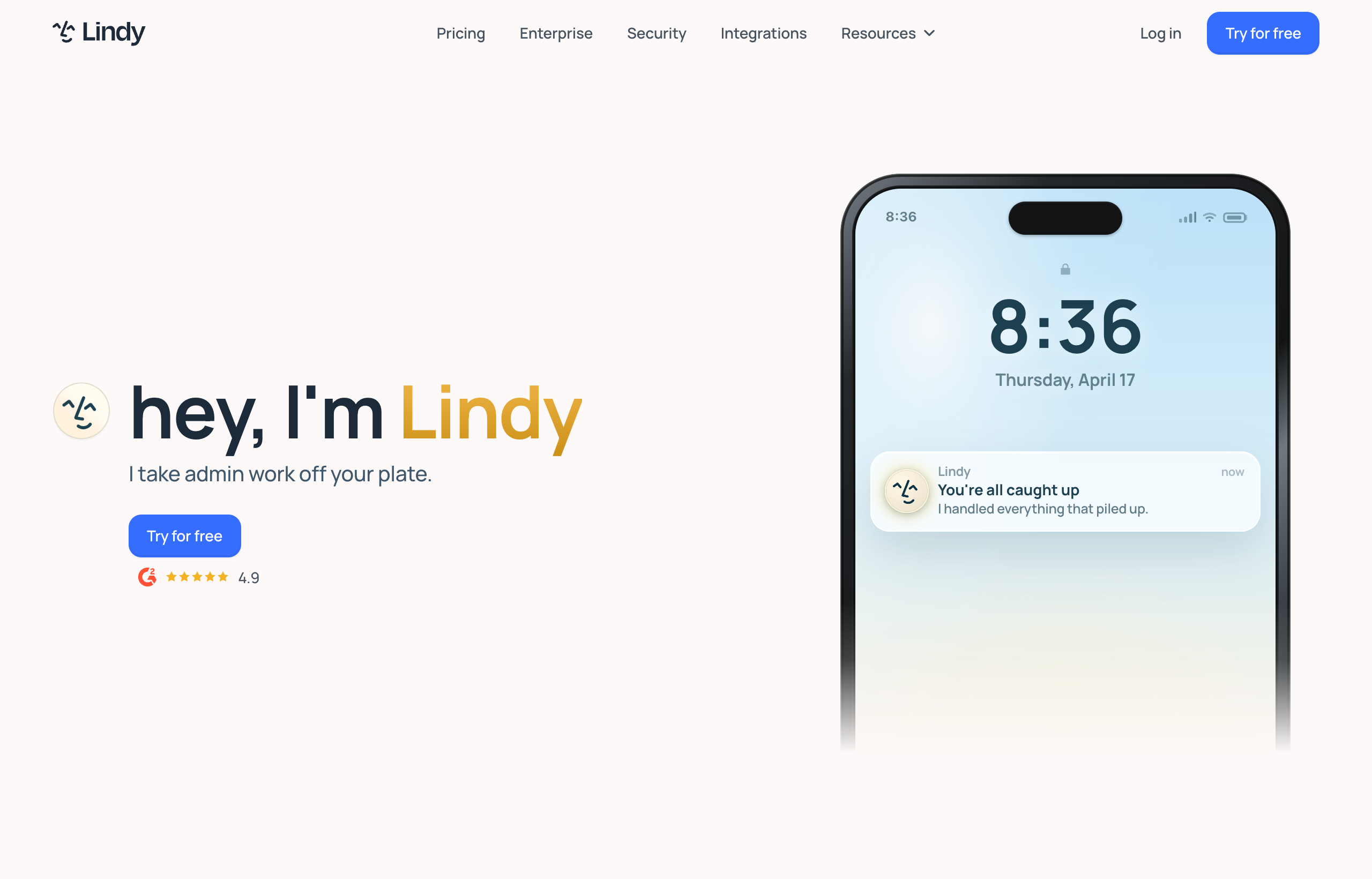
Pick Lindy if you want to design the automation yourself. Lindy’s visual builder lets you wire triggers to actions on a canvas, it starts at $49.99/month, and it texts you like a personal assistant over iMessage or SMS. If you already know the exact flow you want and enjoy building it once so it runs forever, Lindy is a genuinely good tool for that job.
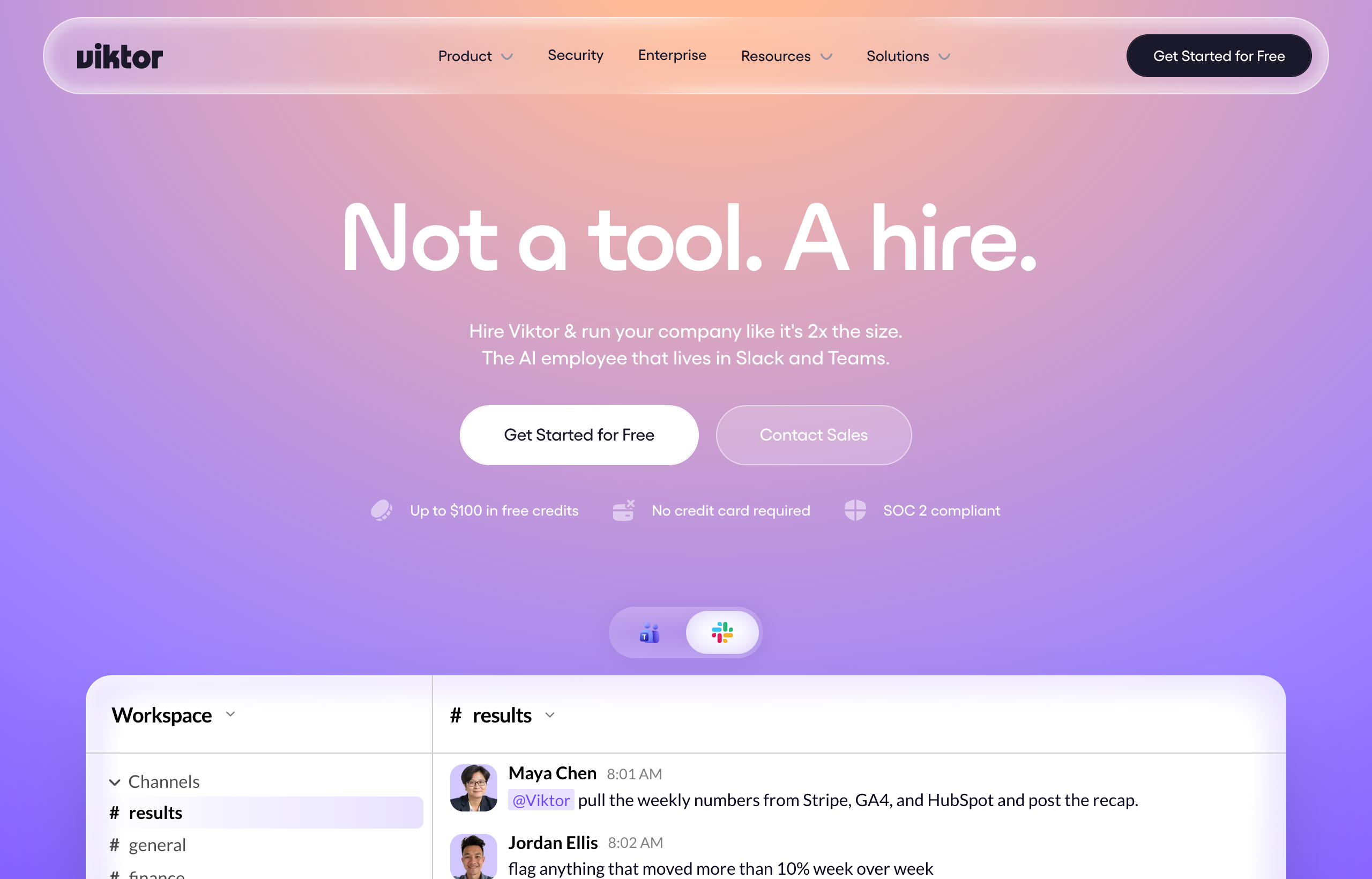
Pick Viktor if your team lives in Slack and you want to describe the outcome, not build the flow. Viktor is Slack and Microsoft Teams native. You mention it in a channel, it plans the steps itself, executes across your connected tools, and comes back with the deliverable: a dashboard, a PR, a report, a scheduled recurring job. No canvas, no node-wiring, no flow to maintain when your process changes.
Neither approach is objectively superior. A visual builder gives you control and predictability for repeatable processes. A conversational coworker gives you speed for one-off, fuzzy, or novel requests where building a flow first would be slower than just asking. The rest of this article is about figuring out which one matches how your team actually works.
If your team already lives in Slack and you are tired of explaining the same task to three different people before it gets done, I would start with Viktor’s free $100 in credits and give it one real task this week, something with a clear deliverable like a competitor pricing audit or a board-update draft. You will know within the first task whether the “coworker, not canvas” model fits your team.
Viktor vs Lindy at a glance
Every figure below comes from each company’s live pricing and product pages, checked in July 2026. Pricing pages change, so treat the numbers as directionally correct and verify anything you are about to commit budget to.
| Viktor | Lindy | |
|---|---|---|
| Core interface | Slack and Microsoft Teams channel, you talk to it like a coworker | Visual node-based builder, plus iMessage/SMS chat with the finished assistant |
| How you configure it | Describe the task in natural language, it plans and executes | Wire triggers, actions, and conditions together on a canvas |
| Free trial | $100 in credits, no card required, credits do not expire | 7-day free trial with full Plus-tier features, no card required to start |
| Entry price | Around $50/month for 20,000 workspace credits | $49.99/month (Plus) |
| Pricing model | Credit-based, workspace-wide, no per-seat charge | Flat monthly tiers (Plus, Pro, Max), scales by usage multiple and inbox count, not seats |
| Mid tier | Around $750/month for 300,000 credits (the most commonly cited “popular” tier) | $99.99/month (Pro), roughly 3x Plus usage plus browser-based computer use |
| Integrations | 3,200-plus, including Stripe, HubSpot, Salesforce, GitHub, Google Ads, Meta Ads, Linear, Jira | 100-plus, strongest on email, calendar, meetings, and CRM connections |
| Deliverables | Deployed web apps with database and auth, code and pull requests, dashboards, reports, scheduled recurring tasks | Drafted emails, scheduled meetings, meeting notes and action items, assistant-style replies over text |
| Best at | Open-ended execution work: “pull this, build that, ship it” without a predefined flow | Repeatable personal-assistant tasks: inbox triage, scheduling, meeting notes, on a flow you designed once |
| Lives in | Slack, Microsoft Teams | Its own builder app, with iMessage and SMS as the chat surface |
The table hides one thing that matters more in practice than any single row: how you spend your first hour with each tool. With Lindy, your first hour is design time, you are dragging blocks and testing branches. With Viktor, your first hour is a conversation, you describe a task and watch it work. Which one you would rather spend an hour doing is a decent proxy for which tool fits you.
What Lindy actually does well
Lindy earns its following honestly, and any comparison that pretends otherwise is not being straight with you. Three things stand out from actually building with it.
The visual builder is genuinely approachable. You are not writing code or reading documentation to wire a trigger to three sequential actions with a condition in the middle. You drag, connect, configure a panel, and test the run. For someone who wants full visibility into exactly what will happen and in what order, and who wants to tweak one step without touching the rest, that visibility is worth a lot. It is the same appeal that made tools like Zapier and Make popular, except Lindy adds an AI reasoning step inside the flow instead of pure deterministic logic.
It behaves like a personal assistant, not just a workflow engine. Texting your Lindy over iMessage to ask “what’s on my calendar tomorrow” or having it draft a reply in your own voice feels closer to delegating to an EA than to configuring software. The meeting-joining, note-taking, and action-item extraction are solid out of the box, and having that live in a channel you already check (your texts) lowers the friction to actually using it daily.
The entry price is honest. $49.99/month for the Plus tier is a flat, predictable number. You know exactly what you will be billed before you sign up, and there is no credit-burn math to do. For a solo operator or a small team that wants one well-defined assistant running a handful of flows, that predictability is a real advantage over usage-based pricing.
Where Lindy runs into limits
A review with no downsides is an advertisement, so here is where Lindy showed real seams in testing.
Building the flow is on you. For anything beyond the templates, you are the one deciding what triggers what, what the fallback branch does, and how errors get handled. That is fine for a task you will run the same way every week. It is friction for a one-off: “check what our top five competitors changed on their pricing pages this month and summarize it” is not a flow you want to build in a canvas, you want to just ask for it and get an answer back.
Integration depth trails the big platforms. 100-plus integrations is real, but it is a fraction of what Zapier, Make, or Viktor connect to. If your stack includes a less common tool, especially something engineering-adjacent like GitHub, Linear, or Jira, you may find the connection thin or missing, which pushes you toward a general-purpose builder like Zapier or Make for that piece instead.
It is not built to write and ship code. Lindy automates communication and scheduling work well. It is not positioned, and does not claim, to open a pull request, deploy a web app with a database, or fix a bug in your codebase. If any part of what you need touches engineering output, Lindy is the wrong tool for that slice of the job regardless of how good it is at the rest.
Inbox limits push you up tiers fast. Plus covers two connected inboxes, Pro covers three, Max covers five. A small team where several people each want their own assistant with their own inbox will find themselves on Pro or Max faster than the headline $49.99 number suggests.
Where Viktor actually does well
Viktor’s pitch, “an AI employee that does the work instead of advising you how to,” sounds like the kind of line every AI tool makes. What separates it in practice is that the deliverables are real artifacts, not summaries of what you should do next.
It executes without you designing the path. Ask it to pull last month’s ad spend from Google Ads and Meta, cross-reference it against Stripe revenue, and drop a summary into a Google Doc, and it plans and runs that sequence itself. You are not pre-wiring the steps. This is the single biggest practical difference from Lindy: Viktor absorbs the “how” so you only have to specify the “what.”
It lives where the team already is. Slack and Microsoft Teams are where most companies’ actual coordination happens. Mentioning Viktor in a channel where the rest of the conversation about that project is already happening means the output, the discussion, and the follow-up questions all stay in one thread instead of splitting across a separate app.
The integration surface is enormous. 3,200-plus connections, spanning Stripe, Notion, HubSpot, Salesforce, GitHub, Linear, Jira, Google Ads, Meta Ads, and Google Drive by name. In practice this means fewer “sorry, we don’t support that tool yet” walls, especially for engineering and finance workflows that Lindy is not built to touch.
It ships engineering output, not just drafts. Code, pull requests, and deployed web apps with database and auth are in scope. Nobody is claiming Viktor replaces a senior engineer, but for internal tools, quick prototypes, and bug triage handoffs, having an AI teammate that can open the PR rather than describe what the PR should contain is a different category of usefulness than Lindy offers.
The honest weakness: credit-based pricing is unpredictable
This is the part every glowing Viktor review conveniently skips, and it deserves the same directness as any other section here. Viktor bills on credits, and credits are consumed by actual model usage, not by a flat seat price. As of this writing, quick tasks run somewhere in the low hundreds of credits, more involved workflows run into the low thousands, and a genuinely full project can burn several thousand. Multiply that by a team actually using the tool for real work, and the effective monthly cost is often meaningfully above the headline entry price. Some real users report burning through a sizable chunk of their starting credits within the first couple of days of aggressive use.
Compare that to Lindy’s flat $49.99, $99.99, or $199.99 tiers: you know the number before the month starts. Viktor’s model is fairer in one sense (you are not paying for capacity you do not use) and harder to budget in another (a heavy week can spike the bill in a way a flat-tier plan never will). If predictable, capped monthly spend matters more to you than usage-matched pricing, weigh that honestly before you commit a team to Viktor. Our full breakdown of the credit math is worth reading before you buy: Viktor pricing explained.
Who should actually pick Lindy over Viktor
Pick Lindy if any of these describe you:
- You want a visual canvas where you can see and control every step of an automation before it runs, not a black box that plans on its own.
- Your core need is personal-assistant work, inbox triage, meeting notes, calendar scheduling, and you want it reachable over iMessage or SMS rather than Slack.
- You want a flat, predictable monthly bill with no usage math to track.
- Your team is not centered in Slack or Teams, and building flows in a dedicated builder app is a better fit than a chat-first interface.
Who should pick Viktor over Lindy
Pick Viktor if any of these describe you:
- Your team already coordinates in Slack or Microsoft Teams and you want the AI teammate to live in the same place.
- You have more one-off, fuzzy, or novel requests than repeatable flows, and building a canvas for every new ask would slow you down.
- Some of what you need touches engineering: opening a PR, fixing a bug, deploying a small internal tool.
- You want a single workspace-wide teammate rather than per-inbox assistants, with no per-seat charge as the team grows.
If you are still not sure, our broader roundup of Viktor alternatives covers how Lindy stacks up against the rest of the field, not just Viktor, which is useful if a builder-style tool turns out to be what you actually want. For the full hands-on writeup of Viktor on its own, including the credit-burn math in real numbers, see our complete Viktor review. And if you want to see how both stack up against the entire category, not just each other, our best AI agents of 2026 roundup ranks the wider field.
Still deciding? Pick one real recurring task, the kind you would normally hand to a Lindy or explain to a new hire, and give it to Viktor in Slack this week. The $100 starting credit is usually enough to run it several times and see how the credit math actually plays out for your workload, before you commit to either tool.
Frequently asked questions
Is Viktor better than Lindy?
Neither is universally better, they solve different problems. Viktor is better for teams in Slack or Teams who want to describe a task and get it executed without building a flow first, especially when the work touches engineering, data pulls, or cross-tool coordination. Lindy is better if you want to design a repeatable automation on a visual canvas and prefer a flat, predictable monthly bill.
Can Lindy do what Viktor does?
Partially. Lindy can automate communication-heavy tasks like scheduling, inbox triage, and meeting notes well, and its visual builder gives you precise control over the flow. It is not built to write and ship code, open pull requests, deploy a web app, or execute genuinely open-ended, undefined requests the way Viktor is designed to.
Is Viktor’s pricing actually cheaper than Lindy’s?
The entry numbers land close, around $50/month for Viktor’s smallest credit tier versus $49.99/month for Lindy’s Plus tier, but they are not directly comparable. Lindy’s price is flat regardless of usage. Viktor’s is metered, so a team doing heavy work can spend well above the headline figure in a given month, while a light user might spend less. Budget for the usage pattern, not the sticker price.
Does Viktor work outside of Slack?
Yes, Viktor is also native to Microsoft Teams. Its primary interface is chat inside one of those two platforms rather than a standalone app, which is the core design difference from Lindy’s dedicated builder plus iMessage/SMS chat surface.
Which tool is easier to get started with?
Lindy is easier to get started with if you like following a template and customizing it on a visual canvas. Viktor is easier to get started with if you would rather type a plain-language request and let it figure out the steps. Both offer a no-card-required way to try before you pay: Lindy’s 7-day trial and Viktor’s $100 in non-expiring starting credits.
The bottom line
Viktor and Lindy are not really fighting over the same buyer. Lindy is for the person who wants to design an assistant once, on a canvas they control, and have it run the same way every time, reachable over text. Viktor is for the team that wants to describe an outcome in Slack and get the deliverable back without ever opening a flow builder, and that occasionally needs the AI teammate to touch actual code.
If your work is mostly repeatable and personal-assistant shaped, Lindy’s builder and flat pricing are a good, honest fit. If your team lives in Slack, your requests are varied, and you want execution rather than a flow to maintain, Viktor is the better bet, with the one caveat that you need to watch the credit meter the way you would watch any usage-based bill.
My actual recommendation after testing both: if you are Slack-first and tired of explaining tasks twice, start Viktor’s free trial and hand it one real deliverable this week. If you know exactly what flow you want and prefer to build it yourself, Lindy’s builder is worth the $49.99. Read our full Lindy review before you decide either way.
Pricing and feature details captured from Viktor’s and Lindy’s live pricing pages, July 2026. Both companies change plans and limits over time, so confirm current numbers on viktor.com/pricing and lindy.ai/pricing before you buy.


