
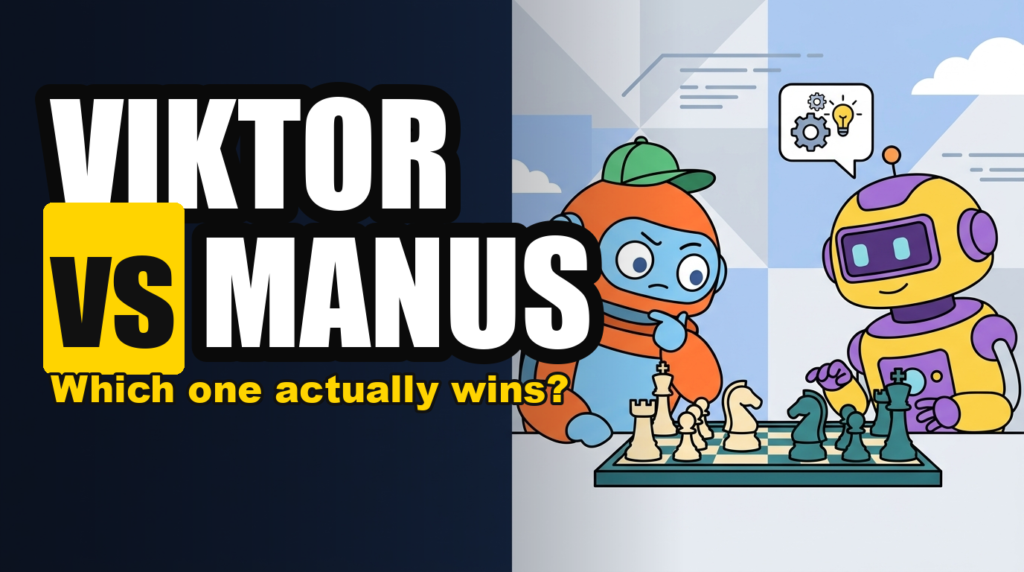
Manus made its name doing something genuinely impressive: give it a loose brief and watch it go build a whole thing on its own, a website, a slide deck, a research report, largely unsupervised. I asked it to research a competitor’s pricing page and turn the findings into a slide deck, and it did exactly that, on its own, in its own workspace, no hand-holding required. Then I gave Viktor the same brief inside a Slack channel, and the difference showed up immediately: Viktor didn’t just produce a deck, it pulled live numbers from our actual Google Ads account, cross-referenced them against a Notion doc we already had, and dropped the result back into the same channel where my team would actually see it. Same instinct, autonomous execution, aimed at two different jobs.
Disclosure: some links in this post are affiliate links. If you sign up through them, we may earn a commission at no extra cost to you. That never changes our verdict.
Short answer
Manus is a general autonomous AI agent built to take a loose goal and run with it independently, researching, browsing, building websites, generating slides and images, largely in its own workspace. Viktor is a Slack and Microsoft Teams-native AI employee built specifically for business work: it connects to 3,200+ real tools your company already runs on and executes tasks inside them, then delivers results where your team already talks. Manus is broader and more general-purpose. Viktor is narrower and built to actually plug into your business.
The fastest way to see which fits your work is to run the same task through both. Start with Viktor’s free $100 in credits, no card needed, and give it something you’d normally hand off to a person: try Viktor here.
What Manus actually is
Manus is a general autonomous AI agent, now under Meta, built around the idea of “less structure, more intelligence.” You give it a goal in plain language and it plans and executes the steps itself: browsing the web through its own browser operator, researching a topic broadly through its “Wide Research” feature, designing visuals and slides, generating images and music, and building things like simple websites or games. It operates mostly inside its own workspace rather than plugging into your existing business tools, which makes it well suited to open-ended, self-contained tasks: “research X and give me a report,” “build me a landing page for this idea,” “make a set of slides on Y.”
Manus’s pricing runs on a credit system too, though the exact numbers move around and Manus doesn’t publish a fully detailed breakdown on its public pricing page as of this writing. Public reporting on current plans generally points to a free tier with a limited daily credit refresh plus a one-time starter credit pack for new users, paid individual tiers in the neighborhood of $20 to $40/month for a few thousand monthly credits, a higher “Pro Top” style tier for heavier users, and team plans priced per seat with a shared credit pool on top. Treat those as approximate, and check Manus’s live pricing page before budgeting against them, since Meta has continued adjusting the structure.
What Viktor actually is
Viktor is also autonomous and agentic, but it’s built around a different unit of work: business tasks inside business tools. It lives in a Slack channel or Microsoft Teams, and instead of working in its own sandbox, it connects to 3,200+ real integrations (Stripe, Notion, HubSpot, Salesforce, Google Ads, Meta Ads, GitHub, Google Drive, and more), pulls actual data from them, and executes multi-step work end to end: assembling reports and dashboards from live numbers, building and deploying web apps with a working database and authentication, writing code and opening pull requests, and scheduling recurring automations on its own initiative. You talk to it in the channel like a coworker, and it goes off, does the work in your real systems, and reports back where your team already is.
The free trial gives you $100 in credits with no card required and no expiration on those credits. Paid team plans start around $50/month for 20,000 credits and scale up (30,000 credits around $75, 40,000 around $100, 80,000 around $200), workspace-wide with no per-seat charge, meaning the whole team draws from one pool. Larger tiers run into the hundreds and low thousands per month for growing teams, with custom enterprise pricing in the tens of thousands for the biggest deployments.
Viktor vs Manus at a glance

| Category | Manus | Viktor |
|---|---|---|
| Core identity | General autonomous agent for open-ended tasks | Slack/Teams-native AI employee for business tasks |
| Where it works | Its own workspace/sandbox | Inside your connected business tools, reporting in Slack or Teams |
| Typical use | Research reports, simple websites, slides, images, browsing tasks | Pulling live business data, deployed apps with database/auth, code + PRs, board reports, recurring automations |
| Integration with your existing tools | Limited; mostly self-contained | 3,200+ real integrations (Stripe, Salesforce, GitHub, Google Ads, etc.) |
| Pricing model | Credit-based, largely per-seat on team plans | Credit-based, workspace-wide, no per-seat charge |
| Entry price | Free tier available; paid individual plans around $20 to $40/mo (approximate, verify current pricing) | Free trial ($100 credits); paid plans from around $50/mo for 20,000 credits |
| Best for | Solo builders, researchers, and one-off autonomous projects | Teams that need work executed inside their real business systems |
Where Manus genuinely wins
- Open-ended autonomy. Manus is built to take a vague, ambitious brief and run with it independently, which is genuinely impressive for research, content drafts, and self-contained builds.
- Good for solo, one-off projects. If you don’t need it to touch your company’s actual systems, a self-contained workspace is simpler, not a limitation.
- Browsing and research depth. Its browser operator and Wide Research feature are strong for gathering and synthesizing information from the open web.
- Creative generation. Slides, images, and music generation inside one tool covers a broad creative surface most agent products don’t attempt.
Where Viktor genuinely wins
- Real integration with your business. 3,200+ tools versus a largely self-contained workspace is the core difference. Viktor works with your actual data, not a copy of it.
- Team-native, not solo-native. Living in Slack or Teams means the whole team sees and benefits from Viktor’s output where they already work, instead of one person logging into a separate app.
- No per-seat pricing. A shared workspace credit pool scales more sensibly for a team than paying per user.
- Business-grade deliverables. Deployed apps with real databases and auth, GitHub pull requests, and scheduled automations against live systems go further than content generation.
The honest weaknesses of each
Manus’s limitation is reach. Because it mostly operates in its own sandbox, it’s a weaker fit when the job requires touching your company’s actual live systems, your CRM, your ad accounts, your internal databases, rather than researching and building something self-contained. Team plans also lean per-seat in the pricing structures currently reported, which adds up differently than a shared pool as your team grows. And because it’s broad by design, it isn’t purpose-built the way Viktor is for business workflows like board reporting or CRM updates.
Viktor’s honest weakness is billing predictability, which I’ll say plainly because it matters for a buying decision: credit-based pricing means costs can spike fast if you assign it several ambitious projects at once. Real users have reported burning through $200 in the first two days of pushing it hard, and active monthly spend for teams doing real work often runs well past the $50 headline, sometimes over $500/month. It’s also a coworker you talk to, not a visual canvas, so if you specifically want to design a rigid, repeatable flow node-by-node, a tool like Zapier or n8n suits that shape better than either Viktor or Manus.
How I actually tested this
I ran three briefs through both tools rather than judging off a single output. The first was the competitor pricing research and slide deck mentioned at the top, an open-ended task with no requirement to touch our own systems. The second was building a simple internal tool, a form that logs submissions somewhere I could review. The third was a recurring task: pull a specific number every Monday and post it somewhere my team would see it without anyone re-triggering it.
On the first task, Manus was genuinely strong, arguably a bit more thorough in its research pass than Viktor was, since Wide Research is built specifically for that kind of broad information gathering. Viktor’s version of the same brief was competent but leaned more on data we already had internally rather than fresh outside research, which makes sense given where each tool is built to look for information. On the second task, both could produce something, but Viktor’s version connected to a real, accessible database through its deployment pipeline, while Manus produced a functional but more self-contained build that took more manual work to connect to anything outside itself. On the third task, the recurring Monday post, Manus had no clean way to schedule it against a live external number the way I needed; Viktor set it up as a standing automation in one message and it has run without me touching it since.
Setup and integration experience
Manus is fast to start using because there’s little to configure. You describe a goal and it gets moving, which is a real strength if what you want is momentum on day one. Viktor’s setup takes a bit more time up front, connecting your Slack workspace and then authorizing whichever of its 3,200+ integrations you actually need, but that investment is what makes the later payoff possible: once connected, Viktor can act inside those systems indefinitely without you re-explaining context each time. In practice, the extra ten to twenty minutes of Viktor setup paid for itself the first time it pulled real numbers without me having to export and upload anything.
Who should pick Manus instead
If your work is mostly solo, open-ended, and doesn’t need to touch your company’s live business systems, research projects, first-draft websites, slide decks, content exploration, Manus’s autonomy in its own sandbox is a genuinely strong fit and likely cheaper for light individual use. It’s also a reasonable choice if you want an agent that can just go build something from scratch without you wiring up integrations first.
Output quality on creative and research tasks
It’s worth being specific about where Manus’s autonomy shines, since it’s easy to undersell in a comparison built around Viktor. Manus’s browser operator genuinely goes out and gathers current information rather than relying only on what it already knows, and Wide Research is built to synthesize across many sources into one coherent output rather than a single search-and-summarize pass. For a competitive landscape report, a market sizing exercise, or a first-pass slide deck to pressure-test an idea before you invest real time in it, Manus produced results in my testing that were genuinely close to what a sharp junior analyst would hand you after a day of work, compressed into a fraction of the time.
Viktor can do research too, and it will pull from connected sources when asked, but it’s optimized for a different shape of output: something that plugs directly into a system you already run rather than a standalone report you then have to distribute yourself. If your team’s bottleneck is genuinely “we need more research bandwidth” rather than “we need this to land inside our existing tools,” that’s a real point in Manus’s favor worth weighing honestly rather than glossing over.
Team versus individual use in practice
The per-seat versus workspace-pool distinction matters more than it first appears once you actually put a few people on either tool. With Manus’s team plans leaning per-seat in current reporting, adding a fourth or fifth person to the account adds cost roughly linearly regardless of how much that person actually uses it. Viktor’s shared workspace pool means a team of five drawing lightly from a 40,000-credit plan pays the same as a team of two drawing the same total amount, which rewards teams with uneven usage across members, the common pattern where one or two people drive most of the actual task volume while others check in occasionally.
My verdict
Manus and Viktor are both autonomous in the sense that you give them a goal and they figure out the steps, but they’re solving different problems. Manus is a strong generalist for self-contained, exploratory work. Viktor is built specifically to be a coworker inside your actual business, pulling real data from real tools and delivering results where your team already talks. If your bottleneck is “I need something researched or built from scratch,” Manus is a legitimate option. If your bottleneck is “I need this task done inside Salesforce, GitHub, or our ad accounts, and I need the whole team to see it,” Viktor is the tool built for that job.
If you’re not sure which category your actual bottleneck falls into, the cheapest way to find out is to test it directly. Viktor’s free $100 in credits doesn’t require a card: start with Viktor.
For more, see our full Viktor review, our Viktor pricing breakdown that decodes the credit model, our Viktor alternatives roundup, and our best autonomous AI agents list for how both compare against the wider field.
My honest suggestion either way: don’t decide from a comparison post, run the same real task through both this week and let the output settle it. Get Viktor’s free trial here.
FAQ
Is Viktor better than Manus?
It depends on the job. For open-ended, self-contained work like research or building something from scratch, Manus is a strong, capable choice. For business tasks that need to touch your real tools like Salesforce, GitHub, or Google Ads and deliver results to your whole team in Slack or Teams, Viktor is built specifically for that and generally wins.
Is Manus cheaper than Viktor?
For light, individual use, likely yes. Manus’s reported paid tiers start around $20 to $40/month for a few thousand credits (verify current pricing, as figures shift), while Viktor’s paid plans start around $50/month for 20,000 credits. Viktor’s free trial with $100 in credits and no card required narrows that gap for testing purposes.
Does Manus integrate with business tools like Viktor does?
Not to the same depth. Manus operates mostly inside its own workspace with browsing and research capabilities, while Viktor connects to 3,200+ real business tools including Stripe, Salesforce, HubSpot, GitHub, Google Ads, and Meta Ads.
Can Manus be used by a whole team the way Viktor can?
Manus does offer team plans, though reporting suggests they lean per-seat with each member getting their own credit allocation. Viktor’s workspace-wide credit pool with no per-seat charge is structured differently and often scales more predictably as a team grows.
Which tool is better for building a real, deployed web app?
Viktor is purpose-built for this: it builds and deploys web apps with a working database and authentication and can open GitHub pull requests. Manus can build simpler self-contained sites and prototypes but is not primarily positioned as a deployment tool for production business applications.


