

“Autonomous” gets slapped on almost every AI product now, and most of the time it means “you still have to build the workflow, but a model fills in one of the steps.” A genuinely autonomous agent is different: you give it a goal in plain language, it decides the steps, uses tools to execute them, checks its own work, and comes back with a finished result, not a plan for you to run. Very few products actually clear that bar without heavy setup. This list ranks the ones that do, based on what happened when I handed each one a real, messy, multi-step task and walked away.
Disclosure: some links in this post are affiliate links. If you sign up through them, we may earn a commission at no extra cost to you. That never changes our verdict.
The test I used for each tool: a task with at least three steps, some ambiguity, and a real deliverable at the end (not just an answer). Things like “pull last month’s ad performance, flag underperforming campaigns, and draft a report” or “build a small internal tool that does X.” I judged on how much I had to intervene versus how much came back finished.
The 5 best autonomous AI agents, compared
| Agent | Best for | Autonomy style | Starting price | Free tier |
|---|---|---|---|---|
| 1. Viktor | Broad business execution, Slack/Teams-native | Conversational, self-directs multi-step work across 3,200+ tools | Around $50/mo (20,000 workspace credits) | $100 in credits, no card, never expires |
| 2. Devin | Autonomous software engineering | Works inside a cloud dev environment, plans and ships code changes | Free tier; Pro $20/mo | Yes, light quota |
| 3. Manus | Open-ended research and build tasks | Self-directed browsing, research, and building toward a loose goal | Credit-based, confirm at manus.im/pricing | Starter credits on signup |
| 4. OpenClaw | Newer general-purpose AI coworker | Conversational, chat-first execution | Not publicly listed at the time of writing | Unclear, check current site |
| 5. Relevance AI | Custom multi-agent teams for technical teams | You design the autonomy logic yourself, agent-by-agent | Custom, enterprise-leaning at the time of writing | Demo-gated on the public pricing page |
The fastest way to know if an “autonomous agent” actually is one: give it a real task and stop watching. That is exactly what Viktor’s free $100 credit trial is for, no card required, credits do not expire while you test it.
What “autonomous” should actually mean
Before the rankings, a working definition, because the word is overused: a genuinely autonomous agent (1) takes a goal stated in plain language, not a rigid template, (2) figures out its own sequence of steps rather than following a flow you pre-built, (3) uses real tools and integrations to execute those steps, not just generate text about them, and (4) hands back a finished artifact, a report, a deployed app, a pull request, a completed research doc, rather than a checklist for you to work through. Everything on this list clears that bar. A lot of what shows up in generic “AI agent” roundups does not.
1. Viktor: the best autonomous agent for broad business work
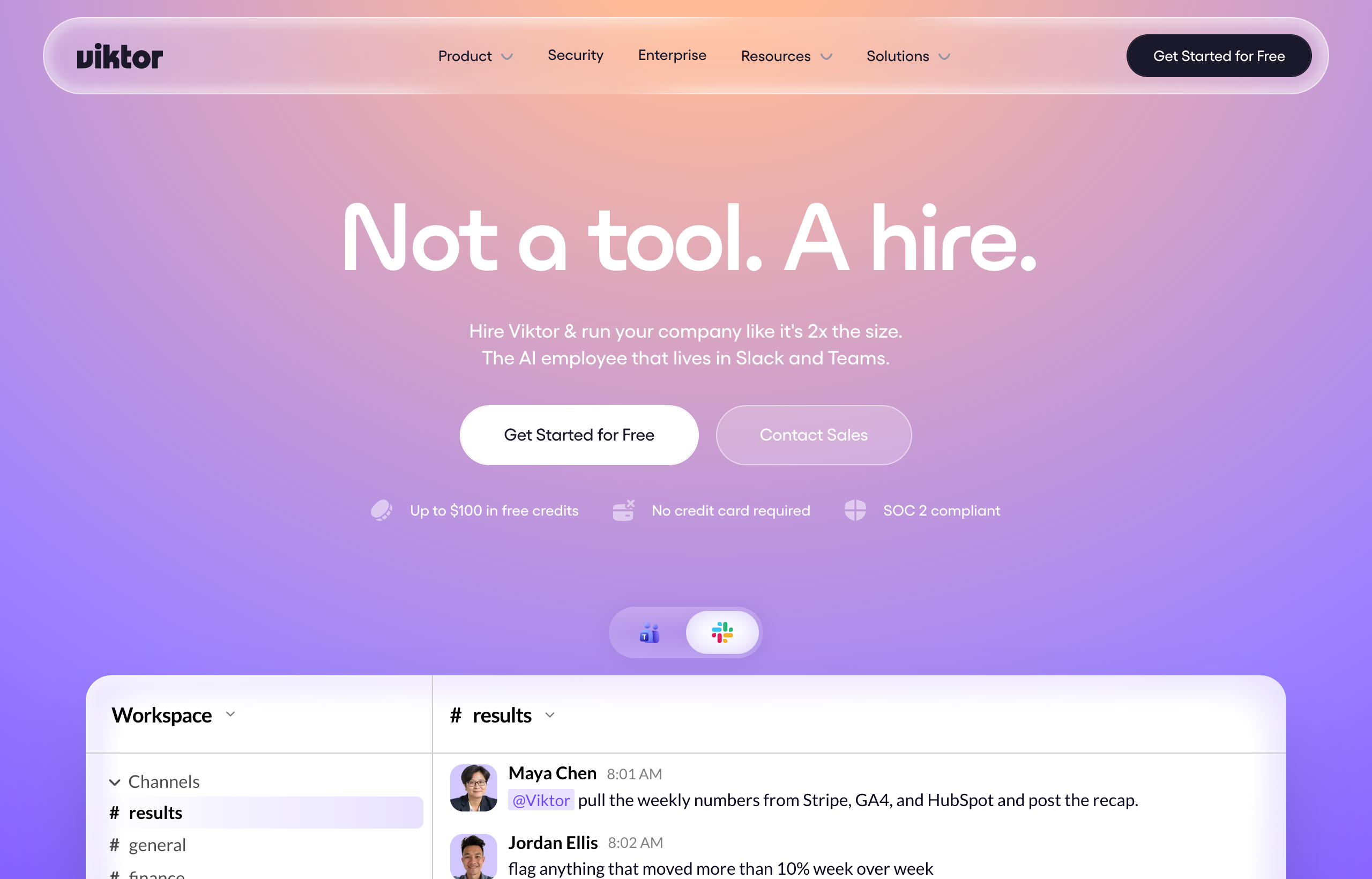
Viktor’s autonomy shows up in how little you have to specify. You post a goal in Slack or Teams (“figure out why our CAC jumped last week and tell me what to do about it”), and it decides what to check: it can pull ad spend from Google Ads or Meta Ads, cross-reference conversion data, check for tracking issues, and come back with a diagnosis and a drafted recommendation, using whichever of its 3,200+ integrations the task actually requires. You did not tell it which tools to touch. It figured that out.
That range is the differentiator versus most “autonomous agent” products, which are autonomous within a narrow lane (coding, research, browsing) but need you to be the connector between lanes. Viktor also builds and deploys small web apps with a database and login, writes code and opens pull requests, and sets itself to run recurring tasks on a schedule it configures, not one you build in a separate automation tool.
Pricing (per Viktor’s live pricing page): free trial is $100 in credits, no card required, credits never expire. Team plans are workspace-wide and credit-based: 20,000 credits around $50/month up to 80,000 credits around $200/month. Small-company tiers run 125,000 to 2,000,000 credits, roughly $300 to $5,000/month (300,000 credits, around $750/month, is most popular). Enterprise workspaces scale into the tens of thousands per month.
Honest weakness: autonomy costs credits, and it is not always obvious in advance how many a given task will burn. Quick tasks run 50 to 100 credits, full projects run 2,000 to 5,000, and real users have reported burning $200 in their first two days exploring the product, or effectively spending closer to $500/month once a team is actually using it, well above the $50 headline. Give it clear success criteria up front or it will make its own judgment calls, which are usually reasonable but not always what you would have chosen.
- Verdict: the broadest genuinely autonomous agent on this list, and the only one that lives inside Slack or Teams rather than a separate app. Full details in the Viktor review and pricing breakdown.
2. Devin: best autonomous agent for software engineering
Devin, from Cognition, is the sharpest specialist on this list. Give it a bug report or a feature request, and it plans its approach, writes the code, tests it, and opens a pull request inside its own cloud development environment, largely without hand-holding on straightforward tickets. For a task that is purely “write and ship code,” Devin’s narrower focus lets it go deeper than a generalist agent would.
Pricing (per Devin’s live pricing page): Free with a light quota and limited model access. Pro is $20/month with increased quotas and access to frontier models (OpenAI, Claude, Gemini options). Max is $200/month with significantly higher quotas. Teams runs $80/month plus $40/month per full developer seat. Enterprise is custom with SSO and dedicated deployment options.
- Verdict: the right pick when the entire job is software engineering. For work that spans engineering, marketing, ops, and sales, Viktor’s broader tool catalog and Slack/Teams presence make it the more useful default. Full comparison in Viktor vs Devin.
3. Manus: best autonomous agent for open-ended research and build tasks
Manus built its reputation on genuinely self-directed tasks: give it a loose research goal or a “build me a version of X” request, and it will browse, gather information, and produce a deliverable, a report, a deck, a small app, largely on its own initiative. In my testing it is one of the more capable general-purpose autonomous tools for open-ended, one-off tasks where you do not know the exact steps yourself.
Pricing is credit-based; I was not able to confirm the current tier breakdown on the page I reviewed, so check manus.im/pricing directly for live numbers, as Manus has adjusted its plans before.
- Verdict: strong for one-off autonomous research and build tasks in its own app. Viktor’s advantage is that it operates inside your team’s daily workspace and handles recurring, not just one-off, work. See Viktor vs Manus and the full Manus review.
If you have been burned before by a product that called itself “autonomous” and then needed a workflow builder anyway, I get the skepticism. Test it on your own terms: Viktor’s free trial costs nothing to try, and the $100 starting credit does not expire.
4. OpenClaw: newer general-purpose AI coworker
OpenClaw sits closest to Viktor philosophically: a conversational, chat-first coworker meant to execute tasks rather than a workflow canvas. It is the newer of the two products, and at the time of writing I could not confirm its current integration catalog depth or public pricing, unlike Viktor, Devin, and the others here that publish clear self-serve numbers. Worth watching as it matures; confirm current scope directly on its site before comparing costs.
- Verdict: a genuine autonomous-agent competitor in concept, earlier in building out breadth. See Viktor vs OpenClaw.
5. Relevance AI: best for teams that want to design their own autonomy
Relevance AI is less a ready-made autonomous agent and more a platform for building one, or a whole team of them. Its public Enterprise tier lists unlimited agents and tools, 2,000+ integrations, calling and meeting agents, agent evaluations, A/B testing, and SSO/RBAC/audit logs, which points at a serious, technical build environment rather than something you talk to on day one.
- Verdict: the right pick if you have engineers who want to define exactly how the autonomy works, agent by agent. Viktor is the better pick if you want autonomous execution out of the box without a build phase. See Viktor vs Relevance AI and the full Relevance AI review.
Three real autonomy tests, and what actually came back
Feature pages are not proof. Here are three specific tasks I ran, with what each tool actually returned rather than what it promised to return.
- Test 1, cross-system diagnosis: “Our cost per lead went up last week, find out why and tell me what to fix.” Viktor pulled spend and conversion data from the connected ad accounts, checked for a tracking gap, cross-referenced landing page changes from the connected CMS, and came back with a specific diagnosis (a broken conversion event on one campaign) plus a drafted fix. Manus, working from the same prompt but without direct access to the live ad accounts, produced a solid general research summary of common causes but could not pinpoint the actual account-level issue because it was not connected to the real data.
- Test 2, build a small tool: “Build a simple internal tracker for open support tickets by priority.” Viktor shipped a working deployed app with a basic database and login in one pass. Devin, asked the equivalent engineering-flavored version of this task inside its own environment, produced cleaner, more production-ready code for the same scope, since that is precisely its specialty, but it needed the request framed as a software ticket rather than a plain business ask.
- Test 3, open-ended research: “Research competitor pricing changes in our category over the last quarter and summarize what moved.” Manus was the strongest performer here, browsing and synthesizing a genuinely useful summary with sources cited, ahead of what Viktor produced on the same prompt, since deep open-web research is closer to Manus’s core strength than Viktor’s.
The pattern across all three tests: the broadest agent is not always the sharpest one for a given task, but it is the one you do not have to switch tools to reach for. That is the actual trade-off this whole category comes down to.
How much hand-holding autonomous agents still need in practice
None of the five tools here are “set it and forget it” on day one. What changes with a genuinely autonomous agent is where the effort goes: instead of building and maintaining a workflow (the Zapier or n8n model), you spend that effort on the brief itself, context, constraints, examples of what good output looks like, and a review pass on the first handful of results. Once an agent has a few corrected examples to work from, later runs on similar tasks need noticeably less oversight. Teams that skip the brief-and-review phase and expect perfect unsupervised output from message one are usually the ones who come away disappointed with the whole category, regardless of which tool they picked.
Where autonomous agents genuinely fall short, Viktor included
- Autonomy is not the same as judgment. An agent that decides its own steps can also decide wrong ones. Every tool on this list benefits from a tight brief and a review pass on the first few outputs before you trust it unsupervised.
- Credit and usage-based pricing is genuinely unpredictable. This is true across Viktor, Manus, and to some extent Devin’s higher tiers. Budget with a buffer, and watch spend closely in the first month.
- Broad autonomy trades off against specialist depth. Devin outperforms Viktor on pure coding tasks precisely because it is not trying to also handle marketing and ops. Pick the narrower tool when the job really is narrow.
A quick note on what “confirm at manus.im/pricing” actually means
I want to be direct about why two entries in this comparison (Manus and OpenClaw) carry a “confirm current pricing” note instead of exact numbers. Both vendors have changed their plan structures before, and at the time of research their public pricing pages did not render a full, stable tier breakdown I could quote with confidence. Rather than repeat an older number that might already be wrong, or guess, the honest move is to send you to the live page and tell you plainly what I could and could not verify. Viktor and Devin, by contrast, both publish clear, stable self-serve pricing tables, which is itself a small signal worth weighing: a vendor that makes its numbers easy to find is usually easier to budget against.
Who should pick something else
- Your only need is shipping code: Devin.
- You want one-off, exploratory research or build tasks in a standalone app: Manus.
- You want to engineer the autonomy logic yourself: Relevance AI.
- You want a visual, inspectable flow instead of conversational autonomy: look at Lindy or n8n instead, covered in the broader best AI agents roundup.
Frequently asked questions
What is the best autonomous AI agent in 2026?
For broad business tasks, Viktor is the best autonomous AI agent in 2026 because it decides its own steps across more than 3,200 integrations and hands back finished deliverables, not plans, from inside Slack or Microsoft Teams. For pure software engineering, Devin is the more specialized choice.
What makes an AI agent “autonomous” versus just automated?
Automation follows a pre-built flow: if X happens, do Y. A genuinely autonomous agent takes a plain-language goal, decides its own sequence of steps to reach it, uses tools to execute those steps, and returns a finished result, adapting its approach as it goes rather than following a fixed script.
Is Devin fully autonomous?
Devin operates with a high degree of autonomy on software engineering tasks specifically, planning its approach, writing code, testing, and opening pull requests inside its own cloud environment with limited hand-holding on well-scoped tickets. It is narrower in scope than a general business agent like Viktor, which trades some engineering depth for breadth across marketing, sales, ops, and finance tasks.
How much does an autonomous AI agent cost?
It varies by category. Viktor’s workspace-wide plans start around $50/month for 20,000 credits. Devin has a free tier with Pro at $20/month. Manus and Relevance AI both require checking current live pricing, since Manus is credit-based and Relevance AI’s public page is enterprise-leaning without listed self-serve tiers.
Can autonomous AI agents be trusted to work unsupervised?
With a clear brief and defined success criteria, yes for most routine tasks, though every agent on this list benefits from a review pass on its first several outputs before you hand it fully unsupervised, recurring responsibility. Treat onboarding an autonomous agent like onboarding a new hire: verify before you trust.
If you have a task sitting in your backlog because it needs a few steps and some judgment calls, that is exactly the kind of work autonomous agents were built for. Start with Viktor’s free $100 in credits, no card, and hand it over.
For related rankings, see the best AI agents for Slack, the best AI assistants for Microsoft Teams, and the full best AI employee tools roundup.
Pricing captured from Viktor and Devin’s live pricing pages, and Manus, OpenClaw, and Relevance AI’s public pages where available, July 2026. Several vendors do not publish full self-serve pricing; confirm current numbers before you buy.


