

People keep putting Viktor and Poke in the same sentence because both get called “AI that texts back and gets things done” in headlines. Having actually used both, that framing hides the more useful fact: one lives in your team’s Slack channel and ships business deliverables, the other lives in your iMessage and manages your personal life. They barely compete for the same job.
Disclosure: some links in this post are affiliate links. If you sign up through them, we may earn a commission at no extra cost to you. That never changes our verdict.
Short answer
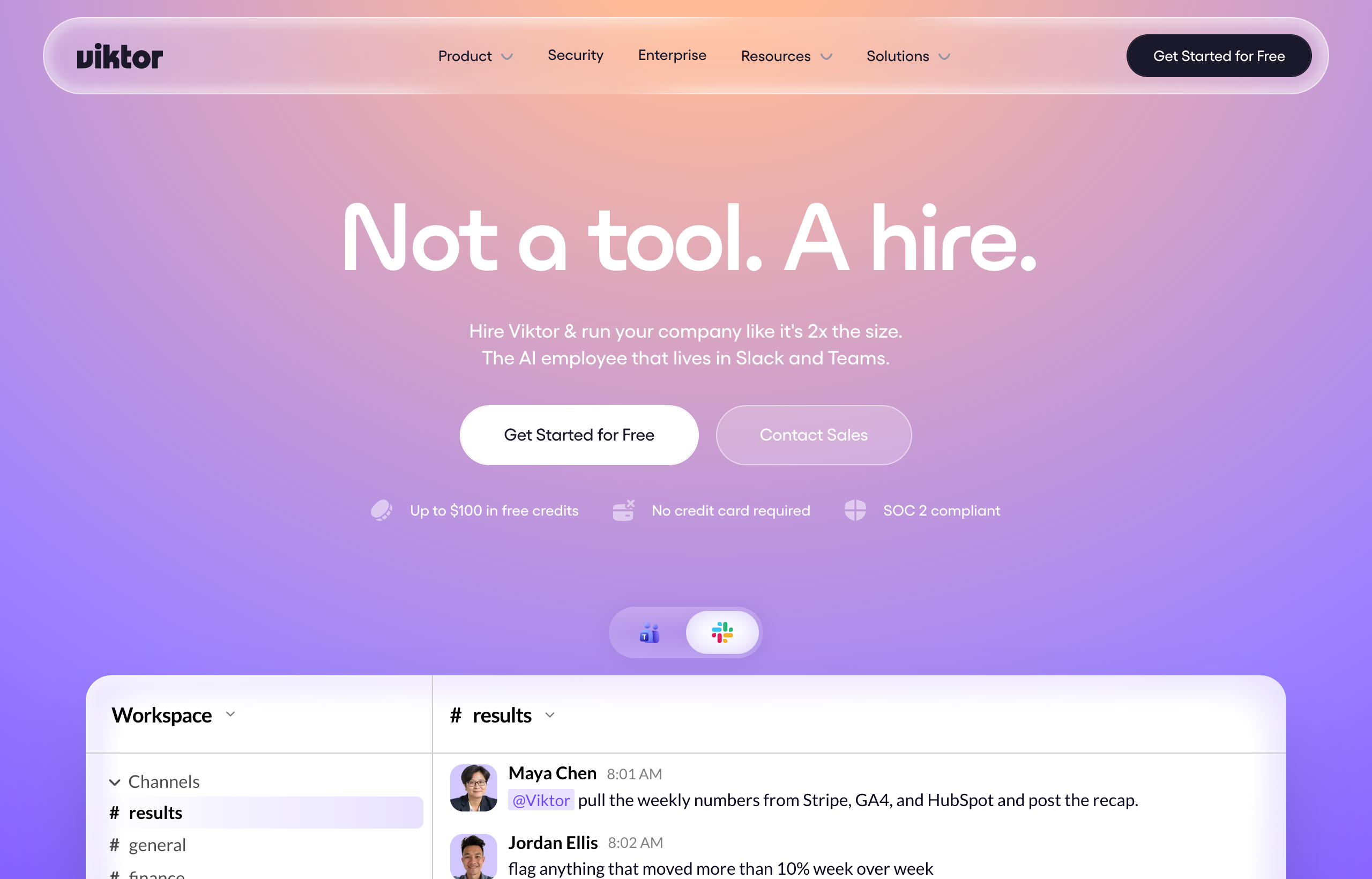
Poke is a personal AI assistant from Interaction that lives in iMessage, WhatsApp, Telegram, and the web, and helps one person manage email, calendar, reminders, and roughly 30-plus connected apps. Viktor is a Slack and Microsoft Teams-native “AI employee” for a team, connected to 3,200+ business tools, that executes work like ad audits, reports, code, and deployed apps rather than just organizing your day. If you want a smarter version of a personal assistant that texts you, get Poke. If you want a coworker your whole team can hand real business tasks to, get Viktor.
If your business need is “I want a coworker in Slack who actually finishes tasks, not a smarter to-do list for myself,” skip the personal-assistant category entirely and go straight to Viktor. Try Viktor free.
What each tool actually is
Poke: a personal assistant that lives where you already text
Poke, built by a company called Interaction out of Palo Alto, is designed around a simple idea: you should be able to text your assistant the way you’d text a friend, using iMessage, WhatsApp, or Telegram, and it should quietly handle the digital admin of your life. It connects to more than 30 apps and services, including Gmail, Google Calendar, Notion, GitHub, Asana, and even health-tracking data from something like an Oura Ring. It supports voice messages, has a feature called “Recipes” for shareable custom automations, and a developer layer called “Poke Kitchen” for building custom integrations.
The framing is personal, not organizational. Poke is built for one person managing their own inbox, calendar, and reminders through a messaging thread, proactively surfacing things it thinks you should know. It is closer to a very capable personal assistant than a team member.
Poke pricing (verify at poke.com, subject to change): a free tier with no card required, a Pro tier at around $19/month with more advanced models and background automations, and an Ultra tier at around $199/month with frontier models and the highest rate limits plus pay-as-you-go overage.
Viktor: a Slack and Teams-native employee for a team
Viktor is built around a different unit of work entirely: the team channel. You talk to it in Slack or Microsoft Teams the way you’d talk to a new hire, and it goes and executes: pulling data from Stripe, Google Ads, Meta Ads, HubSpot, Salesforce, Linear, Jira, GitHub, and thousands of other connected tools, writing and shipping code with real pull requests, building and deploying small web apps with a working database and login, and assembling reports or dashboards. It can also propose its own follow-up automations once it notices a pattern.
Viktor pricing (verify at viktor.com/pricing): free trial with $100 in credits, no card required, credits do not expire. Paid team plans start around $50/month for 20,000 credits, scaling up to $200/month for 80,000 credits, then $300 to $5,000/month for growing companies (125,000 to 2,000,000 credits), with a 300,000-credit tier around $750/month reportedly the most common pick. Billing is workspace-wide and credit-based, not per seat. See the full Viktor review and the pricing breakdown for more detail.
Comparison table
| Viktor | Poke | |
|---|---|---|
| Built for | Teams and businesses | One person’s personal admin |
| Lives in | Slack, Microsoft Teams | iMessage, WhatsApp, Telegram, web |
| Integrations | 3,200+ (Stripe, Google Ads, Meta Ads, HubSpot, Salesforce, GitHub, Notion, and more) | 30+ (Gmail, Google Calendar, Notion, GitHub, Asana, Oura, and more) |
| Core job | Executes business tasks: reports, ad audits, code, deployed apps | Manages personal email, calendar, reminders, proactive surfacing |
| Billing model | Credit-based, workspace-wide, no per-seat charge | Free, Pro (~$19/mo), Ultra (~$199/mo) |
| Free trial | $100 in credits, no card, never expires | Free tier, no card required |
| Best for | A team that needs a coworker to execute work | An individual who wants a smarter personal assistant by text |
A concrete example: the same request, two different tools
The clearest way to see the split is to imagine sending the same rough request to both. Say the request is “handle my Monday morning.” To Poke, that means something like: scan your inbox overnight, surface the three emails that actually need a reply, remind you of the 9am call, and maybe note that your Oura data shows you slept badly so you might want to move the harder meeting. That is genuinely useful and it is exactly what a good personal assistant does: reduce your personal cognitive load before the day starts.
Send Viktor the equivalent business request, “handle our Monday morning,” and the shape of the task changes entirely. It might mean pulling the weekend’s ad spend from Google and Meta, checking whether any campaign blew past its budget, drafting a short summary for the founder to read before the 9am standup, and flagging a Salesforce deal that has gone quiet. Same time slot, same “help me start the week,” completely different data sources and completely different stakeholders. Neither tool could swap into the other’s job without a redesign, because the assumption baked into each one, one person’s life versus one team’s operations, shapes everything downstream: what it connects to, who sees the output, and what “done” looks like.
How the two actually feel to use day to day
Poke’s texting interface is genuinely low friction. There is no app to open, no dashboard to check, you just send a message the way you would to a person, and it either handles it or asks a clarifying question back in the thread. That casualness is the point: it wants to feel like delegating to a very competent friend rather than operating software.
Viktor’s Slack-channel interface has a different rhythm. Because it lives in a shared channel rather than a private thread, its work is visible to teammates by default, which changes the social contract: you are not just delegating a personal errand, you are asking a coworker to do something the rest of the team can see land. That visibility is a feature for accountability and handoffs, but it does mean Viktor is not really designed to be used the way you’d use Poke, as a discreet, private line to an assistant for personal matters.
Where Poke genuinely wins
Poke’s biggest real advantage is habitat: it meets you in a text thread, which is a lower-friction interface for personal tasks than opening a Slack workspace. If you are one person who wants your inbox triaged, your calendar protected, and reminders surfaced without opening an app, Poke’s design is a better fit than Viktor’s, which assumes a team context and a Slack or Teams workspace already exists. Poke’s entry pricing is also considerably lower for an individual, its Pro tier at roughly $19/month is a fraction of what a Viktor team plan costs, because it is solving a smaller, single-user problem.
Poke’s “Recipes” concept, shareable custom automations other users can adopt, is a genuinely nice touch for the personal-assistant category, letting the community crowdsource useful setups rather than everyone reinventing the same reminder flow.
Where Viktor genuinely wins
Viktor’s advantage is scope and depth of execution. It is not managing one person’s calendar, it is pulling live data out of a Stripe account, comparing Google and Meta ad spend, writing code and opening a pull request, or standing up a small internal tool with a working database. None of that is in Poke’s design brief. Viktor also lives in the tool a team already uses for coordination (Slack or Teams), so the output of its work is visible to everyone who needs it, not locked in one person’s private message thread.
The integration breadth is also a different order of magnitude: 3,200+ connected tools versus Poke’s 30-plus. That gap matters less for personal admin (you don’t need 3,200 tools to manage your own inbox) and matters a great deal for business operations, where the tool you need to touch next is often something niche and industry-specific.
Setup and onboarding: what the first hour actually looks like
Getting started with Poke is close to instant: you add its number or connect it in the app, link a handful of accounts (Gmail, Calendar, whichever of the 30-plus integrations you actually use), and start texting. Because it is designed for one user’s own accounts, there is no team permissioning to think through, no deciding who in the company gets access to what.
Viktor’s first hour looks different because the unit of setup is a workspace, not a person. Someone has to install it into the Slack or Teams workspace, decide which business tools to connect first (most teams start with two or three: maybe Google Ads, HubSpot, and GitHub, rather than all 3,200 at once), and think briefly about which channels it should be active in. That is a slightly heavier lift than Poke’s, but it is also proportional to the fact that Viktor’s output is meant to be shared and acted on by a team, not kept private to one inbox. Teams that connect too many tools on day one tend to get overwhelmed; the more successful onboardings connect the two or three systems tied to the most painful recurring task first, then expand from there.
Data access and trust: what each tool actually touches
Because Poke operates on one person’s own accounts, the trust question is relatively simple: you are deciding how much you trust an AI assistant with your own inbox and calendar, a decision you make for yourself. Viktor’s trust question is organizationally bigger: connecting it to Stripe, Salesforce, or a GitHub repo means deciding, as a team or a founder, how much autonomous access an AI coworker should have to revenue data, customer records, or a production codebase. Most teams start Viktor with read-heavy tasks (pull this report, summarize this account) before extending it to write-heavy ones (open a pull request, update a CRM field), which is a reasonable way to build confidence before handing over more consequential actions. Poke’s personal, single-user scope means that graduated-trust process is less necessary, the stakes of a mistaken calendar edit are simply lower than a mistaken production deploy.
Honest weaknesses of both
Viktor’s most common real complaint is unpredictable cost: credit-based billing means the effective monthly price for active daily use is often well above the $50 headline, sometimes into the hundreds, and it takes a week or two of real use to learn how fast credits burn. It also is not built for a single person’s personal life, using it to manage your own calendar and texts would be the wrong tool for the job.
Poke’s limitation is the mirror image: it is not built to touch business systems like Stripe revenue, ad accounts, or a codebase, and its integration list, while solid for a personal assistant, is far narrower than what a business operations task usually needs. Its top Ultra tier at roughly $199/month is also not a small price for what is still fundamentally a personal-assistant category product.
Who should pick something else
If you are one person who wants your email, calendar, and reminders handled through text messages and nothing more, Poke is the right tool and Viktor would be overkill and the wrong interface entirely. If you are a team lead who needs ad account audits, investor reporting, or a deployed internal tool, Poke simply cannot do that job and Viktor or a comparable business agent is the right category. If budget is the deciding factor and you are solo, Poke’s roughly $19/month Pro tier is far cheaper than any Viktor team plan.
Can you use both?
Plenty of founders end up running both, and it is not a wasteful overlap because the two rarely touch the same task. Poke handles the founder’s personal inbox and calendar, the stuff that is genuinely theirs alone, while Viktor sits in the company Slack handling ad reporting, code, and CRM work that the whole team needs visibility into. The combined monthly cost, roughly $19 for Poke Pro plus a Viktor team plan starting around $50, is still modest next to the hours both tools save, but it is worth being honest that you are paying for two separate subscriptions rather than expecting either to cover the other’s job.
Where it gets messier is if you try to make one tool do both jobs. Routing personal reminders through a shared Slack channel means your teammates see your dentist appointment; trying to run business ad audits through a private text thread means nobody else on the team benefits from the output. The two tools are, in that sense, correctly scoped, and fighting that scope tends to create more friction than it saves.
My honest read: this isn’t really a rivalry, it’s two different jobs. If you’re deciding for a business, not yourself personally, don’t overthink it. Use the free credits and see what Viktor does with one real work task this week. Get started with Viktor.
If Poke’s personal-assistant style is closer to what you actually want but you still need something more team-oriented, see how Viktor stacks up against a similar entrant in Viktor vs Tasklet, or browse Viktor alternatives and the wider best AI agents of 2026 roundup for more options.
FAQ
Is Poke the same category of product as Viktor?
Not really. Poke is a personal AI assistant for one person’s email, calendar, and reminders, delivered by text message. Viktor is a team-oriented AI employee that lives in Slack or Teams and executes business tasks like reporting, ad audits, and code. They overlap only in that both are conversational, agentic AI tools.
Can Poke do business tasks like Viktor does?
Poke’s more than 30 integrations lean toward personal productivity tools (Gmail, Calendar, Notion, GitHub, Asana, Oura). It was not built for business systems like ad platforms, CRMs, or payment processors the way Viktor was, so business-specific tasks are outside its core design.
Which is cheaper, Viktor or Poke?
For a single individual, Poke is cheaper: its Pro tier runs around $19/month versus Viktor’s team plans starting around $50/month and scaling higher with usage. But they solve different problems, Poke for personal admin, Viktor for team business execution, so cost should not be the only factor.
Does Viktor work over text message like Poke does?
No. Viktor is built specifically for Slack and Microsoft Teams, where a team already coordinates, rather than for SMS or messaging apps like iMessage, WhatsApp, or Telegram.
Could a team use Poke instead of Viktor?
It’s possible for very light personal-admin tasks, but Poke was not designed for team collaboration or business system integrations, so most teams needing shared reporting, ad audits, or deployed tools would find Viktor’s Slack-native, business-tool-connected design a better fit.


