

Tasklet and Viktor both get filed under “AI agent for work,” and both genuinely execute tasks rather than just chat about them. But the design philosophy underneath is different enough that picking the wrong one means fighting the tool for months. One is a standalone command center for building always-on autonomous agents. The other is a coworker that shows up in the Slack channel your team already lives in.
Disclosure: some links in this post are affiliate links. If you sign up through them, we may earn a commission at no extra cost to you. That never changes our verdict.
Short answer
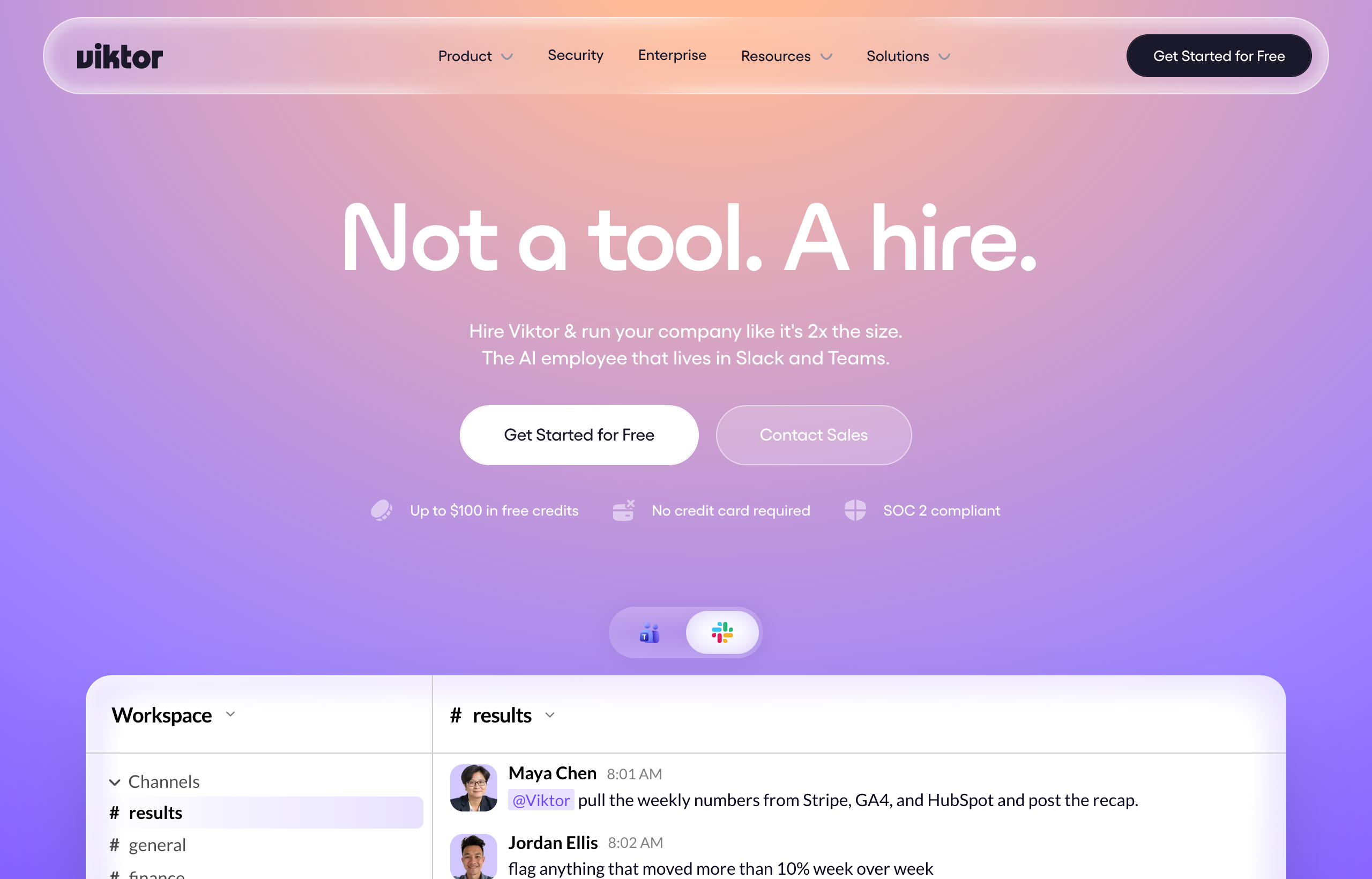
Tasklet is an AI agent platform built around persistent, task-owning agents that run 24/7 in cloud sandboxes, triggered by schedules, events, or webhooks, useful for teams that want to define a job once (“when a support email arrives, look up the customer and draft a reply”) and let it run indefinitely. Viktor is a Slack and Microsoft Teams-native “AI employee” with 3,200+ integrations that you brief conversationally, task by task, and that connects deeply into business tools like Stripe, Google Ads, HubSpot, and Salesforce with no per-seat pricing. If you want an always-on background agent running a defined process, Tasklet fits. If you want a coworker in your team’s existing chat tool that you can hand a wide range of one-off and recurring work to, Viktor fits better.
If what you actually want is a coworker in the channel your team already checks every day, not a separate command center to log into, that is exactly the gap Viktor is built to fill. Try Viktor’s free trial.
What each tool actually is
Tasklet: a command center for always-on autonomous agents
Tasklet’s pitch is that it is not a chatbot interface but a platform for building persistent agents that own a job. A typical example from its own site: “When support@acme.com receives an email, look up the customer in Salesforce, find the answer in Notion, and draft a reply in Gmail.” You describe the task in plain English and Tasklet handles the implementation without you drawing a flowchart. Each agent runs in an isolated cloud sandbox with its own compute for code execution and browser automation, and can be triggered by a schedule, an event, or a webhook, meaning it keeps working even when nobody is watching.
It connects to more than 20 applications by name, including Gmail, Slack, Google Drive, HubSpot, Salesforce, Asana, Airtable, Stripe, Calendly, Outlook, Microsoft Teams, Dropbox, QuickBooks, and Linear, and can also connect to custom HTTP APIs and MCP servers for anything not natively supported. It also routes tasks across multiple models (Claude, GPT, Gemini) depending on the job, and can generate small live software (dashboards, trackers) from a prompt.
Tasklet pricing (verify at tasklet.ai/pricing): a free plan with 300 bonus credits daily and limited usage (10 executions per trigger). A Starter plan around $25/month with 10,000 monthly credits plus 600 daily bonus credits. A Pro plan around $100/month with 40,000 monthly credits. A Custom plan starting around $250/month with 100,000 monthly credits and added support. One-time credit top-ups from $25 to $10,000 are available, valid for a year, and require an active subscription. No per-seat billing, plans support unlimited integrations and agents.
Viktor: a Slack-native coworker with a much wider integration surface
Viktor works differently at the interface level: you brief it inside a Slack or Teams channel, in conversation, the way you would brief a colleague, and it goes and executes. That includes pulling data from connected tools, writing and shipping code with real pull requests, building and deploying small web apps with a database and authentication, assembling reports and dashboards, scheduling recurring tasks, and proposing follow-up automations once it spots a pattern.
The integration breadth is the standout number: Viktor claims 3,200+ connected tools, named examples including Stripe, Notion, Google Ads, Meta Ads, HubSpot, Salesforce, Linear, Jira, GitHub, and Google Drive. That is more than 100 times Tasklet’s named integration count, though Tasklet’s custom HTTP API and MCP server support narrows that gap for teams willing to wire up their own connections.
Viktor pricing (verify at viktor.com/pricing): free trial with $100 in credits, no card required, credits never expire. Paid team plans start around $50/month for 20,000 credits, up to $200/month for 80,000 credits, then $300 to $5,000/month for growing companies (125,000 to 2,000,000 credits), with a 300,000-credit tier around $750/month reportedly the most popular. Billing is workspace-wide, not per seat. See the full Viktor review and how the credit model actually plays out month to month.
Comparison table

| Viktor | Tasklet | |
|---|---|---|
| Interface | Slack, Microsoft Teams (conversational) | Own command center dashboard |
| Core model | Brief it task by task like a coworker | Define persistent agents that run 24/7 on triggers |
| Named integrations | 3,200+ (Stripe, Google Ads, Meta Ads, HubSpot, Salesforce, GitHub, and more) | 20+ named (Gmail, Slack, HubSpot, Salesforce, Stripe, QuickBooks, Linear) plus custom APIs/MCP |
| Compute model | Executes within connected tools and Slack/Teams | Isolated cloud sandbox per agent, own browser/code execution |
| Entry price | Free trial ($100 credits), then around $50/mo | Free plan, then around $25/mo |
| Billing model | Credit-based, workspace-wide | Credit-based, plan plus daily bonus credits |
| Best for | A team wanting a coworker in existing chat tools for broad, varied work | A team wanting one well-defined process running always-on in the background |
A concrete example: the same job, two different setups
Take a common ops request: “when a new lead comes in, check if they match our ICP, and if they do, notify the sales rep and log it in the CRM.” In Tasklet, you would set this up once as a persistent agent tied to a trigger, a webhook from your form or CRM firing the agent, which then runs the lookup and notification logic in its own sandbox, indefinitely, without anyone needing to ask it again. That is the platform working as designed: define the job, walk away, let it run.
In Viktor, the same request can be handled two ways. You can ask it once, conversationally, in the sales Slack channel, and it will do that specific instance of the task on the spot, visible to the whole channel. Or you can ask it to set up a recurring or triggered version of the same check, since it can schedule recurring tasks and propose its own automations once it notices a pattern. The practical difference is less about capability and more about default behavior: Tasklet defaults to “build a standing agent,” Viktor defaults to “do the thing now, and we can make it recurring if that’s useful,” which tends to suit teams that are not sure yet which processes are worth automating permanently.
How the two actually feel to operate week to week
Managing a fleet of Tasklet agents feels closer to managing infrastructure: you have a dashboard listing your defined agents, their triggers, their recent runs, and you check in periodically to see what fired and what needs adjusting. That is a genuinely good model for teams that think in terms of defined, monitorable processes, similar to how an ops team might think about their Zapier stack or their cron jobs, just with an AI layer doing the actual work inside each step.
Working with Viktor feels more like working with a colleague who happens to also handle some recurring duties. Most days you are asking it something new in the moment, and periodically you notice a pattern worth turning into a standing task. That fits teams whose real workload is a long tail of different, non-repeating requests more than a short list of processes worth fully automating, which describes most small teams more accurately than a pure automation platform’s pitch would suggest.
Where Tasklet genuinely wins
Tasklet’s sandbox-per-agent architecture is a real advantage for a specific use case: a defined, always-on process that should keep running without a human triggering it each time, like the support-email-to-CRM-lookup example on its own site. Because each agent has isolated compute, it can run scheduled or webhook-triggered jobs independently of any chat platform, which fits a team that wants “set it up once and forget it” more than “talk to it today.”
Its entry pricing is also lower: the Starter plan at roughly $25/month undercuts Viktor’s roughly $50/month floor, and the free plan’s daily bonus credits give a genuinely usable trial without a subscription. For a small team testing whether agentic automation is worth adopting at all, that lower floor matters.
Where Viktor genuinely wins
Viktor’s core advantage is habitat and breadth. It lives in the tool your team is already using to coordinate, so its output (a report, a completed task, a question back to you) shows up where everyone already looks, rather than requiring a separate login to a Tasklet dashboard to check on an agent’s status. The integration count is also a real, practical gap: 3,200+ named connections versus Tasklet’s 20-plus native ones means Viktor is more likely to already support whatever niche tool your business runs on without you wiring up a custom API connection yourself.
Viktor is also built more around conversational, one-off requests (“pull last week’s ad spend and compare it to last month,” “draft the investor update”) in addition to recurring ones, which fits the reality that most of a team’s AI-agent workload is not a single repeatable process but a rotating set of different asks.
Setup and onboarding: what the first week actually looks like
Getting a first agent live in Tasklet means writing out the task in plain English, connecting whichever of its 20-plus native integrations the job needs (or wiring up a custom HTTP or MCP connection if it is not on the list), and defining the trigger, a schedule, a webhook, or an event. That upfront definition step is real work, but it pays off precisely because the agent then runs unattended; you are trading setup time now for attention time later.
Getting Viktor live is lighter at the start: install it into the Slack or Teams workspace, connect the handful of tools your most common requests will touch, and start asking it things conversationally. There is less upfront definition because most of what you ask it in week one is a one-off request rather than a standing agent. The tradeoff shows up later instead of earlier: teams that never take the extra step of turning a repeated request into a scheduled or triggered task end up re-asking Viktor the same thing weekly, which is fine but slightly less efficient, credit-wise, than Tasklet’s default of defining the job once.
Data access and trust: what each tool actually touches
Because Tasklet’s agents run in isolated cloud sandboxes with their own compute, the trust conversation is largely about scoping each agent narrowly: what specific system can this particular agent read from and write to, and what happens if the trigger fires more often than expected. That sandbox-per-agent model makes it relatively easy to reason about the blast radius of any one agent going wrong, since each one is contained.
Viktor’s trust model is closer to onboarding a new team member into a shared workspace: you are deciding what a single, general-purpose coworker can see and do across everything it is connected to, from ad accounts to your codebase to your CRM. Most teams manage this the same way they would with a human hire, starting it on read-only or low-stakes tasks (pulling reports, drafting content) before extending it to actions with real consequences (opening pull requests, updating live CRM records). Neither approach is inherently safer, they reflect the same underlying difference in design: many narrow, scoped agents versus one broad coworker whose scope grows with what you choose to connect.
Honest weaknesses of both
Viktor’s recurring complaint is the same one across every comparison: credit-based billing is genuinely harder to forecast than a flat fee, and daily heavy use by a team can push real monthly cost well past the $50 entry number, sometimes into the hundreds. It is also not purpose-built for the always-on, scheduled-background-agent use case the way Tasklet is; you can schedule recurring tasks in Viktor, but Tasklet’s sandbox-per-agent model is more explicitly designed around that pattern.
Tasklet’s tradeoffs are the mirror image: its native integration list is far shorter than Viktor’s, so unless your key tools are on that list of 20-plus or you are comfortable wiring up custom HTTP/MCP connections yourself, you may hit walls Viktor would not. It also lives in its own dashboard rather than inside the team chat tool most companies already run on, adding a bit more context-switching for teams that want everything visible in Slack or Teams.
Who should pick something else
If your real need is a single, well-defined process that should run continuously in the background with minimal ongoing conversation (a support-triage bot, a recurring data-sync job), Tasklet’s architecture is arguably a cleaner fit and its lower entry price makes it easy to test. If your team wants a broad range of varied, conversational tasks handled from the chat tool you already use daily, and you expect to lean on a very long tail of business integrations, Viktor’s breadth is the stronger match. Teams with tight, unpredictable budgets should pilot both on their free tiers before committing to a paid plan on either.
Can a team run both?
It is a more natural pairing than it might first appear. A reasonable split is to let Tasklet own the handful of genuinely repetitive, well-defined processes your ops team has already mapped out, the ones where a webhook-triggered sandbox agent is a clean fit, while Viktor handles the daily, unpredictable mix of requests that show up in Slack: pull this number, draft that update, check on this deal. Neither tool is trying to be the other, so running both is less about redundancy and more about matching each tool’s architecture to the shape of the work.
The main cost of running both is exactly that, cost: a Tasklet Pro plan around $100/month plus a mid-tier Viktor plan can add up quickly for a small team, so it is worth starting with whichever tool matches your most pressing bottleneck and adding the second only once you have a concrete process that fits its model.
My honest suggestion if you are torn: run one real recurring task through Tasklet’s free plan and one real ad hoc task through Viktor’s free credits in the same week. The difference in how each handles your actual work will tell you more than any comparison table. Start with Viktor here.
Curious how Viktor stacks up against a more personal-assistant-style entrant instead of a background-agent platform? See Viktor vs Poke. For the wider field, browse Viktor alternatives and the best AI agents of 2026 roundup.
FAQ
What is the main difference between Viktor and Tasklet?
Viktor is a conversational AI employee that lives in Slack or Microsoft Teams and connects to 3,200+ business tools. Tasklet is a command center for building persistent, always-on agents that run in isolated cloud sandboxes, triggered by schedules, events, or webhooks, with a shorter native integration list of 20-plus tools plus custom API support.
Which is cheaper, Viktor or Tasklet?
Tasklet has a lower entry price, with a Starter plan around $25/month versus Viktor’s roughly $50/month floor. Both use credit-based billing, so actual monthly cost depends heavily on usage in either case.
Can Tasklet run tasks without a human triggering them?
Yes, that is one of its core design points. Tasklet agents run 24/7 in cloud sandboxes and can be triggered by schedules, incoming events, or webhooks rather than requiring someone to start a conversation each time.
Does Viktor support custom integrations the way Tasklet does?
Viktor’s named integration list (3,200+) is far larger than Tasklet’s native list, so it is less likely you will need a custom connection in the first place. Tasklet compensates for its shorter native list with support for custom HTTP APIs and MCP servers.
Which tool is better for a team already using Slack every day?
Viktor, since it is built specifically to live inside Slack or Microsoft Teams and surface its work where the team already communicates. Tasklet operates from its own separate dashboard, which means an extra login and context switch to check on agent status.


