
The best Mailchimp alternatives in 2026 depend on why you are leaving, but beehiiv is the strongest overall pick for anyone whose email list is really a newsletter, not a store’s promo channel. It ships a native referral program, an ad network, and 0% fees on paid subscriptions that Mailchimp never built because Mailchimp was never trying to be a newsletter platform. If you are leaving for ecommerce-specific automation instead, Klaviyo is the better fit. If you just want lower prices with solid automation, Brevo or Moosend will do the job for less money. This guide covers all seven, ranked by who each one actually serves.
Disclosure: some links in this post are affiliate links. If you sign up through them, we may earn a commission at no extra cost to you. That never changes our verdict.
Key takeaways
- Mailchimp’s free plan caps out at 250 contacts and 500 sends a month, and the platform has long drawn criticism for how aggressively it counts unsubscribed and cleaned contacts against your plan limit.
- beehiiv is the best all-around alternative for newsletter operators: a native referral program, Boosts marketplace, ad network, SEO-indexable website, and 0% fees on paid subscriptions, with a free plan to 2,500 subscribers.
- Klaviyo is the right move if your business is ecommerce and you need revenue-attributed flows like abandoned cart and browse abandonment, not newsletter growth tools.
- Kit (formerly ConvertKit) has the deepest automation and tagging of the creator-focused tools, with a free plan up to 10,000 subscribers.
- Brevo and Moosend are the budget picks: both charge less than Mailchimp at comparable list sizes and both include marketing automation on entry paid tiers.
Why are people actually leaving Mailchimp in 2026?
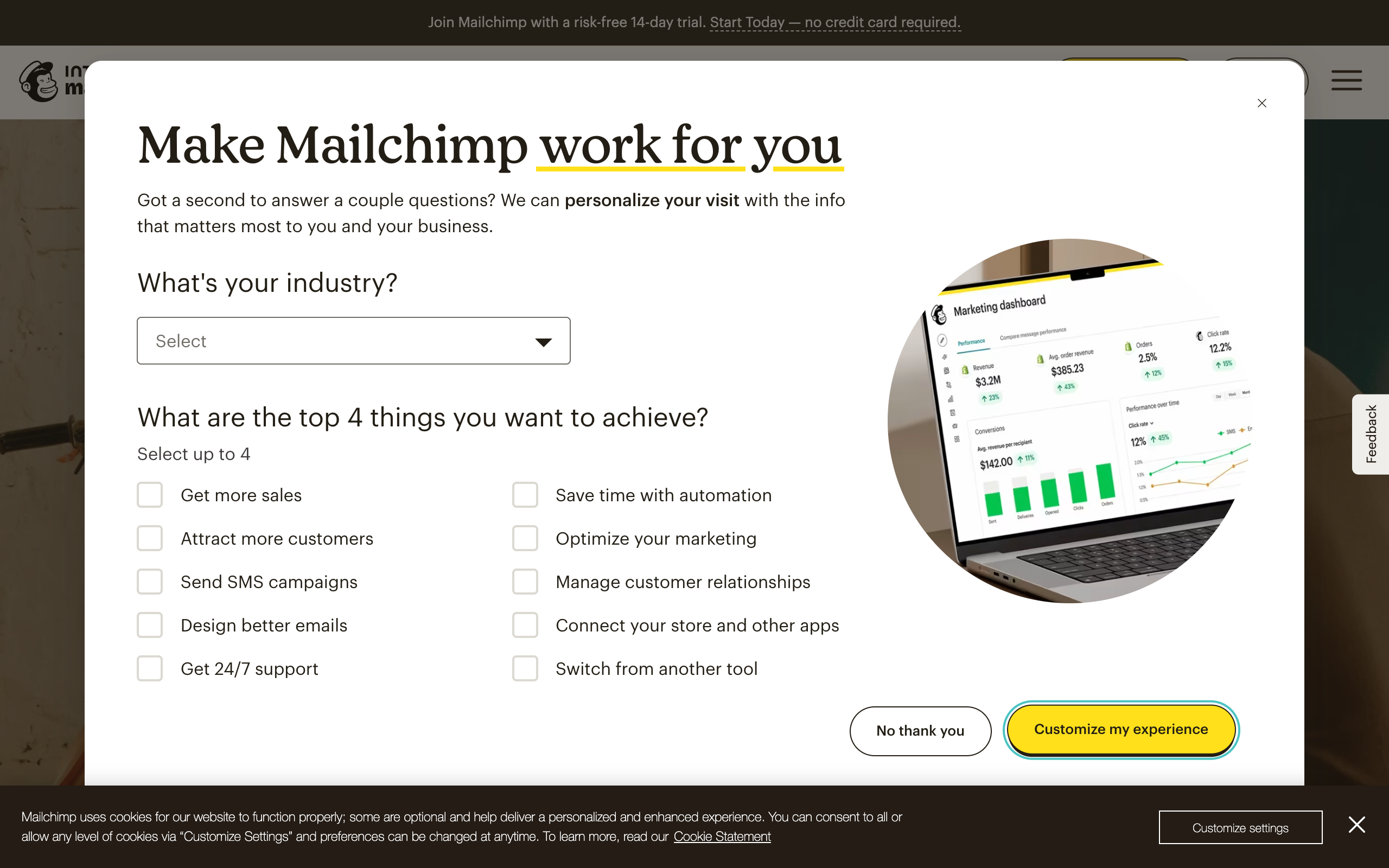
Three complaints come up over and over when I talk to people migrating off Mailchimp. First, the contact-counting problem: Mailchimp has a long history of counting unsubscribed and cleaned contacts against your plan’s limit, which means your bill can climb even as your actual engaged audience shrinks. Second, the free plan is thin. At 250 contacts and 500 sends a month, it stops being usable for a real newsletter almost immediately, where beehiiv’s free plan runs ten times larger at 2,500 subscribers with unlimited sends. Third, and this is the one that matters most for anyone running a newsletter rather than a store, Mailchimp was built for general marketing campaigns, not for growing an audience. There is no referral program, no recommendation network, no ad marketplace connecting you to sponsors. If your business genuinely runs on email promotions for a shop, none of that matters and Mailchimp still works fine. If you are trying to build a newsletter people subscribe to and share, you have likely already felt the platform pulling against that goal.
If a growing newsletter is what you are actually building, the fastest way to see the difference is to start a free beehiiv publication. It runs to 2,500 subscribers with unlimited sends, no card required, so testing it costs an evening.
The 7 best Mailchimp alternatives in 2026, compared
| # | Tool | Best for | Entry paid price | Free plan |
|---|---|---|---|---|
| 1 | beehiiv | Newsletter operators focused on growth and monetization | $43/mo (Scale, annual) | Up to 2,500 subscribers, unlimited sends |
| 2 | Kit | Creators who need deep automation and tagging | $33/mo (Creator, 1,000 subs) | Up to 10,000 subscribers, 1 automation |
| 3 | Brevo | Budget-conscious teams wanting email plus SMS | $9/mo (Starter, 5,000 emails) | 300 emails/day, up to 100,000 stored contacts |
| 4 | Moosend | Small teams wanting automation on a tight budget | Around $9/mo at 500 subscribers (as of mid-2026) | 30-day trial, up to 1,000 contacts |
| 5 | Klaviyo | Ecommerce brands needing revenue-attributed flows | Around $20/mo (500 contacts) | Up to 250 profiles, 500 sends/mo |
| 6 | Constant Contact | Small businesses wanting a simple, guided setup | $12/mo (Lite, 500 contacts) | No free-forever plan, trial only |
| 7 | ActiveCampaign | Teams that live inside complex automation workflows | Around $19/mo (Starter, 1,000 contacts) | No free-forever plan, trial only |
1. beehiiv: the best overall Mailchimp alternative for newsletters
beehiiv tops this list because it solves the actual problem most people leave Mailchimp to solve: growing an audience, not just emailing one. Built in 2021 by Tyler Denk, an early Morning Brew growth employee, beehiiv bundles a newsletter editor, an SEO-indexable website, a native referral program, the Boosts paid recommendation marketplace, an ad network, and paid subscriptions at 0% platform fee, all in one subscription.
The contrast with Mailchimp is not subtle. Mailchimp optimizes for campaign sends and customer journeys tied to a store. beehiiv optimizes for the question a newsletter operator actually asks every week: where does the next thousand subscribers come from? The referral program turns every email into a growth channel automatically. Boosts lets you buy or earn engaged subscribers through a vetted marketplace instead of running paid ads cold. And because every post publishes to a real, indexable website, a year of newsletters becomes a year of pages that can independently rank in search, something Mailchimp’s campaign archive was never built to do.
beehiiv pricing in 2026
Launch (free) covers up to 2,500 subscribers with unlimited sends, a custom domain, and a website. Scale starts at $43/month on annual billing ($517/year), covers up to 100,000 subscribers, and unlocks the referral program, Boosts, the ad network, automations, and 0% fees on paid subscriptions. Max starts at $96/month ($1,151/year) and removes beehiiv branding while adding up to 10 publications. Enterprise is custom for lists over 100,000.
Best for: writers, media operators, and businesses that treat the newsletter as the primary audience relationship, not a side channel.
Open a free beehiiv account and import your Mailchimp list to see the difference in a single send. No card required, free to 2,500 subscribers.
2. Kit: the deepest automation for creators
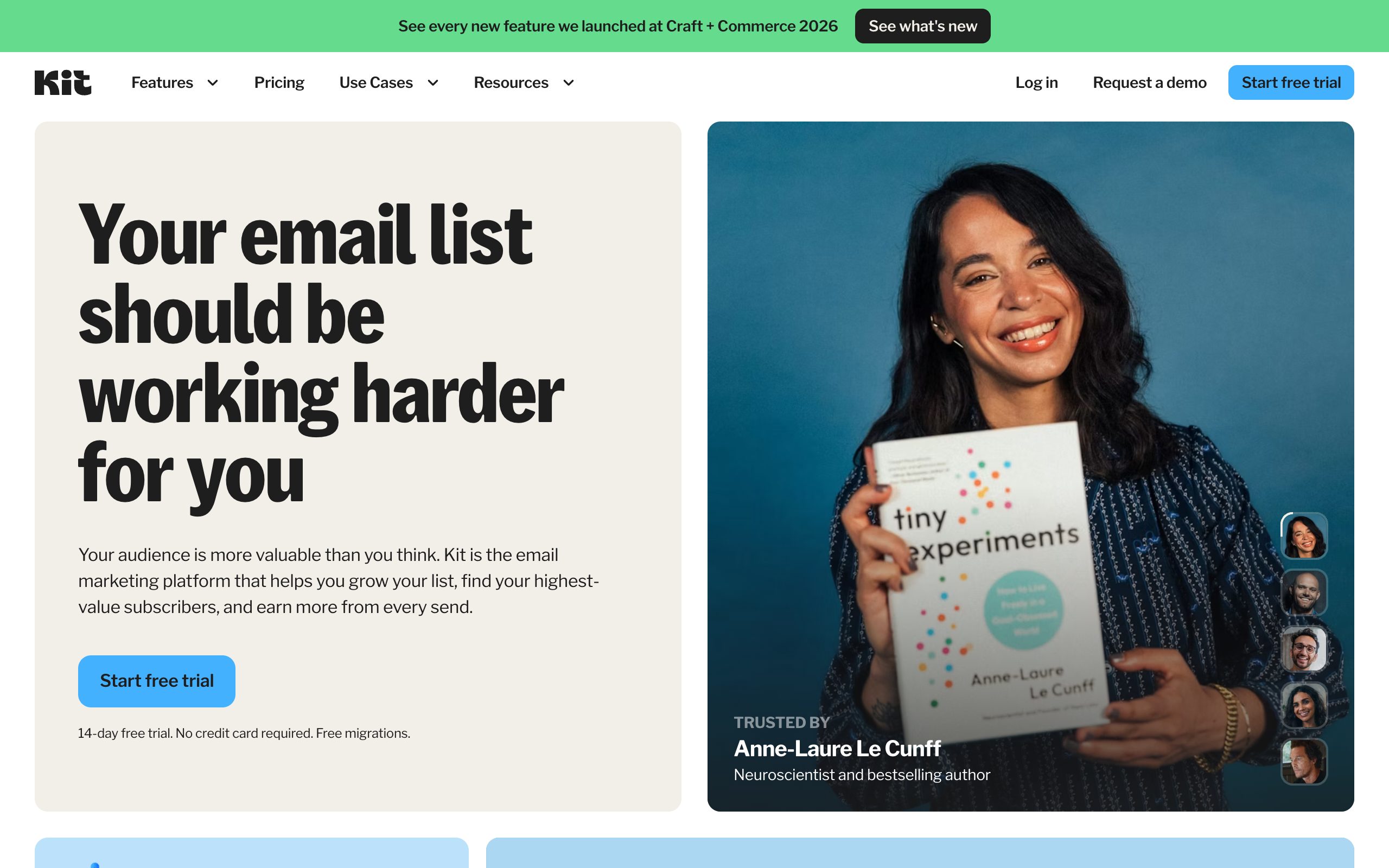
Kit, the platform formerly named ConvertKit, is the pick for anyone whose email strategy leans heavily on tagging, sequences, and selling digital products directly. Its automation builder is visually intuitive and genuinely more powerful than beehiiv’s for complex, conditional flows, if-this-then-that logic across multiple tags and triggers.
Kit’s free plan is the most generous by subscriber count on this list, covering up to 10,000 subscribers with one basic automation. Paid plans start with Creator at $33/month (or $390/year) for 1,000 subscribers, adding unlimited automations, sequences, A/B testing on subject lines, and SMS marketing. Pro, at $66/month or $790/year, adds subscriber engagement scoring, deliverability reporting, and Facebook custom audiences.
Best for: creators selling digital products, courses, or memberships who need funnel-grade automation more than newsletter growth tools.
3. Brevo: the budget all-in-one with SMS built in
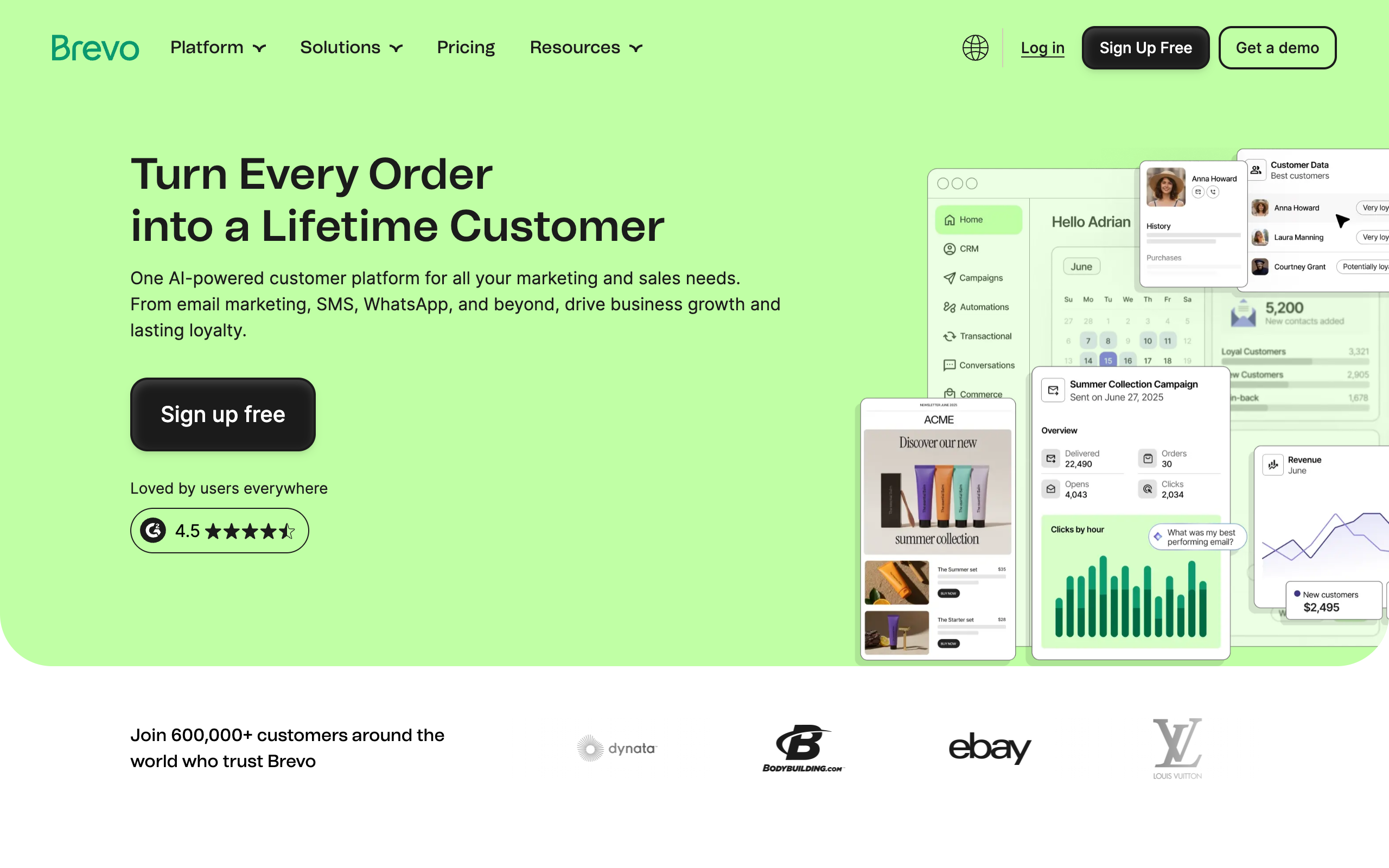
Brevo (formerly Sendinblue) is the strongest budget option if you want email and SMS under one roof. Its free plan is unusually generous on storage, up to 100,000 stored contacts, though sends are capped at 300 emails a day.
Paid plans start at $9/month for the Starter tier at 5,000 emails a month, climbing to $19/month for 20,000 emails and up to $69/month for 100,000 emails. The Standard plan starts at $18/month and adds marketing automation, A/B testing, landing pages, and removes Brevo’s logo. A Professional tier starts at $499/month for larger sending needs, and Enterprise is custom. Worth noting: Brevo retired its old “Business” plan tier in October 2025, so current naming is Free, Starter, Standard, Professional, and Enterprise.
Best for: small businesses that want email and SMS in one dashboard without paying Mailchimp or Klaviyo prices.
4. Moosend: automation on a genuinely tight budget
Moosend is the cheapest real automation platform on this list. The 30-day free trial covers up to 1,000 contacts with unlimited campaigns and one active automation workflow, no credit card required. Paid Pro pricing scales with list size starting around $9/month at 500 contacts (as of mid-2026), and includes unlimited campaigns, automation workflows, landing pages, and A/B testing.
The catch, and it is a real one: some features that ship standard on other platforms, transactional emails, audience discovery, custom reports, are add-ons on Moosend rather than included. Budget for that if you need them. Moosend also offers pay-as-you-go email credits for irregular senders, starting at $350 for 350,000 credits that never expire, which is a pricing model none of the other tools on this list offer.
Best for: small teams and solo marketers who want real automation without paying for features they will not use.
5. Klaviyo: built for ecommerce, not newsletters
Klaviyo is the alternative to pick specifically if your business is ecommerce and your email strategy runs on revenue-attributed flows: abandoned cart, browse abandonment, post-purchase sequences, and win-back campaigns tied directly to store data. Its integration depth with Shopify and other ecommerce platforms is genuinely best in class, and that is the entire reason to choose it over the others on this list.
The free plan covers up to 250 active profiles with 500 email sends a month and $5 of SMS credit. Paid Email plans start around $20/month for 500 contacts, roughly $30/month at 1,000 contacts, and about $100/month at 5,000 contacts, since Klaviyo bills by active profile count and, since a February 2025 billing change, that now includes cold and suppressed contacts you have not emailed in months, not just engaged subscribers. That detail catches people off guard, so prune your list before migrating.
Best for: ecommerce stores that need revenue attribution and flows built around purchase behavior. If your business is a newsletter, not a store, Klaviyo is the wrong tool wearing the right category name; read my full Klaviyo alternatives guide if that describes you.
6. Constant Contact: simple, guided, and built for beginners
Constant Contact has been in the small-business email space for decades and it shows in the product’s philosophy: guided setup wizards, a straightforward campaign builder, and support that assumes you have never done email marketing before. There is no free-forever plan, but there is a free trial to test the platform.
Lite starts at $12/month for 500 contacts with basic email marketing, welcome automation, and social marketing. Standard, at $35/month for the same 500-contact tier, adds A/B testing, segmentation, and pre-built automations. Premium runs $80/month and adds dynamic content, custom automation paths, and a dedicated ad manager. All prices scale up with list size; at 5,000 contacts, Standard runs about $110/month and Premium about $200/month. Annual billing saves up to 15%, and nonprofits get up to 30% off.
Best for: small businesses and nonprofits who want a guided, low-complexity setup over a growth-focused platform.
7. ActiveCampaign: for teams that live in complex automation
ActiveCampaign is the pick if your business runs on intricate, branching automation logic: multi-step funnels, CRM-integrated sequences, and behavioral triggers stacked several conditions deep. It is genuinely the most powerful automation builder on this list, more capable than Kit’s for complicated workflows, but that power comes with a steeper learning curve than any other tool here.
Pricing starts around $19/month for the Starter plan at 1,000 contacts on monthly billing, or roughly $15/month with annual billing. Plus runs about $49/month, Pro about $79/month, and Enterprise starts around $145/month, all scaling up with contact count. Be aware that several genuinely useful features, CRM pipelines, SMS credits, custom reporting, extra users, are separate add-ons rather than included in the base price, so the sticker price understates what a fully-featured setup actually costs.
Best for: teams with dedicated marketing operations staff who will actually use deep automation, not solo creators who just need to send a newsletter.
If you read through all seven and you are still primarily trying to grow an audience rather than run ecommerce flows or CRM automation, that is the signal beehiiv is the right fit. The free plan costs nothing to test against your current Mailchimp setup.
How do you actually migrate away from Mailchimp?
The mechanics are similar across all seven alternatives. Export your audience as a CSV from Mailchimp, including any tags or groups you use for segmentation, and import it into your new platform. Contact data (email, name, custom fields) transfers cleanly everywhere. What does not transfer automatically is your automation logic: welcome sequences, journeys, and any tag-based triggers need to be rebuilt by hand in the new platform’s automation builder, since none of these tools share Mailchimp’s specific automation architecture.
Before you export anything, send one re-engagement campaign from Mailchimp and prune everyone who does not open it. Every platform on this list either prices by contact count or counts inactive contacts against usage limits somewhere in its tiers, so migrating a bloated, years-old list costs you real money on your very first invoice with the new tool. I would rather you hear that from me now than find out from your bill next month.
Which Mailchimp alternative should you actually pick?
- Choose beehiiv if your email list is really a newsletter you want to grow through referrals, search, and eventually monetize through subscriptions or sponsors.
- Choose Kit if you sell digital products or courses and need deep, conditional automation more than growth tooling.
- Choose Brevo or Moosend if price is the deciding factor and you need real automation without Mailchimp’s or Klaviyo’s cost.
- Choose Klaviyo if you run an ecommerce store and need flows tied directly to purchase and browsing behavior.
- Choose Constant Contact if you want a guided, low-complexity setup and have never run email marketing before.
- Choose ActiveCampaign if your team has the bandwidth to build and maintain genuinely complex, multi-step automation.
My honest take, having tested most of these directly: the “which alternative” question is really a “what is your business” question in disguise. People spend weeks comparing feature lists when the answer was obvious the moment they were honest about whether they are running a newsletter, a store, or a marketing operations team. Answer that first, then pick from this list, not the other way around.
How does this compare with other newsletter platform guides?
This list focuses specifically on Mailchimp’s audience. If ecommerce is your primary use case, my dedicated Klaviyo alternatives guide goes deeper on that comparison set. For the direct head-to-head with the pick at the top of this list, read beehiiv vs Mailchimp, my full beehiiv review after actually running a publication on it, and for Mailchimp’s own strengths and weaknesses in more detail, see my full Mailchimp review and the complete Mailchimp pricing breakdown. If beehiiv’s own subscriber-tier pricing is what you need to model before switching, read the full beehiiv pricing breakdown. For the widest view of the category beyond just Mailchimp alternatives, start with my ranking of the best newsletter platforms in 2026.
What should you actually check before signing up for any of these?
A few questions cut through the marketing copy faster than a feature comparison ever will. Ask each platform, or check the pricing page yourself, on these five points before you commit a migration weekend to any of them.
Does the price you see include automation, or is that a separate add-on? Several tools on this list, ActiveCampaign and Moosend in particular, keep the advertised sticker price low by moving genuinely useful features like transactional email or custom reporting into paid add-ons. Read the fine print, not just the pricing table headline.
How does the platform count your list for billing purposes? Mailchimp’s contact-counting reputation is the reason this whole article exists, but it is not the only platform that counts inactive or suppressed contacts against your bill. Klaviyo made a similar change in 2025. Ask directly, or test with a small segment before importing your full list.
What actually happens to your automations during migration? None of these seven tools import Mailchimp’s journey logic directly. Budget real time, a few hours for a simple welcome sequence, considerably more for anything with branching logic, to rebuild automations by hand rather than assuming a one-click transfer.
Is the free plan a real free plan, or a disguised trial? beehiiv, Kit, Brevo, and Klaviyo all have genuine free-forever tiers, while Constant Contact and ActiveCampaign only offer time-limited trials. If budget is tight while you are testing, that distinction matters more than any feature comparison.
Does the platform’s core strength actually match what you are building? This is the one people skip and regret skipping. A newsletter operator on ActiveCampaign is paying for automation depth they will never use. An ecommerce store on beehiiv is missing revenue-attributed flows it actually needs. Match the tool’s core identity to your business model first, then compare prices.
Frequently asked questions
What is the best Mailchimp alternative in 2026? beehiiv for newsletter operators focused on growth and monetization, Klaviyo for ecommerce brands needing revenue-attributed flows, and Brevo or Moosend for budget-conscious teams that still want real automation. The right pick depends on whether your email list is a newsletter, a store’s promo channel, or a marketing operations workflow.
Why are people leaving Mailchimp? The three most common reasons are the free plan’s low limit of 250 contacts and 500 sends a month, a long-running criticism that Mailchimp counts unsubscribed and cleaned contacts against your plan limit, and the platform’s lack of newsletter-specific growth tools like referral programs or ad networks.
Is beehiiv cheaper than Mailchimp? beehiiv’s free plan is significantly larger, 2,500 subscribers with unlimited sends versus Mailchimp’s 250 contacts and 500 sends. On paid tiers, beehiiv’s Scale plan at $43/month includes growth features Mailchimp does not offer at any price, so the platforms are not directly comparable on cost alone.
What is the cheapest Mailchimp alternative? Moosend and Brevo are the least expensive options with real automation included, both starting around $9/month at small list sizes, well below Mailchimp’s Essentials tier at $13/month for a fraction of the features.
Can I export my Mailchimp list to any of these alternatives? Yes. All seven platforms accept a standard CSV export from Mailchimp for contact data. Automation sequences and journeys do not transfer automatically and need to be rebuilt manually in the new platform.
Which Mailchimp alternative is best for ecommerce? Klaviyo, specifically because of its deep native integrations with Shopify and other ecommerce platforms and its revenue-attributed automation flows like abandoned cart and post-purchase sequences.
The bottom line
Every tool on this list can send an email. That was never the hard problem. The real question is what each platform is actually optimized to do beyond sending: grow an audience, sell more product, run a marketing operation, or just get a simple message out the door reliably. Mailchimp tried to be good at all four and ended up being the default rather than the best choice for any one of them, which is exactly why so many people are migrating off it in 2026.
If I had to pick one word for each: beehiiv is growth, Kit is automation-for-creators, Brevo and Moosend are value, Klaviyo is ecommerce, Constant Contact is simplicity, and ActiveCampaign is depth. Match the word to what you are actually building, and the alternative picks itself.
Start your free beehiiv publication today and send your next issue from it instead of Mailchimp. Free to 2,500 subscribers, no card required, and you will know within two sends whether it fits.
Pricing captured from vendor pricing pages, July 2026. Plans change, so confirm current details before you buy.


