
The best Klaviyo alternatives in 2026 depend heavily on whether you actually run an ecommerce store or just got pushed toward Klaviyo because it is the category’s biggest name. If you are a creator, a solo newsletter operator, or a small business without a product catalog to sell against, Klaviyo is genuinely the wrong tool: its pricing and its entire feature set are built around revenue-attributed ecommerce flows you will never use. beehiiv is the strongest alternative for anyone whose real product is the audience itself. Omnisend is the better pick if you do run ecommerce but find Klaviyo’s per-profile pricing punishing. This guide covers all seven, with real 2026 pricing.
Disclosure: some links in this post are affiliate links. If you sign up through them, we may earn a commission at no extra cost to you. That never changes our verdict.
Key takeaways
- Klaviyo bills by active profile count, and since a February 2025 billing change, that count includes cold and suppressed contacts you have not emailed in months, not just engaged subscribers.
- Klaviyo’s Email plan runs roughly $20/month at 500 contacts, $30/month at 1,000, and about $100/month at 5,000, a cost curve that climbs fast for anyone without ecommerce revenue to offset it.
- beehiiv is the strongest alternative for creators and newsletter operators: a native referral program, an ad network, and 0% fees on paid subscriptions, none of which Klaviyo builds because it was never trying to serve that audience.
- Omnisend is the closest like-for-like ecommerce alternative, with a free plan and entry pricing around $11.20/month, meaningfully cheaper than Klaviyo at comparable list sizes.
- Mailchimp, Brevo, Moosend, ActiveCampaign, and GetResponse each cover a different SMB use case Klaviyo was never built to optimize for, from simple guided setup to deep automation.
Why do creators and SMBs keep ending up on Klaviyo, and why does it go wrong?
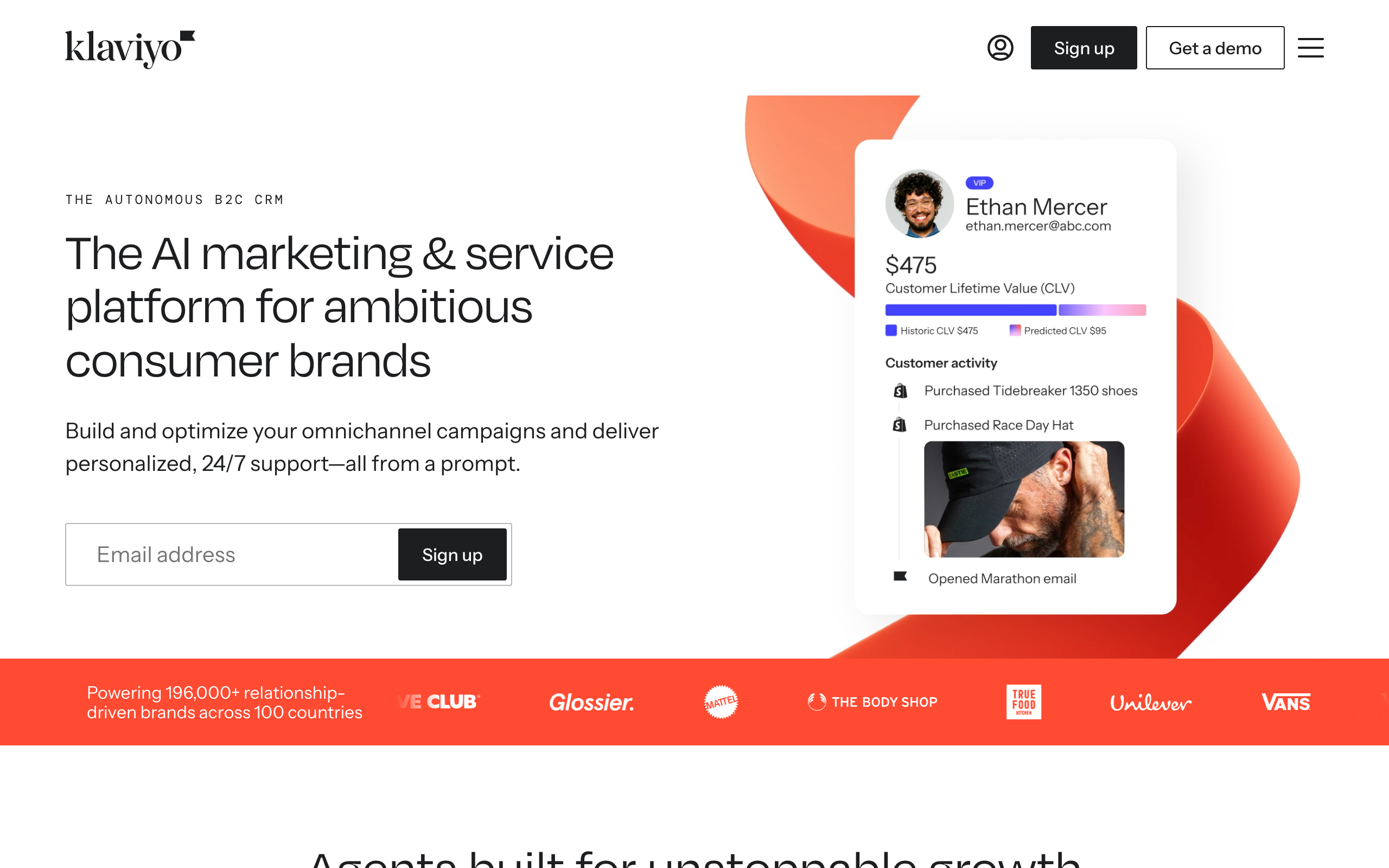
Klaviyo’s reputation is well earned in one specific lane: ecommerce email built around Shopify data. Abandoned cart flows, browse abandonment, post-purchase win-back sequences tied to actual purchase history, no other platform on this list matches that depth. The problem is that Klaviyo’s marketing reaches well past that lane, and a lot of creators, solo newsletter writers, coaches, and small service businesses sign up for Klaviyo because it is the name they have heard most, not because they actually need revenue-attributed flows.
Here is where it goes wrong for that audience. Klaviyo prices by active profile, and the February 2025 billing change means cold and suppressed contacts, people who have not opened an email in months, now count against your bill just like engaged subscribers. For a creator with a growing but imperfectly-scrubbed list, that is real money spent on contacts who are not reading anything. Worse, none of Klaviyo’s actual differentiators, the ecommerce flows, the product recommendation blocks, the revenue dashboards, do anything for a newsletter that is not selling physical or digital products through a cart. You are paying ecommerce prices for a tool built around ecommerce logic, and using roughly a third of what you are paying for.
If your business is the newsletter, not a store, the fastest way to feel the difference is to start a free beehiiv publication. It runs to 2,500 subscribers with unlimited sends, no card required.
The 7 best Klaviyo alternatives in 2026, compared
| # | Tool | Best for | Entry paid price | Free plan |
|---|---|---|---|---|
| 1 | beehiiv | Creators and newsletter operators, not ecommerce | $43/mo (Scale, annual) | Up to 2,500 subscribers, unlimited sends |
| 2 | Omnisend | Ecommerce stores wanting Klaviyo-style flows, cheaper | $11.20/mo (Standard, 500 contacts) | Up to 250 contacts, 500 emails/mo |
| 3 | Mailchimp | General SMB marketing beyond just email | $13/mo (Essentials) | Up to 250 contacts, 500 sends/mo |
| 4 | Brevo | Budget teams wanting email plus SMS together | $9/mo (Starter, 5,000 emails) | 300 emails/day, up to 100,000 stored contacts |
| 5 | Moosend | Small teams wanting automation on a tight budget | Around $9/mo at 500 subscribers (as of mid-2026) | 30-day trial, up to 1,000 contacts |
| 6 | ActiveCampaign | SMBs that need CRM-integrated automation | Around $19/mo (Starter, 1,000 contacts) | No free-forever plan, trial only |
| 7 | GetResponse | SMBs wanting funnels and webinars bundled in | Around $19/mo (1,000 subscribers) | No free-forever plan, trial only |
1. beehiiv: the pick if you are not actually running ecommerce

beehiiv tops this list for one reason: most people who land on a “Klaviyo alternatives” search are not running a store, they are running a newsletter, and beehiiv is built entirely around that job. Founded in 2021 by Tyler Denk, an early Morning Brew growth employee, it bundles an editor, an SEO-indexable website, a native referral program, the Boosts recommendation marketplace, an ad network, and paid subscriptions at 0% platform fee.
The contrast with Klaviyo is structural, not cosmetic. Klaviyo’s dashboards are built around revenue per email and product recommendation blocks. beehiiv’s are built around subscriber growth, referral performance, and content engagement, the metrics that actually matter when the newsletter itself is the product. If you tried Klaviyo because someone told you it was “the best” and found yourself never touching the ecommerce features, that is the tell you are the audience beehiiv actually built for.
beehiiv pricing in 2026
Launch (free) covers up to 2,500 subscribers with unlimited sends, a custom domain, and a website. Scale starts at $43/month on annual billing ($517/year), covers up to 100,000 subscribers, and unlocks the referral program, Boosts, the ad network, and 0% fees on paid subscriptions. Max starts at $96/month ($1,151/year) and adds branding removal plus up to 10 publications.
Best for: creators, writers, and small businesses whose product is the audience itself, not a cart full of items.
Open a free beehiiv account and compare it directly against your Klaviyo trial. No card required, free to 2,500 subscribers.
2. Omnisend: the real ecommerce alternative if you keep the cart
If you genuinely do run ecommerce and need abandoned-cart flows, product recommendations, and SMS tied to purchase behavior, Omnisend is the closest direct substitute for Klaviyo, and it is meaningfully cheaper at comparable list sizes. The free plan covers up to 250 contacts with 500 emails a month. Standard starts at $11.20/month for 500 contacts and 6,000 emails, roughly half of Klaviyo’s $20/month entry price at the same contact count. Pro, at $41.30/month, covers 2,500 contacts with unlimited email sends, AI personalization, and SMS starting around $0.007 per message.
Best for: ecommerce stores that want Klaviyo’s flow logic without Klaviyo’s pricing curve.
3. Mailchimp: general marketing beyond just email
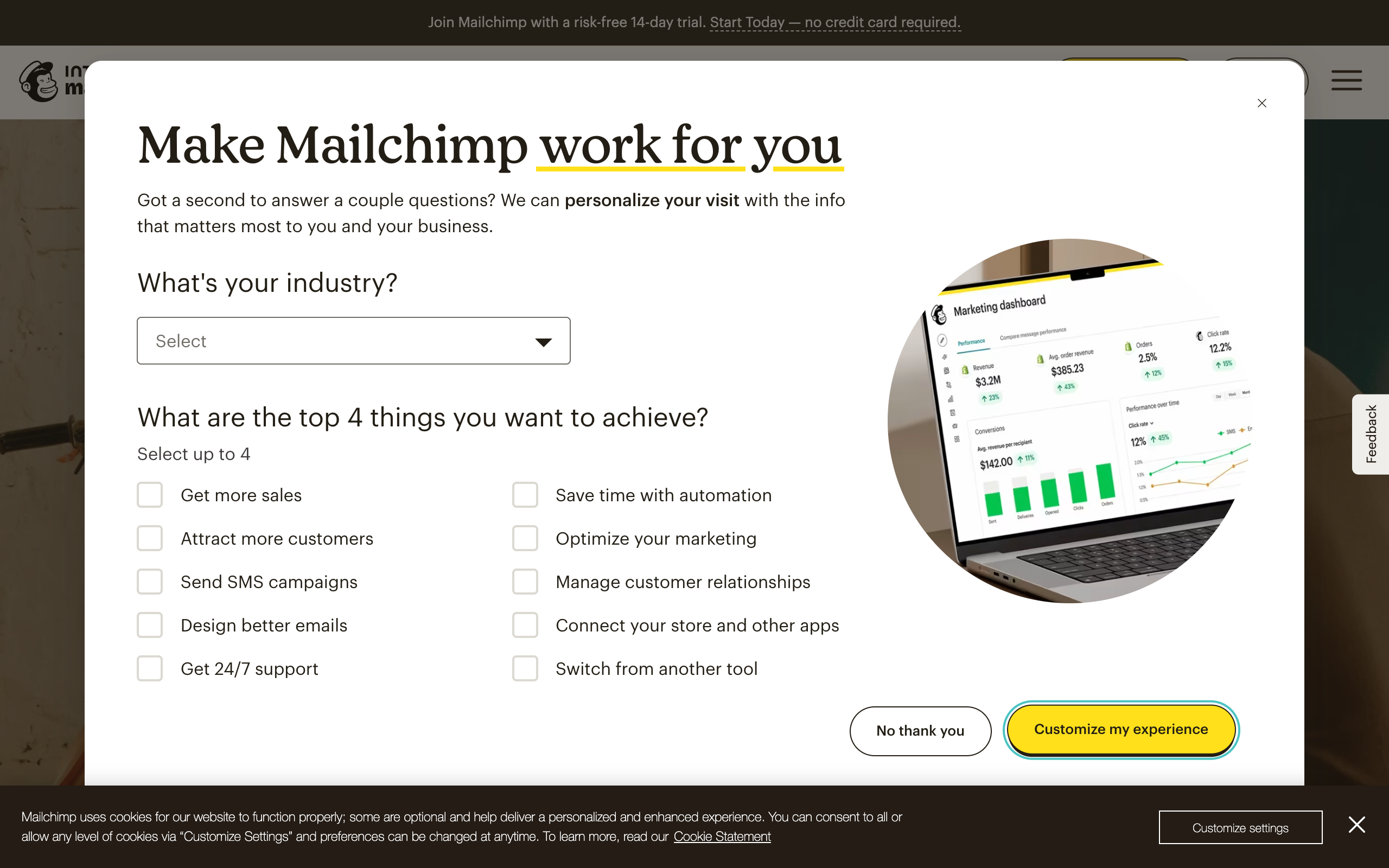
Mailchimp is worth considering if your business needs marketing tools beyond email, social posting, basic CRM features, landing pages, alongside campaigns, and you do not need Klaviyo’s deep ecommerce attribution. The free plan covers up to 250 contacts and 500 sends a month. Essentials starts at $13/month, Standard at $20/month adding up to 200 automation flows and generative AI tools, and Premium at $350/month for unlimited contacts and predictive segmentation.
The honest caveat: Mailchimp has a long-running reputation for counting unsubscribed and cleaned contacts against your plan limit, so audit your list before committing to a tier. If you are choosing between Mailchimp and Klaviyo specifically, my Mailchimp alternatives guide covers that comparison from the other direction.
Best for: small businesses that want one dashboard for general marketing, not deep ecommerce automation.
4. Brevo: the budget pick with SMS built in
Brevo (formerly Sendinblue) is the strongest low-cost option if you want email and SMS under one roof without Klaviyo’s per-profile pricing. The free plan stores up to 100,000 contacts with sends capped at 300 emails a day. Starter begins at $9/month for 5,000 emails, climbing to $19/month for 20,000 and up to $69/month for 100,000. Standard, at $18/month, adds marketing automation and A/B testing.
Best for: small businesses that want SMS alongside email without paying ecommerce-tier prices for either.
5. Moosend: automation on the tightest budget
Moosend is the cheapest real automation platform on this list. The 30-day free trial covers up to 1,000 contacts with unlimited campaigns and one automation workflow. Paid Pro pricing scales with list size, starting around $9/month at 500 contacts (as of mid-2026), with unlimited campaigns and workflows included. Some features, transactional email and custom reporting among them, are paid add-ons rather than included, so check that before assuming the sticker price is the full cost.
Best for: solo marketers and small teams who want automation without Klaviyo’s or Mailchimp’s price tag.
6. ActiveCampaign: for SMBs that need CRM-integrated automation
ActiveCampaign is worth a look if your business needs deep, branching automation tied to a CRM, something Klaviyo does not really build for outside of ecommerce-specific triggers. Pricing starts around $19/month for Starter at 1,000 contacts on monthly billing, roughly $15/month on annual billing, climbing to about $49/month for Plus and $79/month for Pro. Several useful features, CRM pipelines, SMS credits, custom reporting, are separate add-ons, so the advertised price understates a fully-loaded setup.
Best for: small businesses running sales-and-marketing workflows together, not pure ecommerce email.
7. GetResponse: funnels and webinars bundled with email
GetResponse is the pick if your marketing extends into webinars, course delivery, or sales funnels alongside email, features Klaviyo does not offer at all. The entry Email Marketing tier runs around $19/month for 1,000 subscribers (as of mid-2026), scaling to roughly $79/month at 10,000 and $539/month at 100,000. Higher tiers add marketing automation, abandoned cart recovery, and a course-and-webinar builder with attendee caps depending on plan.
Best for: small businesses running webinars or a course funnel who want that bundled with email rather than stitched together from separate tools.
Still unsure whether you are actually a Klaviyo-shaped business or a beehiiv-shaped one? The free beehiiv plan costs nothing to test against what you have now.
Where does Klaviyo actually still win, honestly?
It would be dishonest to write seven alternatives and never say what Klaviyo does better than all of them, so here it is. Klaviyo’s predictive analytics, things like predicted customer lifetime value and churn risk scoring, are genuinely ahead of Omnisend, ActiveCampaign, or anything else on this list, because Klaviyo has more ecommerce transaction data flowing through its models than smaller competitors do. Its native Shopify integration is also the deepest in the category: product catalogs sync automatically, browse and purchase events fire in near real time, and the segmentation you can build off that data is genuinely more precise than what Omnisend offers at a comparable price.
If your store does six or seven figures a year and email already drives a meaningful chunk of revenue, that precision is worth paying for, and switching away from Klaviyo purely to save money on a business where email already converts well is a mistake I would talk a client out of. The alternatives on this list are not “better than Klaviyo” in some absolute sense. They are better for the specific person who signed up for Klaviyo without needing what makes Klaviyo actually good.
What should you check before switching off Klaviyo?
A few questions matter more than any feature comparison table once you are actually deciding.
How much of your current email revenue comes from flows you would have to rebuild? If abandoned cart and post-purchase sequences are doing real work, price out the migration cost, both the tool switch and the time to rebuild and re-test those flows, against what you would save. For a store doing meaningful revenue through those flows, a cheaper platform that takes two months to reach the same conversion rate is not actually cheaper.
Are you being billed for contacts you do not need? Klaviyo’s 2025 change to bill cold and suppressed profiles is the single biggest driver of unexpected cost on this list. Before switching platforms at all, run a suppression cleanup on your existing list. You may find the real fix is pruning, not migrating, and that is worth knowing before you commit a weekend to a full platform move.
Does the alternative’s free plan even fit your current list size? beehiiv, Omnisend, Mailchimp, and Brevo all have genuine free-forever tiers, while ActiveCampaign and GetResponse only offer trials. If you are downsizing specifically to save money, know upfront whether the free tier actually covers your list or whether you will land in a paid tier anyway.
Is your business actually ecommerce, or does it just have a store attached? This is the one worth sitting with. A creator who sells one digital product through a simple checkout link is not the same business as a store with a rotating catalog of hundreds of SKUs, even though both technically “sell things.” The first is closer to beehiiv’s audience. The second needs Omnisend or Klaviyo’s flow depth. Be honest about which one you actually are before picking a tool built for the other.
How do you migrate away from Klaviyo?
Every alternative on this list accepts a standard CSV export of your Klaviyo profiles for contact data, and that part transfers cleanly. What does not transfer is Klaviyo’s flow logic: abandoned cart triggers, browse abandonment sequences, and post-purchase automations are built on Klaviyo-specific event tracking, so plan to rebuild those flows manually inside your new platform’s automation builder, whether that is Omnisend’s flow editor for a like-for-like ecommerce move or beehiiv’s simpler system if you are leaving ecommerce logic behind entirely.
Before you export anything, run a suppression check and remove contacts who have not engaged in the last six months. Given that Klaviyo’s own 2025 billing change now counts cold profiles against your usage, there is a good chance your current bill is already inflated by exactly the contacts you should be pruning anyway, so do it once and carry a cleaner list into whichever tool you pick next.
Which Klaviyo alternative should you actually pick?
- Choose beehiiv if your business is a newsletter or content audience, not a store, and Klaviyo’s ecommerce features have been sitting unused.
- Choose Omnisend if you run real ecommerce and need Klaviyo-style flows at a lower price point.
- Choose Mailchimp if you want general marketing tools (social, landing pages, basic CRM) alongside email.
- Choose Brevo or Moosend if price is the deciding factor and you need real automation without ecommerce-tier pricing.
- Choose ActiveCampaign if your business runs sales-and-marketing workflows together and needs CRM integration.
- Choose GetResponse if webinars or course funnels are part of your marketing, not just email sends.
Here is the blunt version I would tell a friend: if you have had a Klaviyo account for more than three months and have never once opened the abandoned-cart flow builder, you are not a Klaviyo customer, you just have a Klaviyo bill. That is not a small distinction. It is usually the entire decision.
How does this compare with other newsletter platform guides?
If Mailchimp, not Klaviyo, is the tool you are actually trying to replace, my dedicated Mailchimp alternatives guide covers that comparison set directly. For the full head-to-head between the two platforms in this article’s top and bottom slots, read beehiiv vs Klaviyo, and for the deeper dive on why beehiiv earns the top spot here, see my full beehiiv review after actually running a publication on it. For Klaviyo’s own numbers in more detail, read my Klaviyo review and the complete Klaviyo pricing breakdown. If beehiiv’s subscriber-tier pricing is what you need to model before switching, see the full beehiiv pricing breakdown, and for the widest view of the category, start with my ranking of the best newsletter platforms in 2026.
Frequently asked questions
What is the best Klaviyo alternative in 2026? beehiiv for creators and newsletter operators who are not running ecommerce, and Omnisend for ecommerce stores that want Klaviyo-style flows at a lower price. Mailchimp, Brevo, Moosend, ActiveCampaign, and GetResponse each fit different SMB needs beyond pure ecommerce.
Why is Klaviyo so expensive? Klaviyo bills by active profile count, and a February 2025 billing change means cold and suppressed contacts you have not emailed in months now count against that total, not just engaged subscribers. Combined with per-profile pricing that climbs steeply with list size, costs rise faster than many small businesses expect.
Is Klaviyo overkill for a small newsletter? Usually, yes. Klaviyo’s core strengths, abandoned cart flows, product recommendation blocks, purchase-based automation, are ecommerce features a newsletter without a cart will never use, while paying ecommerce-tier prices for them.
What is the cheapest Klaviyo alternative for ecommerce? Omnisend, with a free plan up to 250 contacts and paid tiers starting at $11.20/month, roughly half of Klaviyo’s entry pricing at comparable contact counts, while keeping similar flow-based automation.
Can I export my Klaviyo list to another platform? Yes. All seven alternatives accept a standard CSV export of your Klaviyo profiles for contact data. Flow logic like abandoned cart and post-purchase sequences does not transfer automatically and must be rebuilt manually.
Is beehiiv a good Klaviyo alternative for ecommerce brands? Not really. beehiiv has no native cart-abandonment or purchase-attribution flows, so ecommerce stores are better served by Omnisend or Klaviyo itself. beehiiv is built for audience growth and monetization through subscriptions and sponsorships, not transactional ecommerce automation.
The bottom line
The Klaviyo question almost always resolves the same way once you ask it plainly: are you selling products through a cart, or are you selling an audience’s attention? Klaviyo is genuinely excellent at the first job and structurally irrelevant to the second one, and its pricing does not care which job you actually have. Most of the frustration behind a “Klaviyo alternatives” search comes from people paying ecommerce prices for a job Klaviyo was never trying to do for them.
Pick based on the job, not the brand recognition. If the audience is the product, beehiiv. If the cart is the product, Omnisend beats Klaviyo on price without losing the flow logic that actually matters. Everything else on this list fills a specific SMB gap in between, and the worst outcome is picking based on which name comes up first in a Google search rather than which one matches what you actually sell. Take the twenty minutes to answer that question honestly before you migrate anything.
Start your free beehiiv publication today if the audience, not the cart, is what you are actually building. Free to 2,500 subscribers, no card required.
Pricing captured from vendor pricing pages, July 2026. Plans change, so confirm current details before you buy.


