
Most “Glean alternatives” lists are written for the wrong reader. They assume you want another enterprise search tool, just cheaper or less locked behind a sales call. Sometimes that is true. But a lot of people searching for Glean alternatives actually hit a different wall: Glean found the answer, and now someone still has to act on it, and Glean was never built to do that part. This list covers both readers honestly, tools that search like Glean does, and one tool that does something Glean does not do at all: execute the task once the answer is found.
Disclosure: some links in this post are affiliate links. If you sign up through them, we may earn a commission at no extra cost to you. That never changes our verdict.
30-second verdict
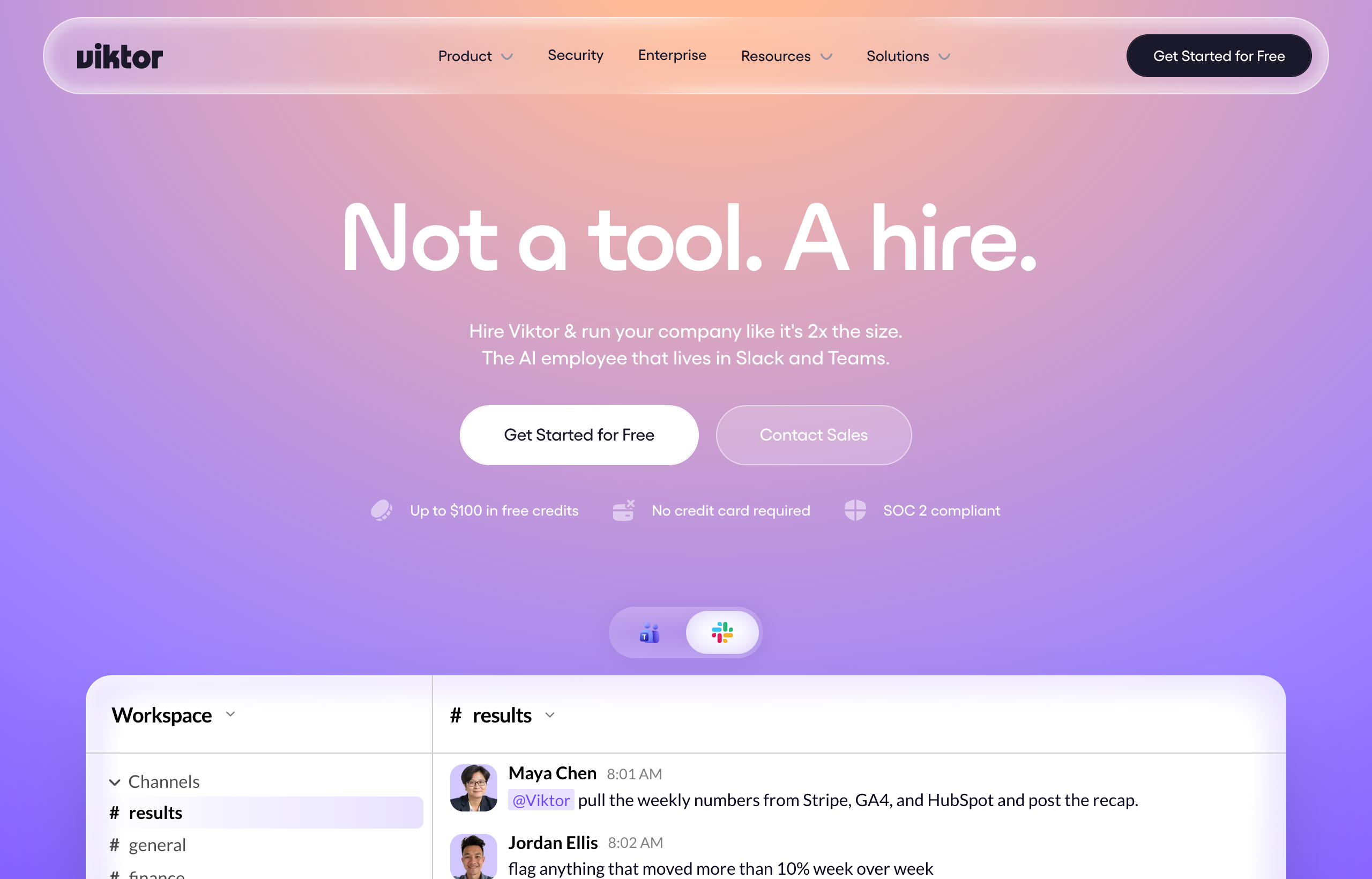
Glean is search-first: it indexes your company’s knowledge across 250-plus connectors and answers questions with cited sources, and it is genuinely good at that job. It is not built to execute multi-step work. Viktor is action-first: it lives in Slack and Microsoft Teams, and instead of just returning an answer, it goes and does the task, pulling from 3,200-plus integrations to build the actual deliverable. That is why it tops this list, not because it is a better search tool (it is not trying to be one), but because it solves the problem that shows up right after a Glean search does its job. Dust, Relevance AI, and Microsoft Copilot round out the field for teams that want other angles on the same broad category.
| Tool | Core strength | Where it lives | Starting price |
|---|---|---|---|
| Viktor | Executes tasks end to end, action-first, not just search | Slack, Microsoft Teams | Free trial with $100 in credits, then around $50/mo |
| Glean | Enterprise search and assistant over company knowledge | Web app, browser extension, Slack | Custom, sales-led (no public self-serve price) |
| Dust | Building custom agents over your own data and tools | Web app + Slack, Chrome extension | Free tier, Pro around $30/user/mo |
| Relevance AI | Assembling multi-agent teams visually | Web app, API | Free tier, usage-based paid plans |
| Microsoft Copilot | AI assistant embedded across Microsoft 365 apps | Word, Excel, Outlook, Teams | Add-on to Microsoft 365 licensing, typically a per-user monthly fee |
Why “search-first” isn’t the whole answer for most teams
Glean’s category, enterprise search grounded in an AI assistant, exists because company knowledge genuinely does get scattered across a dozen tools, and finding the right document used to mean pinging the one person who remembers where it lives. Glean solves that well, connecting to 250-plus sources and answering with cited context rather than a pile of unsorted links. But sit with what happens after the answer arrives. Someone found the churn report from last quarter. Now someone has to build this quarter’s version, actually pull the fresh numbers, compare them, and write the summary. Glean’s search does not do that next step, and for a lot of teams, that next step, not the search itself, is where the actual hours go every week.
That is the gap this list is built around. If your team’s real cost center is people not finding information, keep reading for the search-oriented alternatives below. If it is people finding information and then still having to manually assemble it into something useful, Viktor is worth trying first.
1. Viktor: action-first, not search-first
Viktor lives directly in the Slack or Teams channel your team already uses. You brief it on a task the way you would a new hire, “pull last month’s ad spend from Google Ads and Meta Ads, compare it against Stripe revenue for the same campaigns, and put together a one-page summary,” and it goes and does it, connecting to whichever of its 3,200-plus integrations the task requires (Stripe, Notion, HubSpot, Salesforce, Linear, Jira, GitHub, and more), and returns a finished output: a report, a spreadsheet, a small deployed web app with a database and login, or even a pull request if the task touches code. It also schedules recurring tasks and proposes its own follow-up automations once it notices a pattern in what you keep asking it.
That is fundamentally different from what Glean does. Glean answers “what do we already know.” Viktor answers “here is the finished thing you needed.” The two are not really competing for the same job, which is exactly why Viktor deserves the top spot on a Glean alternatives list aimed at people whose actual bottleneck is execution, not findability.
If the honest problem in your team is “we know the answer, someone just has to go do the work,” try Viktor’s free trial, $100 in credits, no card needed, and hand it the task that has been sitting on someone’s to-do list for two weeks.
Viktor’s pricing is workspace-wide and credit-based rather than per seat: a starter tier of around 20,000 credits runs about $50 a month, scaling to $75 for 30,000 and $100 for 40,000, with larger tiers for bigger teams. Since the whole workspace shares one pool, adding people to the Slack channel does not automatically raise the bill. See the full Viktor review and the direct Viktor vs Glean comparison for more depth on how the two stack up.
2. Glean itself: when search really is the job
It would be strange to leave Glean off its own alternatives list without being fair to what it does well, so here it is. If your company genuinely has years of scattered institutional knowledge across Confluence, Slack, Drive, and a handful of other tools, and the daily pain is “nobody can find the thing that already exists,” Glean’s enterprise search and knowledge graph, connecting to 250-plus sources with source-cited answers, solves that specific problem better than any of the tools on this list. Its Agent Builder and Agent Orchestration features are also pushing it toward more execution capability, though that is an extension of a search-first foundation rather than the core of what it was built to do. Pricing is not public; it is a sales-led, demo-gated enterprise product, so budget for a sales conversation rather than a self-serve signup. Our full Glean review covers strengths and weaknesses in depth, and our best AI agents in 2026 roundup places it alongside the wider field if you want more context before deciding.
3. Dust: build your own agents over company knowledge
Dust sits between pure search and full execution. It lets you build custom AI agents scoped to your company’s documents and tools, connecting to 20-plus data sources and supporting 20-plus frontier models, with multi-agent orchestration on schedules and triggers. It is a legitimate alternative if you have a technical owner willing to design and maintain an agent stack, and it can be configured to do more than search once someone builds that layer. The tradeoff is the same one that separates every builder platform from a ready-made tool: someone has to do the configuring first. Pricing is per seat, around $30 a month for Pro (about $24 billed yearly), which is worth weighing against Viktor’s workspace-pooled model if your team is more than a handful of people. Our Dust alternatives roundup goes deeper on this specific category if Dust’s build-it-yourself model is what you are after.
4. Relevance AI: for wiring multi-agent pipelines
Relevance AI leans into building a visual “team” of AI agents that hand off work between each other, with a canvas for connecting triggers, tools, and roles. It is a strong choice for teams that want to see and edit a multi-step pipeline directly, say a research agent feeding a drafting agent feeding a review agent. Like Dust, it is a platform to build on rather than a finished employee, so the setup investment is real, and it shares the same core tradeoff: powerful once configured, more work than a single Slack message before that point.
5. Microsoft Copilot: if your company already lives in Microsoft 365
For companies deeply embedded in Word, Excel, Outlook, and Teams, Microsoft Copilot has a distribution advantage nothing else on this list can match: it is already inside the apps your team uses all day, summarizing emails, drafting documents, and answering questions grounded in your organization’s Microsoft Graph data. It is closer to a chat assistant than an autonomous executor, generating drafts and summaries you still review and finish yourself, rather than independently pulling data from outside tools like Stripe or Google Ads and assembling a finished deliverable the way Viktor does. It is typically sold as an add-on to existing Microsoft 365 licensing, priced per user per month, so cost scales with headcount similarly to Dust’s model.
A concrete example: the report nobody had time to build
To make the search-versus-action distinction less abstract, here is a scenario I hear constantly from ops and growth leads. A board meeting is coming up, and someone needs a summary of customer acquisition cost trends over the last two quarters, broken out by channel. If your company runs Glean, the process looks like this: someone asks Glean where past CAC reports live, gets pointed to a spreadsheet from last quarter and a few Slack threads discussing methodology, and then has to open a spreadsheet tool, pull fresh numbers from the ad platforms and the billing system, apply the same methodology, and build the new version by hand. Glean shaved real time off the “find the old report and remember how we calculated it” step. It did not touch the actual work of building the new one.
Hand that same task to Viktor instead, and the sequence collapses: you describe the report you want, including the channels and time range, Viktor connects to Google Ads, Meta Ads, and Stripe directly, pulls the current numbers, applies a consistent CAC calculation, and returns a finished one-pager, often faster than it would take a person to just locate the old file. The difference is not that Viktor is smarter than Glean. It is that the two tools were built to stop at different points in the workflow, and knowing which point is actually costing your team time each week is the real decision behind “which Glean alternative should I pick.”
How to think about total cost, not just the sticker price
Because Glean’s pricing is not public, it is easy to underestimate what an enterprise search rollout actually costs once you include the sales process, the implementation time, and the ongoing administration of connectors and permissions. Third-party estimates of enterprise search and knowledge-assistant contracts commonly land well into five or six figures annually for mid-size and larger companies, though your actual number depends entirely on headcount and connector scope, and only a Glean sales conversation will give you a real figure. Dust and Relevance AI are more transparent but scale per seat, so a 20-person team on Dust’s Pro tier is looking at roughly $600 a month before anyone accounts for uneven usage across the team. Viktor’s workspace-pooled credits are the most predictable to estimate from public numbers alone, though as covered above, real usage can still run ahead of the headline figure in a heavy week. Whichever tool you are weighing, ask for (or calculate) a number based on how your team will actually use it, not the smallest plan listed on the pricing page.
Honest weaknesses to weigh, including Viktor’s
Glean’s biggest limitation for many teams is that it answers questions but does not act on them, and its pricing is opaque until you go through a sales process. Dust and Relevance AI both require real setup time before they pay off. Microsoft Copilot is bounded by the Microsoft ecosystem and leans toward assisting with drafts rather than independently executing tasks against outside tools. And Viktor’s credit-based billing, while workspace-wide rather than per-seat, is genuinely less predictable than a flat subscription: quick lookups burn 50 to 100 credits, but a full research-and-build task can run 2,000 to 5,000, and real users have reported burning through a meaningful chunk of a month’s allotment in the first couple of days when several heavy tasks land at once. It is also a conversational tool, not a search index, so if your actual problem is broad findability across scattered historical knowledge, that is closer to what Glean was built for. None of these tools remove the need for a human to check the first several outputs closely, whether that means verifying a Glean answer actually cites the right document or confirming a Viktor deliverable used the correct time range and data source before it goes into a board deck.
Who should pick something else
- If your core problem is genuinely “we cannot find things that already exist” across a large, scattered knowledge base, Glean’s search-first design fits better than an action-first tool.
- If you have a technical owner who wants to design and maintain a custom agent architecture with tight control, Dust or Relevance AI give you the primitives to do that.
- If your company already runs entirely on Microsoft 365 and wants an assistant embedded directly in Word, Excel, and Outlook rather than a separate Slack-based tool, Copilot’s distribution advantage is real.
- If you are a solo user who mainly wants a smart chat assistant without integrations or task execution, any of these is more infrastructure than you need.
The fastest way to know which category you actually need: pick one real task from this week, something you would normally search for context on and then still have to do yourself, and hand the “do it” half to Viktor. If it comes back with a finished deliverable that saves you real time, you have your answer.
FAQ
Is Viktor a direct replacement for Glean?
Not exactly. Glean is built for enterprise search and findability across your company’s existing knowledge. Viktor is built to execute multi-step tasks and produce deliverables. They solve adjacent but different problems, and Viktor is the better fit if your actual bottleneck is execution rather than findability.
What is the best free alternative to Glean?
Dust and Relevance AI both offer free tiers to start building custom agents, though neither replicates Glean’s enterprise search depth for free. Viktor offers a free trial with $100 in credits rather than an ongoing free tier, which is enough to test real tasks before committing.
Why is Glean’s pricing not listed publicly?
Glean sells to enterprise organizations through a sales-led process with custom contracts based on company size and usage, which is common for enterprise search software but means you need to request a demo to get a real number.
Which Glean alternative is best for a startup?
For most startups, Viktor is the more practical starting point because it requires no sales process, no lengthy indexing setup, and prices around usage rather than a large enterprise contract. Dust is a reasonable second option if the startup has a technical owner who wants to build custom agents.
Does Glean have any execution or agent capabilities?
Yes, Glean has expanded into Agent Builder and Agent Orchestration features, letting customers build agents on top of its search foundation. That said, it remains search-first by design and history, while tools like Viktor were built action-first from the start.


