

Dust is a good product. I want to say that upfront, because most “alternatives” posts pretend the tool they are steering you away from is broken. It is not. Dust lets you build custom AI agents on top of your company’s documents, Slack history, and connected tools, and for teams who want to design their own agent stack piece by piece, it is one of the more capable platforms out there. But “build your own agent stack” is a project, not an answer, and a lot of people land on a Dust pricing page or a Dust review looking for something closer to the second thing: a working AI employee they can talk to in Slack today, without spending a sprint on agent configuration first.
Disclosure: some links in this post are affiliate links. If you sign up through them, we may earn a commission at no extra cost to you. That never changes our verdict.
30-second verdict
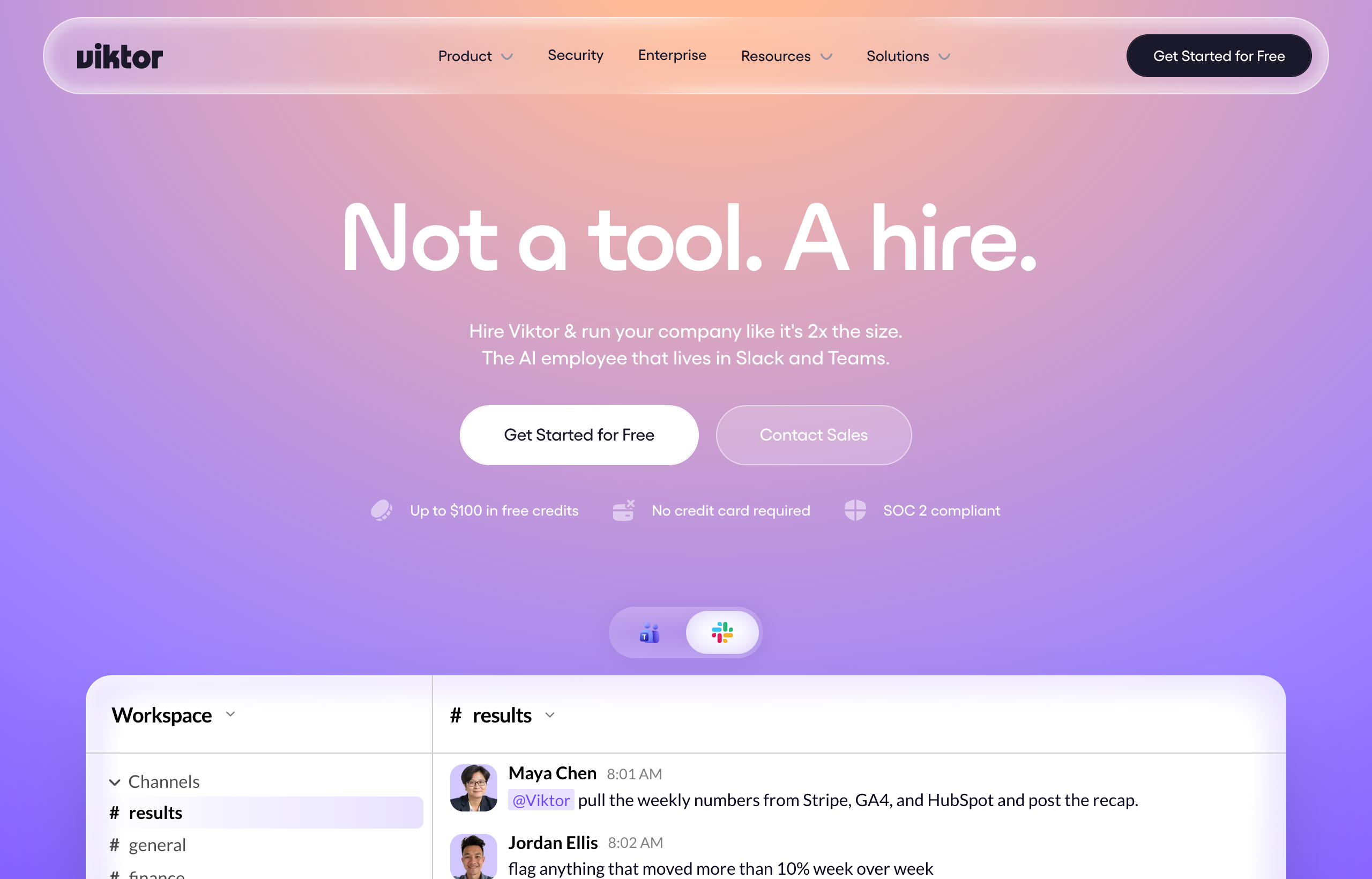
If you want a platform to design custom agents with your own instructions, knowledge bases, and multi-agent workflows, Dust is a legitimate choice and this list will treat it fairly. If you want something that behaves like a coworker from day one, lives in your existing Slack or Teams, and just starts doing tasks when you ask, Viktor is the better starting point for most teams, and it is why it tops this list. Relevance AI, Glean, Lindy, and Sintra round out the field, each with a real (not imaginary) use case.
| Tool | Best for | Where it lives | Starting price |
|---|---|---|---|
| Viktor | A ready-made AI employee that executes tasks, not just chats | Slack, Microsoft Teams | Free trial with $100 in credits, then around $50/mo |
| Dust | Building custom agents over company knowledge, connector by connector | Web app + Slack, Chrome extension | Free tier, Pro around $30/user/mo (around $24 billed yearly) |
| Relevance AI | Assembling multi-agent teams and automations visually | Web app, API | Free tier, paid plans scale with usage |
| Glean | Enterprise search and an assistant grounded in your company’s knowledge | Web app, browser extension, Slack | Custom, sales-led (no public self-serve price) |
| Lindy | Visual, node-based agent builder for specific automations | Web app, integrates into Slack/email | Free tier, paid plans start in the low tens per month |
| Sintra | A roster of pre-built “AI helpers” for common business roles | Its own dashboard | Paid plans, monthly subscription |
Why people go looking for a Dust alternative
Talk to teams that tried Dust and stalled, and the story is almost always the same. Someone technical got excited, connected a few sources, wrote a system prompt for a support or research agent, and it worked. Then the team needed a second agent, and a third, and the person who built the first one moved to a different project, and now nobody quite remembers how the retrieval was scoped or why one agent answers from the wrong space. Dust is a platform. Platforms need an owner. If your company already has that owner and wants full control over how agents reason and what they can see, keep Dust on the shortlist. If you were hoping for something that works more like hiring an assistant than standing up software, that gap is exactly what sends people searching for alternatives.
The other common trigger is pricing shape. Dust prices per seat, which is intuitive but means the bill grows every time you add a person to the workspace, regardless of how much AI work that person actually generates that month. Teams that want the AI to do more of the heavy lifting, and want the cost to track usage rather than headcount, tend to look at workspace-based, credit-pooled pricing instead, which is the model Viktor uses.
Doing the pricing math before you decide
It is worth running actual numbers rather than comparing headline prices, because the two pricing models behave very differently as a team grows. Say you are a 12-person marketing and ops team. On Dust’s Pro tier, that is 12 seats at around $30 a month each (or $24 billed yearly), which lands you at roughly $360 a month before anyone factors in that a few of those seats will barely get used, because not everyone on a marketing team touches an AI agent every day. You are paying for the seat, not the work.
On Viktor’s workspace model, the same team is not billed per person at all. You pick a credit tier based on how much work you expect the AI to actually do that month, say 40,000 credits for around $100, and anyone in the Slack workspace can draw from that pool. A person who only asks Viktor two quick questions a month costs you nothing extra; a person running five deep research tasks draws down the shared pool faster. The tradeoff, to be fair to Dust’s model, is predictability: a per-seat bill is easy to forecast because it only changes when headcount changes, while a credit pool can swing month to month based on how heavily the team happens to use it. If your team’s usage is spiky (busy launch weeks followed by quiet ones), budget for the credit pool running out mid-month at least once before you find the right tier.
1. Viktor: the AI employee that just does the task
Viktor lives inside Slack and Microsoft Teams and behaves like a new hire you brief in a channel. You do not design an agent graph first. You say “pull last month’s ad spend from Google Ads and Meta, compare it to the Stripe revenue for the same period, and put it in a one-page summary,” and Viktor goes and does it: it connects to the relevant tools (it lists over 3,200 integrations, including Stripe, Notion, Google Ads, Meta Ads, HubSpot, Salesforce, Linear, Jira, and GitHub), pulls the data, and comes back with a finished deliverable, whether that is a spreadsheet, a PDF, a small deployed web app with its own database and login, or a pull request against your codebase.
That is the core difference from Dust. Dust is exceptional at retrieval and reasoning over your company’s documents inside a chat interface you configured. Viktor is built to finish the task end to end and hand you the output, and it will propose its own follow-up automations once it sees a pattern in what you are asking for. For the full hands-on breakdown, see our complete Viktor review, or the wider best AI employee tools of 2026 list for how it stacks up against the whole field.
If you have five minutes and want to see the difference for yourself rather than take my word for it, I would start with Viktor’s free trial, which comes with $100 in credits and no card required, and give it one real task this week, something you would normally hand to an ops person.
Viktor’s pricing is credit-based and workspace-wide rather than per seat: around 20,000 credits runs about $50 a month, 30,000 credits around $75, and 40,000 around $100, scaling up from there for larger teams. Because the whole workspace draws from the same pool, adding a fifth or sixth person to the Slack channel does not automatically raise your bill the way it would on a per-seat plan. The honest tradeoff is that credit spend can be lumpy: a quick lookup burns maybe 50 to 100 credits, but a full research-and-build task can burn 2,000 to 5,000, so a busy week can eat through a monthly allotment faster than a light one. Budget for variance, not a flat number.
2. Dust: the platform to build agents, if you have the ownership
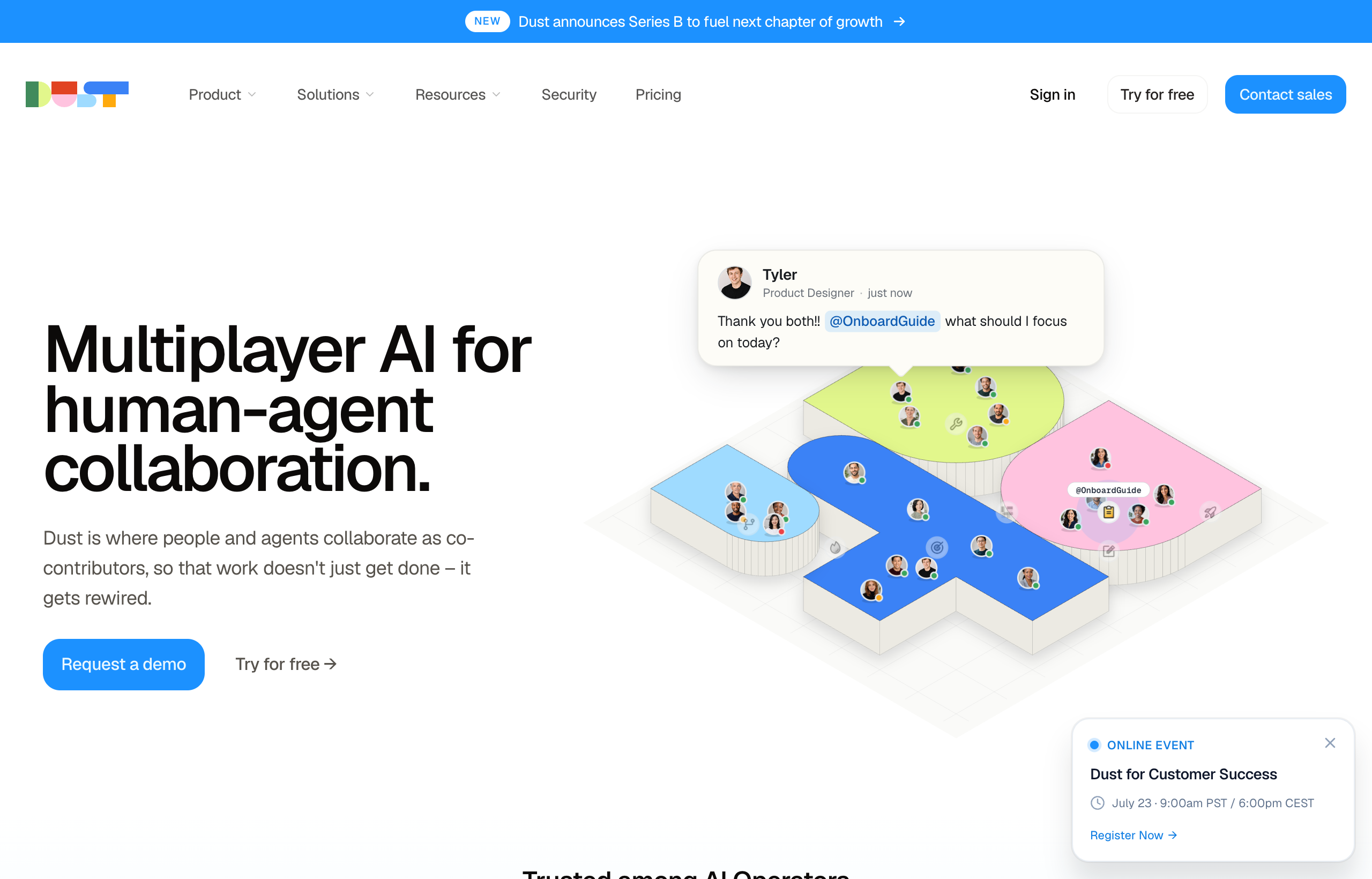
To be fair to Dust, its strengths are real. It supports 20-plus frontier models (GPT, Claude, Gemini, Mistral, DeepSeek) so you are not locked into one vendor’s model quality. It connects to over 20 data sources on its Business plan, more on Enterprise, and it lets you build genuinely custom agents with specific skills, knowledge scoping, and tools, then orchestrate them across schedules and triggers. If your team has an engineer or a very technical ops lead who wants to own the agent layer the way they would own an internal tool, Dust gives them the primitives to do that well, and its full Dust review goes deeper on where it earns that reputation.
Dust’s pricing is seat-based: a Free tier gives 500 credits for the lifetime of the account, enough to try it and not much more. Pro runs around $30 a month per seat (about $24 if billed yearly) for 8,000 credits a month, and Max is around $150 a month per seat (about $120 yearly) for 40,000 credits, aimed at power users running deep research or tool-heavy workflows. Enterprise is custom and adds unlimited connectors, workspace-pooled credits, SCIM, audit logs, and single-tenant deployment. If you want a direct read on how that compares, our Viktor vs Dust breakdown lays the two pricing models side by side.
3. Relevance AI: for assembling multi-agent teams
Relevance AI leans into the idea of building a “team” of AI agents that hand off work to each other, with a visual canvas for wiring triggers, tools, and agent roles together. It is a strong pick if your use case genuinely needs multiple specialized agents cooperating on a pipeline, say a research agent that feeds a drafting agent that feeds a QA agent, and you want to see and edit that pipeline directly. The cost of that flexibility is the same one Dust carries: someone has to design and maintain the pipeline. For a single task delegated in plain language, it is more setup than most teams need.
4. Glean: when the job is finding, not doing
Glean is not really competing for the same job as Dust, Relevance AI, or Viktor, and a fair alternatives list should say so. Glean’s strength is enterprise search and an assistant layer on top of it: it indexes what your company already knows across 250-plus connectors and lets employees ask questions and get accurate, source-cited answers back. If your actual problem is “our knowledge is scattered across Confluence, Slack, Drive, and five other tools and nobody can find anything,” Glean solves that specific problem better than any agent-builder will. It does not, however, execute tasks the way Viktor does, and Glean’s pricing is not public. It is a sales-led, demo-gated enterprise product, so budget for a sales conversation rather than a self-serve checkout. See our Glean review for the full picture, and Glean alternatives if search is your actual starting point.
5. Lindy: visual builder, one automation at a time
Lindy is closer to Dust and Relevance AI in spirit: a node-based canvas where you wire triggers, actions, and AI steps together to build a specific automation, like “when a new lead fills out this form, enrich it and send a Slack alert.” It is approachable for non-engineers and has a generous free tier to start on. Where it differs from Viktor is texture: Lindy is a builder you configure once and let run, while Viktor is a coworker you brief conversationally for both recurring and one-off, novel requests without building a flow first.
6. Sintra: a roster of pre-packaged helpers
Sintra takes a different approach entirely: instead of a blank canvas, it gives you a set of named, role-based AI helpers (a social media helper, a customer support helper, and so on) inside its own dashboard. That packaging makes it easy to get started on narrow, well-defined jobs. The tradeoff is that everything happens in Sintra’s interface rather than the Slack channel your team already lives in, and you are working within its helper roster rather than one general employee that can be redirected to whatever comes up that day.
Honest weaknesses to weigh, including Viktor’s
No tool on this list is free of downsides, and pretending otherwise is how you end up choosing the wrong one. Dust’s per-seat pricing and setup burden are real costs. Relevance AI and Lindy both ask you to design before you delegate. Sintra locks you into its own dashboard instead of your existing workflow tools. And Viktor’s credit model, while workspace-wide rather than per-seat, is also less predictable month to month than a flat subscription: some teams report burning through a chunk of their monthly credits in the first couple of days if they hand Viktor several heavy research or build tasks at once, and the effective monthly cost can land noticeably above the $50 headline figure once real usage kicks in. It is also a conversational tool, not a visual canvas, so if what you actually want is to see and edit a workflow diagram, you will miss that structure.
Who should pick something else
- If you need a dedicated engineer to own a fully custom agent stack with tight control over retrieval and prompts, Dust or Relevance AI fit that ownership model better than a conversational employee.
- If your core problem is findability, not execution, that is, people cannot locate answers across scattered internal tools, start with Glean rather than any of the agent builders.
- If you want zero setup and are comfortable working entirely inside one vendor’s dashboard for a narrow set of pre-built jobs, Sintra’s helper roster may be simpler than a general employee you have to brief well.
- If you are a solo founder who mainly wants a smart chat assistant and does not need integrations or task execution, any of these tools is more than you need; a plain chatbot will do.
My honest suggestion if you are still deciding: pick the one task you keep putting off (a weekly report, a lead enrichment step, a recurring audit) and give it to Viktor for a week using the free $100 in credits. You will know within a few tasks whether conversational delegation fits how your team actually works, before you spend a cent.
FAQ
Is Viktor better than Dust?
They solve different jobs. Dust is better if you want to design and own a custom agent architecture over your company’s knowledge. Viktor is better if you want a ready-made employee that executes tasks in Slack or Teams without configuration. Most teams that just want work done, not a platform to build, find Viktor faster to get value from.
Does Dust have a free plan?
Yes. Dust’s Free tier gives 500 credits for the lifetime of the account at no cost, which is enough to explore the product but not to run it as your daily driver.
How is Viktor priced compared to Dust?
Dust charges per seat: around $30 a month per user for Pro, around $150 for Max. Viktor charges the whole workspace from a shared credit pool, around $50 a month for a starter tier of 20,000 credits, so cost tracks usage rather than headcount.
Is Glean a Dust alternative?
Only partially. Glean is built for enterprise search and answering questions grounded in company knowledge, not for executing multi-step tasks the way Dust’s agents or Viktor can. If search is your actual need, Glean fits better than any agent builder on this list.
What is the easiest Dust alternative to set up?
Viktor, because it requires no agent design before you can use it. You brief it in Slack like a new hire and it figures out which of its 3,200-plus integrations to use for the task.


