
Most ActiveCampaign reviews fall into one of two camps: the affiliate-driven ones that call it “the best email marketing platform, period” without ever mentioning the learning curve, or the frustrated ones that call it “overcomplicated” without acknowledging that the complexity is doing real work for the right customer. Neither camp is being straight with you. I wanted to know what ActiveCampaign is actually like to build in, not skim, so I set up a test account, built a multi-step automation with conditional branches, connected the built-in CRM, and pushed the tagging system past the beginner tutorials to see where it actually earns its reputation.
ActiveCampaign has been in this category since 2003, long enough to have survived several waves of “simpler” competitors trying to steal its customers, and it has held on by doubling down on automation depth rather than chasing ease of use. That is both its greatest strength and the reason a lot of people bounce off it in the first week. Here is what I found running it for real, what it costs, and exactly who should and should not choose it in 2026.
Disclosure: some links in this post are affiliate links. If you sign up through them, we may earn a commission at no extra cost to you. That never changes our verdict.
The 30-second verdict
ActiveCampaign is the deepest marketing automation platform in this category at its price point, with a genuinely useful built-in CRM and predictive AI tooling, and it is overkill for a solo newsletter writer who just wants to send a weekly issue. The automation builder’s branching logic, conditional splits, and if-this-then-that action chains go further than beehiiv, Kit, Flodesk, or Moosend, and the native CRM (deals, pipelines, sales automation) means a business selling through email and closing through a sales process does not need a second tool. I rate it 4.2 out of 5.
The missing 0.8 stars is mostly about who it fits. The learning curve is real: building your first serious automation takes longer here than on any simpler competitor, pricing is not published as flat numbers on the public page and instead renders dynamically per contact tier, and the deep feature set is simply wasted on someone whose only need is “write and send a newsletter.” If your business runs on multi-step funnels and a real sales process, ActiveCampaign is worth the learning curve. If it does not, you are paying for power you will never use.
If your actual need is simpler than a CRM and branching automation, it is worth checking what a newsletter-native platform covers first. Start a free beehiiv publication, free to 2,500 subscribers with no card required, before you commit to ActiveCampaign’s learning curve.
What is ActiveCampaign, and who is it built for?
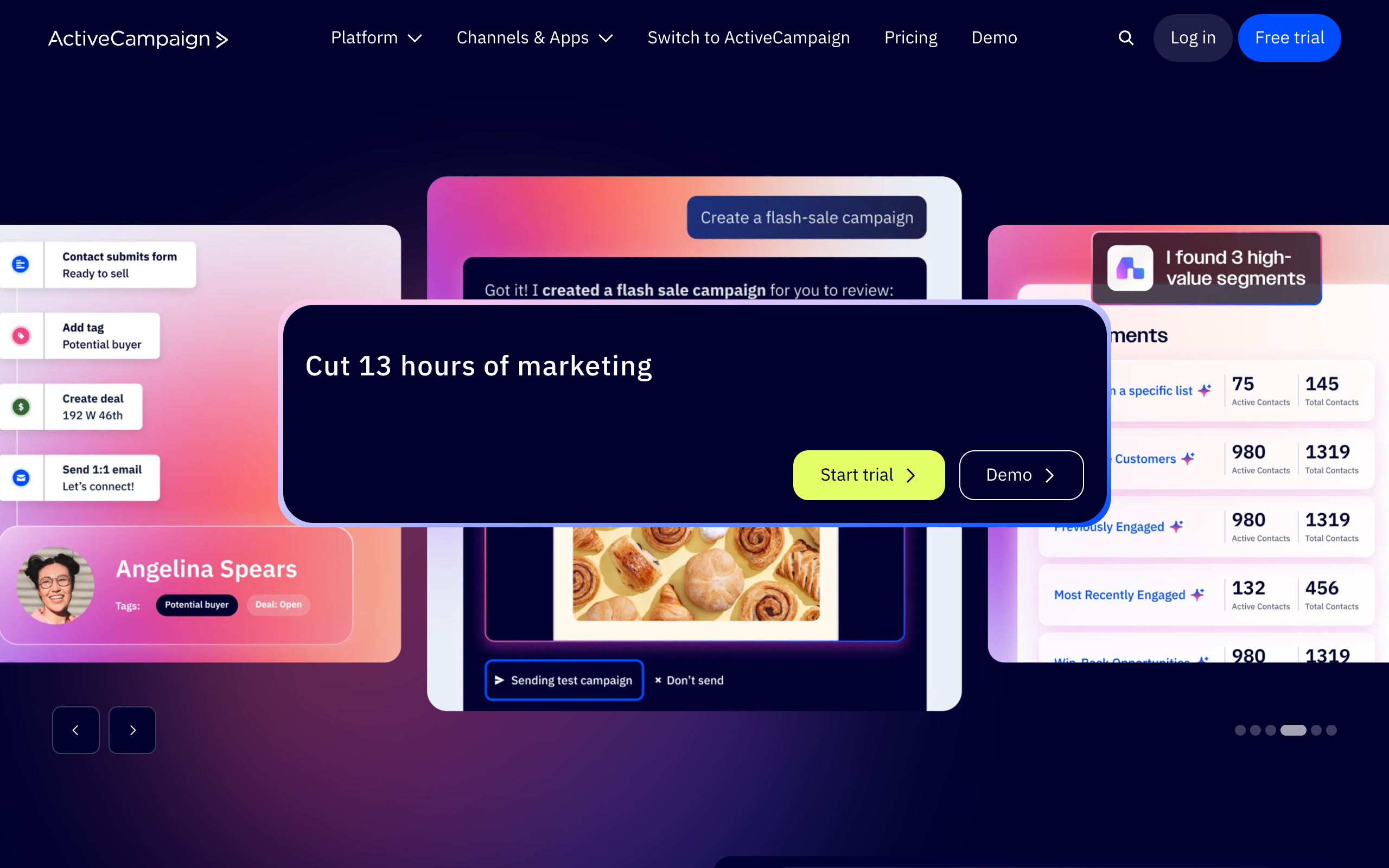
ActiveCampaign launched in 2003 and has grown into what it now calls a “customer experience automation” platform, spanning email marketing, marketing automation, a built-in CRM with sales pipelines, and, more recently, SMS and even WhatsApp business messaging tiers. The company remains privately held and has stayed independent through two decades of consolidation in the martech space, which is unusual in a category where most serious competitors eventually get acquired by a larger suite.
The product’s identity is automation first, email second. Where beehiiv, Flodesk, and Constant Contact start from “here is an email editor, here is some automation on top,” ActiveCampaign starts from “here is an automation and CRM engine, email is one of the channels it can trigger.” That inversion explains almost everything about the product: the interface has more knobs, the setup takes longer, and the payoff is a system that can run genuinely sophisticated, multi-channel customer journeys that most competitors simply cannot replicate, because they were not built around that core.
Who is ActiveCampaign actually for?
The clearest fit is a business with a real sales funnel: a course creator running tripwire offers and upsell sequences, an agency managing client lifecycles, an ecommerce brand with segmented post-purchase flows, or any team that needs marketing and sales to share the same contact record instead of living in two disconnected tools. If you already think in terms of “if this tag, then this branch, then this deal stage,” ActiveCampaign speaks your language natively.
The weaker fit is almost everyone else, and specifically the newsletter operator whose business is the publication itself rather than a funnel underneath it. ActiveCampaign has no referral program, no subscriber discovery network, and no ad marketplace, because none of that is the problem it was built to solve. Worse for that use case, the automation depth that justifies its price for a funnel-heavy business is simply unused capacity for someone who wants to write an essay and hit send once a week. You would be paying CRM prices for newsletter-editor usage.
Where ActiveCampaign genuinely wins
Three things stood out in testing as capabilities I have not found matched, at this price, anywhere else in the category.
The automation builder is the deepest in this comparison set
I built a test automation with a conditional split based on whether a contact clicked a specific link, a wait step, a tag-based branch depending on which of two follow-up emails they opened, and a final action that moved qualifying contacts into a sales pipeline stage. That entire flow, the same kind of multi-path logic that beehiiv and Flodesk simply cannot express and that Kit handles only partially, took about forty minutes to build and worked correctly on the first test run. This is the feature ActiveCampaign’s reputation is actually built on, and in hands-on testing it holds up.
The built-in CRM removes a second tool entirely
Deals, pipelines, and sales automation live in the same account and share the same contact record as your email and marketing automation. In testing, moving a contact from “opened three emails and clicked the pricing link” to “deal created in Negotiation stage” happened automatically as part of the same workflow I built above, no Zapier, no second login, no sync delay. For a business that closes through a human sales process after email nurtures the lead, this single integration is worth more than any individual email feature, because it eliminates the handoff gap where leads usually go cold.
Active Intelligence and predictive tooling are ahead of the category
ActiveCampaign’s AI layer, marketed as Active Intelligence, includes predictive sending (timing sends per contact based on historical engagement), predictive content (recommending which pre-built content block is likely to convert best for a given segment), and win-probability scoring inside the CRM pipeline. In testing, predictive sending shifted delivery times per contact in a way that was clearly using real engagement history rather than a gimmick default, and the win-probability score on my test deals updated sensibly as I changed deal-stage signals. This is meaningfully further along than the AI writing assistants bundled into Moosend or Constant Contact, which generate content rather than predict behavior.
If your funnel is genuinely this complex, ActiveCampaign earns its price. If you are not sure yet, it costs nothing to find out what you actually need first. A free beehiiv publication will tell you within a week whether your business needs a CRM or just a good newsletter editor.
Where ActiveCampaign falls short (the honest list)
The power comes with real costs, and here they are in the order I would weigh them.
The learning curve is the steepest in this category
Building the branching automation described above took forty minutes for someone who has built dozens of email automations across other platforms for this review series. For a first-time user, expect considerably longer, and expect to lean on ActiveCampaign’s (genuinely extensive) template library and documentation rather than figuring it out from scratch. This is not a criticism so much as an honest expectation-setter: if you want to be sending your first automated sequence within the hour, this is not the tool for that.
Pricing is not transparent on the public page
ActiveCampaign’s pricing page displays plan structure (Starter, Plus, Pro, Enterprise) and feature gates clearly, including the detail that each tier multiplies your contact limit differently (10x for Starter and Plus, 12x for Pro, 15x for Enterprise), but it does not display a flat dollar figure without you selecting a specific contact count first, and I was not able to pull a clean, verified number for a standard tier during this review. Historically, and this is worth confirming directly rather than trusting a secondhand figure, entry-level pricing for ActiveCampaign has started in roughly the $15 a month range on annual billing at the lowest contact tier, climbing meaningfully through Plus and Pro. Treat that as a planning range, not a quote, and get your exact number at activecampaign.com/pricing before you commit, since contact-tier multipliers make the real cost highly dependent on your list size.
It is genuinely overkill for a simple newsletter
If your actual workflow is “write an essay, hit send, repeat weekly,” ActiveCampaign’s automation builder, CRM, and predictive tooling are capability you are paying for and never touching. Worse, the interface complexity that serves a funnel-builder well actively works against a writer who just wants a clean compose screen. I found myself missing the simplicity of beehiiv’s or Flodesk’s editor more than once during testing, purely because ActiveCampaign surfaces so many marketing-automation concepts in places a newsletter writer does not need them.
No growth or discovery tooling for newsletters
Same gap as every general-purpose marketing platform in this series: no referral program, no recommendation network, no ad marketplace. ActiveCampaign was built to convert an audience you already have into revenue through automation, not to help you find that audience in the first place. If growth is your actual bottleneck rather than conversion, this tool does not address it at all.
Migrating in takes real setup time
Importing a contact list mapped cleanly to ActiveCampaign’s field structure, but recreating even a moderately complex automation from another platform meant rebuilding it natively rather than importing it, since ActiveCampaign does not offer a one-click automation importer from competitors. Tags and custom fields transferred fine through a standard CSV mapping, but if you are migrating from a tool with years of accumulated segmentation logic, budget more than an afternoon. This is the same tax every deep automation platform charges on the way in: the flexibility that makes ActiveCampaign powerful once configured is exactly what makes the configuration itself take longer than a simpler competitor.
What does ActiveCampaign cost in 2026?
ActiveCampaign’s pricing renders dynamically per contact count rather than displaying flat numbers, so I cannot hand you a verified live dollar figure the way I can for tools with a static pricing table. The structure below reflects the confirmed plan names, contact-tier multipliers, and feature gates from ActiveCampaign’s live pricing page; treat the price ranges as directional based on the plan’s historical pricing pattern, and confirm your exact tier at activecampaign.com/pricing before you commit, since your final number depends heavily on your contact count and the multiplier for your chosen tier.
| Plan | Price | What you actually get |
|---|---|---|
| Starter | Around $15/mo at the lowest contact tier, annual billing (confirm on pricing page) | Email marketing, basic Active Intelligence, 5 automation actions per automation, 1 user, standard CRM integrations, 10x contact-limit multiplier |
| Plus | Mid tier, scales with contacts (confirm on pricing page) | Everything in Starter plus unlimited automation actions, landing pages, standard segmentation, 1 user, 10x contact-limit multiplier |
| Pro (most popular) | Higher tier, scales with contacts (confirm on pricing page) | Everything in Plus plus full Active Intelligence, predictive content, premium ecommerce integrations, attribution tracking, advanced segmentation, 3 users, 12x contact-limit multiplier |
| Enterprise | Custom, contact sales | Everything in Pro plus custom objects, SSO, a dedicated account team, premium CRM integrations, 5 users, 15x contact-limit multiplier |
The read on each tier, briefly. Starter covers real automation, but the 5-action-per-automation cap is a genuine constraint if your funnels are as complex as the ones this platform is known for; you will likely outgrow it faster than the price suggests. Plus removes the automation-action cap and adds landing pages, making it the realistic entry point for anyone actually here for the automation depth. Pro is where the CRM, predictive tooling, and advanced segmentation earn the “most popular” label, and it is the tier most businesses running a real funnel-to-sale process will end up choosing. Enterprise exists for teams that need SSO and custom objects, which is a narrower audience than the marketing page suggests.
How does ActiveCampaign compare with Mailchimp and beehiiv?
ActiveCampaign vs Mailchimp is automation depth versus brand familiarity and integration breadth. ActiveCampaign’s automation builder and native CRM go significantly deeper than Mailchimp’s Customer Journey Builder, and its predictive AI tooling is more advanced. Mailchimp wins on sheer integration count, name recognition, and a gentler learning curve for a first-time user. If your business runs on complex, branching funnels, ActiveCampaign is the more capable tool underneath a steeper curve. Full comparison in ActiveCampaign vs Mailchimp.
ActiveCampaign vs beehiiv is, again, a question of what problem you actually have. ActiveCampaign converts an existing audience into revenue through deep automation and a built-in CRM; beehiiv grows a newsletter audience through a referral program, the Boosts subscriber-swap marketplace, an ad network, and an SEO-indexable website, at 0% fee on paid subscriptions. These are not really competing for the same customer: a newsletter operator whose bottleneck is subscriber growth will get far more value from beehiiv’s toolkit, while a business whose bottleneck is converting an existing list into paying customers through a real sales process will get far more from ActiveCampaign’s automation and CRM. Some serious operators eventually run both, beehiiv for growth and publishing, ActiveCampaign-style automation for the sales layer behind a course or coaching offer. In practice this looks like publishing the newsletter on beehiiv to grow the list through referrals and Boosts, then piping engaged, tagged segments into ActiveCampaign once they show buying signals, rather than trying to force one platform to do both jobs adequately. That combination costs more than picking one tool, but for an operator whose newsletter genuinely feeds a sales funnel behind it, it usually outperforms any single platform trying to be both a growth engine and a CRM. I go deeper on this exact trade-off in beehiiv vs ActiveCampaign, and if you want the full pricing logic on the beehiiv side, read my beehiiv pricing breakdown.
Who should NOT use ActiveCampaign?
- Solo newsletter writers with a simple weekly send. You are paying for automation depth and CRM capability you will never touch. A newsletter-native editor will feel faster and cost less for the same job.
- Anyone who wants to be sending within the hour. The learning curve is the steepest in this comparison set. Budget real setup time, or lean hard on the template library and support docs.
- Newsletter operators focused on audience growth. No referral program, no discovery network, no ad marketplace. ActiveCampaign converts an audience you already have; it does not help you find one.
- Budget-sensitive senders who cannot forecast their contact count. Because pricing multiplies by tier and contact count rather than displaying a flat number, it is easy to underestimate your real monthly cost until you configure the calculator for your actual list.
If any of that sounds like you, my guide to ActiveCampaign alternatives walks through better-fit options for each case, and the wider market is mapped in my ranking of the best newsletter platforms.
Frequently asked questions
Is ActiveCampaign worth it in 2026? For a business running real marketing funnels with a sales process behind them, yes, the automation depth and built-in CRM are hard to match at this price. For a solo newsletter writer, it is more tool and more learning curve than the job requires.
Is ActiveCampaign hard to learn? Yes, relative to competitors. The interface exposes significantly more configuration options than beehiiv, Flodesk, or Moosend, and building a serious automation takes real time investment, especially for a first-time user without prior marketing-automation experience.
Does ActiveCampaign have a free plan? ActiveCampaign typically does not offer a permanent free plan, relying instead on free trials; confirm current trial terms at activecampaign.com/pricing, since trial offers change independently of core plan structure.
Is ActiveCampaign good for newsletters? It can send a newsletter, but it lacks the referral program, discovery network, and ad marketplace that newsletter-native platforms like beehiiv build in by default, so it is a stronger fit for funnel-driven businesses than for audience-first publications.
Does ActiveCampaign include a CRM? Yes, a built-in CRM with deal pipelines and sales automation that shares the same contact record as your email and marketing automation, which removes the need for a separate sales tool for many businesses.
What are ActiveCampaign’s biggest weaknesses? A steep learning curve, pricing that is not transparent without configuring a calculator for your contact count, no growth or discovery tooling for newsletters, and genuine overkill for anyone whose actual need is a simple weekly send.
The bottom line: my verdict after testing it
ActiveCampaign earns its reputation the hard way: not through a beautiful editor or a generous free tier, but through automation and CRM depth that nothing else in this category matches. Building the branching automation and watching it correctly route a contact into a sales pipeline stage was the single most impressive technical moment across every platform I have tested for this series. That capability is real, and for the right business, it is worth every bit of the learning curve.
4.2 out of 5. The score reflects genuine excellence at what it is built for, docked mainly for how badly that excellence is wasted on the wrong customer. If your business runs on a real funnel with a sales process behind it, ActiveCampaign is one of the strongest tools you can buy. If your business is a newsletter and nothing more, you are buying a CRM to write essays, and that mismatch will cost you more in confusion than the subscription ever saves you in automation.
Not sure which camp you are in? Test a free beehiiv publication first, free to 2,500 subscribers, no card required. If you outgrow it and need real branching automation and a CRM behind your funnel, ActiveCampaign will still be there, and you will know exactly why you need it instead of guessing.
Pricing captured from vendor pricing pages, July 2026. Plans change, so confirm current details before you buy.


