

Every few weeks someone asks me whether they should just run their newsletter on Klaviyo since “it’s the best email platform out there.” It usually is, for the job it was built for. The problem is that job is not newsletter growth, and watching a solo creator try to bend Klaviyo’s ecommerce-shaped tooling into a content newsletter is a little like watching someone drive a delivery van to pick up one grocery bag. It works. It is also the wrong vehicle, and you paid for a lot of cargo space you will never use.
I set up test accounts on both platforms specifically to check this claim rather than assume it. beehiiv as a newsletter publication, Klaviyo as a marketing account without a connected store, to see what happens when you try to use it the way a content creator would. What follows is the honest comparison: where Klaviyo’s ecommerce depth genuinely outclasses beehiiv, and the much larger list of places where it is expensive overkill for anyone whose business is the newsletter itself, not a product catalog. I cover beehiiv’s full feature set on its own terms in my standalone beehiiv review and a similarly detailed look at Klaviyo’s ecommerce strengths in my Klaviyo review, if you want the deeper dive on either platform beyond this specific matchup.
Disclosure: some links in this post are affiliate links. If you sign up through them, we may earn a commission at no extra cost to you. That never changes our verdict.
The 30-second verdict
beehiiv is built for newsletter operators: a native referral program, a Boosts marketplace, an ad network, and 0% fees on paid subscriptions, all in one subscription starting free. Klaviyo is built for ecommerce brands: deep Shopify and BigCommerce integrations, abandoned-cart flows, product recommendation blocks, and per-email revenue attribution, priced by contact profile count rather than by feature tier. If you do not run a store, Klaviyo is not a newsletter platform with extra features. It is an ecommerce platform you would be misusing, and you would pay ecommerce-grade prices to do it.
- Klaviyo has no referral program, no Boosts-style marketplace, and no ad network; it was never built to help you find new subscribers, only to convert and retain existing customers.
- beehiiv has no native SMS channel or ecommerce flow builder; Klaviyo’s abandoned-cart and browse-abandonment automations have no beehiiv equivalent.
- Klaviyo’s free plan caps you at 250 profiles and 500 email sends a month; beehiiv’s free plan covers 2,500 subscribers with unlimited sends.
- Klaviyo’s pricing scales with total profile count, including non-buyers, which gets expensive fast for a content newsletter with a large but low-revenue-per-reader audience.
- Neither platform is objectively “better.” Klaviyo wins decisively if you sell physical or digital products through a store; beehiiv wins decisively if the newsletter itself is the product.
If your business runs on content rather than a product catalog, you already know which side of this comparison you are on. Start a free beehiiv publication and send your first issue this week. Free to 2,500 subscribers, no card required.
What are beehiiv and Klaviyo, and why is this comparison lopsided by design?

beehiiv was founded in 2021 by Tyler Denk, an early Morning Brew employee who built the referral system credited with compounding that newsletter’s growth. Every feature beehiiv ships traces back to one question: how does a newsletter find, keep, and monetize readers. It is a publishing-and-growth platform first, with email as the delivery mechanism.
Klaviyo was founded in 2012 and built its reputation as the email and SMS platform of choice for ecommerce brands, particularly on Shopify, where it became close to a default recommendation for stores past a certain revenue size. Klaviyo’s entire product, from its segmentation engine to its flow builder to its analytics dashboard, is organized around purchase behavior: what someone browsed, added to cart, bought, or abandoned. Klaviyo went public in 2023, and its own investor materials describe the company as building for ecommerce and consumer brands specifically, not content publishers.
Here is the thing most comparisons miss: Klaviyo is not a worse newsletter tool than beehiiv. It is not really a newsletter tool at all. It is an ecommerce retention platform that happens to include a capable email editor. Judging it as a newsletter platform is judging it by a standard it was never trying to meet.
Who is each platform actually built for?
beehiiv is built for solo writers, media operators, and creators whose audience relationship lives in the inbox and who monetize through subscriptions, sponsorships, and ads. If you deleted the newsletter tomorrow, the business would lose its main channel.
Klaviyo is built for ecommerce brands and DTC companies with a product catalog, a checkout flow, and revenue events to track. The whole point of the platform is connecting to your store (Shopify, BigCommerce, Magento, WooCommerce) so that emails and texts can react to real purchase behavior: cart abandonment, post-purchase upsells, win-back flows for lapsed customers. A creator without a store to connect gets almost none of what makes Klaviyo worth its price.
| Category | beehiiv | Klaviyo |
|---|---|---|
| Core identity | Newsletter growth and monetization platform | Ecommerce email and SMS marketing platform |
| Referral program / Boosts / ad network | Native, built into Scale plan | Not available |
| SMS marketing | Not available | Native, integrated with email flows |
| Ecommerce integrations | Basic digital product sales only | Deep native integrations (Shopify, BigCommerce, Magento, WooCommerce) |
| Abandoned cart / browse abandonment flows | Not available | Core feature |
| Paid subscriptions from readers | Yes, 0% fee on Scale and above | Not applicable to the product |
| Free plan | 2,500 subscribers, unlimited sends | 250 profiles, 500 email sends/month |
| Pricing basis | Subscriber tiers, flat plan fee | Contact profile count, including non-buyers |
| SEO-indexable website | Included on every plan | Not part of the product |
Does Klaviyo have anything like beehiiv’s growth toolkit?
No, and this is not close. beehiiv’s referral program lets you set milestone rewards, and every send automatically carries the reader’s unique referral link, the same mechanic Morning Brew used to compound its list before it was productized as a checkbox. Boosts is a two-sided marketplace where newsletters pay to reach other newsletters’ audiences and earn money recommending each other, often the first dollar a small publication ever makes. beehiiv’s ad network connects publications directly with sponsors looking to book placements.
Klaviyo has none of this, because Klaviyo was never trying to help you find new readers. Its “growth” tools are signup forms and pop-ups aimed at converting your existing store traffic into subscribers, a fine feature for a shop, useless for a creator without one. If your plan involves growing an audience from a cold start, Klaviyo gives you no mechanism to do that beyond whatever traffic you already generate elsewhere.
Where does Klaviyo genuinely beat beehiiv?
Flip the lens to actual ecommerce, and Klaviyo is not close either, in the other direction. Its flow builder handles abandoned-cart recovery, browse abandonment, post-purchase cross-sell, and win-back sequences with conditional logic based on real purchase and browsing events, not just email opens and clicks. Segmentation can slice by lifetime value, product category purchased, or predicted churn risk. Every email and flow reports revenue attribution directly, so you know exactly how many dollars a specific automation generated, a level of commerce analytics beehiiv does not attempt to offer because it is not selling a product catalog.
Klaviyo also natively integrates SMS into the same platform, letting you build cross-channel flows that text a cart-abandonment nudge and follow up by email if the text goes unread. beehiiv has no SMS channel at all. For a store doing real ecommerce volume, this integrated email-plus-SMS-plus-revenue-attribution stack genuinely justifies Klaviyo’s reputation and its price. None of it means anything if you are not selling physical or digital products through a connected store.
Off-docs observation worth knowing before you sign up: Klaviyo’s own onboarding assumes a connected store from the first screen. If you try to set up a Klaviyo account purely for a content newsletter, you will spend your first hour skipping past ecommerce setup prompts that never quite go away, a small but constant reminder that you are using the tool off-label.
If none of the ecommerce features above apply to you, you already have your answer. Try beehiiv’s free plan instead and put the growth tooling to work on the problem you actually have.
What does each platform cost in 2026?
beehiiv’s numbers are from its live pricing page, captured July 2026. Klaviyo prices by contact profile count through an interactive calculator rather than fixed tiers, so the figures below are entry-level starting points; confirm your exact tier at klaviyo.com/pricing since the total shifts with your specific list size.
| Plan | Price | What you get |
|---|---|---|
| beehiiv Launch (Free) | $0 | Up to 2,500 subscribers, unlimited sends, custom domain, website |
| beehiiv Scale | From $43/mo ($517/yr, annual) | Referral program, Boosts, ad network, 0% fee on paid subs, up to 100,000 subscribers |
| beehiiv Max | From $96/mo ($1,151/yr, annual) | Everything in Scale plus no branding, up to 10 publications, sponsorship storefront |
| Klaviyo Free | $0 | Up to 250 profiles, 500 email sends/month, $5 SMS credit, basic segmentation |
| Klaviyo Email (entry paid tier) | Around $20 to $30/mo at low profile counts (as of mid-2026) | Unlimited email sends, full automation flows, ecommerce integrations, revenue attribution |
| Klaviyo Email + SMS (entry paid tier) | Around $35 to $45/mo at low profile counts (as of mid-2026) | Everything in Email plus native SMS marketing and cross-channel flows |
The trap in that table is the phrase “profile count.” Klaviyo counts every contact, buyers and non-buyers alike, the same way most ecommerce email tools do, which means a content newsletter with a large, mostly non-purchasing audience gets billed like a retailer with a comparably sized customer list, without getting any commerce revenue back to offset the cost. beehiiv’s subscriber-tier pricing has its own step-ups as your list grows (I break those down fully in my beehiiv pricing breakdown), but at least every dollar you spend maps to a platform built around what a newsletter actually needs, not features you are paying for and never touching.
Can you monetize a newsletter directly through Klaviyo?
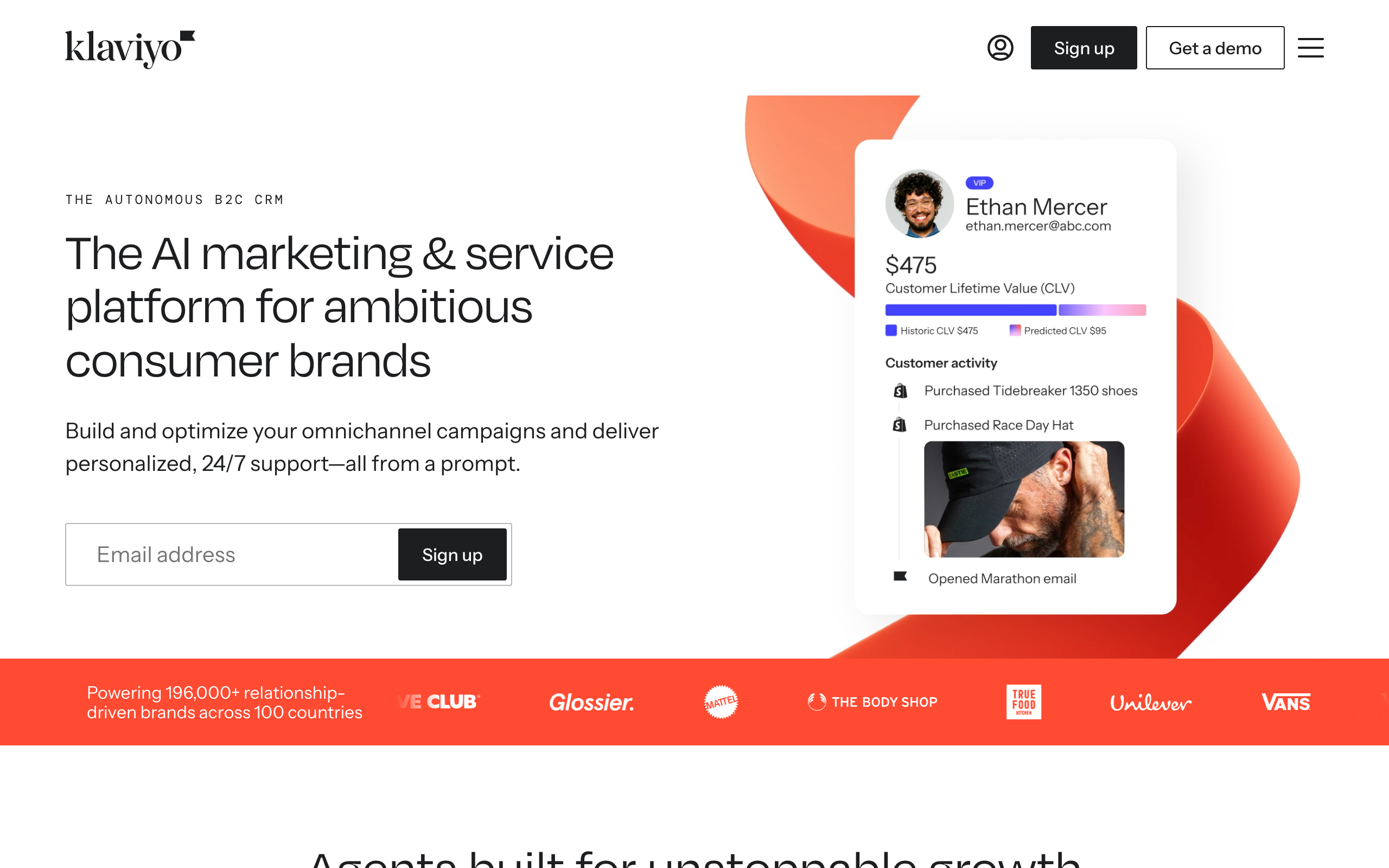
No. Klaviyo has no concept of a paid subscription from a reader. It is built to email and text people who buy from a store you already run elsewhere; the platform does not process reader payments, gate content behind a paywall, or manage recurring subscription billing in any form. beehiiv supports native paid subscriptions on Scale and above at 0% platform fee, keeping everything after standard Stripe processing.
If monetizing directly from your audience, rather than from a separate product you sell them, is any part of your plan, this single gap should end the comparison regardless of how impressive Klaviyo’s automation builder looks. You would be paying ecommerce prices for a platform that structurally cannot do the one thing you actually need.
How do analytics and segmentation compare for a content audience?
Klaviyo’s analytics are built around commerce metrics: revenue per recipient, placed-order rate, and segments defined by purchase history, predicted lifetime value, or churn risk. If your readers do not buy anything through you directly, most of that dashboard reports zeroes, which is a strange feeling the first time you see it. Segmentation is still technically usable for engagement (opens, clicks, list activity), but you are navigating an interface designed around a data model your content newsletter does not generate.
beehiiv’s analytics are built around the metrics a newsletter actually cares about: acquisition source cohorting that shows which channel a subscriber came from and how that cohort engages afterward, per-subscriber engagement history, and click maps tied to content rather than products. In my testing, this is the difference between a dashboard that answers your actual questions and one that answers questions you are not asking. Segmentation on beehiiv covers behavioral triggers like “opened last N sends” or “clicked topic X,” which feed directly into targeted sends and automations built for a content business, not a storefront.
Tell-tale sign you are using the wrong tool: if you find yourself building elaborate workarounds in Klaviyo’s segmentation just to approximate what beehiiv gives you natively as a “engaged reader” segment, that friction is the product telling you it was built for someone else’s business model.
Who should choose Klaviyo over beehiiv?
- Ecommerce brands and DTC stores. If you have a Shopify, BigCommerce, or Magento store, Klaviyo’s abandoned-cart flows and revenue attribution are close to unmatched at this price point.
- Businesses that want SMS and email in one platform. Klaviyo’s cross-channel flows have no real beehiiv equivalent.
- Anyone whose newsletter is secondary to a product catalog. If the newsletter exists to drive purchases from an existing store, Klaviyo’s purchase-behavior segmentation will outperform beehiiv’s content-focused analytics.
- Teams that need per-email revenue attribution tied to actual orders. This is Klaviyo’s core strength and beehiiv does not attempt to compete on it.
Who should choose beehiiv over Klaviyo?
- Anyone starting a newsletter from zero without a store. Klaviyo gives you no mechanism to find new readers; beehiiv’s referral program and Boosts exist specifically for this.
- Creators planning to monetize through paid subscriptions, ads, or sponsorships. Klaviyo cannot process reader payments at all; beehiiv’s ad network brings sponsor demand directly to you.
- Anyone who wants an SEO-indexable website bundled in. beehiiv posts publish as crawlable web pages by default; Klaviyo has no publishing layer at all.
- Budget-conscious solo writers. beehiiv’s free plan covers 2,500 subscribers with unlimited sends; Klaviyo’s free plan caps out at 250 profiles and 500 sends a month, a ceiling a real newsletter clears almost immediately.
If you are weighing the wider field of ecommerce-adjacent tools, my guide to Klaviyo alternatives and full ranking of the best newsletter platforms cover the options in between these two extremes.
One more nuance worth stating plainly: there is a middle group of businesses that genuinely sell both content and products, a paid newsletter with a small merch store, say, or a creator who occasionally sells a digital course through the list. For that group, the honest answer is rarely “pick one platform and force-fit the other use case into it.” It is closer to accepting that you will eventually run two tools that talk to each other, beehiiv for the audience relationship and growth engine, something Klaviyo-shaped for the transactional side, once transaction volume justifies the second subscription. Trying to make one tool do both jobs from day one usually costs more in wasted setup time than just paying for two focused tools once each is actually needed.
Can you migrate between beehiiv and Klaviyo?
Technically yes, but this is a less common migration than most in this category because the two platforms rarely serve the same purpose long enough for someone to outgrow one into the other. If you started a newsletter inside Klaviyo because your store already used it, and the content side is now outgrowing the commerce use case, export your subscriber list as a CSV and import it into beehiiv, then rebuild your welcome sequence and any content-focused automations from scratch, since Klaviyo’s flow logic does not translate. If you are adding a store to a beehiiv-based newsletter and need real ecommerce automation, the more common pattern is running both in parallel rather than migrating away from beehiiv entirely: beehiiv for the newsletter and its growth tooling, Klaviyo connected to the store for transactional and cart-recovery flows.
Frequently asked questions
Is Klaviyo good for a newsletter? Only if the newsletter supports an ecommerce store you already run. Klaviyo has no referral program, no growth marketplace, and no way to charge readers directly, so a pure content newsletter gets ecommerce-grade pricing without the ecommerce features that make Klaviyo worth it.
Is beehiiv better than Klaviyo? For a content-first newsletter, yes, since beehiiv’s referral program, Boosts marketplace, ad network, and paid subscriptions all target exactly that use case. For an ecommerce brand’s retention marketing, Klaviyo is the stronger platform, since beehiiv has no store integrations or SMS channel at all.
Does beehiiv have SMS marketing like Klaviyo? No. beehiiv is email and web-only. If SMS is a requirement, Klaviyo (or a dedicated SMS tool alongside beehiiv) is necessary, since beehiiv has no native texting feature.
Why is Klaviyo so expensive for a small newsletter? Klaviyo prices by total contact profile count, including non-buyers, the same model used for its ecommerce customers. A content newsletter with a large but non-purchasing audience gets billed at a rate designed for a retailer’s customer list, without the purchase revenue Klaviyo assumes is funding that cost.
Can I use Klaviyo and beehiiv together? Yes, and this is more common than migrating between them. Many operators run beehiiv for the newsletter and its growth tools, then connect Klaviyo separately to an ecommerce store for cart-recovery and post-purchase flows, keeping the two audiences and use cases distinct.
Does Klaviyo have a free plan? Yes, capped at 250 profiles and 500 email sends a month, with a small SMS credit included. beehiiv’s free plan is significantly more generous for a content newsletter at 2,500 subscribers and unlimited sends.
The bottom line: which should you actually pick?
This comparison resolves faster than most once you ask the one question that matters: do you have a product catalog and a checkout flow, or do you have an audience and a content habit? If it is the former, Klaviyo’s ecommerce depth, SMS integration, and revenue attribution are genuinely best in class, and beehiiv would be the wrong tool wearing the right category name. If it is the latter, Klaviyo is not a stronger version of beehiiv. It is a different product entirely, priced for a business model you do not have, missing the exact features (referral growth, sponsor demand, reader-funded subscriptions) that would actually move your numbers.
My honest recommendation for anyone reading this because they are starting a newsletter and wondering whether the “best” email tool is worth the premium: it depends entirely on what “best” is measuring. Klaviyo is the best at converting store traffic into repeat purchases. beehiiv is the best at growing and monetizing an audience from nothing. Pick based on which problem you actually have this month, not on which tool has the bigger reputation in a category you are not really operating in.
Start a free beehiiv publication today, free to 2,500 subscribers with no card required, and let the growth tooling do the job Klaviyo was never built to do.
Pricing captured from vendor pricing pages, July 2026. Plans change, so confirm current details before you buy.


