
Most “Klaviyo review” posts read like they were written by someone who opened the pricing page, skimmed the feature list, and never actually built a flow. You can tell within two paragraphs: they praise “powerful segmentation” without saying what segment they built, and they never mention what happens to your bill the day your list crosses 500 profiles. I set up a real Klaviyo test account, built a segment from scratch, walked through the flow library, and connected it to a store integration to see what the onboarding actually asks of you. This review is what I found, including the parts Klaviyo’s own marketing does not lead with.
Disclosure: some links in this post are affiliate links. If you sign up through them, we may earn a commission at no extra cost to you. That never changes our verdict.
The 30-second verdict
Klaviyo is the strongest email and SMS platform on the market for ecommerce brands, built around predictive analytics, deep Shopify-grade store integrations, and automation flows that understand purchase behavior in ways no newsletter-first tool attempts. If you sell physical or digital products online, the revenue attribution alone usually justifies the price. I rate it 4.2 out of 5.
The missing 0.8 comes from three real costs: pricing that climbs fast once you pass a few thousand profiles, a learning curve that will frustrate anyone who just wants to write and send a newsletter, and a near-total absence of the audience-growth tooling (referral programs, recommendation networks, ad marketplaces) that newsletter-native platforms build in. Klaviyo was not built to grow an audience from zero. It was built to convert one you already have.
If your business is a newsletter first and a store second, or you have no store at all, you are probably reading the wrong review for your use case. Open a free beehiiv account and send one real issue this week before you commit to anything. It runs free to 2,500 subscribers with no card required, and it will tell you in an afternoon whether a newsletter-first tool fits better than an ecommerce CRM like Klaviyo.
What is Klaviyo, and why does its ecommerce-first origin matter?
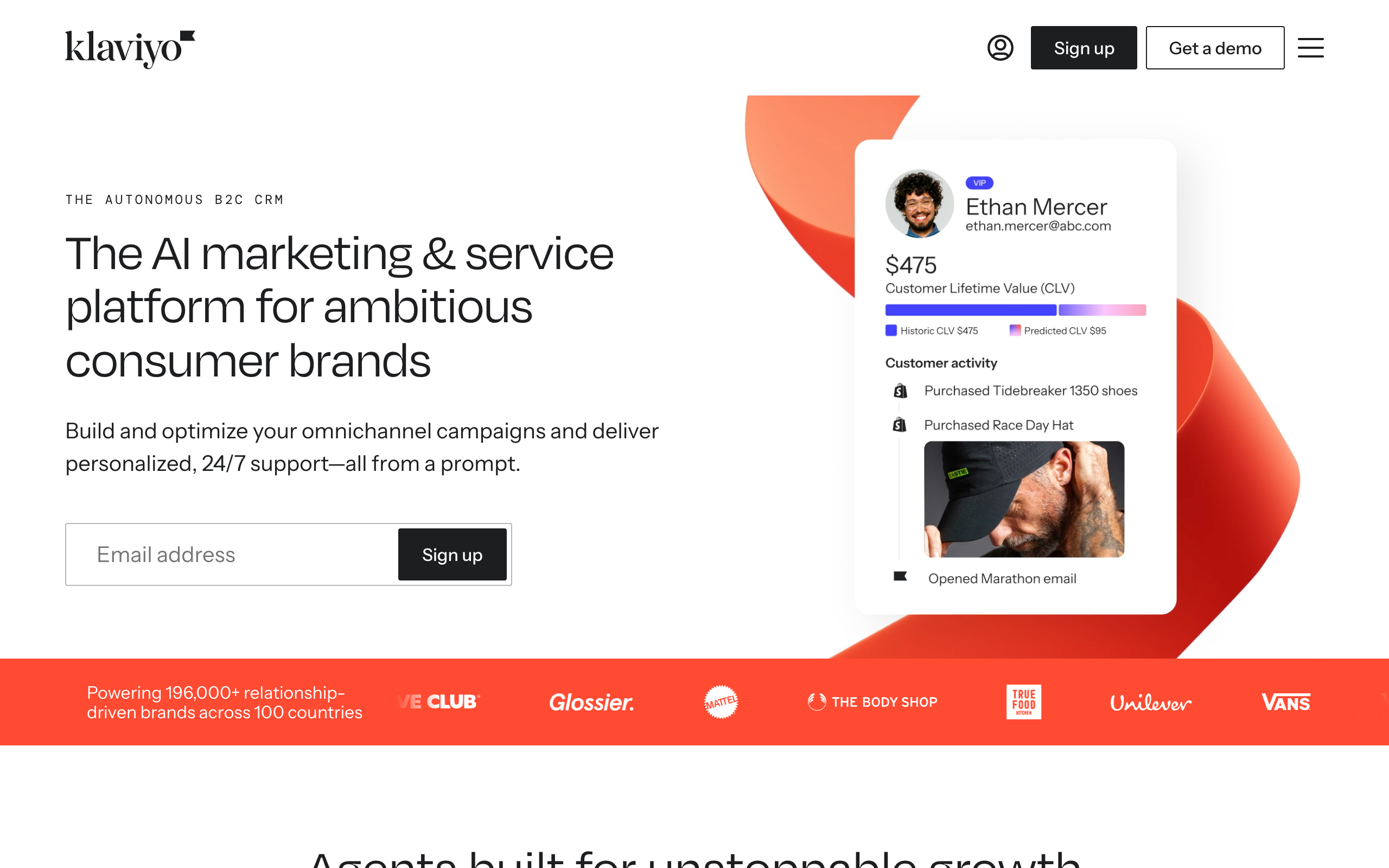
Klaviyo was founded in 2012 by Andrew Bialecki and Ed Hallen, and it went public on the New York Stock Exchange in 2023 under the ticker KVYO, one of the few email marketing companies to reach that scale. From day one, the product was built around a specific bet: that online stores generate rich behavioral data (what you browsed, what you added to cart, what you bought before), and that email and SMS sent using that data outperforms generic broadcast newsletters by a wide margin. That bet paid off. Klaviyo is now the default recommendation inside Shopify’s own ecosystem for merchants who outgrow Shopify Email, and its integration marketplace lists over 350 apps built specifically around commerce data.
That origin story is the entire product, and it explains both Klaviyo’s strengths and its blind spots. Because the company optimized for revenue-per-email from day one, its flow builder, segmentation engine, and analytics dashboards are all built around purchase events: added to cart, viewed product, placed order, churned. A newsletter platform like beehiiv or Substack optimizes for a completely different event: did someone open, click, and stay subscribed. Klaviyo can technically send a plain newsletter, but the entire product is quietly nudging you toward ecommerce triggers the whole time you use it, right down to the free plan’s framing around “Basic Customer Hub” and “order tracking” rather than anything about growing a readership.
Who is Klaviyo actually for?
The clean test: if you have a Shopify, WooCommerce, BigCommerce, or Magento store and email is currently an afterthought bolted onto your ecommerce platform, Klaviyo is very likely your best option. If your business generates revenue through product sales and you are not yet running abandoned-cart flows, post-purchase sequences, and win-back campaigns triggered by real purchase data, you are leaving money on the table that Klaviyo is specifically built to capture.
If your business is the newsletter itself, if you make money through sponsorships, paid subscriptions, or affiliate content rather than product sales, Klaviyo is the wrong aisle. You will pay ecommerce-tool prices for features you will never use (contact scoring based on purchase behavior, RFM segmentation, back-in-stock alerts) while getting none of the growth tooling that newsletter platforms build in specifically because they know audience growth, not conversion rate, is your bottleneck.
Where Klaviyo genuinely wins
Every strength here traces back to the same root: Klaviyo knows more about each contact than almost any competitor, because it is built to ingest commerce events, not just email engagement.
Segmentation that goes past “opened in the last 30 days”
Most email tools let you segment on email engagement and maybe a custom field or two. Klaviyo’s segmentation engine lets you combine purchase history, browsing behavior, predicted lifetime value, predicted next order date, and email engagement into a single filter, live and constantly recalculating. Building a segment in the test account, I could filter for “opened an email in the last 60 days AND placed an order in the last 90 days AND predicted to churn in the next 30 days” without writing a single line of code or exporting anything to a spreadsheet. That specific combination, engagement plus purchase plus predictive churn risk, is the kind of segment that turns a generic win-back campaign into one that actually recovers revenue, and it is genuinely hard to replicate on a newsletter-first platform.
Flows are the deepest automation library in the category
Klaviyo ships pre-built flow templates for the entire ecommerce lifecycle: welcome series, browse abandonment, cart abandonment, post-purchase upsell, win-back, replenishment reminders (useful for consumable products with a predictable reorder window), and review requests. Each flow can branch on nearly any data point Klaviyo has, including product category, order value, and customer lifetime value tier. This is the single clearest gap between Klaviyo and platforms like beehiiv or MailerLite: those tools have automation builders that handle a welcome sequence and a few triggered sends well, but they do not have a library of ecommerce-specific triggers because ecommerce was never the target user.
Revenue attribution tells you what actually made money
Klaviyo attributes revenue directly to specific campaigns and flows, tracked through the store integration rather than estimated. In practice this means you can look at last month’s abandoned-cart flow and see a dollar figure it generated, not an open rate you have to mentally translate into revenue. That single feature, revenue-per-flow, is often the number that gets a marketing budget approved internally, and it is the reason ecommerce teams tolerate Klaviyo’s higher price relative to generic email tools. No newsletter-first platform in this category, beehiiv included, attempts to compete on this specific metric, because none of them are built to see order data the way Klaviyo does natively.
The free plan is a real testbed, not just a trial
Klaviyo’s free plan covers up to 250 active profiles, 500 email sends a month, and $5 of mobile message credit, along with the built-in reporting dashboard, basic segmentation, a basic Customer Hub (self-service order tracking and account management), and a basic Helpdesk with shared inbox and ticket management. For a very small store or someone testing whether Klaviyo’s data model fits their business before committing budget, this free tier genuinely lets you build a real flow and see real attribution, not a crippled demo. Email support is included, but only for the first 60 days, a detail Klaviyo’s pricing page states plainly rather than burying.
Everything above assumes your revenue comes from product sales. If it comes from your audience itself, sponsorships, paid subs, or affiliate content, the calculus flips entirely. My honest suggestion in that case: try beehiiv’s free plan and send your next issue from there instead. You will feel within two sends whether a growth-first platform fits your business better than a conversion-first CRM like Klaviyo.
Where Klaviyo falls short (the honest list)
A review that only praises a platform is an advertisement. Here is what genuinely bothered me, worst first.
Pricing scales fast, and it is based on total active profiles, not just the ones you email
Klaviyo changed its pricing model in February 2025 to bill on active profiles rather than only the contacts you actively email each month, which means your entire database counts against your tier even if a chunk of it never opens anything. The Email plan starts at $20 a month for 251 to 500 active profiles with 5,000 monthly sends included, and the combined Email and SMS plan starts at $35 a month for the same profile range. Those entry numbers look reasonable next to Klaviyo’s ecommerce depth, but the climb from there is steep, and stores with active lists in the tens of thousands routinely report monthly bills in the hundreds to low thousands of dollars. If you are used to newsletter-platform pricing, where a few thousand subscribers might cost you $20 to $50 a month, Klaviyo’s ecommerce-calibrated pricing will feel aggressive by comparison, because it is priced against the revenue it generates for stores, not against what a content creator typically pays for software.
The learning curve is real, and it is steepest for exactly the people who do not need the depth
Klaviyo’s flow builder, segmentation engine, and Customer Data Platform layer are genuinely powerful, and genuinely a lot to learn if your only goal is “send a good-looking newsletter twice a week.” In the test account, getting from signup to a working, well-targeted flow took real time spent reading documentation and watching Klaviyo Academy tutorials, nothing insurmountable, but nothing like the fifteen-minute setup you get on a lighter tool. If your business does not need predictive lifetime value scoring or RFM segmentation, that complexity is pure overhead, not a feature.
No native audience-growth tooling at all
This is the gap that matters most if you are reading this review while also considering beehiiv, Substack, or Kit. Klaviyo has no referral program, no recommendation network, no ad marketplace connecting you to sponsors, and no SEO-focused public website for your content the way beehiiv builds one into every publication. Klaviyo assumes you already have traffic (from your storefront, ads, or social) and its entire job is converting that traffic into revenue through email and SMS. If the actual problem you are trying to solve is “I need more subscribers,” Klaviyo will not help you get there. It was never built to.
Support access depends heavily on your plan
Free-plan users get email support for their first 60 days only, after which they are on their own with the Help Center, Academy, and Community. Paid plans get ongoing email and chat support, but phone support and dedicated deliverability specialist time are reserved for the higher Professional-tier bundles Klaviyo sells as add-ons. If white-glove support matters to you at a lower price point, budget for that when comparing platforms, not just the base subscription cost.
What does Klaviyo cost in 2026?
Numbers from Klaviyo’s live pricing page, captured July 2026. Klaviyo prices in tiers of active profiles rather than a single flat number per plan, so figures below reflect the entry tier; costs increase as your profile count grows, and Klaviyo does not publish every tier openly on the page itself, so confirm your exact tier using Klaviyo’s own calculator before you commit.
| Plan | Starting price | What’s included at entry tier |
|---|---|---|
| Free | $0 | Up to 250 active profiles, 500 email sends/mo, $5 mobile message credit/mo, basic reporting, basic Customer Hub and Helpdesk, email support (first 60 days) |
| From $20/mo | 251 to 500 active profiles, 5,000 monthly email sends, 150 SMS/MMS credits, email and chat support | |
| Email + SMS | From $35/mo | Everything in Email, plus 1,250 SMS/MMS credits and mobile push notifications |
| Add-ons (Service, Composer, Customer Agent) | Custom, 30% intro discount shown on pricing page | Helpdesk upgrades, AI campaign/flow builder (Composer), AI customer service agent |
| Enterprise / Professional Services | Custom (talk to sales) | Large-list pricing, dedicated support, advanced Klaviyo Data Platform, custom onboarding |
The read on each tier, briefly. Free is a legitimate testbed for a small store, not a crippled demo, but the 500-email monthly cap means you will outgrow it fast the moment you have a real flow sending regularly. Email at $20 a month is the plan most small stores actually land on, and it is competitive against other ecommerce-focused tools at that profile count. Email + SMS at $35 only makes sense once you have a real SMS strategy; do not add it just because it is there, since SMS compliance and list-building rules are stricter than email’s. The AI add-ons (Composer, Customer Agent) are new enough that I would treat them as promising rather than proven, worth testing on the discounted intro rate rather than committing to long term without seeing the output quality on your own catalog.
How does Klaviyo compare with beehiiv, Mailchimp, and Kit?
These four platforms rarely compete for the exact same buyer, but people researching “Klaviyo review” are often deciding between an ecommerce-first tool and a newsletter-first one, so the comparison is worth being explicit about.
Klaviyo vs beehiiv is really “convert an audience” versus “grow an audience.” beehiiv’s entire product, the referral program, Boosts marketplace, ad network, and SEO-indexable website, exists to solve the growth problem Klaviyo does not touch, and I cover exactly how those growth mechanics work in my full beehiiv review. Klaviyo’s segmentation, flows, and revenue attribution solve the conversion problem beehiiv does not attempt. If you are unsure which side of that line your business sits on, the honest test is simple: is your bottleneck “not enough people know about us” or “people know about us but aren’t buying”? The first points to beehiiv, the second to Klaviyo. On price, beehiiv’s paid Scale tier starts far below Klaviyo’s mid-list bills, detailed in beehiiv’s pricing breakdown. I map the full feature comparison out in beehiiv vs Klaviyo.
Klaviyo vs Mailchimp is a closer fight on paper (both serve ecommerce), but Klaviyo’s data model runs deeper. Mailchimp’s automation and segmentation are broader in scope (built for SMB marketing generally, not just commerce) while Klaviyo’s are narrower but sharper, purpose-built around purchase events with predictive analytics Mailchimp does not match at comparable price points. Stores serious about email revenue tend to graduate from Mailchimp to Klaviyo as they scale, not the other way around.
Klaviyo vs Kit is barely a contest because the two rarely serve the same business. Kit (formerly ConvertKit) is built for creators selling digital products and courses through funnels and tagging, with a free tier to 10,000 subscribers and a Creator Network for paid recommendations. If you sell physical products through a real storefront with browse and cart data to act on, Klaviyo’s depth wins easily. If you sell digital products directly to an email list without a traditional ecommerce backend, Kit’s tagging and funnel tools usually fit better. For the full field of newsletter-focused platforms, start with my ranking of the best newsletter platforms, which covers this exact fork in more depth.
Who should NOT use Klaviyo?
- Newsletter writers and content creators with no product to sell. You are paying ecommerce-tier prices for a Customer Data Platform layer you will never touch, with none of the growth tooling that actually solves your real problem.
- Anyone whose business runs on sponsorships or paid subscriptions. Klaviyo has no built-in ad marketplace, no referral program, and no discovery network. beehiiv and Substack both solve this directly; Klaviyo was never designed to.
- Very small lists just getting started. The free plan’s 500-email monthly cap is tight, and the learning curve is a poor match for someone who has not sent their first ten campaigns yet. A simpler tool will get you moving faster.
- Budget-constrained solo operators. Once you cross a few thousand active profiles, Klaviyo’s bill will likely exceed what a MailerLite or Kit subscription costs at the same list size, for capabilities you may not be using.
If any of those describe you, my guide to Klaviyo alternatives walks through the better-fit pick for each situation, and the full tier-by-tier cost breakdown lives in my separate Klaviyo pricing explainer if the number on this page is the only thing you came for.
Frequently asked questions
Is Klaviyo worth it in 2026? For ecommerce brands with a real storefront and purchase data to act on, yes. The revenue attribution and predictive segmentation routinely outperform generic email tools enough to justify the higher price. For newsletter operators or creators without a product catalog, the value proposition weakens considerably, since you are paying for ecommerce depth you cannot use.
Is Klaviyo free to use? Klaviyo’s free plan covers up to 250 active profiles and 500 email sends a month, with basic reporting, segmentation, and support for the first 60 days. It is a real, usable testbed rather than a crippled trial, but most active stores outgrow the sending cap quickly.
Is Klaviyo better than Mailchimp? For ecommerce specifically, Klaviyo’s segmentation and predictive analytics generally outperform Mailchimp’s broader, less commerce-specific toolset. Mailchimp remains a reasonable choice for SMBs whose marketing needs extend well beyond a single online store.
How does Klaviyo pricing work? Klaviyo bills based on the number of active profiles in your account, not just the contacts you email, starting at $20 a month for the Email plan at 251 to 500 profiles or $35 a month for Email plus SMS. Pricing increases in tiers as your active profile count grows.
Does Klaviyo work for non-ecommerce businesses? Technically yes, you can send plain newsletters through Klaviyo, but the product’s segmentation, flows, and reporting are all optimized around purchase events. A newsletter-native platform will generally serve a non-ecommerce content business better for the same or lower price.
What is the biggest weakness of Klaviyo? No native audience-growth tooling. There is no referral program, recommendation marketplace, or ad network, so Klaviyo assumes you already have traffic and focuses entirely on converting it. Pricing that scales quickly with total active profiles is the second most common complaint among growing stores.
The bottom line: my verdict after testing it
Klaviyo does one thing better than almost anyone in this category: turning a store’s own data into email and SMS that converts. The segmentation, the flow library, and the revenue attribution are not marketing claims, they held up in the test account, and they explain why ecommerce brands keep paying a premium price for this specific tool over cheaper generalist alternatives.
What keeps this from a higher score is not a flaw in execution, it is a mismatch in intent for a large share of the people who land on a “Klaviyo review” search. If your business is a store, Klaviyo earns its price. If your business is a newsletter, an audience, or content that monetizes through sponsorships rather than product sales, Klaviyo is powerful software solving a problem you do not have, and you will pay ecommerce-tier prices to find that out. Know which one you are before you sign up, not after your first invoice.
If you read this whole review and realized your business is the audience, not the store, start a free beehiiv publication instead. It costs nothing to 2,500 subscribers, no card required, and it is built around the exact growth problem Klaviyo does not solve.
Pricing captured from vendor pricing pages, July 2026. Plans change, so confirm current details before you buy.


