
Mailchimp and Klaviyo both call themselves “email marketing platforms,” and that shared label is the source of most of the confusion in this comparison. They are not really competing for the same customer. Klaviyo wins for ecommerce stores that need revenue attribution, product-level automation, and deep Shopify or WooCommerce integration, while Mailchimp still makes sense for small businesses that want one simple tool for email, light CRM, and basic marketing without a steep learning curve. If you sell physical or digital products online and your store is on Shopify, Klaviyo is very likely the better long-term pick despite costing more as your list grows. If you run a local business, a services company, or you just want to send a monthly update without thinking hard about flows and triggers, Mailchimp remains the easier front door.
Disclosure: some links in this post are affiliate links. If you sign up through them, we may earn a commission at no extra cost to you. That never changes our verdict.
Key takeaways
- Klaviyo is built for ecommerce: it ties directly into your store’s order data, so every automation and every email report can be traced to actual revenue, not just opens and clicks.
- Mailchimp is a general-purpose marketing tool: it still does ecommerce integrations, but the automation and segmentation logic was designed for a broader audience, so it feels shallower once you need real product-triggered flows.
- Both platforms have shrunk their free tiers. As of mid-2026, Mailchimp’s free plan covers up to 250 contacts and 500 sends a month, and Klaviyo’s free plan covers up to 250 profiles and 500 sends a month, so neither is a long-term free option for a growing list.
- Klaviyo’s pricing climbs faster than Mailchimp’s as your contact count grows, especially once you add SMS, but it usually pays for itself through better-targeted flows that most Mailchimp users never build.
- Neither tool is built to grow an audience the way a newsletter platform is. If distribution and list growth matter as much as sending emails to people you already have, that gap is worth knowing about before you commit to either one.
What is the real difference between Mailchimp and Klaviyo?
Mailchimp started in 2001 as a general email marketing tool for small businesses and freelancers, long before “ecommerce platform” was a category. Over two decades it added landing pages, a website builder, light CRM features, social ads, and eventually ecommerce integrations, but the bones of the product are still a campaign-and-audience tool built for anyone who needs to email a list. Intuit acquired Mailchimp in 2021, folding it into the same family as QuickBooks, which tells you a lot about the direction the product has drifted: toward small-business operations software, not toward specialized ecommerce marketing.
Klaviyo launched in 2012 with a narrower, sharper focus: connect directly to ecommerce platforms (first Magento, then Shopify, BigCommerce, and WooCommerce) and use real purchase data, not just email engagement, to trigger and personalize sends. That single design decision is the whole story. Klaviyo’s automations know whether someone bought a product, browsed a category, abandoned a cart, or is a repeat customer, and it builds flows around that behavior. Mailchimp can connect to your store too, but the automation logic was not purpose-built around commerce events from day one, and it shows in how deep you can go before hitting a wall.
Neither tool is wrong. They were built to solve different problems, and the “which is better” question only makes sense once you know which problem you actually have.
Who is Mailchimp actually for?
Mailchimp fits a business that wants one dashboard for marketing basics: send a newsletter, run a welcome series, build a simple landing page, maybe sync with a store, and not think too hard about the plumbing underneath. It is popular with local service businesses, consultants, small nonprofits, and anyone whose email marketing is a supporting activity rather than the main revenue engine. The interface is approachable, templates are decent, and the AI content tools Mailchimp has added since the Intuit acquisition (Standard plan and above) genuinely speed up campaign creation for someone who is not a designer or copywriter by trade.
Where Mailchimp starts to strain is exactly where Klaviyo starts to shine: once you need automation that reacts to specific product behavior across a catalog with hundreds or thousands of SKUs, or you need to segment customers by lifetime value, predicted churn, or product category affinity. Mailchimp’s automation builder (“Customer Journeys”) can technically do a version of this, but building it feels like fighting the tool rather than using it, and the segmentation options are noticeably shallower than what Klaviyo treats as a default.
Who is Klaviyo actually for?
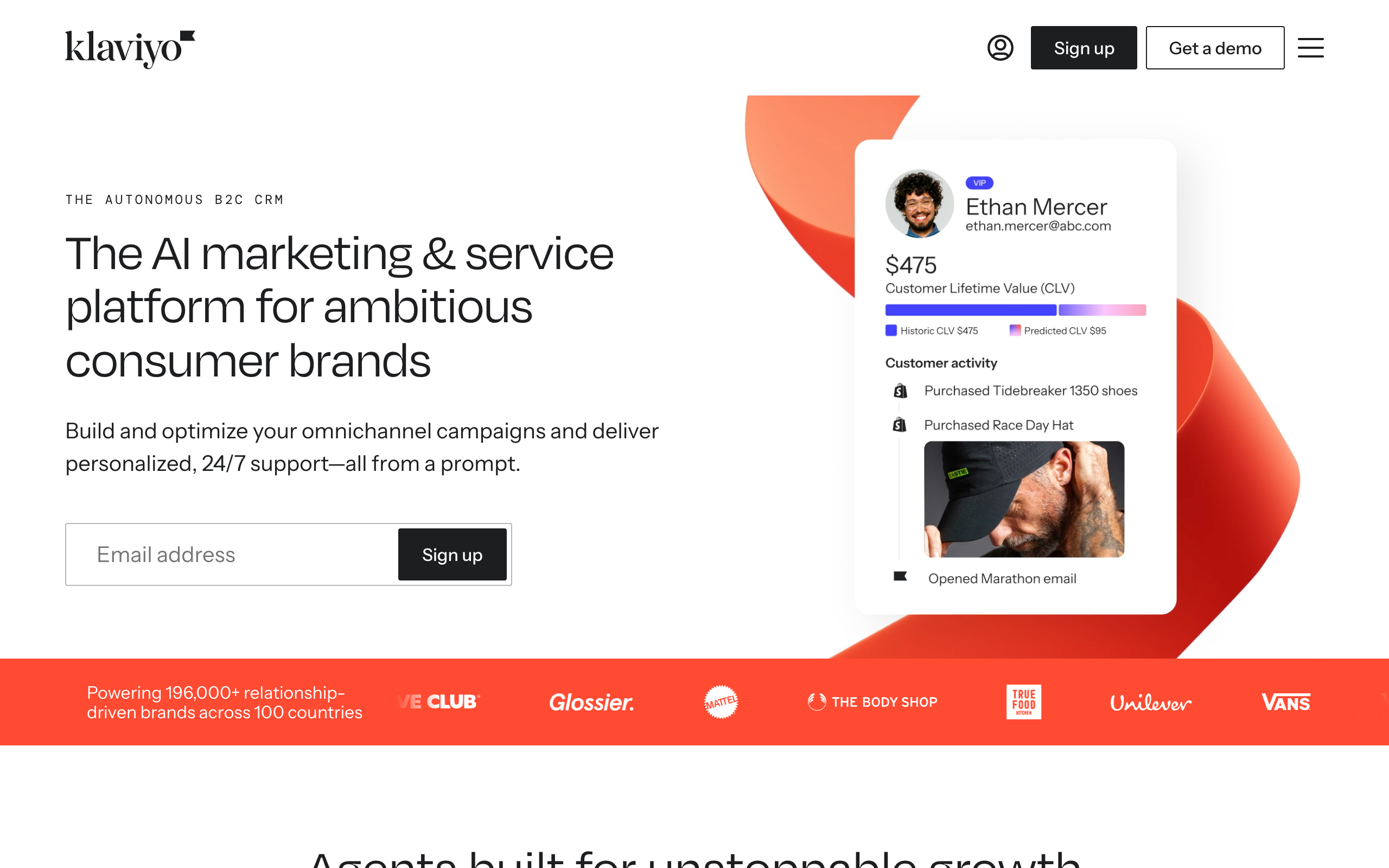
Klaviyo is built for one customer profile: a store owner or ecommerce marketer who wants email and SMS revenue to be a measurable, optimizable channel, not a guess. If you run a Shopify store, Klaviyo’s integration is close to plug-and-play: it pulls in your product catalog, order history, and customer profiles automatically, and from there you can build flows that reference specific products, discount codes, purchase frequency, and predicted customer lifetime value without custom development.
The flows that make Klaviyo worth the higher price are the ones almost every serious store runs: abandoned cart (often the single highest-ROI automation any store builds), post-purchase upsell and cross-sell, browse abandonment, win-back sequences for lapsed customers, and replenishment reminders for consumable products. Each of these ties directly to a dollar figure in Klaviyo’s reporting, which is the feature that keeps ecommerce marketers loyal even as the bill grows: you can see, campaign by campaign and flow by flow, exactly how much revenue Klaviyo generated last month. Mailchimp’s revenue reporting exists but is not as tightly woven into the product’s core experience.
Mailchimp vs Klaviyo pricing in 2026
Numbers below are pulled from Mailchimp’s and Klaviyo’s live pricing pages as of mid-2026. Both platforms price primarily by contact or profile count, so treat the entry prices as a floor that rises with your list size.
| Plan | Mailchimp | Klaviyo |
|---|---|---|
| Free | $0, up to 250 contacts, 500 sends/month | $0, up to 250 profiles, 500 email sends/month, plus $5 of SMS/MMS credit monthly |
| Entry paid tier | Essentials from $13/month (0-500 contacts tier), 10x contacts in monthly sends, A/B testing, 3 audiences | Email plan starts once you exceed 250 profiles. Klaviyo prices this through a live calculator rather than flat tiers; expect roughly $20 to $30/month around 500 active profiles (as of mid-2026), climbing from there |
| Mid tier | Standard from $20/month, up to 200 automation flows, generative AI included, custom-coded templates, 5 audiences | Cost scales with your list; many stores in the 5,000 to 10,000 active profile range report Email plan bills roughly in the $100 to $150/month range (as of mid-2026), more if you add the SMS plan on top |
| Top tier | Premium from $350/month, predictive segmentation, unlimited audiences and users, phone support | Enterprise-level pricing available on request for large lists, with dedicated support and advanced deliverability tooling |
The honest reading: at very small list sizes the two are close enough that price is not the deciding factor. As your list crosses a few thousand contacts, Klaviyo’s per-contact cost tends to run noticeably higher than Mailchimp’s equivalent tier, especially once SMS enters the picture. Store owners generally accept this because the flows Klaviyo enables (abandoned cart recovery above all) tend to generate more revenue than the price difference, but that only holds if you actually build the flows. If you sign up for Klaviyo and use it like Mailchimp, sending only broadcast campaigns, you are paying ecommerce prices for general-purpose usage, and that math does not work in your favor.
Because both companies adjust these numbers and slider curves fairly often, check klaviyo.com/pricing and mailchimp.com/pricing/marketing directly before you commit to either plan; the entry-tier prices above are a reliable floor but the exact figure at your list size can shift.
Ecommerce features compared
This is where the gap is widest and least debatable. Klaviyo’s Shopify and WooCommerce integrations sync in near real time: product catalogs, order status, discount codes, and customer purchase history all flow into Klaviyo automatically, and the platform’s flow templates are literally named after commerce events (Abandoned Checkout, Browse Abandonment, Post-Purchase, Winback). You can drag a product recommendation block into an email and Klaviyo will personalize it per recipient based on their browsing and purchase history, without you writing any logic yourself.
Mailchimp’s ecommerce integration works, and for a small catalog with straightforward promotional needs it is genuinely fine: you can sync a Shopify store, send abandoned cart emails, and see revenue-per-campaign in the reporting. But the moment you want conditional logic based on product category, purchase frequency tiers, or predicted next purchase date, you will find yourself building manual segments and static rules where Klaviyo would have handled it as a default automation setting. If your store has more than a handful of SKUs and you actually plan to build a real automation program rather than sending occasional newsletters, this gap will cost you more in lost revenue than Klaviyo costs in subscription fees.
Ease of use and setup time
Mailchimp is the easier tool to open cold and be productive in within an hour. The campaign builder is drag-and-drop, the AI writing assistant on Standard and above drafts subject lines and body copy competently, and the learning curve for sending a single well-designed newsletter is short. If your only job is “send an email that looks good,” Mailchimp gets you there faster.
Klaviyo has a steeper initial learning curve, mostly because the tool exposes so much more data and so many more trigger conditions. The flow builder is powerful but assumes you understand your own customer journey well enough to design around it: what counts as a cart abandonment window, which segment gets which upsell, how aggressive the SMS cadence should be. Klaviyo’s own onboarding and template library have gotten considerably better at shortening this curve, and most stores can have a solid starter flow set (welcome series, abandoned cart, post-purchase) running within a week using templates rather than building from scratch. But the ceiling is much higher than Mailchimp’s, and reaching that ceiling takes real time investment.
Automation and segmentation depth
Segmentation is the clearest technical difference between the two products. Mailchimp segments primarily on email engagement (opens, clicks), basic demographic and location data, and simple purchase history if the store is connected. Klaviyo segments on all of that plus predicted metrics: predicted customer lifetime value, likelihood to churn, next predicted order date, and custom properties you can define from any event you track, including events from outside your store if you pipe them in through an API or a tool like Zapier.
This matters most in automation. A Klaviyo flow can branch based on whether a customer’s predicted CLV crosses a threshold, sending high-value customers a different offer than one-time buyers. Building the equivalent in Mailchimp requires manual segment maintenance and static rules that go stale as customer behavior changes. If your marketing strategy depends on treating different customer tiers differently and automatically, Klaviyo’s segmentation engine is doing real work that Mailchimp’s simply was not designed to do.
Neither Mailchimp nor Klaviyo is built to grow an audience from scratch the way a dedicated newsletter platform is. If part of your plan is building a content-driven list before you have a store, or running a newsletter alongside your ecommerce email program, it is worth spending an afternoon with a free beehiiv publication to see what a referral program and a built-in growth toolkit feel like. Free to 2,500 subscribers, no card required.
Deliverability and sending reputation
Both platforms operate on shared sending infrastructure at the lower tiers, and both have invested heavily in deliverability tooling because email revenue depends on actually reaching the inbox. Klaviyo has built specific deliverability monitoring into its dashboard, including engagement-based sending recommendations that help you avoid mailing disengaged segments who would otherwise drag down your sender reputation. This matters more for ecommerce senders because promotional email volume tends to be higher and more frequent than a typical newsletter, which puts more strain on reputation if you are not managing list hygiene.
Mailchimp’s deliverability tools are solid for its use case but less specialized. For most senders under a few hundred thousand contacts, both platforms deliver reliably when you follow basic hygiene practices: authenticate your domain (SPF, DKIM, DMARC), avoid buying lists, and prune unengaged contacts periodically. Neither is a magic fix for a poorly maintained list, and neither will meaningfully out-deliver the other if your fundamentals are bad.
SMS marketing compared
Klaviyo built SMS into the same platform and same automation flows as email from early on, so a flow can branch or escalate between email and text based on engagement, and attribution reporting treats both channels the same way. This integrated approach is a meaningful advantage for stores that lean on SMS for cart recovery or flash sales, since you are not managing two disconnected tools and two separate reporting dashboards.
Mailchimp added SMS more recently and it functions as more of a bolt-on than a first-class channel woven through every flow the way Klaviyo’s is. If SMS is a serious part of your revenue plan rather than an occasional campaign, Klaviyo’s integration will feel noticeably more mature.
Customer support compared
Mailchimp’s support scales with plan tier: free and Essentials users get email and chat support, Standard adds a personalized onboarding session, and Premium adds phone and priority support with a dedicated onboarding specialist. Klaviyo’s free plan includes email support for the first 60 days only, after which paid-plan users get access to fuller support channels; higher tiers add faster response times and more hands-on account help.
In practice, both companies lean heavily on self-serve documentation and community resources at the entry tiers, and reserve human, responsive support for paying customers on higher plans. If white-glove support is a deciding factor for you, budget for a mid-tier plan on either platform rather than expecting much from the free tier.
When Mailchimp wins
Choose Mailchimp if your business sends email as one marketing channel among several, your list is a few thousand contacts or fewer, you want a shorter learning curve, and your automation needs are simple: a welcome series, an occasional promotional blast, maybe an abandoned cart nudge. Service businesses, local businesses, small nonprofits, and anyone running a light ecommerce operation without a large or complex catalog will generally get more value per dollar and per hour from Mailchimp than from Klaviyo, because they will never use enough of Klaviyo’s depth to justify its price.
Mailchimp also wins if you want one platform for more than email: its landing page builder, social ad management, and CRM-lite features mean a very small business can run most of its marketing from a single login, which has real value when you do not have a dedicated marketing hire.
When Klaviyo wins
Choose Klaviyo if ecommerce is your business, your store lives on Shopify, BigCommerce, or WooCommerce, and you want email and SMS to be a measurable, optimizable revenue channel rather than a once-a-month newsletter. Any store with a catalog large enough to benefit from product-level personalization, any brand relying on abandoned cart recovery as a real revenue line (which is most stores that check the numbers honestly), and any team planning to build a genuine lifecycle marketing program should expect Klaviyo to outperform Mailchimp enough to justify the higher bill.
The rule of thumb that holds up in practice: if you can name your last three email automations and describe exactly which customer behavior triggers each one, you are already using Klaviyo the way it is meant to be used, or you should be. If you cannot name them, you are probably not ready to extract Klaviyo’s value yet, and Mailchimp will feel like plenty of tool for where you are today.
What if you also run a newsletter or content brand?
Something worth flagging honestly: neither Mailchimp nor Klaviyo was designed to grow a subscriber base from zero. Both assume you already have contacts, whether from a store checkout or a lead form, and focus on what you do with them after they opt in. If part of your business is a content-driven newsletter, whether standalone or sitting alongside a store, you will feel the absence of a referral program, a recommendation network, or an SEO-indexable post archive on either platform, because neither ships those features.
This is a real gap, not a nitpick. Growth features like a built-in referral program and a way for other publications to recommend you are exactly what compounds a list over time instead of leaving you dependent on paid ads or existing traffic. It is a different job than what Mailchimp and Klaviyo do well, which is why a dedicated newsletter platform is worth evaluating separately rather than trying to force either ecommerce or general-purpose email tool into that role.
If a content or newsletter arm is part of your roadmap, even a small one that runs alongside your store, start a free beehiiv publication and compare the growth tooling directly. It costs nothing to run to 2,500 subscribers, and it will show you what a platform built specifically for list growth does differently from a store’s email tool.
How does this compare to other options?
Mailchimp and Klaviyo are not the only two names in this space, and depending on your priorities, a third option might fit better than either. If budget is the primary constraint, our MailerLite vs Mailchimp comparison covers a considerably cheaper general-purpose alternative. And if list growth through referrals and an ad network matters as much as sending the emails themselves, our beehiiv review, the full ranking of the best newsletter platforms, and our breakdown of exactly what beehiiv costs at every list size lay out the newsletter-specific case in more depth. If you want the full list of Mailchimp competitors across every use case, see our Mailchimp alternatives guide, and for Klaviyo specifically, our Klaviyo alternatives guide breaks down the ecommerce-focused options.
The bottom line
Mailchimp versus Klaviyo is not really a “which is the better product” question; it is a “which problem do you have” question. Ecommerce stores that want revenue-attributed, product-triggered automation should expect to pay more for Klaviyo and get more back in recovered carts and repeat purchases, provided they actually build the flows the platform is designed around. Small businesses, service providers, and anyone whose email marketing is a supporting activity rather than the main revenue engine will generally find Mailchimp cheaper, faster to learn, and entirely sufficient for what they actually need.
If you are still unsure after reading this, the fastest way to find out is to trial the one that matches your business model (ecommerce store versus general marketing) rather than the one with more features on paper. Both companies offer free tiers or trials specifically so you do not have to guess.
And if any part of your growth plan runs through content rather than a store checkout, that is the one job neither Mailchimp nor Klaviyo was built for. Open a free beehiiv publication and see what a referral program and an SEO-indexable post archive add on top of the email sending you already have. It is free to 2,500 subscribers and takes an afternoon to test.
Frequently asked questions
Is Klaviyo better than Mailchimp for ecommerce? For most ecommerce stores, yes. Klaviyo’s direct integration with Shopify, BigCommerce, and WooCommerce, combined with its predictive segmentation and product-level automation, tends to generate more revenue per contact than Mailchimp’s more general-purpose ecommerce features, especially once your catalog and automation program grow past the basics.
Is Mailchimp cheaper than Klaviyo? At the entry tiers, yes. Mailchimp’s Essentials plan starts around $13/month while Klaviyo’s paid Email plan typically starts somewhat higher once you exceed the 250-profile free limit. The gap widens as your list grows, particularly if you add Klaviyo’s SMS plan, so compare pricing at your actual list size rather than the entry-level numbers alone.
Can I use Mailchimp for an ecommerce store? Yes, and for a small catalog with straightforward promotional needs it works fine. You will hit a ceiling faster than with Klaviyo if you want deep product-level personalization, predictive segmentation, or SMS woven into the same automations as email.
Does Klaviyo work with platforms other than Shopify? Yes. Klaviyo integrates natively with BigCommerce, WooCommerce, Magento, and several other ecommerce platforms, though the Shopify integration is generally considered the most seamless and widely used.
Which platform has a better free plan? Both free plans are similarly limited as of mid-2026: roughly 250 contacts or profiles and about 500 sends a month on each. Neither free tier is meant to support a growing list long-term; treat both as a way to test the product, not a permanent home for your marketing.
Is switching from Mailchimp to Klaviyo difficult? Klaviyo provides guided migration tools and documentation for importing contacts and rebuilding common flows from Mailchimp, and the process is generally manageable for a small to mid-size list. The bigger time investment is usually not the technical migration but rebuilding your automations to take advantage of Klaviyo’s deeper segmentation, which is worth doing properly rather than replicating your old Mailchimp flows one-for-one.
Pricing captured from vendor pricing pages, July 2026. Plans change, so confirm current details before you buy.


