

The MailerLite complaint I hear most is not about the product breaking. It is about the ceiling showing up faster than expected: the free plan that used to cover 1,000 subscribers now stops at 250, the automation builder caps out at a handful of steps right when your welcome sequence needs a sixth branch, and the “unlimited” language on the marketing page turns out to have an asterisk once you actually try to scale past a hobby list. MailerLite is still one of the cleanest budget tools in email marketing. It is also, for a growing number of people, a tool they have outgrown.
The best MailerLite alternative in 2026 depends on what you actually outgrew. If it was growth tooling for a newsletter, beehiiv is the clear pick: a free plan to 2,500 subscribers plus a referral program, Boosts, and an ad network MailerLite has never offered, all while keeping a 0% fee on paid subscriptions. If it was automation depth for selling products, ActiveCampaign or Kit go deeper than MailerLite ever will. If you run an online store, Klaviyo is built for exactly that job. The rest of this guide is the pricing, the honest trade-offs, and the specific caps in MailerLite that push people toward each option.
Disclosure: some links in this post are affiliate links. If you sign up through them, we may earn a commission at no extra cost to you. That never changes our verdict.
Why are people leaving MailerLite in 2026?
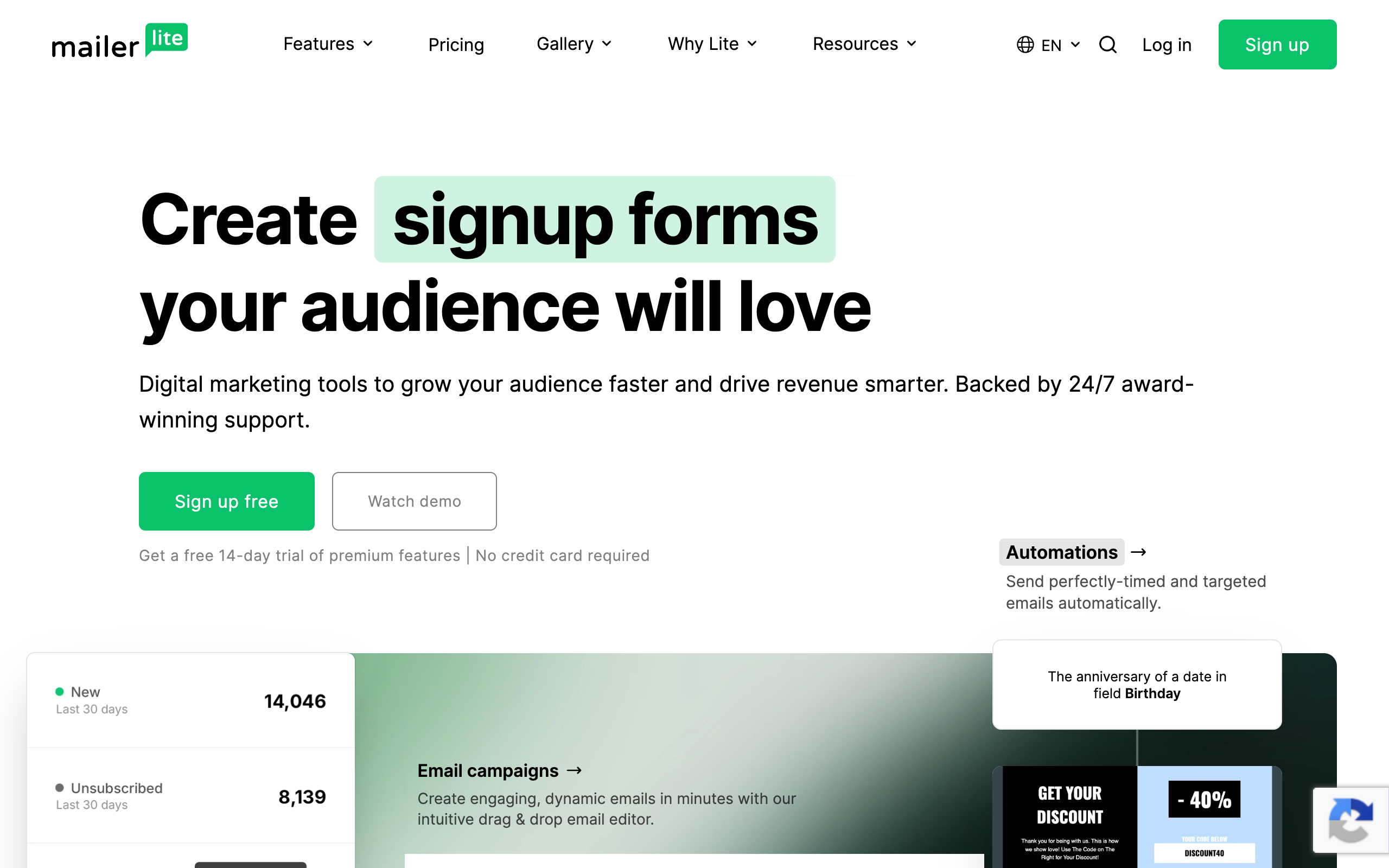
MailerLite earns its reputation as the clean, cheap option, and I want to say that plainly before spending four thousand words pointing people elsewhere. But four specific caps show up again and again in the switching conversations I have had, and they are structural, not the kind of thing a support ticket resolves.
1. The free plan shrank hard. For years, MailerLite’s free tier famously covered 1,000 subscribers. As of MailerLite’s live pricing page in July 2026, the free plan covers just 250 active subscribers and 2,500 monthly email sends, functioning now as a trial rather than a home for a small but real list. Anyone who bookmarked an old review with the 1,000-subscriber figure is in for an unpleasant surprise.
2. Automations hit a wall on the entry paid plan. The free plan allows 3 active automations with 5 steps each, and Comfort, the entry paid tier, raises that to 50 automations with 100 steps. That sounds generous until you are actually building a multi-branch funnel with conditional logic based on purchase behavior or tag combinations; MailerLite’s automation canvas is competent for straightforward sequences but was never built for the deep, nested logic that ActiveCampaign or Kit handle natively.
3. There is no growth engine built in. MailerLite sends email well. It does not have a referral program, a cross-promotion network, or an ad marketplace connecting you to sponsors. Every subscriber you gain, you found through channels entirely outside the platform. For a newsletter operator trying to compound growth, that is the gap beehiiv was built to close.
4. Ecommerce features are thin next to purpose-built tools. MailerLite offers basic ecommerce integrations and simple automation triggers, but if you need abandoned-cart flows with real product recommendation logic, predictive send-time optimization, or deep Shopify-native segmentation, MailerLite is a generalist tool wearing an ecommerce hat. Klaviyo was built for that job specifically.
If none of those four bother you, skip to the section titled “When you should stay on MailerLite.” If at least two made you nod, keep reading.
If the growth ceiling is your actual complaint, do not wait to find out whether the switch is worth it. I would open a free beehiiv publication tonight and import my MailerLite export before the weekend. The free plan covers 2,500 subscribers on your own custom domain, ten times MailerLite’s current free tier, so the comparison costs you nothing.
How I ranked these MailerLite alternatives
I looked at each platform’s live pricing page, mapped what its automation builder can actually do against MailerLite’s step and trigger limits, and weighed migration effort using MailerLite’s standard CSV export as the starting point. I scored four things: how well each option removes the specific cap that sends people searching for this article, what it truly costs at a realistic starting list size, how much harder (or easier) it is to operate day to day than MailerLite, and where it beats MailerLite outright rather than merely matching it. Pricing was captured from each vendor’s live pricing page in July 2026 unless noted as dynamically calculated or currency-converted.
The 7 best MailerLite alternatives in 2026
1. beehiiv: the best pick for newsletter growth MailerLite cannot deliver
beehiiv is where I send anyone whose real complaint about MailerLite is not the price, it is the ceiling on growth. MailerLite is a competent send tool. beehiiv is a send tool plus the machinery that compounds an audience: a native referral program, a Boosts marketplace where newsletters pay each other for subscriber recommendations, and an internal ad network that connects sponsors to your publication once you have an audience worth advertising to. None of that exists inside MailerLite at any price.
Per beehiiv’s live pricing page in July 2026, the free Launch plan covers up to 2,500 subscribers with unlimited sends and a custom domain, ten times MailerLite’s current 250-subscriber free tier. Scale starts at $43 a month on annual billing and unlocks the referral program, Boosts, the ad network, email automations, and a 0% fee on paid subscriptions, scaling up to 100,000 subscribers. Max starts at $96 a month annually, removing beehiiv branding and adding up to 10 publications. Full tier-by-tier detail lives in our beehiiv pricing breakdown.
The honest trade-off: beehiiv’s automation builder, while more capable than MailerLite’s free tier, is not as deep as ActiveCampaign’s or Kit’s for genuinely complex funnel logic. If your MailerLite frustration was specifically about automation depth rather than growth tooling, weigh option 3 below instead. I cover the full comparison in our direct beehiiv vs MailerLite breakdown, and the unfiltered strengths and weaknesses in the full beehiiv review.
Migration effort: low. MailerLite’s CSV export maps cleanly into beehiiv’s importer; the slower part is rebuilding automations by hand, since none of MailerLite’s flow logic transfers automatically.
Choose beehiiv over MailerLite if: your newsletter is the product and growth tooling is the gap. Stay away if: your business runs on intricate multi-branch automation, which is the one place MailerLite’s paid tiers and beehiiv both fall short of the next two picks.
2. Kit: the best pick for creators selling digital products
Kit (formerly ConvertKit) is the natural next step for anyone who hit MailerLite’s automation ceiling while trying to sell an ebook, a course, or a membership through email sequences rather than through growth mechanics. Its visual automation canvas handles branching logic, tag-based conditions, and multi-step funnels more elegantly than MailerLite’s builder, even at MailerLite’s higher paid tiers.
Per Kit’s live pricing page in July 2026, the free Newsletter plan covers up to 10,000 subscribers with one basic automation, a far larger free ceiling than MailerLite offers, though the automation limit means you will feel the paywall the moment you need real logic. Creator starts at $33 a month on annual billing and unlocks unlimited automations, A/B testing, and Kit Commerce for selling digital products directly. Pro starts at $66 a month annually and adds subscriber-level engagement analytics.
What Kit does not fix: growth tooling. Like MailerLite, Kit has no native referral program or ad network on the scale of beehiiv’s, though its Creator Network offers some cross-promotion. If your MailerLite ceiling was automation, not growth, Kit is the closer match.
Migration effort: low. CSV import handles subscribers cleanly; MailerLite automations must be rebuilt by hand in Kit’s canvas.
3. ActiveCampaign: the deepest automation on this list
ActiveCampaign exists for exactly the person who has read the words “MailerLite automation step limit” one too many times. Its automation builder is built around genuinely complex logic: conditional branching, split testing inside a workflow, a built-in CRM layer, and predictive send optimization. If your business runs on funnels with real decision trees, this is the tool that stops fighting you.
ActiveCampaign’s pricing page renders its figures dynamically rather than publishing fixed public numbers, so treat the following as directional and confirm the live quote before buying: as of mid-2026, published third-party tracking puts Starter around $15 a month, Plus around $49 a month, Pro around $79 a month, and Enterprise around $145 a month, each at the 1,000-contact entry tier on annual billing. That is a meaningfully higher price than MailerLite at every tier, and it buys automation depth MailerLite was never built to match.
What you give up: simplicity. ActiveCampaign’s interface has a real learning curve compared with MailerLite’s clean editor, and the CRM features that justify the higher tiers are wasted if you only send newsletters. This is a tool for people who need the depth, not a general-purpose upgrade.
Migration effort: medium. Contact import is straightforward; rebuilding MailerLite automations as ActiveCampaign workflows takes real time given how much more logic the builder can hold, and the CRM setup is a separate project if you use it. Our full ActiveCampaign review covers the learning curve in more depth.
4. Klaviyo: the pick if your list exists to sell physical products
Klaviyo is the answer when MailerLite’s “basic ecommerce integrations” stopped being enough. It was built specifically for online stores: abandoned-cart flows with real product data, predictive analytics on customer lifetime value, and deep native integrations with Shopify, WooCommerce, and BigCommerce that go well beyond MailerLite’s connector-level integrations.
Per Klaviyo’s live pricing page in July 2026, the free plan covers up to 250 active profiles with 500 email sends a month. Paid pricing is profile-based and reported to start around $20 a month for the Email plan at the 251 to 500 profile tier as of mid-2026, scaling with list size (published figures put a 50,000-profile list around $720 a month for email alone). Treat these paid figures as directional since Klaviyo’s calculator updates the number live; confirm your actual tier before committing.
The trade-off is cost and complexity. Klaviyo is meaningfully more expensive than MailerLite at almost every list size, and its interface is built for ecommerce marketers who live inside revenue-attribution dashboards. If your list is not attached to a store, Klaviyo is overkill; if it is, nothing on this list attributes revenue to individual sends as precisely.
Migration effort: medium to high. Store integration setup (Shopify, WooCommerce) takes real configuration time beyond a simple CSV import, and rebuilding cart-abandonment flows with Klaviyo’s deeper trigger logic is worth doing properly rather than quickly. See our Klaviyo review for a full breakdown of the ecommerce-specific features.
5. GetResponse: the pick for funnels, webinars, and automation in one tool
GetResponse is worth a look if what you actually wanted from MailerLite was a broader marketing suite, not just deeper email automation. It bundles landing pages, webinar hosting, and a sales-funnel builder alongside email marketing and automation, which can replace two or three separate subscriptions for a small business.
GetResponse’s pricing page localizes to regional currency, so treat these as directional conversions rather than exact figures: as of mid-2026, the entry Starter plan runs around $19 a month at standard monthly billing (roughly $15.50 a month on annual billing) at the 1,000-contact tier, with the Marketer tier around $59 a month monthly (around $48.50 annual) adding unlimited automation workflows, abandoned-cart recovery, and sales funnels, and a Creator tier around $69 a month monthly (around $57 annual) layering in a website builder and course creation for up to 500 students. Confirm current USD pricing directly on GetResponse’s site before buying, since currency display varies by region.
What you give up moving from MailerLite: simplicity again. GetResponse’s interface reflects its breadth, meaning more menus and more setup than MailerLite’s cleaner, narrower tool. If you only ever wanted to send a newsletter well, this is more platform than you need.
Migration effort: medium. Contact import is standard; the value here is in adopting the funnel and webinar tools, which is a separate onboarding project beyond just moving your list.
6. Brevo: the pick for large, quiet lists
Brevo (formerly Sendinblue) flips MailerLite’s pricing logic on its head. MailerLite, like most tools on this list, charges by how many subscribers you store. Brevo charges primarily by how many emails you send. If you have a large list you email infrequently, that inversion can save real money.
As of Brevo’s pricing information in mid-2026, the free plan allows roughly 300 emails a day to an unlimited number of stored contacts, and paid marketing plans are reported starting around $9 a month depending on monthly send volume. Brevo’s pricing page renders its calculator dynamically, so these figures are directional; confirm the live quote against your actual list size and sending frequency before switching.
Brevo is also a broader platform than MailerLite: transactional email, SMS, WhatsApp campaigns, and a built-in CRM live under the same roof. That breadth means more interface than a pure newsletter tool, and there is nothing newsletter-native here, no referral program, no publication website, no monetization rails.
Migration effort: low to medium. Contact import is easy; new accounts go through a sending-reputation warmup period that can throttle your first few large sends, so plan your first campaign accordingly.
7. Mailchimp: the familiar name, mostly for ecommerce
Mailchimp belongs on this list because you will compare it regardless, and I would rather arm you with real numbers than let you assume. For someone leaving MailerLite specifically for more room to grow, Mailchimp is usually the wrong direction: its pricing has gotten less generous over the years, not more.
Per Mailchimp’s live pricing page in July 2026, the free plan now covers just 250 contacts, matching MailerLite’s current free tier exactly. Essentials starts at $13 a month and Standard at $20 a month, both at the 501-contact entry tier, and Premium runs $350 a month with unlimited contacts. A structural gotcha worth knowing: Mailchimp counts unsubscribed and non-subscribed contacts toward your billable total, so a list you have not cleaned in a while can cost more than its actual active size suggests.
Where Mailchimp does win: ecommerce integrations tied to customer purchase history and multichannel campaign tools, if your list is really a store’s marketing arm rather than a standalone newsletter. For pure newsletter operators, it offers little that MailerLite does not already do, at a comparable or higher price.
Migration effort: low for contacts, medium for automations given Mailchimp’s flow-step restrictions on lower tiers.
MailerLite alternatives compared: pricing and best use
| Platform | Free plan | Paid entry price | Automation depth | Best for |
|---|---|---|---|---|
| beehiiv | 2,500 subscribers, unlimited sends | $43/mo annual (Scale) | Moderate | Newsletter growth (referrals, Boosts, ad network) |
| Kit | 10,000 subscribers, 1 automation | $33/mo annual (Creator) | High | Digital product and course funnels |
| ActiveCampaign | None (14-day trial) | ~$15/mo (Starter, 1,000 contacts) | Very high | Complex automation and CRM |
| Klaviyo | 250 profiles, 500 sends/mo | ~$20/mo (Email, 500 profiles) | High (ecommerce-specific) | Online stores |
| GetResponse | None (14-day trial) | ~$19/mo (Starter, 1,000 contacts) | High | Funnels, webinars, automation in one |
| Brevo | ~300 emails/day, unlimited contacts | ~$9/mo (send-based) | Moderate | Large lists, infrequent sends |
| Mailchimp | 250 contacts, 500 sends/mo | $13/mo (Essentials) | Low to moderate | Ecommerce and small-business marketing |
| MailerLite (baseline) | 250 subscribers, 2,500 emails/mo | $12/mo (Comfort) | Moderate (step-capped) | Cheap, simple newsletters |
Prices captured from each vendor’s live pricing page in July 2026 at entry tiers, annual billing where offered. ActiveCampaign, Klaviyo, GetResponse, and Brevo figures are directional as of mid-2026 since those vendors render pricing dynamically or in local currency; confirm your exact quote before buying.
Which MailerLite alternative should you choose?
Rankings are averages, and your list is not average. Match your actual constraint instead:
- You want growth tooling, not just a bigger send limit: beehiiv, for the referral program, Boosts, and ad network MailerLite never built.
- You sell digital products through email funnels: Kit, for the automation-to-commerce pipeline.
- Your funnels need real branching logic and a CRM: ActiveCampaign, worth the price jump if you use the depth.
- You run an online store: Klaviyo, built specifically for that job.
- You want landing pages, webinars, and email in one subscription: GetResponse.
- Your list is large and quiet: Brevo’s send-based pricing rewards low frequency.
- Your newsletter is really a store’s marketing channel: Mailchimp, reluctantly.
If you are comparing the whole market rather than specifically leaving MailerLite, our roundup of the best newsletter platforms in 2026 starts from a blank slate.
The cheapest way to settle this for yourself: open a free beehiiv account and import your MailerLite export this week. It costs nothing up to 2,500 subscribers, and one real send will tell you more about whether growth tooling is what you were missing than any comparison table, including this one.
When should you stay on MailerLite?
An honest alternatives guide includes this section, because switching has real costs that never show up on a pricing page. Stay on MailerLite if any of these describe you.
Your list is genuinely under 250 subscribers and growing slowly. The free plan’s shrunk ceiling still costs nothing. Migrate when the constraint becomes real, not before you have actually hit it.
Your automations are simple and working. If a welcome sequence and a couple of tag-based triggers cover your needs, MailerLite’s Comfort tier at $12 a month is genuinely one of the cheapest ways to run that setup well. Do not pay more for depth you will not use.
You are price-sensitive above all else. MailerLite’s paid tiers still undercut most of this list at comparable list sizes. If your business cannot absorb a higher monthly bill right now, that constraint is real and worth respecting over a feature wishlist.
You do not need growth tooling or ecommerce depth. If your newsletter is a side project rather than a business with acquisition and monetization ambitions, the extra machinery on beehiiv, ActiveCampaign, or Klaviyo is overhead you do not need yet.
The pattern behind all four: MailerLite is still a genuinely good tool for a specific, smaller job. The switch only pays off when you have actually outgrown that job, not when a comparison article convinces you that you might.
How to migrate off MailerLite without losing subscribers
Whichever platform you choose, the move follows roughly the same sequence. Skipping a step is how migrations lose deliverability or a chunk of engaged subscribers, so the order matters as much as the individual steps.
- Export your full subscriber list with groups and fields. MailerLite’s export includes group membership and custom fields; pull the complete CSV so segmentation survives the move rather than flattening into one undifferentiated list.
- Authenticate your sending domain on the new platform before importing. Set up SPF, DKIM, and DMARC first, and send test emails to seed accounts at Gmail and Outlook. A migration’s first real send from an unauthenticated domain is the most common way it lands in spam.
- Rebuild automations by hand, starting with the welcome sequence. No platform on this list imports MailerLite’s automation logic automatically. New subscribers should never land in a dead zone, so get this one right before anything else.
- Map MailerLite groups to the new platform’s segmentation model. Some tools use tags, others use lists or segments; do this mapping deliberately rather than dumping everyone into one bucket.
- Run both platforms in parallel for two or three sends. Keep MailerLite active for a couple of weeks, compare deliverability and engagement on identical content, and cancel from evidence rather than hope.
Budget a weekend for a simple list with light automation, and a full week of part-time attention if you are moving deep automation logic or ecommerce integrations to a new platform.
Frequently asked questions
What is the best MailerLite alternative in 2026? It depends on what you outgrew. For newsletter growth tooling, beehiiv is the best MailerLite alternative in 2026, with a 2,500-subscriber free plan and built-in referrals, Boosts, and an ad network. For deep automation, ActiveCampaign or Kit go further than MailerLite. For ecommerce, Klaviyo is purpose-built for that job.
Why did MailerLite’s free plan get smaller? MailerLite reduced its free tier from a widely cited 1,000-subscriber ceiling to 250 active subscribers with 2,500 monthly sends, as confirmed on its live pricing page in July 2026. The change positions the free plan as a trial rather than a permanent home for a small list, pushing serious users toward the paid Comfort and Power tiers faster than before.
Is beehiiv better than MailerLite? beehiiv is better than MailerLite for anyone building a newsletter as a business: a bigger free tier, an SEO-indexable website, a native referral program, Boosts, an ad network, and 0% fees on paid subscriptions. MailerLite remains a cheaper, simpler choice for straightforward email sends without growth ambitions. Our full beehiiv vs MailerLite comparison covers every angle.
What is the cheapest MailerLite alternative? On sticker price, Brevo’s send-based pricing (reported around $9 a month as of mid-2026 for lower volumes) can undercut MailerLite for large, infrequently emailed lists. For a genuinely fee-free option under 2,500 subscribers, beehiiv’s free plan costs nothing at all.
Can I migrate from MailerLite without losing my subscribers? Yes. Every alternative in this guide imports a standard CSV export from MailerLite, including group membership and custom fields, so subscribers transfer cleanly. Automations do not transfer and must be rebuilt by hand, and you should authenticate your sending domain before your first send to protect deliverability.
Should I switch from MailerLite to ActiveCampaign? Only if you actually need the automation depth. ActiveCampaign costs meaningfully more than MailerLite at every tier and has a steeper learning curve, so the switch pays off when your funnels genuinely require conditional branching, a built-in CRM, or predictive send logic. If your automations are simple, staying on MailerLite or moving to Kit is usually the better trade.
The bottom line
Remember what actually sent you looking: the free plan that shrank under you, the automation step that would not let you add a sixth branch, or the growth you could not find a lever for. Each alternative on this list solves a different version of that problem. ActiveCampaign and Kit for automation depth. Klaviyo for ecommerce. GetResponse for an all-in-one funnel suite. Brevo for large quiet lists. And for the majority of people whose real complaint was growth, not automation, beehiiv, which is the only platform here that gets structurally better for you as your list grows instead of just charging you more for the privilege of growing.
You do not have to take a ranked list on faith. Open a free beehiiv account, import your MailerLite export, and publish one real issue. It costs nothing up to 2,500 subscribers, your list stays yours either way, and one real send will tell you more than four thousand words ever could.
Pricing captured from vendor pricing pages, July 2026. Plans change, so confirm current details before you buy.


