

MailerLite’s pricing page looks simple until you actually try to price out your list, and then the slider, the subscriber tiers, and the “starting at” language start doing a lot of quiet work. I pulled every number straight off MailerLite’s live pricing page, ran a test account through the free and Comfort tiers, and mapped what actually happens to your bill as your list grows. Here is what MailerLite costs in 2026, where the sticker price hides real limits, and where it is genuinely the cheapest serious option in the newsletter category.
Disclosure: some links in this post are affiliate links. If you sign up through them, we may earn a commission at no extra cost to you. That never changes our verdict.
The 30-second verdict
MailerLite is the cheapest full-featured newsletter and email tool that doesn’t feel stripped down, with a free plan to 250 subscribers, a Comfort plan starting at $10.80 a month on annual billing, and a Power plan at $22.50 a month that removes every meaningful cap. For a solo writer or small business watching every dollar, it beats Mailchimp and Klaviyo on price at nearly every subscriber count, and it undercuts beehiiv’s paid tier by roughly $30 a month at the entry level.
The catch is what that price does not include. MailerLite has no built-in referral program, no ad marketplace, and no paid recommendation network, the growth machinery that platforms like beehiiv bundle into their subscription. You are paying less for a tool that expects you to bring your own audience-growth strategy. If growth tooling matters more to you than the monthly invoice, read this pricing breakdown, then read my full MailerLite review before you commit either way.
If you want the fastest way to compare, skip to the numbers below, or just open a free beehiiv account and send one issue this week. It costs nothing to 2,500 subscribers, and having a second platform open while you read pricing pages makes the comparison a lot more concrete than staring at a table.
Key takeaways
- MailerLite’s free plan covers up to 250 active subscribers and 2,500 monthly emails, more generous than Mailchimp’s free tier and roughly in line with the free plans across the category.
- Comfort starts at $12 a month billed monthly, or $10.80 a month ($129.60 a year) billed annually, for up to 500 subscribers, and includes the AI writing assistant, 50 automations, and 10 websites or landing pages.
- Power starts at $25 a month billed monthly, or $22.50 a month ($270 a year) billed annually, for up to 500 subscribers, and removes the caps on emails, seats, automations, and everything else.
- Pricing on every paid plan rises in subscriber tiers as your list grows past 500, and MailerLite auto-upgrades and bills the next tier the moment you cross the line, so model your list size a year out, not today.
- MailerLite has no native referral program, Boosts-style marketplace, or ad network, the features that justify beehiiv’s higher price for operators focused on audience growth rather than pure cost.
What is MailerLite, and who is it actually built for?
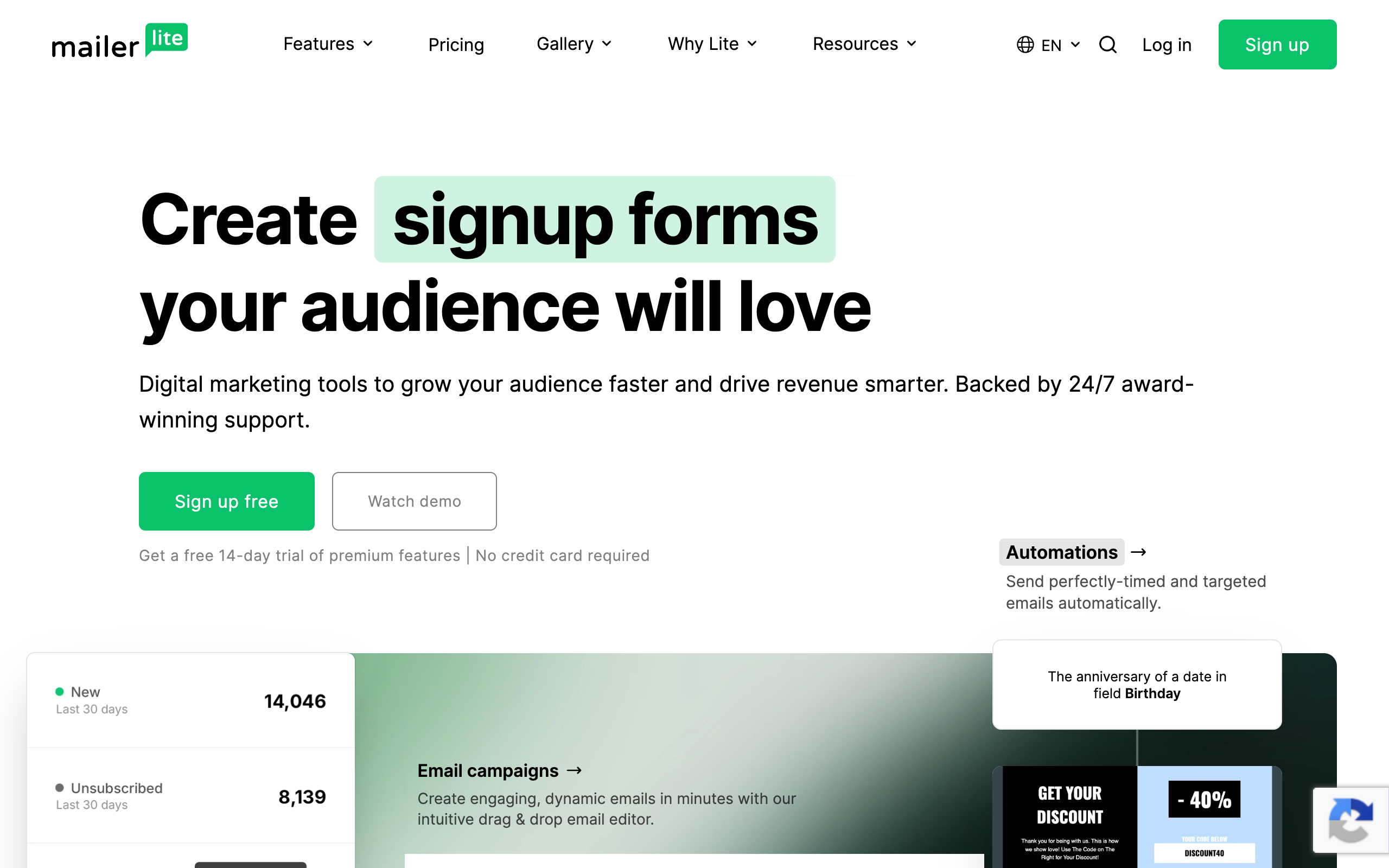
MailerLite is a Lithuania-founded email marketing and newsletter platform that has spent over a decade positioning itself as the budget-conscious alternative to Mailchimp, and more recently as a lighter-weight option next to creator tools like Kit and beehiiv. The company’s own tagline, “Keeping it Lite,” is not just branding. It describes a real product philosophy: fewer bells and whistles, a simpler interface, and a price that undercuts almost everyone else in the category at every subscriber count.
The people who get the most out of MailerLite are solopreneurs, small businesses, bloggers, and early-stage newsletter writers who need real automation and a real website builder, but who do not yet need (or want to pay for) growth marketplaces, deep ecommerce triggers, or agency-grade reporting. If your newsletter is a side project or a lean main channel and you are watching monthly software spend closely, MailerLite is built for exactly that budget.
Where it starts to strain is the same place every budget tool strains: once your list crosses a few thousand subscribers and you need deeper segmentation, native growth tools, or heavier automation logic, you start noticing what the lower price left out. That tradeoff is the entire story of this pricing page, and it is worth understanding plan by plan.
What are MailerLite’s pricing plans in 2026?
Numbers pulled directly from MailerLite’s live pricing page, captured mid-2026, shown at the entry tier of up to 500 subscribers (the tier the sticker prices below are quoted at).
| Plan | Price (monthly billing) | Price (annual billing) | What you get at the entry tier |
|---|---|---|---|
| Free | $0 | $0 | Up to 250 subscribers, 2,500 monthly emails, 2 seats, 1 website, 1 landing page, 3 active automations |
| Comfort | $12/mo | $10.80/mo ($129.60/yr) | Up to 500 subscribers, 5,000 monthly emails, 3 seats, 50 automations, 10 websites/landing pages, 5 digital products, AI writing assistant |
| Power | $25/mo | $22.50/mo ($270/yr) | Up to 500 subscribers, unlimited monthly emails, unlimited seats, unlimited automations, forms, and digital products |
| Enterprise | Custom | Custom | 200,000+ subscribers, dedicated success manager, dedicated IP, account audits, deliverability support |
Both paid plans use a slider on MailerLite’s own pricing page that recalculates cost as you drag past 500 subscribers, and the company does not publish a static table of every tier beyond that starting point. If your list is already above 500, the honest move is to run the slider yourself before you commit, the shape of the pricing holds (Comfort stays meaningfully cheaper than Power at every tier, and both climb roughly in step with list size), but I would rather send you to the live slider for your exact number than print a guess.
How much does the free plan actually get you?
MailerLite’s free plan is more usable than most people expect from a “free forever” tier. You get 250 active subscribers, 2,500 monthly emails, two user seats, and, notably, access to all three of MailerLite’s email editors (drag and drop, custom HTML, and a simplified editor) rather than a crippled version of one. You can run campaigns, build a basic automation (capped at 3 active automations with 5 steps each), launch one website and one landing page, and create signup forms.
What you do not get on free: email sending through the API or MCP server (both are read-limited, sending is a paid-plan feature), most templates (the library is limited), and any live chat support beyond the first 14 days, when every new account gets a taste of premium features during a trial window. After that trial ends, free accounts fall back to email support only, no live chat.
The gotcha worth flagging clearly: once your active subscriber count exceeds 250 on the free plan, MailerLite locks sending entirely, both campaigns and automations, until you either upgrade or trim your list back under the limit. There is no grace period or overage charge on free. It just stops.
What do you get on Comfort, and is $12 a month worth it?
Comfort is the plan MailerLite is really selling. For $10.80 a month on annual billing (or $12 month to month) at the 500-subscriber tier, you get the full creative toolkit: unlimited templates, dynamic email content, the AI writing assistant, “Smart sending” (MailerLite’s send-time optimization), a subscriber preference center, and the ability to remove the MailerLite logo from your emails. Automations jump from 3 to 50 active flows with up to 100 steps each, which covers a genuinely wide range of welcome sequences, abandoned-signup nudges, and lead-magnet delivery flows.
The monthly email allowance on Comfort is worth understanding precisely, because it is not a flat number. MailerLite gives you 10 times the ceiling of your subscriber tier every month. If you are on the up-to-500 tier, that is 5,000 emails a month, whether you actually have 120 subscribers or 490. The multiplier is based on the top of your tier, not your exact headcount, so a newer list on Comfort effectively gets more room to send test campaigns and re-sends without worrying about hitting the ceiling. In practice this is roughly two full sends a week to your entire list with buffer to spare, which covers the sending cadence of most newsletters comfortably.
I would put Comfort as the right plan for almost anyone starting a paid MailerLite account, unless you already know you will send more than twice a week or run automations aggressively enough to want no ceiling at all. In that case, Power is the better math.
When does Power’s $25 a month pay for itself?
Power removes every numeric limit that Comfort still has: unlimited monthly emails (subject to a fair use policy MailerLite does not publish exact numbers for, but is generous in practice), unlimited user seats, unlimited automations and automation steps, unlimited websites, landing pages, digital products, and signup forms. It also adds partner discounts, a 15% Google Workspace discount, and access to a dedicated IP as a paid add-on for senders who need control over their own sending reputation.
The math on Power versus Comfort is simple once you write it down. The gap is $14.20 a month on annual billing ($22.50 versus $10.80) at the same subscriber count. That is worth it the moment any single one of these is true for you: you send more than twice a week, you run more than 50 active automations (agencies and multi-funnel businesses hit this fast), you have more than 3 team members who need seats, or you sell more than 5 digital products through MailerLite’s built-in commerce tools. If none of those apply yet, Comfort covers you and the $14 a month is better spent elsewhere.
What about Enterprise?
Enterprise kicks in for lists over 200,000 subscribers and is entirely custom-quoted, no published number exists. What you get for that custom price is a dedicated success manager, a dedicated IP as a standard inclusion rather than an add-on, account audits and deliverability support, and onboarding consultation. This tier is not relevant to the vast majority of newsletter operators reading a pricing comparison, but it matters if you are migrating a very large list and evaluating whether MailerLite can support it at scale. The honest answer is that MailerLite’s Enterprise tier is younger and thinner than beehiiv’s or Klaviyo’s equivalent, and if you are already past 200,000 subscribers, get a call with their sales team and ask pointed questions about deliverability infrastructure before you sign anything.
Worth testing side by side before you decide: beehiiv’s free Launch plan runs to 2,500 subscribers with no card required, which is ten times MailerLite’s free ceiling. If growth tooling and a real website matter as much to you as the monthly bill, spend twenty minutes in both free accounts before you pick.
How does MailerLite count subscribers and emails, and where are the hidden costs?
This is the section most pricing pages skip, and it is where budget-conscious buyers actually get surprised. MailerLite bills on active subscribers, meaning anyone with an active status in your account. Unsubscribed and bounced contacts do not count against your limit or your bill, which is fairer than platforms that bill on total contacts regardless of engagement.
The part that catches people off guard is the cumulative counting rule within a billing cycle. If a subscriber was active at any point during your current billing cycle, they count toward your limit for the rest of that cycle, even if you delete them the next day. Your subscriber count only resets on your monthly billing anniversary. So a launch-week spike, a bad list import, or a one-time promotion that adds 300 people you later prune will still count against your tier until your next billing date rolls around. Plan list cleanup around your billing anniversary, not randomly during the month, or you risk paying for a tier you no longer need.
The second gotcha is automatic tier escalation. On paid plans, the moment your active subscriber count crosses your current tier’s ceiling, MailerLite automatically raises your limit and charges your card for the next pricing tier, no warning email required first (though MailerLite does notify you as you approach the limit). This is convenient in the sense that your sends never get blocked, but it also means an unexpected subscriber surge turns into an unexpected charge. Free accounts behave differently: cross 250 subscribers on free and sending locks entirely rather than auto-upgrading, since there is no card on file to charge.
How does MailerLite pricing compare to beehiiv, Kit, Mailchimp, and Klaviyo?
Sticker price alone tells you almost nothing until you line platforms up at the same subscriber count and ask what each one includes for that price. Here is the entry-tier comparison, paid plans shown on annual billing where each platform offers it.
| Platform | Free plan | Cheapest paid plan | What the cheapest plan skips |
|---|---|---|---|
| MailerLite | 250 subscribers, 2,500 emails/mo | $10.80/mo (Comfort, 500 subs) | No referral program, no growth marketplace, capped automations on Comfort |
| beehiiv | 2,500 subscribers, unlimited sends | $43/mo (Scale, annual) | Automations shallower than Kit; free plan lacks referral/Boosts/ad network |
| Kit | 10,000 subscribers, 1 automation | ~$29+/mo (Creator) | No ad network; growth relies on Creator Network and paid recommendations |
| Mailchimp | 500 contacts, 1,000 sends/mo | Varies by contact count | No referral or growth tooling; bills on total (not just active) contacts |
| Klaviyo | 250 profiles, 500 sends/mo | $20/mo (Email, 500 profiles) | Built for ecommerce, not newsletter growth; SMS priced separately |
Two things jump out once the numbers sit next to each other. First, MailerLite’s free plan is the stingiest on subscriber count in this table, 250 versus beehiiv’s 2,500 and Kit’s 10,000, but its paid entry price is the lowest by a wide margin. Second, every platform that beats MailerLite on price (or matches it) is either narrower in purpose (Klaviyo is ecommerce-first) or thinner on features at the entry tier. beehiiv and Kit cost more because they are selling something MailerLite mostly leaves out: built-in growth infrastructure. If you already have a way to grow your list (existing audience, paid ads budget, a podcast or YouTube channel feeding subscribers), MailerLite’s lower price stops costing you anything real. If audience growth is the actual problem you are trying to solve, the extra $30 a month on beehiiv’s Scale plan buys a referral program, a recommendation marketplace, and an ad network that MailerLite simply does not have at any price tier below Enterprise.
I break down that specific tradeoff, and the fee structure on paid subscriptions, in more depth in beehiiv vs Mailchimp and in my wider ranking of the best newsletter platforms, which is the better starting point if you have not settled on MailerLite yet and want the full field compared side by side.
Is MailerLite cheaper than beehiiv once you account for what each plan includes?
On raw dollars, yes, decisively. MailerLite’s Comfort plan at $10.80 a month is roughly a quarter of beehiiv Scale’s $43 a month at their respective entry tiers. But “cheaper” and “better value” are not the same question, and the honest way to answer this is to ask what each price actually buys.
beehiiv’s Scale plan bundles a native referral program, the Boosts marketplace (a two-sided network where newsletters pay each other for subscribers), an ad network that brings sponsorship demand to you, and 0% fees on paid subscriptions. Read my full breakdown in beehiiv’s pricing explained if you want the tier-by-tier math on that side. None of that exists on MailerLite at any price point short of custom Enterprise conversations. If you are trying to monetize a newsletter through sponsorships or grow it through referral mechanics, beehiiv’s higher price is buying you tools you would otherwise have to build or pay for separately (a referral tool alone often runs $50 to $100 a month standalone).
If your monetization plan does not depend on those growth mechanics, if you are running a lead-generation newsletter for an existing business, a personal blog, or a small agency’s client updates, then MailerLite’s lower price is not a compromise. It is simply the correct amount to pay for the feature set you actually use. I would not recommend anyone pay for beehiiv’s growth tooling if they have no intention of using a referral program or chasing ad network sponsorships; that is money spent on a feature set sitting unused.
Who should pick MailerLite on price, and who should look elsewhere?
- Solo writers and small businesses on a tight budget. Comfort at $10.80 a month gets you automation, a website, and an AI writing assistant for less than a single cup of coffee a week. This is the clearest win case for MailerLite.
- Agencies managing multiple small client lists. Unlimited seats on Power, plus the ability to spin up multiple websites and landing pages, makes the per-client cost very low if you are managing several accounts.
- Nonprofits. MailerLite offers a documented 30% discount on paid plans for verified nonprofit organizations, which stacks favorably against most competitors’ nonprofit programs.
- Ecommerce brands with complex triggers. Skip MailerLite here. Klaviyo’s cart-abandonment and revenue-attribution tooling is purpose-built for this, and MailerLite’s ecommerce integrations are basic by comparison.
- Newsletter operators betting on referral growth or ad sponsorships as a revenue channel. The lower price does not buy you the tooling to actually execute that strategy. beehiiv’s Scale plan does, and the math in the section above explains when that gap is worth paying for.
If you read that list and landed on “the growth tooling is what I actually need,” it is worth spending an evening with both platforms before you commit a year of billing to either one.
The fastest way to know which one fits: start a free beehiiv publication and run it alongside a MailerLite free account for a week. Both cost nothing to test at small scale, and an hour inside each editor will tell you more than any pricing table, including this one.
Frequently asked questions
How much does MailerLite cost per month in 2026? MailerLite is free up to 250 subscribers. Paid plans start at $10.80 a month (Comfort, billed annually) or $12 a month billed monthly, for up to 500 subscribers, with the Power plan starting at $22.50 a month annually ($25 monthly) for the same subscriber ceiling but unlimited sending and automations. Pricing rises in tiers as your subscriber count grows past 500.
Is MailerLite really free? Yes, the free plan is genuinely free indefinitely, not a time-limited trial, covering up to 250 active subscribers and 2,500 monthly emails. The tradeoff is that sending locks completely if you exceed 250 subscribers without upgrading, and premium features like live chat support and the AI writing assistant are only available during a 14-day trial window on new accounts.
What is the difference between MailerLite Comfort and Power? Comfort caps you at 5,000 monthly emails (at the 500-subscriber tier), 50 automations, and 3 seats, while Power removes all of those caps entirely: unlimited emails, unlimited automations, and unlimited seats, for roughly $14 more a month on annual billing. Power is worth the jump once you send more than twice a week or need more than 50 active automations.
Is MailerLite cheaper than Mailchimp? At almost every subscriber tier, yes. Mailchimp’s free plan caps out at 500 contacts and 1,000 sends a month, and its paid pricing climbs with total contact count, including unsubscribed contacts in some counting methods historically criticized by users. MailerLite counts only active subscribers and starts its paid tier lower.
Does MailerLite charge for unsubscribed or bounced contacts? No. MailerLite bills based on active subscribers only. Unsubscribed and bounced contacts are excluded from your subscriber count and do not count against your plan’s limit or trigger a tier upgrade.
Does MailerLite have a referral program or growth marketplace like beehiiv? No. MailerLite does not offer a native referral program, a paid-recommendation marketplace, or an ad network at any pricing tier. If audience growth tooling is central to your strategy, that is the main reason to consider beehiiv’s Scale plan despite its higher price, covered in detail in my beehiiv review.
My verdict after pricing every MailerLite plan
MailerLite earns its reputation as the budget pick honestly. Comfort at $10.80 a month is a real, usable email and website toolkit, not a stripped-down trial dressed up as a plan, and Power at $22.50 removes every cap that might slow down a growing operation. For anyone whose newsletter is not yet, or will never be, a growth-marketing project with referral funnels and sponsorship deals, MailerLite is the rational choice on price alone.
Where I would stop someone from choosing purely on the sticker price: if your plan involves monetizing through sponsorships, paid recommendations, or a referral-driven growth loop, the money you save on MailerLite gets spent right back building or buying the tools beehiiv bundles for $43 a month. Price the platform you need, not the platform that is cheapest on the first page you land on. For most solo writers and small businesses just trying to keep software costs low while they build an audience, MailerLite’s Comfort plan is the correct answer, and I would start there.
Full feature and workflow testing lives in my MailerLite review, and if you have already decided MailerLite is not the fit, my guide to MailerLite alternatives and the cheapest newsletter platforms compared both walk through where to look next.
Pricing captured from vendor pricing pages, July 2026. Plans change, so confirm current details before you buy.


