

MailerLite gets recommended constantly as “the budget option,” and that framing undersells it in a way that makes people expect a stripped-down tool. I set up a test account on the free plan, built a signup form, ran a basic automation, sent a campaign through both the drag-and-drop and simple editors, and pushed one landing page live to see how much MailerLite actually gives you before you pay a cent. The honest finding: for straightforward newsletter sending, it is not a compromise. It is a genuinely capable tool that happens to also be cheap, and the two things are different claims.
Where MailerLite earns the “budget” label fairly is in growth ambition. It is built to send email well and affordably, not to grow your audience for you. This review covers what MailerLite does right, where it runs out of road, exactly what it costs in 2026, and who should look at a different tool instead.
Disclosure: some links in this post are affiliate links. If you sign up through them, we may earn a commission at no extra cost to you. That never changes our verdict.
The 30-second verdict
MailerLite is the best low-cost email and newsletter platform in 2026 for beginners and budget-conscious senders who want a clean editor, real automation, and a genuinely usable free plan without paying for features they will not touch. The free plan covers up to 250 active subscribers and 2,500 monthly sends, real limits for a real free plan, not a crippled trial. Paid plans start around $12/month on the Comfort tier. I rate it 4 out of 5.
The star it loses is about ceiling, not floor. MailerLite is excellent at what it does, and what it does is send email cleanly at a low price. It has no native referral program, no recommendation marketplace, no ad network, and its automation depth tops out well below Kit or ActiveCampaign. If you are starting small or running a lean operation, none of that matters yet. If you are trying to build serious growth infrastructure or complex funnels, you will outgrow it, and it is worth knowing that going in rather than discovering it at month eight.
If growth tooling is part of your plan from day one, it is worth comparing MailerLite’s simplicity against a platform built for growth specifically. Start a free beehiiv publication, free to 2,500 subscribers with no card required, and see the difference for yourself.
What is MailerLite, and who is it actually built for?
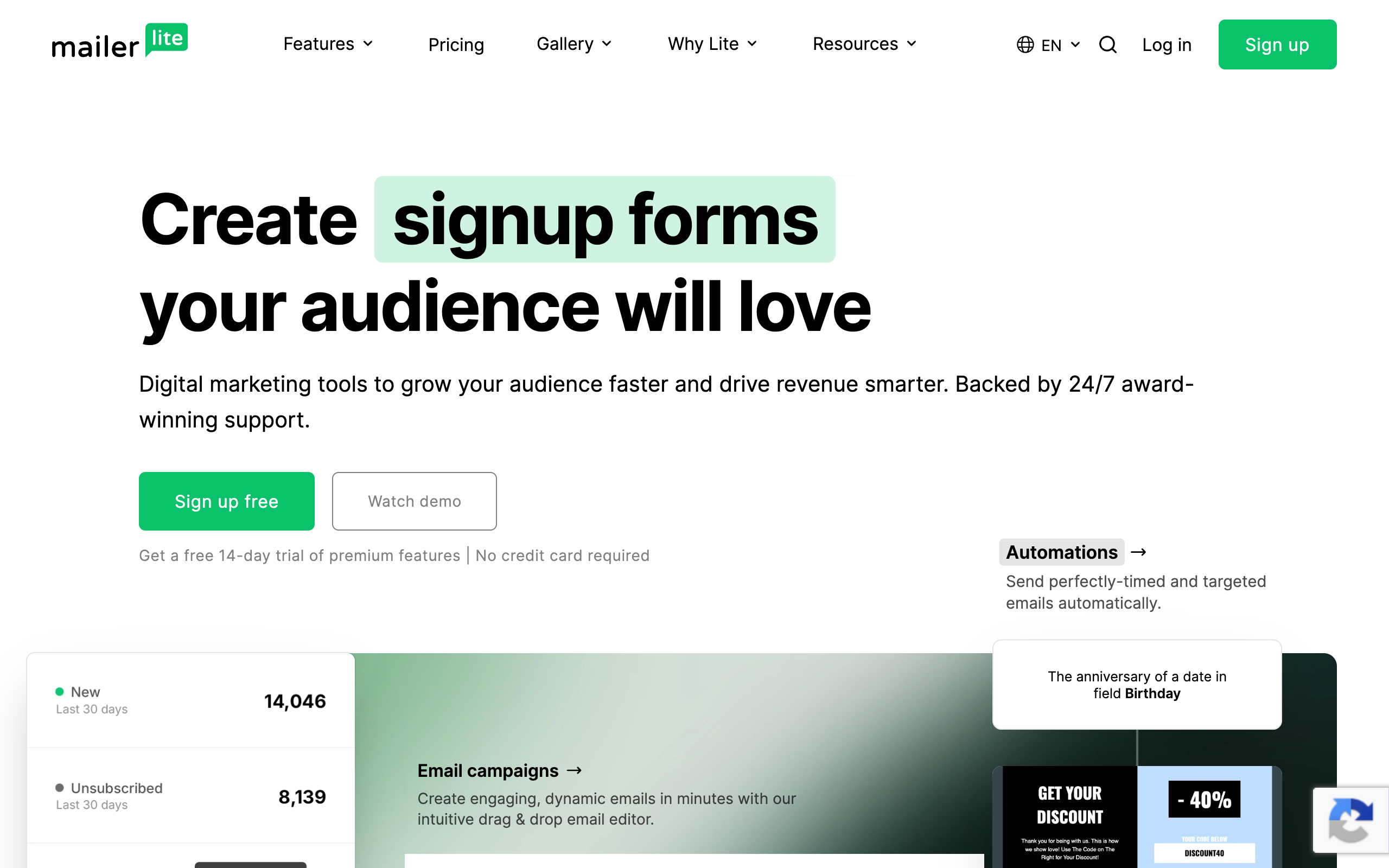
MailerLite is a Lithuania-founded email marketing platform launched in 2010, built around a simple premise that has held for over a decade: email marketing tools do not need to be complicated to be effective, and most small senders are better served by a clean, fast tool than a feature-bloated one they will only use 20% of. That philosophy shows up everywhere in the product, from the pricing page (four plans, no confusing add-ons) to the editor itself, which strips away the clutter that platforms like Mailchimp have accumulated over years of feature creep.
The target user is anyone sending email on a budget who does not yet need (or want to pay for) deep automation, advanced segmentation, or growth marketplaces: small businesses, solo creators just starting a newsletter, bloggers, local shops, and anyone testing whether email marketing is worth investing in before committing serious budget to it. MailerLite is also popular with technically comfortable users who want a lot of functionality (websites, landing pages, digital products, automations) bundled into one low-cost tool rather than paying for five separate services.
Where MailerLite genuinely wins
The free plan is actually usable, not a bait-and-switch trial
MailerLite’s free plan covers up to 250 active subscribers and 2,500 emails a month, with two user seats, basic visual automations (up to 3 active automations with up to 5 steps each), one website, one landing page, three signup forms, a single digital product or booking slot, campaign A/B testing, access to 100-plus integrations, and performance reporting. That is a real, permanent free tier, not a 14-day trial dressed up as one. In my testing, I built a functioning welcome sequence and a signup form entirely on the free plan without hitting a paywall mid-task, which is more than I can say for some “free” tiers in this category that gate basic automation behind the first paid plan.
The editor is clean and genuinely fast to work in
MailerLite offers three editing modes: drag-and-drop, a simpler block editor, and custom HTML for anyone who wants full control. The drag-and-drop editor in particular felt noticeably lighter and faster than Mailchimp’s equivalent in my side-by-side testing, with fewer clicks to get a clean campaign built and less visual clutter competing for attention while you write. For a solo operator sending a weekly newsletter, that speed adds up over a year of sends in a way that is easy to underrate until you have used a slower tool for a while.
Automation is simple but genuinely functional
The free plan’s automation is capped at 3 active automations and 5 steps each, which sounds thin until you realize most small newsletters only need one real automation: the welcome sequence. On paid plans, MailerLite expands to 50 active automations on Comfort and effectively unlimited campaigns and automations with up to 100 steps on Power, plus multiple trigger types and ecommerce triggers for stores that need cart-abandonment-style flows. It will not match Kit’s tag-based branching logic or ActiveCampaign’s automation maps, but for the automations a typical small newsletter or small business actually runs (welcome series, post-purchase follow-up, simple re-engagement), it does the job cleanly.
Websites, landing pages, and digital products are bundled in
MailerLite includes a basic website builder and landing page tool starting on the free plan (one of each), expanding to 10 on Comfort and unlimited on Power. It also supports selling a digital product or booking directly, without a separate commerce platform. For a creator just starting out who does not yet want to pay for Squarespace plus ConvertKit plus a booking tool separately, having a passable version of all three bundled into one low-cost subscription is a genuine value proposition, even though none of the individual pieces will outperform a dedicated tool at scale.
Pricing scales gently and predictably
MailerLite’s paid tiers price against subscriber count, but the bands are wide and the jumps feel proportionate rather than punishing. Comfort’s send allowance scales at roughly ten times your subscriber tier ceiling each month, which is generous headroom for anyone sending more than a single weekly campaign, and annual billing knocks a further discount off the monthly rate on every paid tier. Compared with steeper tier cliffs elsewhere in this category, MailerLite’s curve is one of the gentler ones to grow along.
MailerLite is a strong choice if sending clean email cheaply is the whole job. If you also need built-in growth tooling (referrals, a recommendation marketplace, sponsorships), that is a different job, and worth testing directly. Set up a free beehiiv publication and compare the two; the free plan runs to 2,500 subscribers with no card required.
Where MailerLite falls short
No growth tooling at all
MailerLite has no native referral program, no recommendation marketplace, and no ad network. There is nothing in the product that helps you find new subscribers beyond your own forms and landing pages. That is consistent with MailerLite’s whole philosophy (keep the tool simple, let you bring your own growth channel), but it means if audience growth is your open problem rather than sending mechanics, MailerLite gives you nothing to work with there. beehiiv’s entire product thesis is the opposite of this, and I lay out that contrast in detail in beehiiv vs MailerLite.
Automation and segmentation have a real ceiling
Even on the top Power plan, MailerLite’s automation tops out at 100 steps per automation with multiple trigger types, which is a meaningful jump from the free plan but still shallower than what Kit, ActiveCampaign, or Klaviyo offer for genuinely complex multi-branch funnels. Segmentation is solid for basic behavioral splits (opened, clicked, purchased) but lacks the deep predictive and engagement-scoring layers that pricier platforms build their premium tiers around. For a small business or solo newsletter, this ceiling rarely gets hit. For anyone running intricate lifecycle marketing, it will.
Design templates feel a step behind the polish of pricier tools
MailerLite’s templates are clean and functional, but in my testing they did not feel as visually distinctive as what beehiiv or Ghost ship by default, or as customizable as a dedicated website builder. For a newsletter where email content matters more than visual branding, this is a non-issue. For a brand-forward business that wants every touchpoint to look distinctly like them without custom development, the templates can feel like a lowest-common-denominator starting point rather than a finished look.
Deliverability support is lighter at the free tier
Like most platforms in this category, dedicated IPs and deeper deliverability support live on the higher, Power-tier end, with 24/7 live chat support starting there too. Free and Comfort users get solid infrastructure but less hand-holding if something goes wrong with inbox placement. In my testing, sends landed reliably in the primary inbox at major providers, so this is a theoretical concern for most senders rather than a practical one, but large-list senders with revenue on the line should know dedicated IP support is a Power-tier feature, not a given at every tier.
Advanced features assume some comfort with the interface
The free-plan simplicity that makes MailerLite fast to start with becomes a slightly steeper learning curve once you dig into automation triggers, ecommerce integrations, and multivariate testing on Power. None of it is genuinely hard, but the jump from “send a campaign” to “build a real automated flow” asks a bit more patience than the marketing copy implies.
What does MailerLite cost in 2026?
Numbers from MailerLite’s live pricing page, captured July 2026. Subscriber-tier pricing applies to Comfort and Power; figures below are entry-tier rates.
| Plan | Price | What you actually get |
|---|---|---|
| Free | $0 | Up to 250 active subscribers, 2,500 emails/month, 2 users, 3 active automations (5 steps each), 1 website, 1 landing page, 3 signup forms, 1 digital product or booking, A/B testing, 100+ integrations, performance reports |
| Comfort | Starting around $12/mo | Everything in Free, plus unlimited templates, 50 active automations, 10 websites and landing pages, 10 signup forms, 5 digital products/bookings, AI writing assistant, smart sending, multivariate testing, subscriber preference center, branding removed, 3 users, 24/7 email support |
| Power | Starting around $25/mo | Everything in Comfort, plus unlimited subscribers, unlimited sends (fair use policy), unlimited campaigns, automations, forms, landing pages, websites, and digital products, 100 automation steps, multiple triggers, ecommerce triggers, RSS campaigns, auto-resend, dedicated IP option, unlimited users, 24/7 live chat support |
| Enterprise | Custom pricing | For 200,000+ active subscribers, custom send volume, dedicated success manager, onboarding and training, account audits, deliverability support, priority support |
Both Comfort and Power’s entry prices are quoted for the smallest paid subscriber band; like beehiiv and Kit, the actual bill climbs as your list grows, so check MailerLite’s own calculator against your real subscriber count before budgeting. Annual billing saves roughly 10% off the monthly rate across paid plans, per MailerLite’s pricing page. The jump from Comfort to Power is worth noting for a different reason than most upgrade decisions in this category: Power’s headline feature is not more automation depth, it is removing the subscriber and send caps entirely and adding a dedicated IP option, which matters far more to a fast-growing list than to someone comfortably settled under Comfort’s ceiling.
How does MailerLite compare with beehiiv and Mailchimp?
MailerLite vs beehiiv is budget-and-simplicity versus growth-and-monetization. MailerLite is cheaper at every comparable tier and easier to pick up on day one, but it has no referral program, no Boosts-style marketplace, and no ad network, and its website builder is not built to double as an SEO-indexable publishing platform the way beehiiv’s is. I cover exactly what beehiiv’s growth tooling looks like in practice, after actually running a publication on it, in my full beehiiv review. If you are sending a straightforward email newsletter on a tight budget, MailerLite. If growing an audience through referrals, discovery, and sponsorships is core to your plan, beehiiv’s higher price buys real infrastructure MailerLite does not have. Full comparison in beehiiv vs MailerLite.
Worth naming plainly since it comes up in every comparison thread: MailerLite is not a worse version of beehiiv at a lower price, and beehiiv is not a bloated version of MailerLite at a higher price. They are built for different jobs. MailerLite’s whole product exists to make sending email as frictionless and cheap as possible, and it succeeds at that job better than almost anything else in the category. beehiiv’s whole product exists to make growing a newsletter into a real business easier, and sending is almost a secondary concern to the growth machinery wrapped around it. Picking between them by feature-count alone misses the point; picking by which job you actually need done gets you to the right answer fast.
MailerLite vs Mailchimp is a much closer fight on paper (both are general email tools with ecommerce leanings) but MailerLite wins on value at almost every comparable price point. Mailchimp’s free plan caps at 500 contacts and 1,000 sends a month and famously counts unsubscribed contacts toward your limit; MailerLite’s free plan, while capped at fewer subscribers, does not carry that unsubscribe-counting quirk and includes automation MailerLite historically gated less aggressively than Mailchimp did at comparable price points. For a small business choosing between the two on pure cost-to-feature ratio, MailerLite generally comes out ahead unless you specifically need Mailchimp’s deeper ecommerce integrations. I go feature-by-feature in MailerLite vs Mailchimp, and for the full category view, my ranking of the best newsletter platforms places both in context alongside beehiiv, Kit, and Ghost. For beehiiv’s own pricing in the same level of detail as the table above, see the beehiiv pricing breakdown.
Who should NOT use MailerLite?
- Newsletter operators whose main goal is fast audience growth. No referral program, no recommendation marketplace, no ad network. You are bringing your own growth channel entirely.
- Businesses running complex, tag-based automation funnels. MailerLite’s 100-step ceiling on Power is generous for a budget tool but will frustrate anyone used to Kit, ActiveCampaign, or Klaviyo’s deeper logic.
- Brand-forward businesses that need highly distinctive design out of the box. The templates are clean but not especially customizable without extra effort; a platform like Ghost gives more design control at a comparable price.
- Writers planning to charge for paid subscriptions as the core business model. MailerLite is not built around paid membership the way Ghost or beehiiv are; digital product and booking sales are supported, but recurring paid-subscriber newsletter monetization is not the product’s focus.
If any of those describe you, my guide to MailerLite alternatives covers the best specific pick for each scenario.
Frequently asked questions
Is MailerLite worth it in 2026? For beginners, small businesses, and budget-conscious senders who want clean, reliable email sending without paying for growth tooling or deep automation they will not use, yes. The free plan is genuinely usable and paid plans stay affordable as you scale. It is a weaker fit if audience growth or complex automation funnels are core to your strategy.
Is MailerLite’s free plan actually free forever? Yes. It covers up to 250 active subscribers and 2,500 emails a month indefinitely, with no time limit and no credit card required to sign up, and includes basic automation, forms, a website, and a landing page.
How much does MailerLite cost per month? The free plan costs $0. Comfort starts around $12/month and Power starts around $25/month, both at the entry subscriber tier; the price increases as your subscriber count grows, so confirm the rate for your list size on MailerLite’s pricing page. Annual billing saves roughly 10% off the monthly rate.
Is MailerLite better than Mailchimp? For most small senders on a budget, yes, largely on value: MailerLite’s automation and features come at a lower comparable price, and its free plan does not penalize you for unsubscribed contacts the way Mailchimp’s historically has. Mailchimp still has an edge in deep ecommerce integrations for larger online stores.
Does MailerLite have a referral program or growth tools like beehiiv? No. MailerLite has no native referral program, recommendation marketplace, or ad network. It is built to send email affordably and cleanly, not to help you acquire new subscribers, which is the core differentiator versus beehiiv.
Can I sell digital products on MailerLite? Yes. The free plan supports one digital product or booking; Comfort expands to five, and Power supports unlimited digital products and bookings, all without needing a separate ecommerce platform.
The bottom line: my verdict after running it
MailerLite does one thing extremely well and does not pretend to do the things it does not: sending clean, well-designed email affordably, with just enough automation and just enough bundled tooling (websites, landing pages, digital products) to cover a small operation’s real needs without upselling features most senders will never touch. The free plan is one of the few in this category that is genuinely usable rather than a taste-test for the paid tiers, and the pricing curve stays gentle as you grow.
The missing star is the same story as Ghost’s, from the opposite direction: MailerLite will send your email beautifully, but it will not help you find the people to send it to. If you already have a growth channel, or you are early enough that the free tier’s headroom is all you need for now, MailerLite is a genuinely smart pick. If growth infrastructure is the thing standing between you and a bigger list, that is a different product, and worth testing before you build a year of workflow around a tool that will not solve it.
Want to compare MailerLite’s simplicity against a platform built around growth from day one? Start a free beehiiv publication and send one real issue. Free to 2,500 subscribers, no card required, so the comparison costs you an evening, not a commitment.
Pricing captured from vendor pricing pages, July 2026. Plans change, so confirm current details before you buy.


