

I gave Manus a genuinely open-ended brief: research a competitor’s recent pricing changes and turn the findings into a slide deck I could actually present. It went off, browsed on its own, and came back with a deck that was better than what most people would produce in a first afternoon of manual research. That part is real and worth saying plainly before the rest of this review gets into the parts that frustrated me. The parts that frustrated me were the credit meter and, on a second and more complex task a few days later, watching a multi-step job derail halfway through and burn credits on a run I ended up throwing away.
Disclosure: some links in this post are affiliate links. If you sign up through them, we may earn a commission at no extra cost to you. That never changes our verdict.
Short answer

Manus is a general-purpose autonomous AI agent, now operating under Meta after its 2026 acquisition, built to take a loose goal and run with it largely unsupervised: researching a topic, browsing the web, building a simple website or slide deck, generating images. It genuinely delivers on open-ended, self-contained tasks. What it does not do reliably is touch your actual business systems, and its credit-based billing is the single most common complaint from real users, with unpredictable burn rates and reports of tasks failing mid-run without a refund. If your work is mostly solo research and first drafts, it is worth trying. If you need something that plugs into Stripe, Salesforce, or your ad accounts and delivers where your team already works, that is a different job.
If you want to see the difference on the exact same kind of task, try Viktor’s free $100 in credits and give it something that needs your real business data, not just the open web. No card required.
What Manus actually is
Manus positions itself around the idea of “less structure, more intelligence”: you describe a goal in plain language and it plans and executes the steps on its own, mostly inside its own sandboxed workspace rather than plugging into the tools your company already runs on. Its browser operator lets it navigate and interact with live websites the way a person would, filling forms, extracting data, following links. A feature it calls Wide Research is built specifically for broad information gathering, synthesizing across many sources into one coherent output instead of a single search-and-summarize pass. Beyond research, Manus can generate slide decks, simple websites, images, and music, and it offers an API and SSO for teams that want to build on top of it or roll it out more formally.
The company was acquired by Meta in 2026, a fact Manus now states plainly on its own site (“Manus is now part of Meta”), which is worth knowing both for where the product is likely headed and for how its pricing and infrastructure decisions may shift going forward.
Where Manus genuinely wins
Real autonomy on open-ended tasks
This is Manus’s strongest claim and it holds up in practice. Give it a goal with real ambiguity, “research this space and tell me what I’m missing,” and it does not ask for a rigid step-by-step brief the way a lot of agent tools quietly expect. It plans its own approach and executes it, which is genuinely useful for research, first-draft content, and exploratory work where you don’t yet know exactly what the finished thing should look like.
Browsing and research depth
The browser operator and Wide Research combination are legitimately strong for gathering current information from the open web and synthesizing it into something coherent, rather than working only from a model’s training data. For competitive research, market sizing, or a first-pass literature review, Manus produced results in my testing that were genuinely close to what a sharp junior analyst would hand back after a day of focused work, compressed into a fraction of the time.
Creative and self-contained generation in one place
Slides, simple websites, images, and music inside a single tool covers a broader creative surface than most agent products attempt, and it means a solo founder or freelancer can go from idea to a presentable first draft without switching between four separate tools.
Low friction to start
There’s very little to configure before you can use Manus. You describe a goal and it starts moving, which is a real advantage if what you want on day one is momentum rather than a setup phase.
Where Manus genuinely falls short
A review with no real downsides is an ad, and Manus has enough real ones that they deserve their own section, not a token paragraph.
Reliability on longer or more complex tasks is uneven
This is the complaint I hear most consistently from other users and the one I ran into myself. On a straightforward research-and-summarize task, Manus is genuinely strong. On a longer task with branching logic, multiple dependent steps, or anything that requires it to recover gracefully from an unexpected page layout or a dead end mid-browse, execution gets uneven. Tasks fail mid-stream, and because billing is credit-based, that failure still costs you the credits already spent getting partway there.
The credit system is genuinely opaque, and it is the top complaint for a reason
Manus runs on a credit system where cost scales with task complexity, simple questions running roughly 10 to 50 credits and complex, multi-step tasks running into the hundreds or low thousands. Reported plans put the entry paid tier, often called Standard, around $20 a month for roughly 4,000 credits, which sounds workable until you do the math most reviews skip: real users report that allotment covering as few as four or five genuinely complex tasks in a month, not the twenty or thirty a casual buyer might assume from the sticker price. The number one complaint across independent review sites and user forums is exactly this, credits disappearing faster than expected, with billing surprises coming up again and again in user discussions.
Failed tasks don’t get refunded, and support complaints follow from that
Because credits are consumed as a task runs rather than only on successful completion, a task that fails partway through still costs you the credits it burned getting there. Independent reviews and user complaints describe support responses to billing disputes as often templated, with refunds that reportedly do not materialize in many cases. I want to be careful here since this is reported user sentiment rather than something I can verify as company policy, but the volume and consistency of these complaints across multiple independent sources is enough that it belongs in an honest review, not left out because it’s uncomfortable.
It mostly does not touch your real business systems
Manus operates largely inside its own sandbox. It can browse the open web and interact with public sites, but it is not built to connect to your company’s Stripe account, your CRM, or your internal databases the way a business-focused agent is. If the task requires pulling your actual numbers rather than researching a topic from public sources, Manus is the wrong tool for that job by design, not by accident.
Team plans lean per-seat
Current reporting on Manus’s team offering points to per-seat pricing with each member getting their own allocation, rather than a shared workspace pool. That scales cost roughly linearly with headcount regardless of how evenly the team actually uses the tool, a meaningfully different economics than a shared credit pool.
A closer look at where the reliability actually breaks down
It’s worth being specific rather than just saying “reliability is uneven,” because that phrase alone doesn’t tell you anything useful for deciding whether to trust it with real work. In my own testing, single-step and two-step tasks, “research this and summarize it,” “find these five data points and put them in a table,” ran cleanly almost every time. The failures showed up once a task needed Manus to make a judgment call partway through and adjust its own plan: a page that didn’t load the way it expected, a source that turned out to be paywalled after it had already committed to pulling from it, a research task where the right next step depended on what it found in step three rather than being knowable up front. That is exactly the kind of branching, adaptive work that separates a genuinely reliable agent from one that is impressive on the happy path and brittle off it, and it lines up with what independent reviewers and Trustpilot users report about peak-hour reliability and complex workflows derailing.
The practical takeaway: if the task you’re handing Manus is a single clear ask with a predictable path to the answer, it performs close to as well as its demos suggest. If the task has real branches, dependencies on earlier findings, or needs to recover gracefully from something unexpected on the open web, budget for the possibility that a run fails partway through, and remember that failure still costs the credits already spent getting there.
What does Manus cost?
Manus does not publish a fully detailed pricing breakdown on its public pricing page as of this writing, and the structure has shifted since Meta’s acquisition, so treat the numbers below as reported and approximate, not confirmed.
| Plan | Reported price | What you get |
|---|---|---|
| Free | $0 | Limited daily credit refresh, plus a one-time starter credit pack for new users |
| Standard (individual) | Reportedly around $20/mo | Roughly 4,000 credits a month, enough for 20 to 40 moderate tasks or around 4 to 5 complex ones |
| Higher individual tier | Reportedly around $39 and up/mo | Larger monthly credit allotment for heavier individual use |
| Team | Per seat, reported structure | Each member gets an individual allocation rather than a shared pool |
Verify current tiers directly on Manus’s live pricing page before budgeting, since Meta has continued adjusting the structure and public reporting on exact figures is inconsistent across sources.
Who Manus is genuinely built for
- Solo researchers, founders, and freelancers who need open-ended research, first-draft content, or a simple self-contained build (a landing page, a slide deck) without needing it to touch company systems.
- Anyone who wants an agent that starts working immediately with almost no setup or integration to configure first.
- Light, occasional users who won’t push past a handful of complex tasks a month, where the entry tier’s credit allotment is less likely to feel constraining.
Who should look elsewhere
- Teams that need an agent to pull real data from business tools like Stripe, Salesforce, Google Ads, or an internal database rather than research from the open web.
- Anyone whose work involves longer, multi-step tasks with real dependencies, where Manus’s reliability on complex runs has been genuinely inconsistent in independent testing and user reports.
- Finance-conscious teams that need predictable monthly spend rather than a credit system with a track record of user complaints about unexpected burn and non-refunded failed tasks.
- Teams, not just individuals, who want a shared workspace pool instead of per-seat credit allocations.
The Slack-native alternative for business work
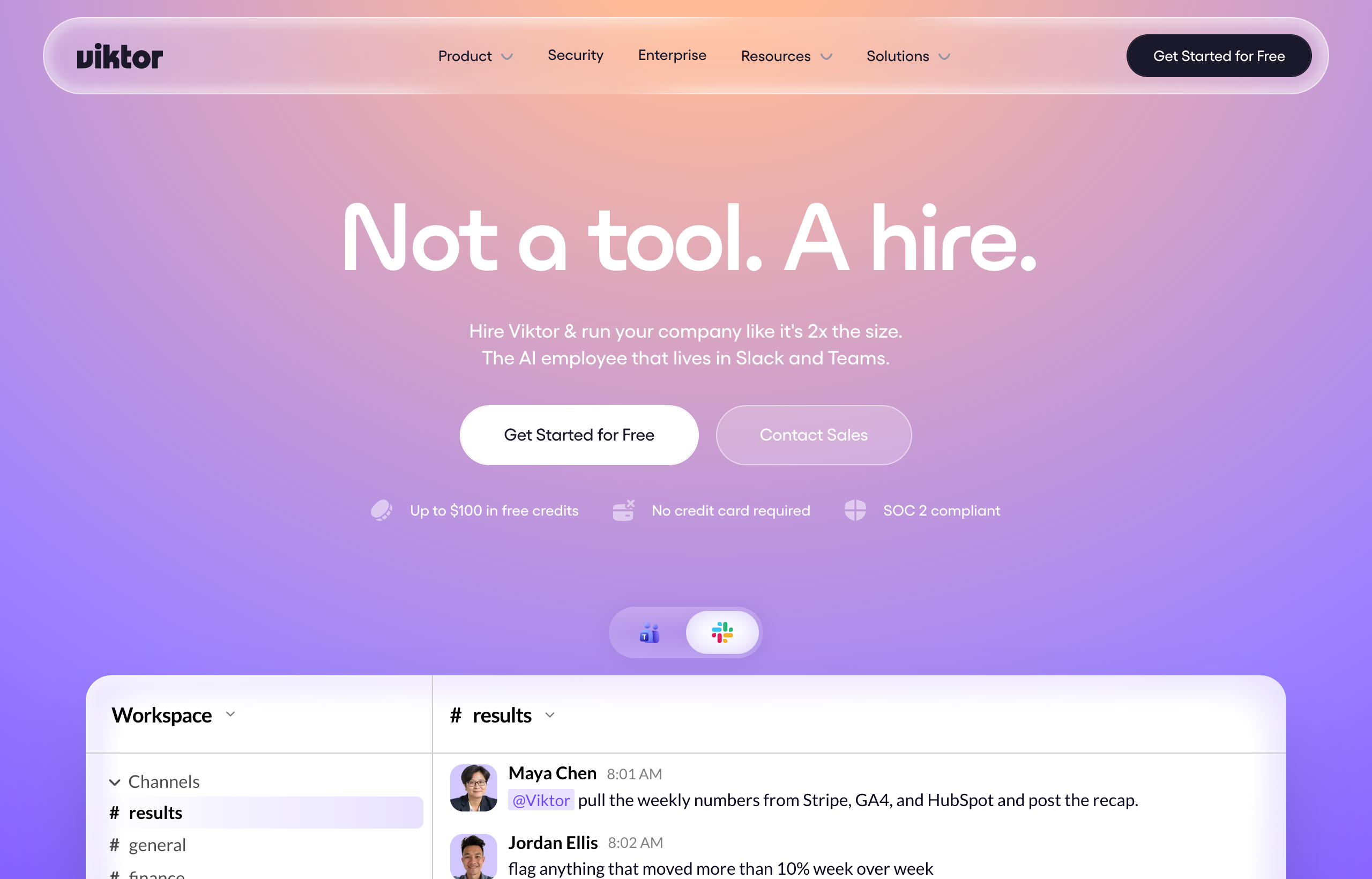
This is the gap Viktor is built to close, and it is a genuinely different shape of tool, not a cheaper Manus. Viktor lives inside the Slack channel or Microsoft Teams chat your team already uses, and instead of working in its own sandbox, it connects directly to more than 3,200 real business tools, Stripe, Notion, HubSpot, Salesforce, Google Ads, Meta Ads, GitHub, Google Drive, and more, pulling actual live data rather than researching from the public web. You brief it like a coworker, and it goes and executes: assembling reports and dashboards from real numbers, building and deploying a small web app with a working database and login, writing code and opening a pull request, or setting up a recurring automation that runs on its own from then on. The output lands back in the same Slack thread your team already reads, not a separate app someone has to remember to check.
Pricing is public and self-serve: a free trial with $100 in credits, no card required, then workspace-wide credit tiers starting around $50 a month for 20,000 credits, with no per-seat charge, so the whole team draws from one pool instead of each person needing their own allocation. To be fair in the same way this review was fair to Manus’s downsides: Viktor’s credit billing carries its own real tradeoff, quick tasks run roughly 100 to a few hundred credits while a full project can run 2,000 to 5,000, and real active teams commonly land closer to $300 to $750 a month once genuine usage kicks in, well above the $50 headline. Neither tool’s credit model is a free lunch; the difference is what the credits are actually being spent to do.
The fastest honest comparison is running the same task through both. Start with Viktor’s free trial and hand it something that needs your company’s real numbers, not the open web, and see what comes back.
For more depth, our direct Viktor vs Manus comparison runs three real briefs through both tools side by side, our full Viktor review covers the hands-on details on Viktor specifically, and our best autonomous AI agents roundup places both tools in the wider category.
Frequently asked questions
Is Manus worth paying for in 2026?
For solo, open-ended work like research or first-draft content, yes, the free and entry tiers are enough to evaluate it honestly. For business tasks that need your company’s real data or for anything with complex multi-step dependencies, its reliability and credit unpredictability are real risks worth weighing first.
What is Manus’s biggest weakness?
Credit-based billing that is genuinely opaque and, according to widespread independent reports, the single most common source of user complaints, combined with uneven reliability on longer, more complex tasks and failed runs that consume credits without a refund.
Does Manus connect to business tools like Stripe or Salesforce?
Not natively in the way a business-focused agent does. Manus operates largely inside its own sandbox with web browsing capability, rather than connecting directly to a company’s CRM, billing system, or ad accounts.
How much does Manus actually cost per month?
Reported pricing puts the entry paid tier around $20 a month for roughly 4,000 credits, though real users report that covering only 4 to 5 genuinely complex tasks. Verify current figures on Manus’s live pricing page, since the structure has shifted since Meta’s 2026 acquisition.
What should I use instead of Manus for team business work?
An AI employee built for business tools rather than open-web research, like Viktor, which lives in Slack or Teams and connects to more than 3,200 real integrations to execute tasks against your actual company data.
The bottom line
Manus is genuinely good at what it was built for: give it an open-ended, self-contained brief and it will run with real autonomy and often impressive results. The credit system’s unpredictability and the reliability gap on longer tasks are not minor nitpicks, they are the two things that came up most in my own testing and in independent user reports, and they are worth weighing seriously before you commit budget to a heavier plan. For business work that needs to touch your company’s actual systems and land in front of your whole team, it is simply not the tool it was built to be, and that gap is where something like Viktor picks up.
Try Viktor’s free $100 in credits, no card required, and give it a task that needs your company’s real numbers this week. You’ll know quickly whether execution against your actual tools is the gap you have.
Pricing figures for Manus are reported and approximate, based on public sources current as of July 2026, since Manus does not publish a fully detailed pricing breakdown. Confirm current numbers on Manus’s live pricing page before budgeting.


