

Zapier launched Agents as its answer to a question every automation company got asked constantly in 2025: what happens when the trigger itself is fuzzy. A Zap still needs a defined event and a defined action. An “agent” is supposed to handle the part in between, deciding what to do with information that does not arrive in a clean, structured shape. I tested Zapier Agents the same week I ran Viktor through a batch of real Slack tasks, and the honest takeaway is that Zapier built a genuinely useful feature bolted onto its existing platform, while Viktor built the platform around being an agent from day one. That difference in starting point shows up in almost everything below.
Both products get lumped into “AI agents” comparisons, and both will happily use that language in their marketing. But they solve the problem from opposite directions: Zapier Agents adds agentic behavior to a workflow automation company’s existing app catalog and Zap engine. Viktor is a Slack-native AI employee first, with automation as one of many things it does. This is the direct comparison, with real 2026 pricing pulled from both companies’ live pricing pages, a fair look at what Zapier Agents does well, and an honest read on when each one is the better fit.
Disclosure: some links in this post are affiliate links. If you sign up through them, we may earn a commission at no extra cost to you. That never changes our verdict.
The 30-second verdict
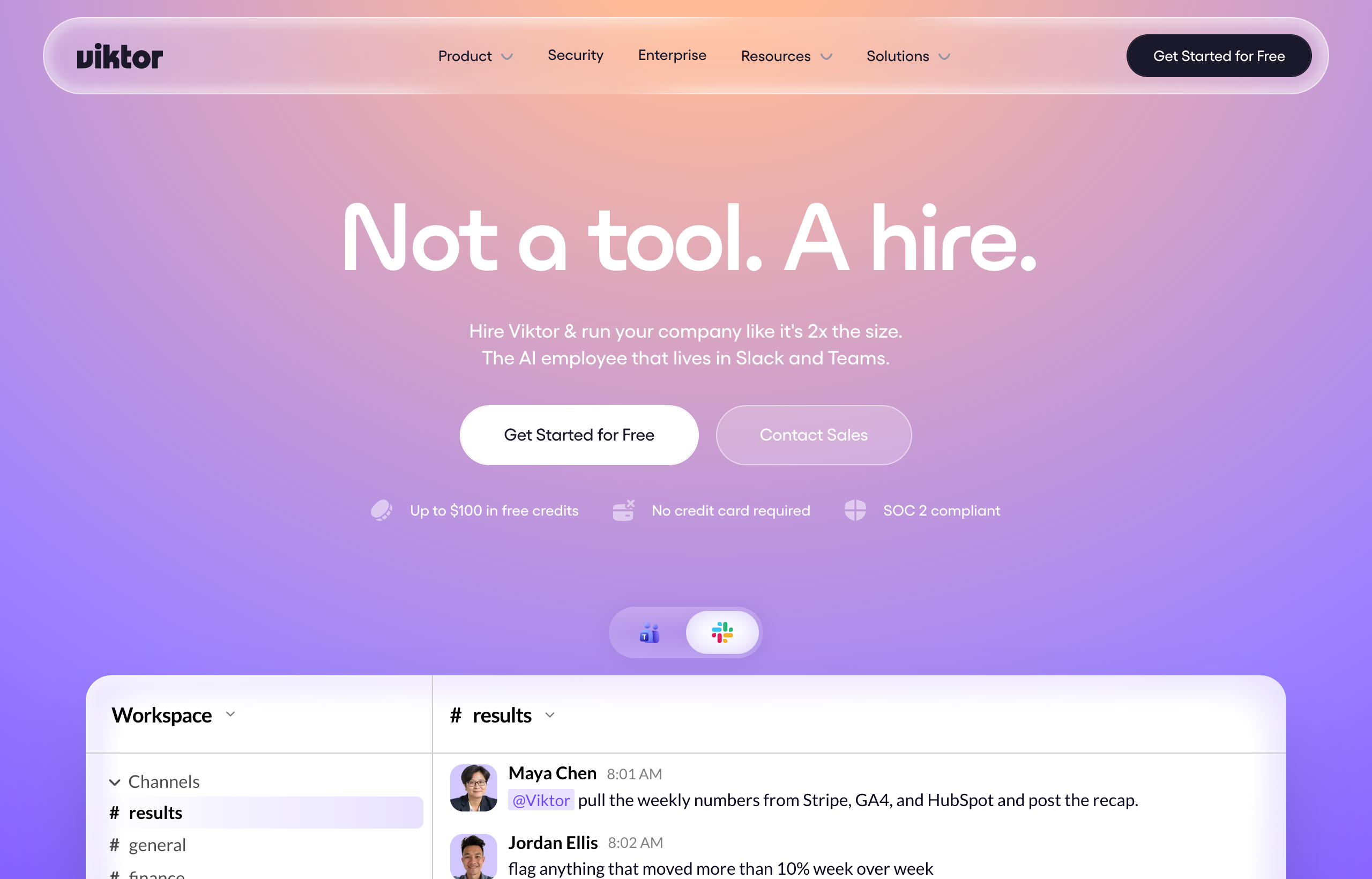
Zapier Agents is a genuinely useful, cheap way to add AI decision-making into workflows built on Zapier’s existing 7,000-plus app catalog, and if your operations already run on Zapier, it is worth trying before you look anywhere else. Viktor is a broader, Slack and Microsoft Teams-native AI employee that executes end-to-end work, from research to deployed code, without needing to live inside another platform’s automation model first. If your team already has Zaps built and just wants to add a layer of judgment on top, start with Zapier Agents, since it is nearly free to try. If you want a coworker you can hand an open-ended request to and get a finished deliverable back, without first thinking in terms of Zapier’s activities and flows, Viktor is the more direct fit.
- Zapier Agents is a separate product from Zapier’s core automation plans, priced on its own activity-based tiers, with a genuinely free forever tier. Viktor is priced on workspace-wide credits with a $100 free trial.
- Zapier Agents lives inside the Zapier ecosystem: it is strongest when paired with the Zaps and apps you already have connected. Viktor lives inside Slack or Teams and does not require any prior automation setup.
- Zapier Agents can browse the web and pull from live data sources as part of a flow. Viktor does that plus builds and deploys full applications, writes and opens pull requests, and assembles complete reports, a wider scope of finished output.
- Zapier Agents is the newer of the two products by a meaningful margin, added on top of a mature automation platform. Viktor was built agent-first from the start.
If you already have a Zapier account and want the cheapest possible way to test agentic AI, it is worth comparing that against Viktor’s free $100 in credits on the same task, since neither one costs anything to try.
What Zapier Agents and Viktor actually are
Zapier Agents is Zapier’s dedicated AI agent product, built on top of the same automation platform that powers Zaps. Rather than a rigid trigger-and-action sequence, an Agent can reason over live data, browse the web, and take actions across Zapier’s app catalog with more flexibility than a traditional Zap, while still operating inside Zapier’s world of connected apps and activities. Zapier positions it as a way to add an AI decision-maker into the processes you have already built, and any Zapier user can try Agents independently of their main platform subscription, which lowers the barrier to testing it.
Viktor takes a different shape entirely. It is an AI employee that lives inside a Slack channel or a Microsoft Teams chat, not a feature layered onto an existing automation product. You brief it in plain language and it goes and does the work: connecting to 3,200-plus tools (Stripe, Notion, Google Ads, Meta Ads, HubSpot, Salesforce, Linear, Jira, GitHub, Google Drive, and more), pulling and cross-referencing data, writing code and opening pull requests, building and deploying small web apps with a database and auth, assembling reports and dashboards, and scheduling its own recurring tasks. There is no separate agent-builder screen and no dependency on an existing automation platform. You do not need to already use Zapier, or anything like it, for Viktor to be useful on day one.
Who each one is actually built for
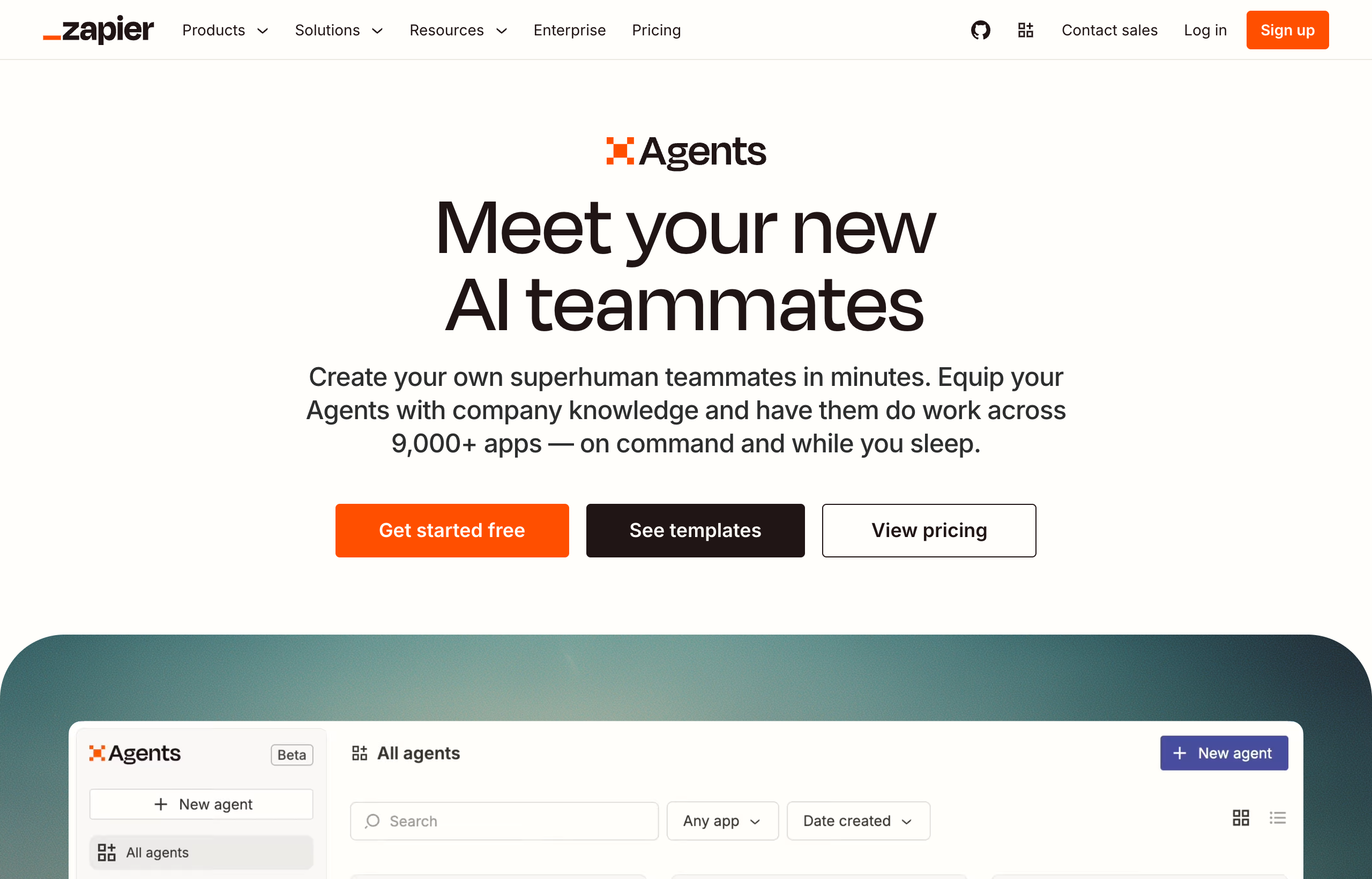
Zapier Agents makes the most sense for a team that already has meaningful Zapier infrastructure: existing Zaps, a familiarity with the app catalog, and a specific point in a process where a human is currently making a judgment call that could be handed to an AI layer instead. It is an upgrade to an existing workflow, not a new way of working.
Viktor makes the most sense for a team that wants an AI coworker as its own thing, independent of whatever automation platform it does or does not already use. A founder who has never touched Zapier can add Viktor to a Slack channel and get useful work done in the first session. It does not require existing automation infrastructure to be valuable; it is the infrastructure, in the sense that it is a full employee rather than a feature inside one.
| Category | Zapier Agents | Viktor |
|---|---|---|
| Core model | AI agent layer built on Zapier’s automation platform and app catalog | Standalone Slack/Teams-native AI employee, no platform dependency |
| Best fit | Teams that already run on Zapier and want to add AI judgment to existing flows | Any team that wants a general AI coworker, with or without existing automation |
| Where you work | Zapier’s web app, alongside Zaps and connected apps | Slack or Microsoft Teams, no separate app to check |
| Scope of output | Actions inside connected apps, live data lookups, web browsing | Full deliverables: deployed apps, code and pull requests, reports, dashboards, recurring tasks |
| App/tool coverage | Zapier’s app catalog, 7,000+ apps (per Zapier) | 3,200+ integrations (per Viktor) |
| Free tier | Forever free, 400 activities/month | $100 in trial credits, no card required, never expire |
| Entry paid tier | Around $33.33/month (billed annually at $400/year) for 1,500 activities/month | Around $50/month for 20,000 workspace-wide credits |
| Maturity | Newer product, added on top of an established automation platform | Agent-first product from launch |
Where Zapier Agents genuinely wins
Zapier Agents has one real structural advantage neither Viktor nor most standalone agent tools can match: it inherits Zapier’s app catalog and years of maintained integrations, more than 7,000 apps by Zapier’s count, without having to rebuild any of that connective tissue from scratch. If your team’s tools are already wired into Zapier, an Agent can act inside that existing web of connections on day one. It is also genuinely easy to start: any Zapier user can try Agents for free, independent of their core subscription, and the entry-level pricing is low, around $33 a month billed annually for 1,500 monthly activities, which is a low-risk way to test whether agentic AI earns a place in your stack before committing real budget.
The feature set is also legitimately useful for what it targets: live data sources and web browsing let an Agent pull current information into a flow rather than working only from what was true when a Zap was built, and Enterprise-tier organizational sharing means a company that has standardized on Zapier can roll Agents out the same way it rolled out Zaps. For a team whose whole operation is already Zapier-shaped, that continuity is worth something real, and I would not talk a Zapier-heavy team out of testing it first.
Where Viktor genuinely wins
The limitation baked into Zapier Agents is the same thing that makes it easy to adopt: it is still, at its core, an extension of Zapier’s world. When I tested Viktor against a task that had nothing to do with any existing automation, drafting a full investor update by pulling numbers from Stripe and comparing them against a HubSpot pipeline export, then formatting the result as a shareable document, it did not need me to have any prior Zaps built. I described the task in a Slack message and it produced a finished, formatted deliverable in the same thread. Zapier Agents, by contrast, is at its best acting inside a flow you have already designed; asking it to independently originate and complete a multi-system deliverable with no existing scaffolding is not really the job it was built for.
Viktor’s scope of output is also just wider. It writes and opens real pull requests against a codebase, builds and deploys small web applications with a working database and authentication, and assembles polished reports rather than performing actions inside a chain of connected apps. That is a materially bigger set of finished outputs than “look up live data and take an action,” which is roughly where Zapier Agents’ capability currently sits. And because Viktor lives directly in Slack or Teams rather than inside a separate automation platform’s dashboard, there is no context switch between having an idea and handing it off; you type it where your team already talks.
If you want to see the scope difference for yourself, give both the exact same open-ended task, something with no existing Zap or flow behind it, like “build me a one-page summary of this month’s ad performance across two platforms.” Viktor’s free trial credits make that a zero-cost comparison.
What do they actually cost in 2026?
Zapier Agents runs on its own activity-based pricing, separate from Zapier’s core automation plans. The Free tier is forever free with 400 activities a month, no time limit on the trial. The Pro tier costs $400 billed annually, which works out to around $33.33 a month, for 1,500 activities a month. Enterprise pricing is custom, with a custom number of monthly activities and organizational sharing, arranged through a sales conversation. It’s worth noting this pricing is separate from Zapier’s main automation plans (Free at $0 for 100 tasks a month, Professional from around $19.99 a month, Team from around $69 a month); if you want both the core Zaps and Agents, you are potentially paying for two separate products, or using the free tiers of each together.
Viktor’s pricing runs on credits rather than activities. The free trial gives $100 in credits with no card required, and those credits never expire. Paid team plans are workspace-wide instead of per seat: around $50 a month for 20,000 credits, around $75 for 30,000, around $100 for 40,000, and around $200 for 80,000. Small-company tiers scale from roughly 125,000 to 2,000,000 credits, priced from about $300 to $5,000 a month, with 300,000 credits at around $750 a month reported as the most popular tier. Enterprise pricing is custom, with reported tiers starting around $35,000 a month at the highest usage bands. Viktor says credits reflect actual model and tool cost with no added markup, and that a quick task tends to burn a couple hundred credits while a full project can run into the low thousands. Credits on paid plans reset monthly; trial credits persist.
| Plan | Zapier Agents | Viktor |
|---|---|---|
| Free | Forever free, 400 activities/month | $100 in trial credits, no card, never expire |
| Entry paid tier | Around $33.33/month (annual billing), 1,500 activities/month | Around $50/month for 20,000 workspace-wide credits |
| Growth tier | Not published between Pro and Enterprise | Around $750/month for 300,000 credits (most popular small-company tier) |
| Enterprise | Custom, contact sales | Custom, reported from around $35,000/month at the top end |
| Relationship to core platform | Separate product from Zapier’s automation plans, billed independently | Standalone product, no separate platform required |
The honest weaknesses (both sides)
Zapier Agents is, by its own newness, less proven than Zapier’s core automation product, and less proven than an agent-first product like Viktor at handling genuinely open-ended requests. Its natural habitat is still a flow, acting inside apps you have connected, rather than independently originating and completing a broad, undefined deliverable from scratch. Activity-based billing also carries the same unpredictability problem as any usage-based pricing: a heavier task consumes more of the monthly allotment, and 1,500 activities a month at the entry paid tier can go quickly for a team that starts leaning on it for real daily work rather than occasional lookups. And because it is tied to the Zapier ecosystem, teams that are not already Zapier users are adopting a second platform’s mental model just to use it.
Viktor’s honest weakness is the same one worth repeating in every comparison: credit-based billing is unpredictable in a way a flat-rate plan is not. Real users have reported burning through a large share of trial credits in the first couple of days while exploring, and monthly spend for an active team can land well above the entry $50 headline, sometimes several times that. Because credits track actual usage, a heavy task costs meaningfully more than a light one, and predicting a monthly bill takes a cycle or two of real use. Viktor also is not a visual flow builder; if what you actually want is to design a specific, inspectable sequence of steps inside apps you already use, Zapier’s underlying builder (with or without Agents layered on top) gives you a kind of structural control Viktor’s conversational model does not offer.
Who should pick Zapier Agents over Viktor
- Teams already deep in the Zapier ecosystem who want to add AI judgment to existing flows without adopting a new platform.
- Anyone testing agentic AI on a near-zero budget, since the free tier and low-cost Pro tier make it cheap to experiment.
- Processes that are mostly automation with one fuzzy decision point, where an agent only needs to handle a small piece of judgment inside an otherwise deterministic flow.
- Organizations standardizing on a single vendor for both automation and AI agent tooling.
Who should pick Viktor over Zapier Agents
- Teams that want a full AI coworker, not a feature inside another platform’s flows, that can originate and complete open-ended work.
- Anyone who lives in Slack or Microsoft Teams and wants to hand off a task without opening a separate automation dashboard.
- Teams without existing Zapier infrastructure who do not want to build automation scaffolding just to get value from an AI agent.
- Work that requires a broad range of finished outputs: deployed apps, code, pull requests, full reports, not just actions inside connected apps.
Frequently asked questions
Is Zapier Agents the same product as Zapier’s core automation plans?
No. Zapier Agents is billed on its own activity-based tiers, separate from the task-based pricing on Zapier’s Free, Professional, Team, and Enterprise automation plans. Any Zapier user can try Agents independently of their main subscription.
Does Viktor need Zapier or any automation platform to work?
No. Viktor is a standalone AI employee that connects directly to 3,200-plus tools and lives in Slack or Microsoft Teams. It does not require an existing Zapier account, Zaps, or any other automation platform to be useful from the first session.
Which is cheaper, Zapier Agents or Viktor?
At the entry level, Zapier Agents is cheaper on paper, with a genuinely free forever tier and a Pro tier around $33 a month for 1,500 activities. Viktor’s entry paid tier runs around $50 a month, though it also includes a larger free trial ($100 in credits) to test before paying anything.
Can Zapier Agents build and deploy an app the way Viktor does?
Not to the same extent. Zapier Agents is built to reason over live data, browse the web, and take actions inside Zapier’s connected app catalog. Viktor’s scope includes writing and opening code pull requests and building and deploying small web applications with a working database and auth, a broader range of finished outputs.
Should a team use both Zapier Agents and Viktor?
It can make sense, particularly for a team already invested in Zapier: use Zapier Agents to add judgment inside existing flows, and use Viktor for the broader category of open-ended requests that never had a flow to begin with.
The bottom line
Zapier Agents is Zapier extending a platform it already built extremely well, and for a team that lives inside that ecosystem, it is a legitimately cheap, low-risk way to add AI judgment to existing flows. Viktor is a different kind of product: an AI employee designed from the start to take an open-ended request and hand back a finished deliverable, with no dependency on any other platform being in place first. Neither claim cancels the other out; they answer different questions about what you actually need help with.
My honest read: if your team already runs on Zapier and the gap you’re trying to close is small, a single fuzzy decision inside an existing flow, try Agents first, since it costs next to nothing. If what you actually want is a coworker you can hand a genuinely open-ended project to and trust to come back with something finished, that is the job Viktor was built around.
Start with Viktor’s free $100 in credits and give it one real, undefined task this week. It costs nothing to find out whether you needed a flow at all, or just someone to ask.
For the full picture, see the standalone Zapier Agents review, the broader Viktor vs Zapier comparison covering Zapier’s core automation plans, the complete Viktor review, or the best AI agents in 2026 roundup for how both fit against the wider field.
Pricing captured directly from zapier.com/pricing and viktor.com/pricing, July 2026. Both companies change plans and limits regularly, so confirm current numbers before you budget against them.


