

I broke a Zapier flow last year by renaming a column in a Google Sheet. One word, one Zap, and a whole outbound sequence quietly stopped firing for four days before anyone noticed. That is not a knock on Zapier, it is just what deterministic automation is: powerful when the inputs stay exactly where you told it they would be, brittle the moment reality drifts. The week I started testing Viktor, I gave it a version of the same problem in plain English instead of a Zap, and it just asked a clarifying question and adjusted. That gap, between a tool that runs the flow you built and a tool that understands the goal you described, is the entire comparison in this article.
Zapier and Viktor get compared a lot because both promise to take work off your plate, but they are not really competing for the same job. Zapier is the reigning champion of “when X happens, do Y,” at massive scale, across thousands of apps. Viktor is an AI employee that lives in Slack and Microsoft Teams and does open-ended, one-off, or fuzzy work the moment you ask for it, no flow-building required. I have used both for real tasks, not just poked at the marketing pages, and this is the honest breakdown: what each one is actually good at, real 2026 pricing, and who should pick which.
Disclosure: some links in this post are affiliate links. If you sign up through them, we may earn a commission at no extra cost to you. That never changes our verdict.
The 30-second verdict
Zapier is still the best tool on the market for deterministic, trigger-based automation between apps: reliable, mature, and connected to a genuinely enormous catalog of software. Viktor is the better pick when the work does not fit neatly into “when this happens, do that,” when it is a one-off request, a judgment call, or a task that changes shape every time you ask for it. If you already have a Zap that works and just needs to keep running, Zapier is not the thing to replace. If you keep finding yourself needing something Zapier cannot express as a trigger and an action, that is exactly the gap Viktor was built to fill.
- Zapier connects a claimed 7,000-plus apps through a visual, node-by-node builder: you choose a trigger, add steps, and it runs the same way every time. Viktor connects to 3,200-plus tools and you brief it conversationally in Slack or Teams; there is no flow to design.
- Zapier is priced around a shared monthly task pool starting free at 100 tasks and scaling into paid tiers. Viktor is priced around workspace-wide credits that track actual usage, starting with a free $100 trial.
- Zapier is deterministic: the same trigger produces the same output every time, which is exactly what you want for invoicing, lead routing, or data syncing. Viktor is adaptive: it can handle a task it has never seen phrased that way before, which is exactly what you want for research, reporting, or anything that needs judgment.
- Neither replaces the other cleanly. Many teams that use Viktor well still keep their reliable Zaps running in the background; Viktor is not trying to rebuild your invoicing pipeline, it is trying to be the person you’d hand a messy, undefined request to.
If you have a task this week that does not cleanly fit into a Zapier trigger, something you’d normally type into a Slack message and hope a teammate has time for, I would try it on Viktor’s free $100 in credits before assuming you need to build anything.
What Zapier and Viktor actually are
Zapier is workflow automation software. You pick a trigger app and event (a new row in a spreadsheet, a new Stripe payment, a form submission), then chain one or more action steps across other apps (send a Slack message, create a Notion page, update a CRM record). Every step is something you configure by hand in a visual builder: which field maps to which field, what filters apply, what happens on an error. Once it’s built and turned on, it runs the same deterministic path every single time the trigger fires, at whatever scale you need, across a catalog Zapier says covers more than 7,000 apps. That reliability at scale is the entire value proposition, and it is a real one: for well-defined, repeatable processes, nothing beats a system built to do exactly one thing, correctly, every time.
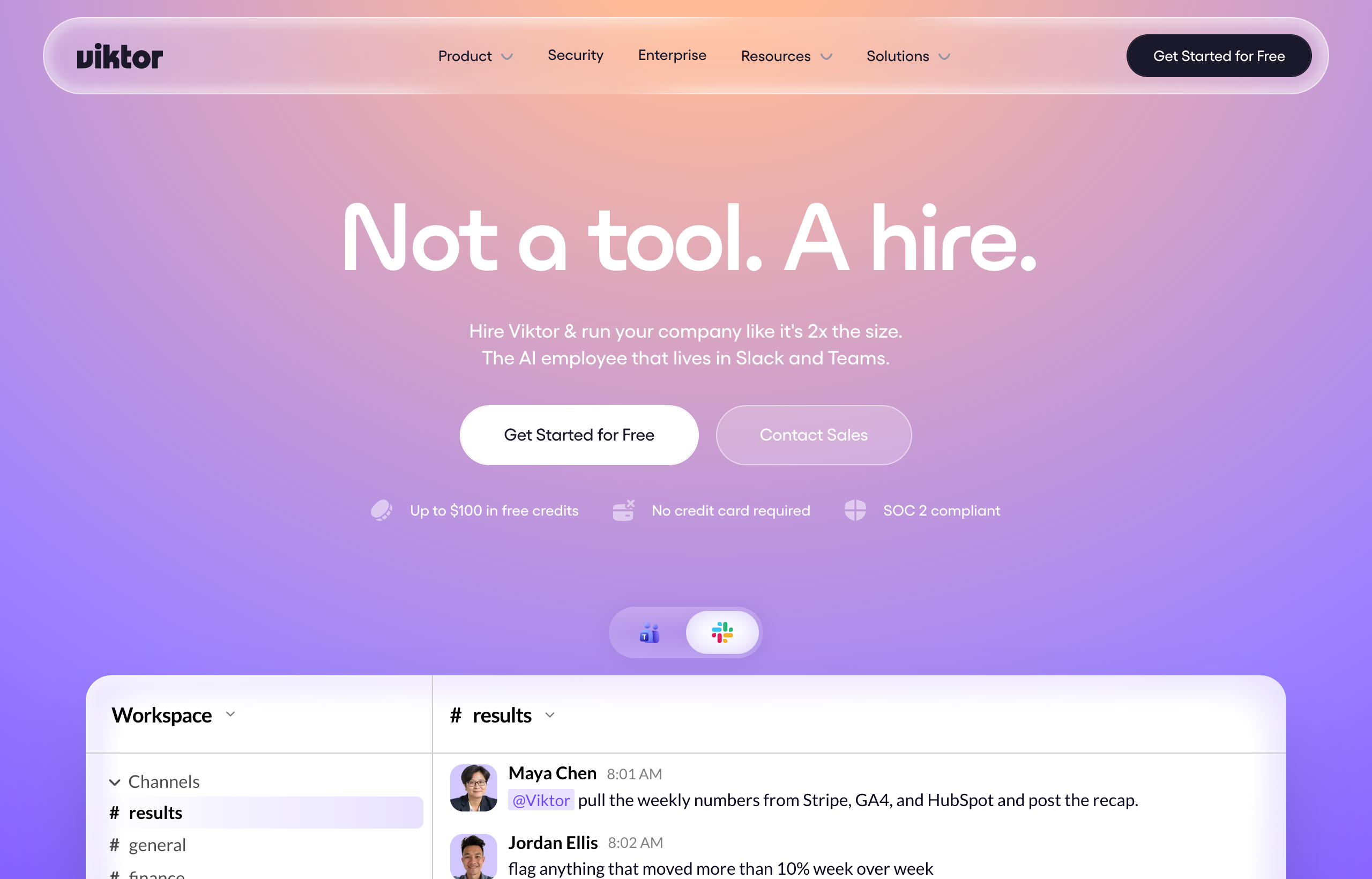
Viktor takes a different starting point entirely. It is an AI employee that lives inside a Slack channel or a Microsoft Teams chat, not a flow you build in advance. You describe a task in plain language, the same way you’d brief a new hire, and Viktor goes and does it: pulling data from connected tools (Stripe, Notion, Google Ads, Meta Ads, HubSpot, Salesforce, Linear, Jira, GitHub, Google Drive, and more, across 3,200-plus integrations), writing code and opening pull requests, building and deploying small web apps with a database and auth, assembling reports and dashboards, and setting up its own recurring tasks when that makes sense. There is no builder screen, no trigger to configure, no flow diagram. You ask, it works, it reports back in the thread.
Who each one is actually built for

Zapier’s ideal user already knows exactly what should happen and just needs it to happen reliably, forever, without a human in the loop. Think: a new lead in a form should always create a CRM record and always notify sales in Slack. That process does not change shape from one instance to the next, and that consistency is precisely what a Zap is good at guaranteeing. Ops teams, RevOps, and anyone standardizing a repeatable process across a growing team lean on Zapier because “it works the same way every time” is the feature.
Viktor’s ideal user has work that changes shape constantly: a founder who needs a different investor-update angle each month, a marketer who needs an ad account audited today and a competitor teardown tomorrow, an ops lead who needs a one-off report built from three systems that have never been queried together before. None of that fits a trigger-and-action model, because there is no repeatable trigger, just a request. Viktor is built for the “can someone just handle this” category of work that most teams currently either do manually or don’t do at all.
| Category | Zapier | Viktor |
|---|---|---|
| Core model | Visual, trigger-based workflow automation you build node by node | Conversational AI employee you brief in Slack/Teams, no flow to build |
| Best at | Repeatable, deterministic processes at scale | One-off, fuzzy, or novel tasks that need judgment |
| Where you work | Zapier’s own web app and flow builder | Slack or Microsoft Teams, where your team already is |
| App/tool coverage | 7,000+ apps (per Zapier) | 3,200+ integrations (per Viktor) |
| Setup for a new task | Build or edit a Zap: choose trigger, map fields, add filters, test | Type a request in Slack; no configuration step |
| Consistency | Deterministic, same output every time a trigger fires | Adaptive, judgment-based, can vary with context |
| Free tier | Free forever, 100 tasks/month | $100 in trial credits, no card required, credits don’t expire |
| Entry paid tier | Professional from around $19.99/month | Around $50/month for 20,000 workspace-wide credits |
| Pricing model | Shared monthly task pool, scales from 100 to 2,000,000+ tasks | Workspace-wide credits based on actual usage, no per-seat charge |
Where Zapier genuinely wins
Give Zapier its due: for the job it was built for, it is genuinely excellent, and I would not talk anyone out of it for the right use case. The app catalog is the biggest practical advantage, more than 7,000 apps by Zapier’s own count, which means there is almost never a tool in your stack Zapier cannot touch. Reliability is the second advantage, and it matters more than people give it credit for: a Zap that has been tested and turned on will keep doing the exact same thing, correctly, at whatever volume you throw at it, without needing to be re-briefed or second-guessed. That predictability is worth real money for anything customer-facing or compliance-sensitive, where “it did something slightly different this time” is not an acceptable outcome.
Zapier is also the more budget-predictable option at the low end. The free plan is genuinely free forever at 100 tasks a month, not a time-boxed trial, and the Professional tier starts at around $19.99 a month with a flat, published price you can budget against without watching a usage meter nervously. If your automation needs are modest and well-defined, Zapier can be cheaper and far more predictable than a credit-based tool, because a Zap that runs the same way every month costs roughly the same every month.
Where Viktor genuinely wins
The flip side of “reliable and repeatable” is “someone has to design it first,” and that is the wall I kept hitting with Zapier for anything that was not already a known, stable process. When I tested Viktor, I gave it a task I would never have built a Zap for: pull the last 30 days of Google Ads spend against target CPA, cross-reference it with a HubSpot pipeline export, and write up a short summary flagging which campaigns were burning budget without matching pipeline value. That is not a trigger and an action, it is a one-time judgment call involving two systems that have never talked to each other in an automation before. Viktor did it in one Slack thread, no builder, no field mapping, no test run.
Viktor also lives where the conversation already happens. Zapier’s builder is a separate destination you open, configure, and leave. Viktor sits in the Slack channel your team already has open all day, so handing it a task costs nothing more than typing a sentence, and the output shows up in the same place your team already looks for updates. For work that is inherently variable, ad-hoc reporting, competitor research, drafting a document, triaging a bug, building a quick internal tool, that difference in friction is the whole reason to reach for Viktor instead of opening the Zapier builder and trying to force a one-off task into a trigger it was never designed for.
A good test: think of the last request you typed into Slack that started with “can someone just.” Hand that exact request to Viktor with the free trial credits and see how close it gets. That is a more honest evaluation than reading a features page.
What do they actually cost in 2026?
Zapier’s pricing, checked directly on its live pricing page, starts with a free plan at $0 a month, forever, with 100 tasks a month. The Professional plan starts from around $19.99 a month and unlocks multi-step workflows and unlimited premium app connections. The Team plan starts from around $69 a month and supports up to 25 users with shared workflows. Enterprise pricing is custom, with unlimited users, arranged through a sales conversation. All of Zapier’s core plans draw from a single, unified task pool that scales from 100 tasks a month at the low end up to 2,000,000-plus tasks a month at the high end, with a custom limit available above that, and paying annually saves around 33% versus paying monthly.
It’s worth being precise here: Zapier also sells a separate product called Zapier Agents, which is not the same as the core automation plans above and is priced on its own activity-based tiers. That product gets its own full comparison in Viktor vs Zapier Agents, since it is close enough in concept to Viktor to deserve a dedicated breakdown rather than a paragraph here.
Viktor’s pricing runs on credits instead of tasks. The free trial gives you $100 in credits with no card required, and those trial credits do not expire. Paid team plans are workspace-wide rather than per seat: around $50 a month for 20,000 credits, around $75 for 30,000, around $100 for 40,000, and around $200 for 80,000. Small-company tiers scale from roughly 125,000 to 2,000,000 credits, priced from about $300 to $5,000 a month, with 300,000 credits at around $750 a month reported as the most popular tier for growing teams. Larger organizations move into custom Enterprise pricing, with reported tiers starting around $35,000 a month at the highest usage bands. Viktor says credits reflect actual model and tool cost with no added markup, and that a quick task in Slack tends to burn a couple hundred credits while a full project, like building an internal app, can run into the low thousands. Monthly plan credits reset each cycle; trial and bonus credits do not.
| Plan | Zapier | Viktor |
|---|---|---|
| Free | $0/month forever, 100 tasks/month | $100 in trial credits, no card, never expire |
| Entry paid tier | Professional from around $19.99/month | Around $50/month for 20,000 workspace-wide credits |
| Team tier | From around $69/month, up to 25 users | Around $750/month for 300,000 credits (most popular small-company tier) |
| Enterprise | Custom, unlimited users, contact sales | Custom, reported from around $35,000/month at the top end |
| Pricing basis | Shared task pool, same cost whether tasks are simple or complex | Usage-based credits, cost scales with how much a task actually does |
The honest weaknesses (both sides)
Zapier’s real weakness shows up the moment your process is not actually repeatable. Every new use case means opening the builder, mapping fields, adding filters, and testing before it’s trustworthy, and that setup cost does not go away even for a task you’ll only need once. Multi-step Zaps with a lot of conditional logic can also get genuinely hard to maintain, and when an upstream app changes a field name or an API response shape, as happened to me, the Zap does not adapt, it just quietly breaks or misfires until a human notices. Zapier is also not built to exercise judgment: it will do exactly what you told it to, even when what you told it to do stops making sense for the current situation.
Viktor’s honest weakness is the one worth repeating in every review of it: credit-based billing is unpredictable in a way a flat task-pool price is not. Real users have reported burning through a large chunk of trial credits in the first couple of days while exploring, and monthly spend can land well above the entry $50 headline once a team is actually using it for real, sometimes several times that. Because credits track actual usage, a data-heavy or tool-heavy task costs more than a light one, which makes budgeting harder until you’ve run it for a billing cycle or two. Viktor is also not a visual builder: if what you actually want is to design and inspect a specific, repeatable, multi-step process node by node, and see exactly what happens at each stage, Zapier’s builder gives you a level of visual control Viktor’s chat interface does not.
Who should pick Zapier over Viktor
- Anyone with a well-defined, repeatable process: lead routing, invoice generation, data syncing between two systems that always behave the same way.
- Teams that need guaranteed determinism, the same trigger must produce the same output every time, with no room for judgment calls.
- Budget-conscious teams with modest, predictable automation needs who want a flat, low monthly price they can set and mostly forget.
- Anyone who wants to see every step of a process visually and debug it node by node when something goes wrong.
Who should pick Viktor over Zapier
- Anyone whose work changes shape constantly: one-off reports, research, competitor audits, drafting, ad-hoc dashboards.
- Teams that live in Slack or Microsoft Teams and want to hand off a task without leaving the conversation.
- Founders and small teams without time to build and maintain flows for every new kind of request that comes up.
- Anyone who needs a task done that touches multiple systems in a way nobody has automated before, and does not want to build that automation just to run it once.
Frequently asked questions
Can Viktor replace Zapier entirely?
Not for processes that already work reliably as Zaps. Viktor is better suited to work that does not fit a trigger-and-action model in the first place. Many teams that use Viktor well keep their proven Zaps running and use Viktor for the work that never had a clean automation to begin with.
Can Zapier do what Viktor does?
Zapier can chain steps and, through its separate Agents product, add some AI decision-making inside a flow, but the core builder is still fundamentally trigger-based. It does not brief like a coworker or handle a genuinely novel, undefined request the way Viktor does without you first designing the flow.
Which is cheaper, Zapier or Viktor?
For light, predictable automation, Zapier is usually cheaper and more predictable, starting free at 100 tasks a month and around $19.99 a month after that. Viktor’s cost depends heavily on how much you actually use it, since it is credit-based, and it is not designed to compete on price for simple, repeatable tasks Zapier already handles well.
Do I need both Zapier and Viktor?
Plenty of teams end up running both: Zapier for the proven, repeatable processes that should never need a human to re-check them, and Viktor for the constant stream of one-off requests that never had a clean automation. They are not really substitutes for each other.
Is Viktor harder to learn than Zapier?
The opposite, in practice. Zapier requires learning a builder: triggers, actions, filters, field mapping. Viktor requires typing a request in Slack the way you’d brief a person. The learning curve is lower; the tradeoff is less visual control over exactly how the work gets done.
The bottom line
This is not really a “which one is better” comparison, because they are solving different problems. Zapier is the right tool when you know exactly what should happen and you want it to happen the same way every time, at scale, without a human checking it. Viktor is the right tool when you do not have a repeatable process yet, just a task that needs doing, and you would rather describe it in a sentence than build a flow to run it once.
My honest recommendation: keep the Zaps that already work. For everything else, the pile of one-off requests that currently gets typed into Slack and either handled manually or quietly ignored, that is worth testing against an AI employee before you decide it needs a flow at all.
Try Viktor with the free $100 in credits on the next request that does not fit neatly into a Zap. If it handles it well, you just saved yourself a builder session for a process you were only ever going to run once.
For more on where Viktor fits against the rest of the field, see the full Viktor review, the breakdown of how Viktor’s credit pricing actually works, or the roundup of Viktor alternatives if you want to see how it stacks up against Lindy, Relevance AI, and Zapier Agents in one place. If Zapier is not quite the fit either, the best Zapier alternatives roundup covers Make and n8n as well.
Pricing captured directly from zapier.com/pricing and viktor.com/pricing, July 2026. Both companies change plans and limits regularly, so confirm current numbers before you budget against them.


