
Every “Zapier alternatives” list I read before writing this one made the same mistake: it compared five automation builders against each other as if they were interchangeable, and ignored the fact that a growing share of the work people search for a Zapier alternative to solve is not actually an automation problem anymore. It is an “I need this done and I do not want to build a flow for it” problem. That distinction matters, because the right alternative depends entirely on which problem you actually have.
This list covers both kinds of alternatives honestly. If you want a different visual automation builder, Make and n8n are the real contenders, and I will tell you exactly where each beats Zapier and where it does not. If what you actually want is to stop building flows altogether and hand work to something that just does it, that is a different category, and Viktor, an AI employee that lives in Slack and Microsoft Teams, is the one I would put first, for reasons I will back up with real pricing and honest tradeoffs rather than affiliate-driven hype.
Disclosure: some links in this post are affiliate links. If you sign up through them, we may earn a commission at no extra cost to you. That never changes our verdict.
The 30-second verdict
For teams that want to keep building visual, trigger-based automations but need more power, control, or a lower price than Zapier, Make and n8n are the strongest real alternatives, with n8n adding a self-hosted, open-source option Zapier does not have. For anyone whose actual need is “get this task done” rather than “build a reliable recurring flow,” Viktor is the alternative worth trying first, since it skips the flow-building step entirely and executes the work conversationally inside Slack or Teams. Zapier itself still wins on pure automation reliability and app catalog size, and this list says so honestly rather than pretending otherwise.
- Viktor: AI employee in Slack/Teams, best for one-off, fuzzy, or novel tasks with no flow to build. Around $50/month for 20,000 credits, free $100 trial.
- Make: visual automation builder with a more powerful, granular flow editor than Zapier’s. Free tier plus paid plans from around $9/month.
- n8n: open-source, self-hostable automation with a node-based canvas and full code-step flexibility. Free if self-hosted; cloud plans from around $20/month.
- Lindy: personal AI assistant built for scheduling, inbox, and repeatable communication tasks, texted or emailed like a human assistant.
- Relevance AI: platform for building custom multi-agent “workforces” with a visual canvas, best for technical teams who want to design their own agents.
If your actual problem is a growing pile of “can someone just handle this” requests rather than a broken Zap, start with Viktor’s free $100 in credits before you evaluate another automation builder.
Why people go looking for a Zapier alternative
The searches that lead here usually come from one of three places. Some people hit Zapier’s task-based pricing at scale and want the same kind of automation for less money, which points toward Make or n8n. Some people want more granular control over a complex, multi-branch flow than Zapier’s builder comfortably allows, which also points toward Make or n8n, both of which expose more low-level control. And a growing group are not actually unhappy with Zapier as an automation tool, they have simply run out of things that fit the trigger-and-action model and need something that can handle open-ended, judgment-based work instead, which is a different category of tool entirely and the reason Viktor is on this list at all.
Viktor: best overall for AI-agent work (not pure automation)

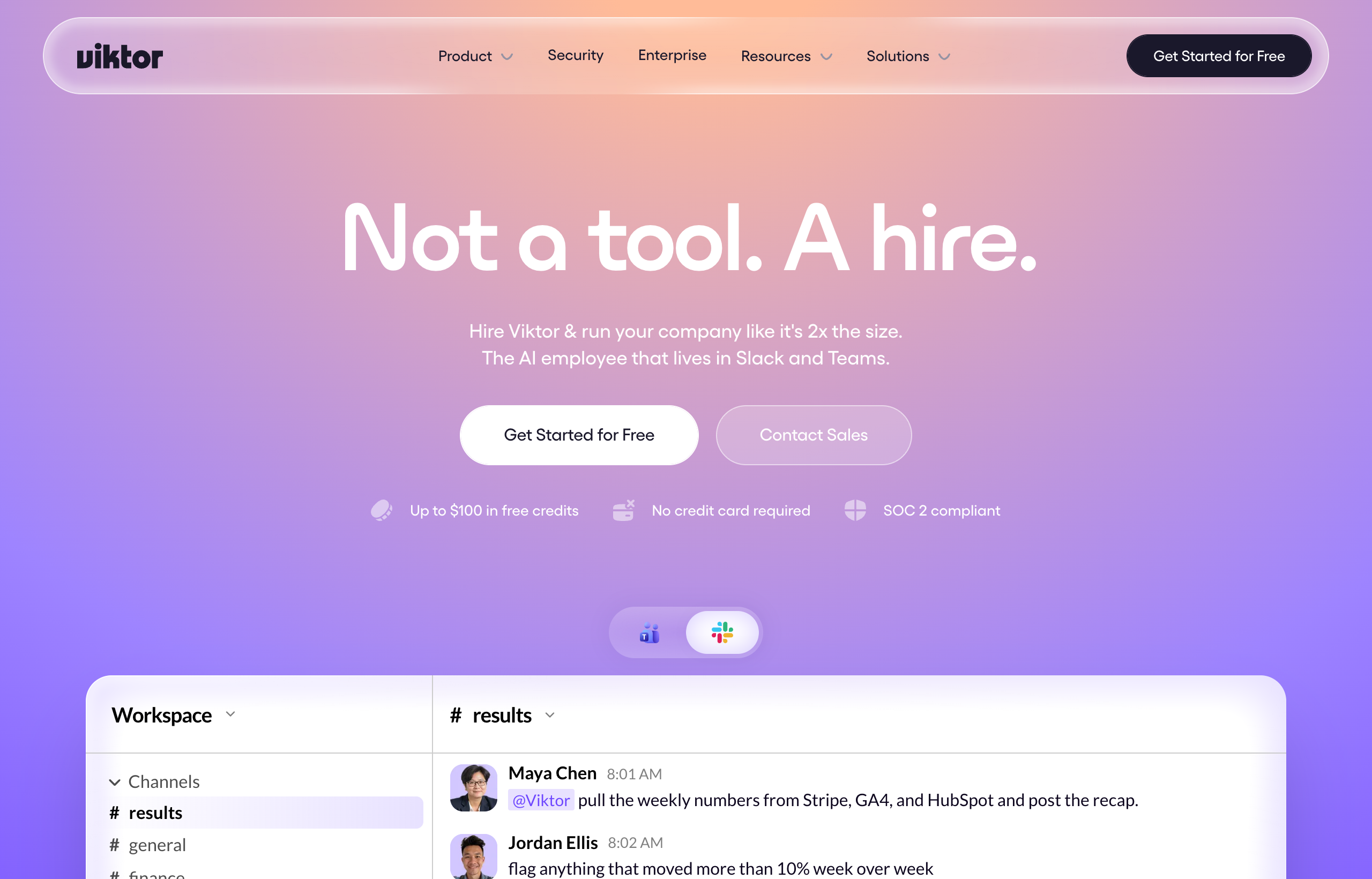
Viktor is an AI employee that lives inside a Slack channel or a Microsoft Teams chat and executes work end to end rather than requiring you to design a flow first: it connects to 3,200-plus tools (Stripe, Notion, Google Ads, Meta Ads, HubSpot, Salesforce, Linear, Jira, GitHub, Google Drive, and more), pulls and cross-references data, writes code and opens pull requests, builds and deploys small web apps with a working database and auth, assembles reports and dashboards, and sets up its own recurring tasks when appropriate. There is no builder screen. You describe a task the way you’d brief a new hire, and it goes and does it, reporting back in the same Slack thread.
I am putting it first on this list with an important caveat that I want to state plainly: Viktor is not a drop-in replacement for a well-built, reliable Zap. If you have a deterministic process that already works, new form submission always creates a CRM record, Viktor is not the tool to replace that with, and Zapier still wins that specific job. Where Viktor earns the top spot is everything Zapier structurally cannot do without you first building an automation for it: one-off research, ad-hoc reports across systems that have never been queried together, drafting documents, triaging a bug, or building a small internal tool on request. Pricing starts with a free trial of $100 in credits, no card required, credits that never expire. Paid team plans are workspace-wide rather than per seat, starting around $50 a month for 20,000 credits, scaling up through around $750 a month for 300,000 credits at the popular small-company tier, with custom Enterprise pricing above that. The honest weakness worth naming here too: credit-based billing is less predictable than Zapier’s task pool, and active teams have reported monthly costs well above the entry $50 figure. Full head-to-head in Viktor vs Zapier.
Make: best if you want more visual power than Zapier
Make (formerly Integromat) is the closest thing to a like-for-like Zapier alternative on this list: a visual, node-based automation builder connecting thousands of apps, with a genuinely more granular flow editor than Zapier’s. Where Zapier’s builder is linear, step after step, Make’s canvas lets you branch, loop, and route data in ways that are harder to express in Zapier without stacking multiple Zaps together. For teams building complex, conditional automations, that extra control is a real advantage, and Make’s pricing has historically undercut Zapier’s at comparable usage levels, with a free tier and paid plans starting in the single digits per month before scaling with operations volume. The tradeoff is a steeper learning curve: Make’s power comes from exposing more of the underlying logic, which means more to learn before you’re productive. It is also, like Zapier, fundamentally a flow-building tool: it does not solve the “I have a one-off task and no flow for it” problem any better than Zapier does.
n8n: best if you want open-source and self-hosted
n8n is a node-based workflow automation tool available both as a hosted cloud product and as a fully self-hostable, open-source option, a structural difference nothing else on this list offers. For a technical team that wants to run automation infrastructure on its own servers, avoid per-task pricing entirely, and have full code-level control over custom steps, self-hosted n8n can be effectively free beyond hosting costs, with cloud plans available from roughly $20 a month for teams that want the hosted convenience without managing infrastructure. The catch is that self-hosting is a real technical commitment: someone has to run, secure, and maintain the instance, which is a very different cost than a subscription line item. n8n’s app catalog, while large, is also generally smaller than Zapier’s, and like Make, it is still a flow-builder at its core, aimed at deterministic automation rather than open-ended, conversational task execution.
Lindy: best if you want a personal-assistant-style AI
Lindy builds AI agents through a visual canvas but frames the output as a personal assistant you interact with over text or email rather than a workflow you monitor in a dashboard, strongest for scheduling, inbox triage, and repeatable communication tasks. It is well-priced and honestly built for that specific shape of work. Where it differs from Viktor is scope and home base: Lindy is not Slack or Teams-native the way Viktor is, and its strength is repeatable, assistant-style automations built on its canvas rather than open-ended, cross-system project work. Full comparison in Viktor vs Lindy.
Relevance AI: best if you want to build custom multi-agent systems
Relevance AI is a platform for building your own AI workforce, custom agents, tools, and multi-agent orchestration with a visual canvas and enterprise controls like SSO and audit logs. It genuinely earns its place on a list like this for a technical team that wants to design bespoke agent behavior from the ground up, with agent evaluation and A/B testing that neither Zapier nor Viktor offers. The cost of that power is a real setup investment, hours to days of building before you see results, and limited public self-serve pricing, with much of the offering pointing toward a sales conversation. If you want maximum control and have the engineering time to invest, it’s worth evaluating; if you want a working AI coworker on day one, it asks more of you first than Viktor does. Full comparison in Viktor vs Relevance AI.
How to actually decide between them
Skip the feature comparison for a second and ask one question first: is the thing you need done repeatable, or is it a one-time request dressed up as a process? If you can describe the trigger and the action in one sentence and expect to run it the same way next month, you want an automation builder, and the only real question left is whether Zapier, Make, or n8n fits your budget and technical comfort. If you cannot describe a clean trigger because the “trigger” is really just “someone needs to think about this and produce an answer,” you are describing a task for a person, not a flow, and that is the exact shape of work Viktor is built around.
A second useful filter is how often the request changes. Zapier, Make, and n8n all reward you for the time spent building a flow by running it identically, cheaply, at volume, for months. That payoff only exists if the same flow runs many times. If you are building something you will genuinely only need once, a full-week investor update format, a one-time competitor teardown, an ad-hoc audit of a campaign that misbehaved, the setup cost of a flow-builder is pure overhead. Viktor’s conversational model has no setup cost per task, which is exactly why it wins on variable, unrepeated work and loses on high-volume, identical, deterministic work where a well-built flow is genuinely cheaper per run.
Comparison table
| Tool | Category | Best for | Starting price |
|---|---|---|---|
| Viktor | AI employee (Slack/Teams) | One-off, fuzzy, or novel tasks with no flow to build | $100 free trial credits; around $50/month for 20,000 credits |
| Zapier | Visual workflow automation | Reliable, repeatable, deterministic processes at scale | Free forever (100 tasks/mo); around $19.99/month |
| Make | Visual workflow automation | Complex, branching, conditional automations | Free tier; paid from around $9/month |
| n8n | Visual/code-hybrid automation | Self-hosted, open-source, full custom control | Free self-hosted; cloud from around $20/month |
| Lindy | Personal AI assistant (canvas-built) | Scheduling, inbox, repeatable communication tasks | Around $49.99/month after a 7-day trial |
| Relevance AI | Custom multi-agent builder | Technical teams designing bespoke agent workforces | Limited public pricing; largely sales-led |
The honest weaknesses to weigh
None of these tools is a universal upgrade over Zapier, and pretending otherwise is how “alternatives” listicles lose credibility. Make and n8n both ask you to learn a more powerful, and therefore more complex, builder than Zapier’s, and neither has Zapier’s sheer app catalog breadth (Zapier’s 7,000-plus apps is genuinely hard to match). n8n’s self-hosted option trades subscription cost for real infrastructure responsibility. Lindy is excellent at a narrower band of assistant-style work than its marketing sometimes implies. Relevance AI demands real setup time and engineering comfort before it pays off. And Viktor, the tool I’m recommending first for AI-agent work, is genuinely not the right swap for a deterministic process that already runs reliably as a Zap; its credit-based pricing is also less predictable than a flat monthly fee, and real users have reported costs climbing well past the entry $50 figure once usage ramps up.
Who should stick with Zapier
- Anyone with well-tested, working Zaps already in production. If it works reliably, migrating it elsewhere is pure risk with no clear upside.
- Teams that need the widest possible app catalog, since Zapier’s 7,000-plus apps is still the largest on this list.
- Non-technical teams who want the gentlest learning curve among the visual automation builders, since Make and n8n both trade simplicity for power.
- Anyone happy with Zapier’s pricing at their current usage level, where switching would save little and cost real migration time.
Who should look at an alternative
- Teams hitting Zapier’s task-pool pricing at scale who want the same automation model for a lower cost (Make, n8n).
- Technical teams that want self-hosted, open-source infrastructure with full code-level control (n8n).
- Anyone whose real problem is one-off, judgment-based work rather than a repeatable trigger, which no visual automation builder solves well (Viktor).
- Teams that want a personal-assistant-style AI for scheduling and communications specifically (Lindy).
Frequently asked questions
What is the best free alternative to Zapier?
For pure automation, n8n’s self-hosted, open-source option is free beyond hosting costs, and Make has a genuine free tier as well. For AI-agent work rather than trigger-based automation, Viktor’s free trial gives $100 in credits with no card required.
Is Make actually cheaper than Zapier?
At comparable usage levels, Make has historically been priced lower than Zapier, with a free tier and paid plans starting in the single digits per month, though exact figures should be confirmed on Make’s current pricing page since both companies adjust plans regularly.
Is Viktor really a Zapier alternative, or a different kind of tool?
Honestly, both. It solves a different problem, executing open-ended, conversational tasks rather than building deterministic flows, but it is the most direct answer for the growing share of “Zapier alternative” searches that are actually about work Zapier was never built to handle in the first place.
Which alternative has the largest app catalog?
None of the alternatives on this list match Zapier’s claimed 7,000-plus apps directly. Viktor’s 3,200-plus integrations cover most common business tools; Make and n8n both connect a large but generally smaller set of apps than Zapier.
Can I use more than one of these alongside Zapier?
Yes, and many teams do. It is common to keep reliable Zaps running for deterministic processes while adding Viktor for one-off, judgment-based work, or adding Make or n8n for a specific complex flow Zapier’s builder handles awkwardly.
The bottom line
If your search for a Zapier alternative is really about automation, cheaper pricing, more visual control, self-hosting, Make and n8n are the honest picks, and this list says so without spin. But if what actually sent you looking is a backlog of tasks that never fit a trigger in the first place, the fix is not a better automation builder, it’s a tool that does not require building a flow at all. That is the specific gap Viktor fills, and it is why it tops this list even though it is not competing on Zapier’s exact turf.
Try Viktor’s free $100 in credits on the next task that made you go looking for a “Zapier alternative” in the first place. If it was a repeatable process, you’ll probably end up back with Zapier, Make, or n8n, and that’s a useful thing to learn too.
For more detail, see the full Viktor review, the direct Viktor vs Zapier and Viktor vs Zapier Agents comparisons, or the wider best AI agents in 2026 roundup.
Pricing captured from vendor pricing pages, July 2026. Plans and limits change regularly across every tool on this list, so confirm current numbers before you buy.


