
Lindy alternatives get searched most often by people who hit the same wall: they like the idea of an AI assistant, built a flow or two on Lindy’s canvas, and then realized the tool is built for a different kind of work than the one sitting on their desk. Maybe the request was not repeatable enough to justify wiring a flow. Maybe it needed to touch GitHub or Jira, where Lindy’s 100-plus integrations run thin. Maybe the team just does not live in a separate assistant app, it lives in Slack, and switching contexts to check on an automation got old fast.
I went through six real alternatives here, not a scraped list of “top AI tools” nobody has actually opened. Each one gets a straight assessment of what it does well and where it falls short, because a list that only flatters every entry is not a list, it is an ad. Viktor tops it, for reasons the rest of this article backs up with specifics rather than assertion.
Disclosure: some links in this post are affiliate links. If you sign up through them, we may earn a commission at no extra cost to you. That never changes our verdict.
The short answer
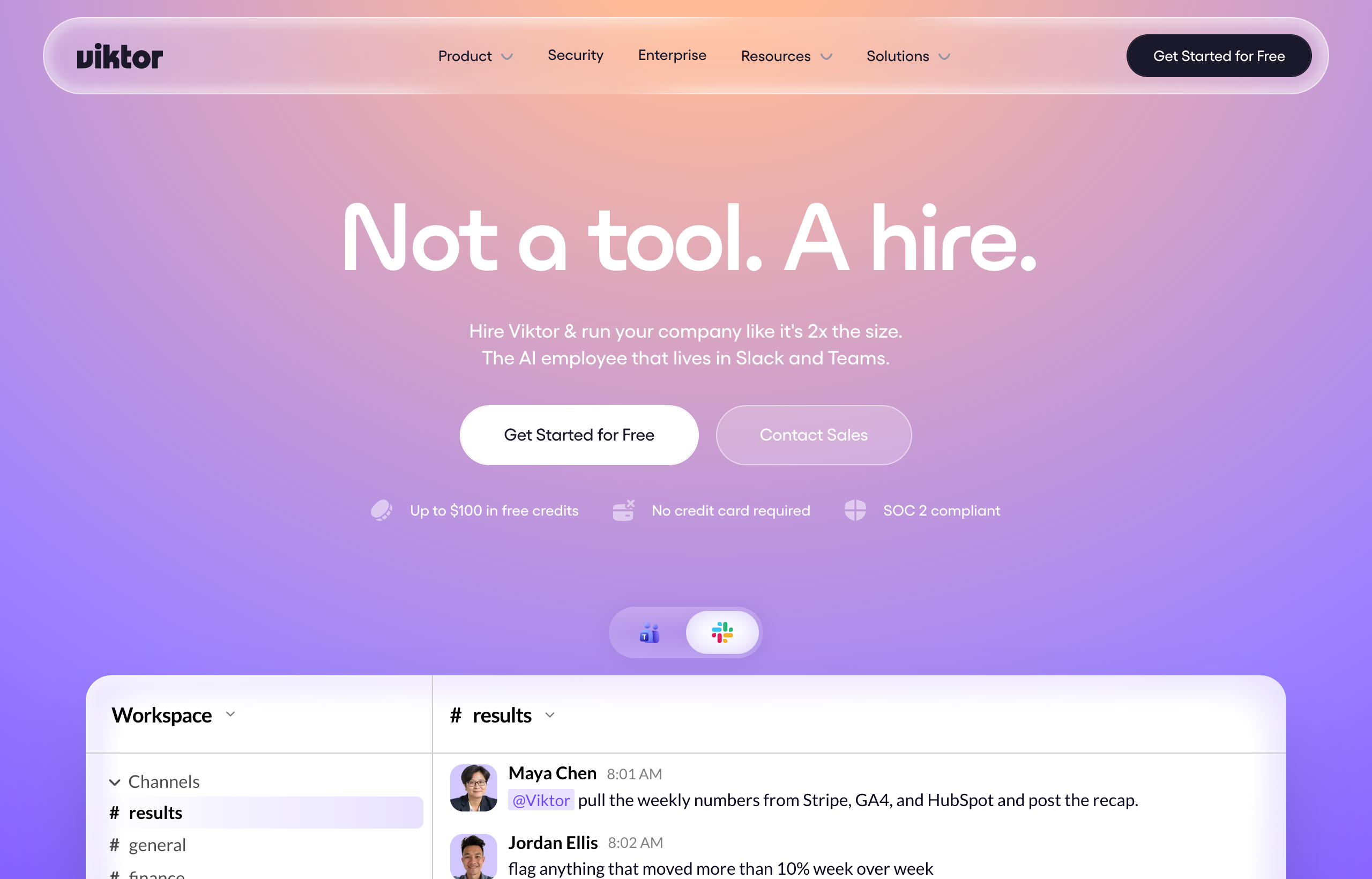
Viktor is the best all-around Lindy alternative if your team works out of Slack or Microsoft Teams and you want to describe a task in plain language rather than build a flow for it, especially when the work touches code, data pulls across many tools, or genuinely one-off requests. If you specifically want to stay in the “visual builder” category Lindy pioneered but need a bigger integration ecosystem, Zapier Agents or Make are the more mature options. If you want pre-packaged role-based helpers instead of a blank canvas, Sintra is closer to what you are picturing. Read on for the honest breakdown of all six.
If you already know your team is Slack-first, skip the comparison shopping and start Viktor’s free trial with $100 in credits. Give it one task you would normally build a Lindy flow for, and see whether “just ask” beats “build it yourself” for your actual work.
Lindy alternatives compared at a glance
| Tool | Best for | Interface | Starting price |
|---|---|---|---|
| Viktor | Slack/Teams-native teams that want execution, not flow-building | Chat in Slack or Microsoft Teams | ~$50/mo (20,000 credits), $100 free trial credits |
| Sintra | Solo founders who want role-based AI helpers (marketer, designer, etc.) | Dedicated dashboard with named “AI Helpers” | Paid plans from roughly the same range as Lindy’s Plus tier; check current pricing |
| OpenClaw | Teams wanting an AI coworker with deep Slack/Teams integration coverage | Chat-based, coworker-style | Verify current pricing on openclaw.com |
| Relevance AI | Technical teams who want to build custom multi-agent systems | Visual builder plus API/SDK for custom agent logic | Free tier available; paid plans scale with usage |
| Zapier Agents | Teams already deep in the Zapier ecosystem who want AI added to existing zaps | Visual builder, layered onto Zapier’s automation platform | Included in or added to existing Zapier plans; check zapier.com/agents |
| Make | Technical operators who want granular, visual control over complex automations | Highly detailed visual scenario builder | Free tier available; paid plans from roughly the low double digits per month |
1. Viktor: the best Lindy alternative for Slack-first teams
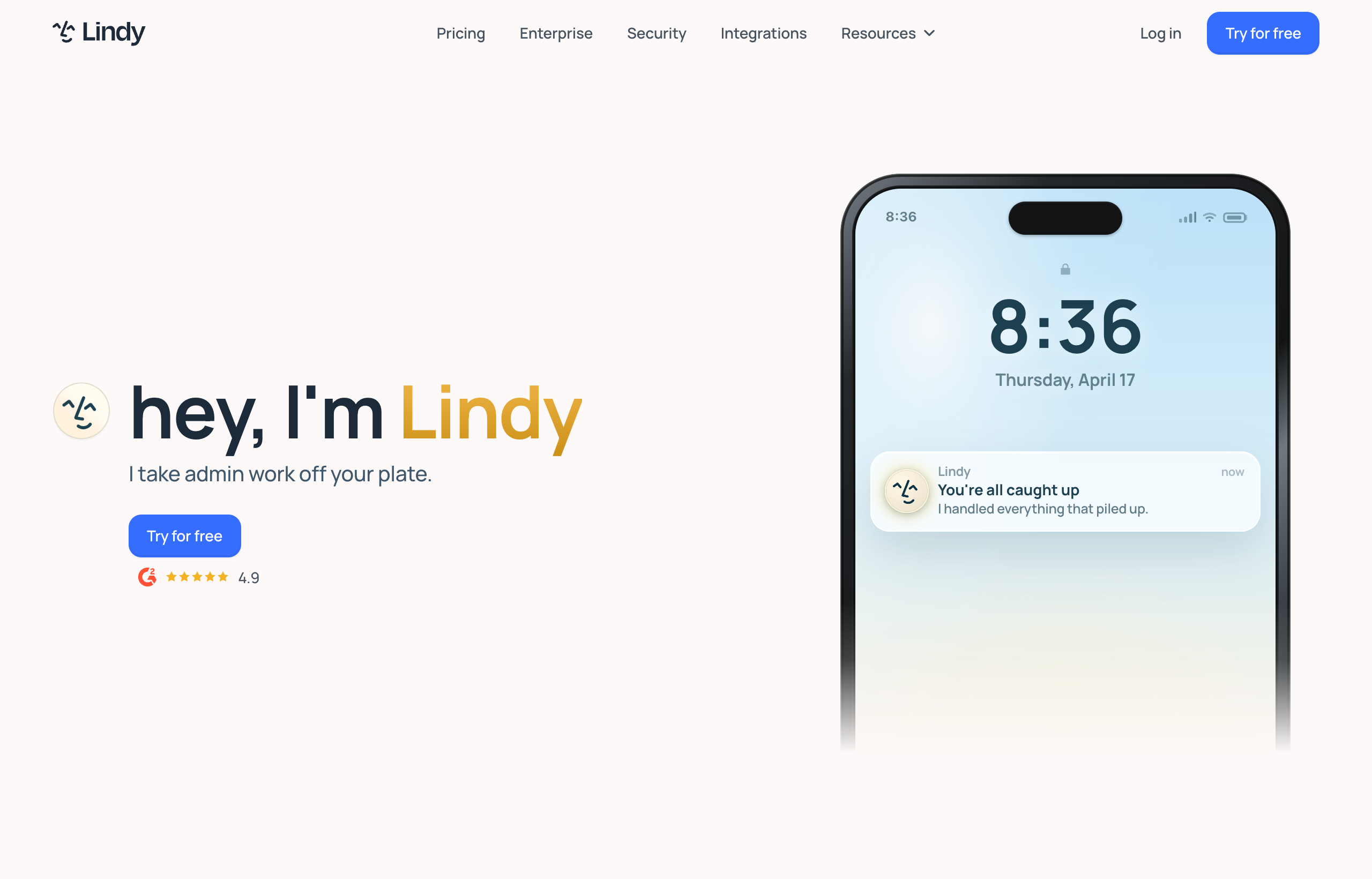
Viktor is an “AI employee” that lives inside Slack and Microsoft Teams. The core difference from Lindy, and from every visual-builder tool on this list, is that you do not design a flow before Viktor can act. You mention it in a channel, describe the outcome you want, and it plans and executes the steps itself, pulling from 3,200-plus connected tools: Stripe, Notion, HubSpot, Salesforce, GitHub, Linear, Jira, Google Ads, Meta Ads, and Google Drive among them.
What makes it a genuine step up from Lindy for a certain kind of team: it ships real deliverables, not just drafts or summaries. Deployed web apps with a database and auth, code changes and pull requests, assembled reports and dashboards, scheduled recurring tasks it proposes on its own. Lindy is excellent at communication-shaped work: drafting emails, joining meetings, extracting action items, sending texts. Viktor is built for a wider slice of actual company work, including the technical slice Lindy does not touch.
Honest weakness: pricing is credit-based and workspace-wide rather than a flat per-seat number, which means a heavy-use week can cost noticeably more than the entry $50/month tier suggests. Quick tasks run a few hundred credits, more complex workflows run into the low thousands, and a genuinely heavy team can burn through a starting allotment fast. It is also a coworker you talk to, not a canvas you design, so if you specifically want to see and control every step of a flow before it runs, that visibility is not the default experience here.
Best for: teams already coordinating in Slack or Teams who want an AI teammate that executes varied, sometimes one-off requests without anyone building a flow for each one.
Viktor’s free trial gives you $100 in credits that never expire, no card required. That is usually enough to run several real tasks and see the credit math for yourself before you decide.
2. Sintra: role-based AI helpers instead of a blank canvas
Sintra takes a different shape entirely from both Lindy and Viktor. Instead of a canvas you build or a coworker you converse with, it hands you a roster of named, role-based “AI Helpers”, think a marketing helper, a customer service helper, a data helper, each pre-specialized for a job function, working inside Sintra’s own dashboard.
The appeal is real for a solo founder or very small team: you are not starting from a blank flow or explaining context every time, each helper already has a defined lane. The tradeoff is that you are working inside Sintra’s world rather than inside the tools your team already lives in. If your team is Slack-first, adding another dashboard to check is exactly the kind of context-switch that made you look for a Lindy alternative in the first place.
Best for: a solo operator or very small team that wants pre-built role specialization more than a place to design custom flows or a coworker embedded in existing chat tools.
3. OpenClaw: the other “AI coworker” in Slack and Teams
OpenClaw is the closest philosophical match to Viktor on this list: both position themselves as an AI coworker rather than a builder or a chatbot, and both lean into being native where teams already communicate. The practical differentiator worth knowing before you compare the two directly is integration breadth: Viktor’s named connection count runs into the thousands, spanning finance, sales, engineering, and ad-platform tools specifically. If your evaluation comes down to these two, the honest move is to list the five tools your team actually needs connected and check both against that exact list rather than against a marketing page.
Best for: teams evaluating the “AI coworker in chat” category broadly and wanting a second option to compare directly against Viktor.
4. Relevance AI: build your own custom agents and teams
Relevance AI is a platform for building custom AI agents, and multi-agent “teams” of them, rather than a single ready-made employee. It gives you a visual builder plus API and SDK access, so a technical team can define exactly how an agent reasons, what tools it can call, and how multiple agents hand work off to each other. That is real power, and if your use case is specific enough that no off-the-shelf agent fits (a custom internal support triage system, say), Relevance AI is built for exactly that kind of construction project.
The tradeoff against Viktor is setup cost. Viktor and Sintra hand you something working on day one. Relevance AI hands you the parts and expects you, or a technical hire, to assemble them. That is the right tradeoff if you need something bespoke and have engineering time to invest. It is the wrong one if you want a coworker running real tasks by this afternoon.
Best for: technical teams building custom, purpose-specific agents or multi-agent systems, rather than adopting a general-purpose employee off the shelf.
5. Zapier Agents: AI layered onto the automation platform you already run
Zapier Agents extends Zapier’s existing automation platform with an AI reasoning layer, so if your company already has hundreds of zaps connecting your stack, adding an agent that can make judgment calls inside that existing infrastructure is a low-friction move. You are not starting from zero on integrations, Zapier’s connector library is one of the largest in the industry, and your team likely already knows the interface.
The honest limitation is that Zapier Agents inherits Zapier’s fundamental shape: you are still working within triggers and actions, even with an AI step added in. It is a meaningfully different experience from opening a Slack channel and describing an open-ended task in a sentence. If your team already has deep Zapier muscle memory, that familiarity has real value. If you are choosing a tool fresh, it is worth being honest that you are picking a flavor of the builder model, not stepping outside it.
Best for: teams with an existing, substantial Zapier setup who want to add AI decision-making to flows they already maintain.
6. Make: the most granular visual automation builder
Make (formerly Integromat) is the choice for operators who want maximum visual control over complex, multi-branch automations, arguably more granular than Lindy’s own builder. Its scenario editor lets you see and manipulate every data field moving between steps, which technical users genuinely appreciate for debugging and for building automations that would be fragile or opaque elsewhere.
That granularity is also the cost. Make has a steeper learning curve than Lindy, Zapier, or a chat-first tool like Viktor. It rewards someone who enjoys building and maintaining complex scenarios and punishes someone who just wants a task done without becoming the in-house automation architect.
Best for: technical operators who want deep, granular visual control and do not mind investing time in building and maintaining complex scenarios.
What actually changed in this market recently
Two years ago “AI agent” mostly meant a chatbot with a slightly longer memory. What has shifted since is execution: the newer wave of tools, Viktor and OpenClaw among them, actually finish tasks rather than describe how you might finish them yourself. That shift is why “Lindy alternatives” searches look different now than they did when Lindy first launched its visual builder. Back then, the alternatives people wanted were other builders: a different canvas, a different template library. Now a meaningful share of people searching this term are not looking for a better builder at all, they are questioning whether they want to build anything in the first place.
That matters for how you read this list. If you are comparing Lindy against Make or Zapier Agents, you are comparing builders, and the decision comes down to integration depth, learning curve, and how granular you want control to be. If you are comparing Lindy against Viktor or OpenClaw, you are comparing two different philosophies of how AI should relate to work, one where you specify the mechanism, one where you specify the outcome. Knowing which comparison you are actually making saves you from evaluating six tools against the wrong criteria.
How to actually choose
Work through these three questions in order, they resolve most of the decision on their own.
- Is the task repeatable or one-off? Repeatable, well-defined process you will run the same way for months: a visual builder (Lindy, Make, Zapier Agents, Relevance AI) earns its setup cost. One-off, fuzzy, or novel requests: a conversational coworker (Viktor, OpenClaw) is faster because there is no flow to build first.
- Where does your team actually coordinate? If the honest answer is “Slack” or “Microsoft Teams,” a tool native to that surface (Viktor, OpenClaw) removes a context switch every other option on this list requires.
- Does any of the work touch code or deployment? If yes, most of this list is out of scope. Viktor is the only tool here that writes code, opens pull requests, and deploys web apps as part of its core capability.
For most teams reading a “Lindy alternatives” article, the honest pattern is that they liked the idea of an AI assistant but got tired of being the one who has to build it. That is the exact gap Viktor is built to close. For a full head-to-head against the tool that sent you searching in the first place, read our Viktor vs Lindy comparison, and if you want the unvarnished take on Lindy itself, including where it is genuinely still the right call, see our full Lindy review. Our own hands-on Viktor review covers the pick’s strengths and real credit-cost weaknesses in more depth, and the wider best AI employee tools of 2026 roundup places all six of these against the full category.
If you have read this far, you probably already have the one task in mind that made you start searching for alternatives. Take that exact task to Viktor’s free trial this week and see whether it needed a flow at all, or just a clear ask.
Frequently asked questions
What is the best alternative to Lindy?
Viktor is the best overall alternative for teams that coordinate in Slack or Microsoft Teams and want to describe tasks in plain language rather than build a visual flow. For teams that specifically want to stay within the visual-builder category, Zapier Agents or Make are stronger on integration maturity and granular control respectively.
Is there a free alternative to Lindy?
Relevance AI and Make both offer free tiers for lighter usage, and Viktor offers $100 in non-expiring free trial credits with no card required, enough to run several real tasks before paying anything. Lindy itself offers a 7-day free trial rather than an ongoing free tier.
Why would someone switch from Lindy to Viktor?
The most common reason is wanting to skip building a flow for every new request. Lindy’s visual builder is well suited to repeatable, well-defined automations. Teams with a lot of one-off or fuzzy requests, or requests that touch code and deployment, tend to find a conversational, Slack-native coworker like Viktor faster because there is nothing to design before it can start.
Which Lindy alternative is easiest for non-technical users?
Viktor and Sintra require the least technical setup since neither requires you to build a flow: Viktor because you simply describe the task in Slack or Teams, Sintra because you are assigning work to a pre-built role-based helper. Make and Relevance AI require the most technical comfort.
Do any of these alternatives write code like Devin?
Viktor is the only tool on this list that writes code and opens pull requests as part of its core capability, though it is a broader business employee rather than a dedicated software engineering agent. For coding-specific autonomous work, see our Viktor vs Devin comparison.
The bottom line
Every tool on this list is a legitimate choice for someone. The question a “Lindy alternatives” search is usually really asking is narrower: do you want a different flavor of builder, or do you want to stop building flows altogether and just ask for outcomes. If it is the second, Viktor is the clearest answer, especially for a team that already spends its day in Slack. If it is the first, Make and Zapier Agents give you more visual control and a bigger integration library than Lindy’s own builder offers.
Start Viktor’s free trial, $100 in credits, no card needed, and hand it the task that made you start reading this list in the first place.
Pricing and feature details reflect each company’s public pages as of July 2026. Plans and limits change, confirm current details on each provider’s site before you buy.


