

Viktor vs n8n is a comparison that trips people up because the two tools live in almost opposite worlds. n8n is a node-based workflow automation platform: you drag triggers and actions onto a canvas, wire them together, drop in a JavaScript or Python code node when the built-in logic is not enough, and you can self-host the whole thing on your own server for free. Viktor has no canvas at all. You open a Slack channel, type what you want in plain English, and it plans the steps and executes them across 3,200-plus connected tools.
I have spent real hours in both, not demo time: building an n8n workflow that syncs new Stripe customers into a CRM and posts a Slack alert, and running the same kind of task through Viktor by just asking for it. The difference is not “which tool is smarter.” It is who does the engineering, you or the tool, and that single question decides which one actually fits your team.
Disclosure: some links in this post are affiliate links. If you sign up through them, we may earn a commission at no extra cost to you. That never changes our verdict.
The 30-second verdict
If you read nothing else, read this.
Pick n8n if you want full control over the automation and you (or someone on your team) can build it. n8n is genuinely open in the source-available sense, self-hostable for free, and lets a technical person build precise, deterministic workflows with code nodes for anything the pre-built connectors do not cover. It is one of the most powerful and cost-effective automation platforms available if you have the skill to run it.
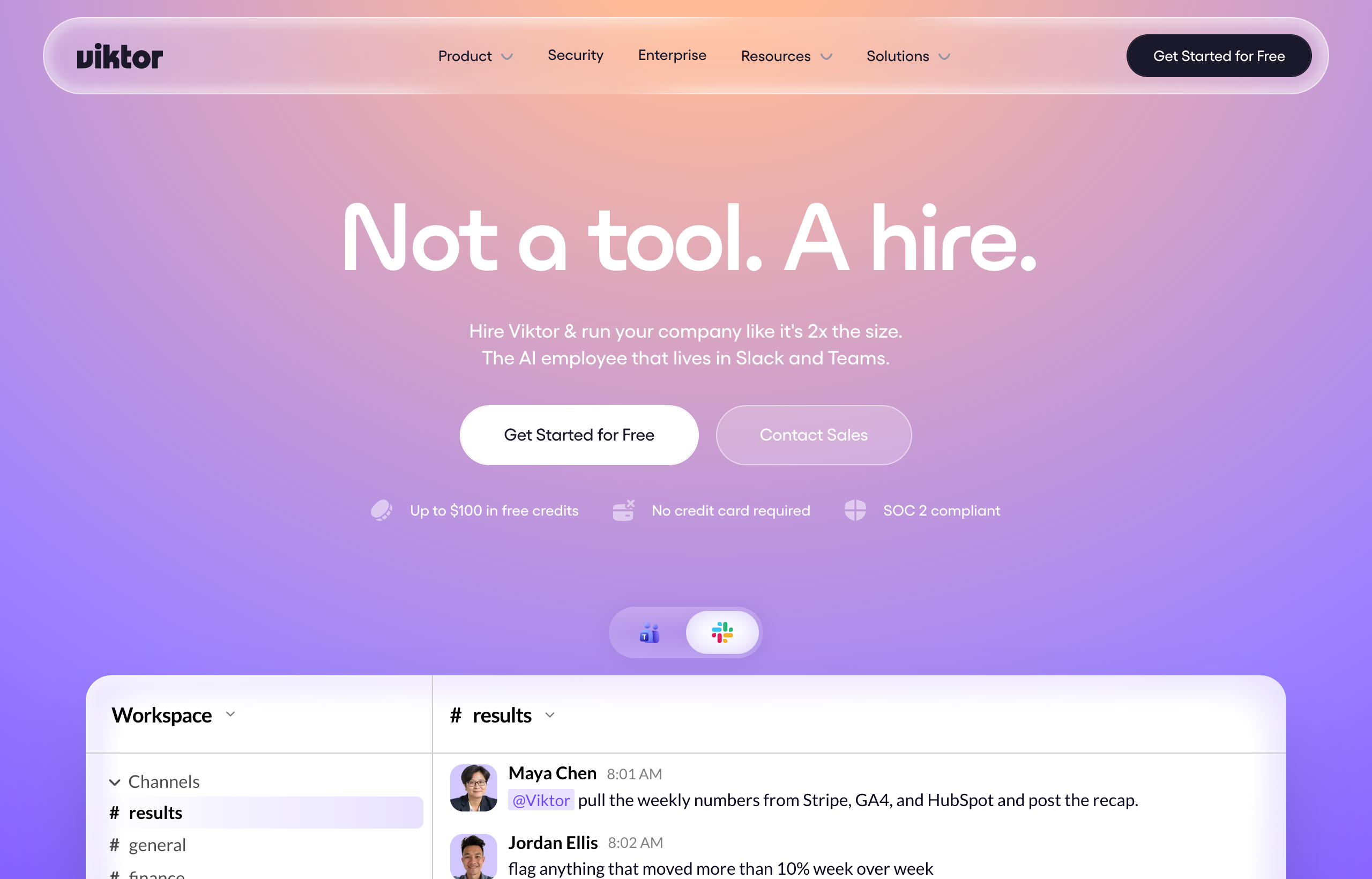
Pick Viktor if you want to describe the outcome and have it happen, without anyone on your team learning a node editor. Viktor lives inside Slack and Microsoft Teams. You mention it in a channel, it figures out the steps, executes across your connected tools, and comes back with the finished thing, a report, a synced record, a dashboard, without a flow diagram involved.
Neither tool is “better” in a vacuum. n8n rewards a team with engineering capacity and a need for tight, repeatable, auditable automation. Viktor rewards a team that wants execution without becoming automation architects. The rest of this article breaks down exactly where that line falls.
If you have ever opened n8n to build a “quick” automation and lost an afternoon to a JSON parsing error in a code node, it is worth trying Viktor’s free $100 in credits on the same task and seeing how long it actually takes when you just describe what you want instead of wiring it yourself.
Viktor vs n8n at a glance
Figures below come from each company’s live pricing pages, checked in July 2026. n8n’s cloud pricing is quoted in euros; the dollar figures are approximate at today’s exchange rate and will drift, so treat them as directional.
| Viktor | n8n | |
|---|---|---|
| Core interface | Slack and Microsoft Teams channel, you talk to it like a coworker | Node-based visual canvas, self-hosted or n8n Cloud |
| How you configure it | Describe the task in natural language, it plans and executes | Drag triggers and actions onto the canvas, wire them together, write JavaScript or Python in code nodes for custom logic |
| Free tier | $100 in trial credits, no card required, credits do not expire | Community edition is free forever, self-hosted, unlimited workflows and users |
| Entry price | Around $50/month for 20,000 workspace credits | Free if self-hosted, or around €20 (roughly $22) a month for the Cloud Starter plan, billed annually |
| Pricing model | Credit-based, workspace-wide, no per-seat charge | Free self-hosted, or execution-based cloud tiers (2,500 to 40,000-plus executions/month) |
| Mid tier | Around $750/month for 300,000 credits (the most commonly cited “popular” tier) | Around €50 (roughly $54) a month for Cloud Pro, 10,000 executions/month |
| Integrations | 3,200-plus, including Stripe, HubSpot, Salesforce, GitHub, Google Ads, Meta Ads, Linear, Jira | 500-plus pre-built nodes, plus generic HTTP request and webhook nodes that can talk to essentially any API |
| Deliverables | Deployed web apps with database and auth, code and pull requests, dashboards, reports, scheduled recurring tasks | Automated data syncs, triggered actions across apps, scheduled jobs, custom logic pipelines you design |
| Best at | Open-ended execution work: “pull this, build that, ship it” without a predefined flow | Deterministic, repeatable technical workflows where you need exact control over every step and full ownership of hosting |
| Lives in | Slack, Microsoft Teams | Your own server (self-hosted) or n8n’s cloud, accessed through a browser-based editor |
The row that matters most in practice is “how you configure it.” With n8n, building the automation is the job, and once it is built, it runs exactly the same way every time until you change it. With Viktor, there is no build step, you describe the outcome and it works out the path itself, which means the result can vary slightly run to run in a way a hand-wired n8n flow never will. Whether that tradeoff sounds like freedom or risk to you is a decent proxy for which tool you will actually enjoy using.
What n8n actually does well

n8n has nearly 200,000 stars on GitHub and a genuinely large, active community, and that following is earned, not hyped. Here is where it stands out from real use.
You can self-host it for free, permanently. The Community edition runs on your own infrastructure, Docker or a plain npm install, with unlimited workflows and unlimited users at no license cost. For a technical team that already runs its own servers, that means automation infrastructure with zero recurring software fee, only your hosting bill. Very few competitors in this category offer that.
The node canvas gives you exact, auditable control. Every step of a workflow is visible: what data comes in, what transforms happen, what condition routes to which branch. When something breaks, you can see precisely which node failed and inspect the exact payload that caused it. That level of visibility is genuinely valuable for anything where “why did this automation do that” needs a fast, concrete answer, compliance-adjacent work especially.
Code nodes remove the ceiling other no-code tools hit. When the pre-built nodes cannot do what you need, you drop in a JavaScript or Python code node and write the logic yourself. This is the feature that separates n8n from more consumer-facing automation tools: you are never actually blocked, you can always write your way out of a limitation, which is a meaningful difference for a team with any engineering capacity at all.
Cloud pricing is honestly cheap relative to the category. Around €20 a month for 2,500 executions, or around €50 a month for 10,000, undercuts a lot of the automation category on a pure cost basis, and that is before accounting for the free self-hosted option existing at all.
Where n8n runs into limits
A comparison that only lists strengths for one side is not being straight with you. Here is where n8n showed real friction.
Building and maintaining the flow is entirely on you. Nothing runs until someone designs it, node by node, condition by condition, and when the underlying app changes its API or your process shifts, someone has to go back in and fix the workflow. For a stable, repeatable process, that is a reasonable one-time cost. For a one-off request, “pull last week’s ad spend across three platforms and summarize what changed,” building a flow to answer a question you will only ask once is slower than the question itself.
It has a real learning curve. n8n is friendlier than writing raw code, but it is not a tool you hand to someone with zero technical background and expect a working workflow from in ten minutes. Expressions, data structure between nodes (items, JSON paths), and debugging a failed execution all require a level of comfort that a genuinely non-technical operator usually does not have without ramping up first.
It is “fair-code,” not fully open source in the permissive-license sense. This is the detail most comparisons skip. n8n’s source is publicly visible and self-hostable for free, but it ships under a Sustainable Use License rather than a permissive open-source license like MIT, which restricts things like reselling n8n as a hosted competing service. For the overwhelming majority of teams just running their own automations, this distinction changes nothing in practice, but it is worth knowing before you repeat “open source” as a selling point in a board deck.
Self-hosting is free in license cost, not in total cost. Running your own instance means you are also running your own server, your own updates, your own backups, and your own uptime. That is real ongoing work, even if it never shows up as a subscription line item. Teams that pick self-hosted n8n to “save money” sometimes underestimate the maintenance hours that replace the fee.
Where Viktor actually does well
Viktor’s pitch is that it is a coworker, not a canvas, and the practical difference shows up the moment you compare “build a flow” against “ask a question.”
It absorbs the engineering step. Ask it to pull Stripe customers created this week, cross-reference them against your CRM, and post anything unmatched to a Slack channel, and it plans and runs that sequence itself. You never touch a node editor or debug an expression. For a request that would take twenty minutes to wire in n8n, Viktor can often just be asked and it goes and does it.
It lives where the conversation already happens. n8n’s canvas is a separate app you open to check on or edit an automation. Viktor sits directly inside the Slack channel where the actual work discussion is already taking place, so the request, the output, and any follow-up questions stay in one thread instead of splitting across two tools.
It handles novel and fuzzy requests n8n cannot pre-wire for. n8n is deterministic by design, which is a strength for repeatable processes and a real limit for anything you cannot fully specify in advance. Viktor’s model reasoning handles the ambiguous middle ground, “check if anything looks off in this data” or “summarize what changed,” that a rigid node flow was never built to answer.
It ships broader deliverables than a data-sync tool. n8n moves data between systems and triggers actions. Viktor goes further: deployed web apps with a database and auth, code changes and pull requests, assembled reports and dashboards. If any part of what you need is a built artifact rather than a data pipe, that is outside n8n’s actual scope, however well you build the flow.
The honest weakness: credit-based pricing is unpredictable
This is the part a glowing Viktor writeup would skip. Viktor bills on usage credits, not a flat number, and credits are consumed by actual model work. Quick tasks run somewhere in the low hundreds of credits, more involved workflows run into the low thousands, and a genuinely full project can burn several thousand. A team using it hard in a given week can spend meaningfully more than the entry $50/month tier suggests, and some real users report burning through a sizable chunk of their starting credits within the first couple of days of aggressive use.
Set that against n8n’s model: free if self-hosted, or a flat, execution-count tier on the cloud plan that you know before the month starts. n8n’s pricing is more predictable by design. Viktor’s is fairer in the sense that light usage costs less, and harder to budget in the sense that a heavy week can spike the bill. If a predictable monthly number matters more to you than usage-matched pricing, that is a legitimate reason to lean n8n, or at least read our full breakdown of the credit math before committing a team: our honest n8n review covers the same tradeoff from n8n’s side.
Who should actually pick n8n over Viktor
Pick n8n if any of these describe you:
- You have someone technical who wants exact, auditable control over every step of an automation, visible on a canvas.
- You want to self-host for free and already run infrastructure you are comfortable maintaining.
- Your automations are repeatable and well-defined, and you would rather build them once than describe them every time.
- Budget predictability matters more than usage-matched pricing, and a flat execution tier fits how your team thinks about cost.
Who should pick Viktor over n8n
Pick Viktor if any of these describe you:
- Your team already coordinates in Slack or Microsoft Teams and you want the AI teammate to live in the same place.
- You do not have engineering time to spend building and maintaining node-based flows.
- Your requests are more one-off and fuzzy than repeatable, and building a flow for each new ask would slow you down more than it helps.
- Some of what you need is a built deliverable (a report, a dashboard, a small deployed app), not just a data sync between two systems.
If you want the full unvarnished take on n8n by itself, including where it genuinely wins on cost and control, read our standalone n8n review. For a wider set of options if n8n’s node-based model is not quite the fit either, see best n8n alternatives, which covers where n8n itself still wins. Our full hands-on Viktor review covers the credit-burn math in real numbers, and if you want to see how both stack up against the wider category rather than just each other, our best AI agents of 2026 roundup ranks the full field.
Still deciding? Take one recurring task you already run through n8n and give it to Viktor in Slack this week instead. The $100 starting credit is usually enough to run it several times and feel the actual difference between building a flow and just asking.
Frequently asked questions
Is Viktor better than n8n?
Neither is universally better, they solve different problems. n8n is better when you need exact, repeatable, auditable control over a deterministic workflow, especially if you want to self-host for free. Viktor is better when you want to describe an outcome in Slack or Teams and have it executed without building or maintaining a flow.
Can n8n do what Viktor does?
Partially. n8n can move data between systems, trigger actions, and run custom logic through code nodes, which covers a lot of automation work well. It does not reason through open-ended, fuzzy requests, plan its own multi-step approach, or ship built deliverables like a deployed app or a written report the way Viktor is designed to.
Is n8n really free?
The Community edition is free to self-host, with unlimited workflows and users, forever. You still pay for your own server and the time to maintain it. n8n Cloud, the hosted option, starts at around €20 a month for a limited number of monthly executions if you would rather not run your own infrastructure.
Does Viktor require any technical setup?
No. You connect the tools you want Viktor to use and start describing tasks in Slack or Microsoft Teams. There is no canvas to build, no code node to write, and no server to host, which is the core practical difference from n8n.
Which is cheaper, Viktor or n8n?
n8n is cheaper on paper, free if self-hosted, or a flat low-double-digit euro fee on Cloud. Viktor’s entry tier is around $50/month but scales with actual usage, so a light month can cost less than expected and a heavy month can cost more. Factor in the engineering time n8n requires to build and maintain flows before assuming it is the cheaper option overall.
The bottom line
Viktor and n8n are not competing for the same buyer, even though they both get called “automation.” n8n is for the team that wants to build and own a precise, repeatable workflow, ideally with someone technical driving, and values free self-hosting and full control over every step. Viktor is for the team that wants to describe the outcome and have it happen inside the chat app they already live in, without anyone becoming the in-house automation engineer.
If your work is mostly stable, repeatable, and you have the technical capacity to build it once and let it run, n8n’s free self-hosted option and low-cost cloud tiers are a genuinely good, honest fit. If your requests are varied, your team lives in Slack, and you would rather ask than build, Viktor is the better bet, with the one caveat that you should watch the credit meter the way you would watch any usage-based bill.
My actual recommendation after using both: if you are technical and want full control for free, n8n’s self-hosted Community edition is worth setting up. If you would rather just ask and skip the build step, start Viktor’s free trial and hand it one real task this week. Read our full n8n review before you decide either way.
Pricing and feature details captured from Viktor’s and n8n’s live pricing pages, July 2026. Both companies change plans and limits over time, so confirm current numbers on viktor.com/pricing and n8n.io/pricing before you buy.


