

Searching for Notion AI alternatives usually means one of two things. Either you like Notion AI fine for writing but you actually need something to go do work outside your wiki, pulling numbers, reconciling data, shipping a deliverable, or you are evaluating tools before committing your team’s documentation to Notion at all and want to know what else is out there. This list is written for the first case mostly, because that is the far more common gap: Notion AI is a genuinely good writing assistant that stops being useful the moment a task needs to leave the page.
I have used Notion AI for real documentation work and I am not going to pretend it is bad, it is not. But if your actual complaint is “I keep writing beautifully organized pages about tasks nobody has finished yet,” the honest fix is not a better writing tool, it is an execution tool. That is where Viktor fits, and it tops this list, followed by four more real options assessed honestly.
Disclosure: some links in this post are affiliate links. If you sign up through them, we may earn a commission at no extra cost to you. That never changes our verdict.
The short answer
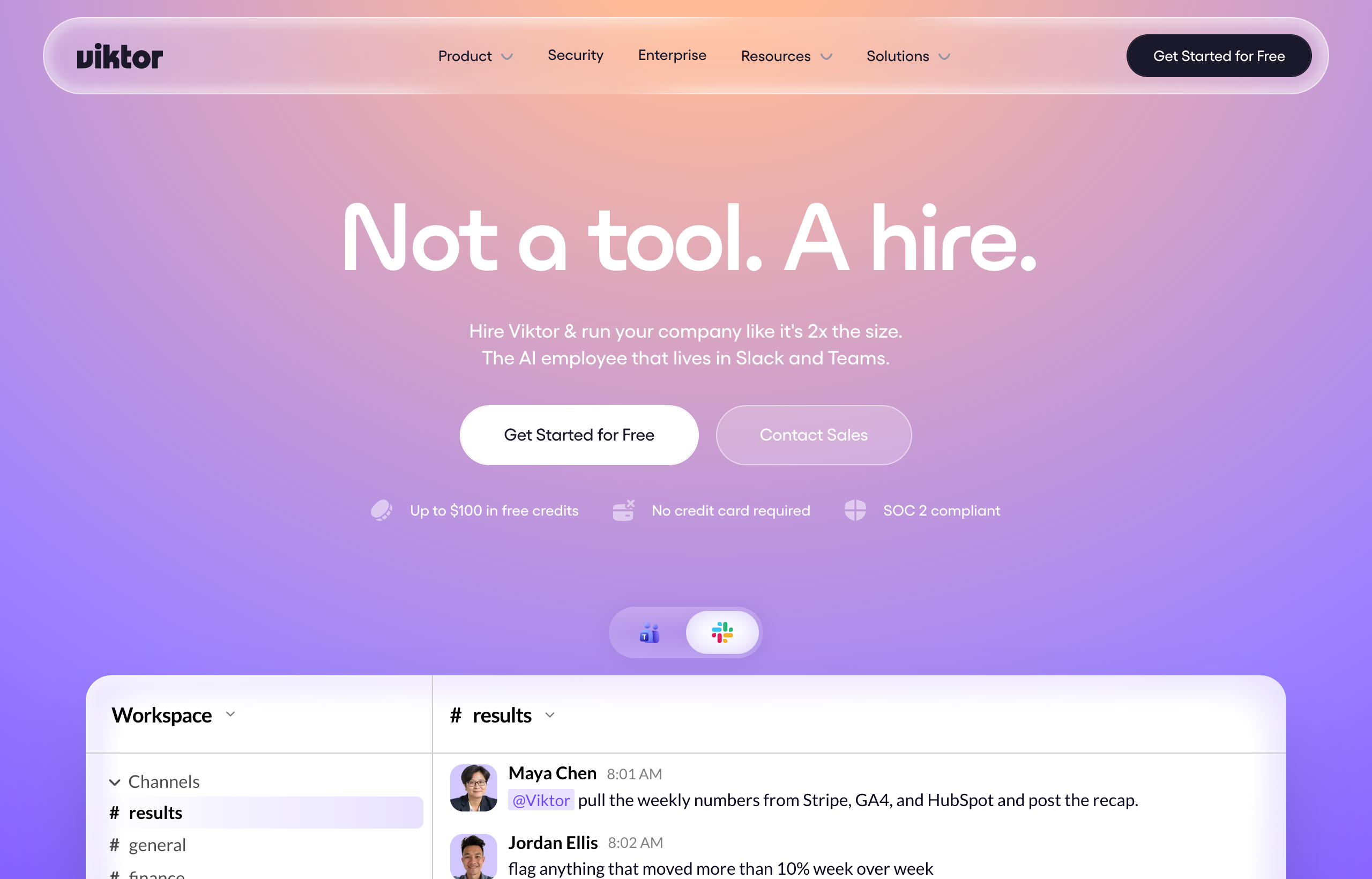
Viktor is the best Notion AI alternative if what you actually need is an AI that acts, pulling data from your real tools and shipping a finished deliverable, rather than helping you write about work inside a page. It lives in Slack or Microsoft Teams, connects to more than 3,200 tools, and prices by workspace credits instead of per seat. If your need is genuinely just better writing inside Notion itself, the honest answer is that Notion AI already does that job well, and switching away from it for pure in-document writing is usually a step backward, not forward. For the wider field: ChatGPT is the strongest general-purpose writing and reasoning upgrade, Microsoft Copilot is the equivalent if your documents live in Word instead of Notion, Glean is the pick if your real problem is finding scattered company knowledge rather than writing new content, and Lindy is worth a look if what you actually want is a personal-assistant feel for scheduling and inbox work.
If your problem is really “my Notion docs describe work that never actually gets done,” skip ahead and start Viktor’s free trial with $100 in credits. Hand it the exact task your last well-written Notion page was describing and see what comes back.
Notion AI alternatives compared at a glance
| Tool | Best for | Interface | Starting price |
|---|---|---|---|
| Viktor | Cross-tool execution from Slack or Teams, not just in-document writing | Chat in Slack or Microsoft Teams | Around $50/mo (20,000 credits), $100 free trial credits |
| ChatGPT | General-purpose writing, reasoning, and research outside any one app | Standalone chat app, web and desktop | Free tier available; Plus around $20/month |
| Microsoft Copilot | Teams whose documents live in Word, Excel, and PowerPoint instead of Notion | Embedded inside Microsoft 365 apps | Around $28.20/user/month bundled with Business Standard |
| Glean | Finding scattered company knowledge across many internal systems | Search bar plus assistant, integrated across company apps | Custom, quote-based; typically enterprise-tier budgets |
| Lindy | Personal-assistant-style automation: inbox, scheduling, meeting notes | Visual builder, plus iMessage/SMS chat with the finished assistant | Around $49.99/month (Plus tier) |
1. Viktor: the best Notion AI alternative for getting things done
Viktor is an AI employee that lives inside Slack and Microsoft Teams, and its entire design is built around a gap that Notion AI, by construction, cannot close: acting outside the document. Where Notion AI rewrites, summarizes, and organizes the words on a page, Viktor pulls real data from Stripe, HubSpot, Salesforce, Google Ads, Meta Ads, GitHub, and more than 3,200 other tools, and does something with it, building a report, reconciling numbers, writing code, deploying a small internal app.
The pricing model is also structurally different. Notion AI’s full capability sits behind the Business plan at around $20 per member per month, a cost that scales with headcount. Viktor is priced in workspace-wide credits, so the whole team can be in the channel without the bill multiplying by seat count, only by how much real work actually gets asked of it.
Honest weakness: credit-based billing takes real getting used to. The entry tier starts around $50 a month, but a genuine project can burn 2,000 to 5,000 credits, and an actively-used team commonly lands closer to $300 to $750 a month once real work is flowing through it. And to be direct about the one thing Notion AI still wins outright: if what you want is polish inside a Notion page itself, tightening a paragraph, reformatting a table, summarizing a long doc, Viktor has no in-document writing surface at all. That specific job still belongs to Notion AI.
Best for: teams whose real bottleneck is getting tasks done across multiple tools, not writing better documents about tasks that still need doing.
Viktor’s free trial gives you $100 in credits that never expire, no card required. Enough to run several real tasks and see how it compares to writing another Notion page about the same work.
2. ChatGPT: the general-purpose upgrade outside any one app
ChatGPT is the obvious pick if what you actually want is a strong, general writing and reasoning assistant that is not tied to Notion, Word, or any specific document tool. It handles drafting, brainstorming, research synthesis, and code help well, and unlike Notion AI it is not bounded by needing your content to already live inside a specific workspace, you can paste in anything from anywhere and get help with it.
What it does not do, at least as most teams deploy it, is independently execute multi-step tasks across your actual business tools. It has grown genuine agentic capabilities (browsing, code execution, connectors to some external services), but as a default deployment it remains closer to “a very capable assistant you prompt and then act on yourself” than a coworker you hand a task to and walk away from.
Best for: individuals or teams that want a flexible, general-purpose writing and reasoning tool not tied to any single document app, without needing full agentic execution.
3. Microsoft Copilot: the same idea, for Word instead of Notion
If your team’s actual documentation problem is not “we need a better Notion AI” but “we are considering Notion versus staying in Microsoft 365,” Copilot is the direct equivalent for that world: AI embedded inline inside Word, Excel, PowerPoint, and Outlook, reading your organization’s real files, calendar, and email through the Microsoft Graph. For a team already committed to Microsoft’s ecosystem, it removes the same kind of friction Notion AI removes for a Notion-based team, help exactly where the writing already happens, no new app.
The tradeoffs mirror Notion AI’s: it is strictly per-seat, roughly $25 a user a month as an add-on to an existing Microsoft 365 Business plan you must already own, and its core job is drafting and summarizing inside documents, not independently executing cross-tool tasks the way Viktor does.
Best for: teams whose documents live in Word, Excel, and PowerPoint rather than Notion, and who want the same kind of in-app writing help Notion AI offers, inside Microsoft’s ecosystem instead.
4. Glean: for finding knowledge, not writing new content
Glean solves a genuinely different problem worth naming precisely. If your actual pain is not “help me write better” but “nobody can find the right document, Slack thread, or ticket across our fifteen different internal systems,” Glean’s enterprise search and permission-aware assistant is purpose-built for exactly that, unifying search across your company’s real tools rather than living inside one writing app.
It is not a writing or execution tool the way Notion AI or Viktor are. It answers questions grounded in what already exists in your systems rather than creating new content or doing new work. If your evaluation of Notion AI alternatives is really about “how do we stop losing information across tools,” Glean is the more accurate answer than any writing-focused alternative on this list.
Best for: larger organizations with knowledge scattered across many internal systems who need unified search and retrieval, not writing help or task execution.
5. Lindy: for a personal-assistant feel, not document writing
Lindy is worth including because some people searching for Notion AI alternatives are not actually looking for a different writing tool, they are looking for something that behaves more like a personal assistant: triaging an inbox, scheduling meetings, turning meeting recordings into action items, reachable over iMessage or SMS rather than embedded in a wiki page. Its visual builder lets you configure exactly that kind of repeatable automation, and the flat $49.99 a month Plus tier is predictable with no usage math.
The honest limitation against both Notion AI and Viktor: Lindy does not help you write or organize documents the way Notion AI does, and it is not built for broad, cross-system business execution (pulling ad spend, writing code, reconciling invoices) the way Viktor is. It sits in a narrower, more personal-assistant-shaped lane.
Best for: a solo operator or small team wanting personal-assistant-style automation for inbox, calendar, and meetings, not document writing or broad task execution.
The one honest caveat: Notion AI still wins at being Notion AI
It would be dishonest to write this list without saying plainly: if your actual need is polishing writing inside a Notion page, summarizing a long doc, reformatting a messy database, or auto-filling properties across rows, Notion AI does that job well and none of the five alternatives above replace it for that exact use case. ChatGPT comes closest for general writing help, but it lacks Notion AI’s awareness of your workspace’s actual page structure and database relationships. If in-Notion writing is genuinely your only complaint, the honest recommendation is to keep Notion AI and look at this list only for the tasks it was never built to do.
How to actually choose
- Is your pain writing or doing? If you want better writing and organizing inside documents, stick with Notion AI, or look at ChatGPT or Copilot depending on which app you actually write in. If you want the AI to go get data and finish a task, Viktor is built for that.
- Is your pain finding information or acting on it? If the real problem is scattered knowledge across many systems, Glean solves that specific problem better than any writing-focused tool.
- Does cost need to scale with usage or with headcount? Per-seat tools (Notion AI Business, Copilot) are predictable for many light users. Workspace-wide credit pricing (Viktor) can be cheaper for a smaller team doing heavy, real work.
For the direct head-to-head, read our full Viktor vs Notion AI comparison. Our hands-on Viktor review covers its strengths and the real credit-cost weaknesses in more depth, and if Microsoft 365 rather than Notion is the ecosystem you are actually weighing, our Microsoft Copilot alternatives guide covers that side of the comparison. The wider best AI agents of 2026 ranking places all the execution-focused options against the full category.
If you have read this far, you likely already know whether your gap is writing or doing. If it is doing, take that exact task to Viktor’s free trial this week and see what comes back.
Frequently asked questions
What is the best alternative to Notion AI?
Viktor is the best alternative for teams that need an AI to execute tasks outside a document, pulling data from tools like Stripe or HubSpot and shipping a finished result. If your need is purely better writing inside Notion itself, Notion AI remains the strongest tool for that specific job.
Is there a free alternative to Notion AI?
ChatGPT offers a genuinely useful free tier for general writing help. Viktor offers $100 in non-expiring free trial credits with no card required, enough to test real execution tasks before paying anything.
Why would someone look for a Notion AI alternative?
The most common reason is wanting execution rather than writing help. Notion AI is strong at improving and organizing content inside Notion pages, but it cannot independently pull data from outside tools and act on it the way Viktor is built to.
Does anything on this list also help write documents like Notion AI?
ChatGPT is the closest general substitute for writing help, though it lacks Notion AI’s native awareness of your workspace’s page and database structure. Microsoft Copilot offers the equivalent in-document experience if your team writes in Word instead of Notion.
Which Notion AI alternative is best for a small team?
Viktor’s entry tier starts around $50 a month workspace-wide, which can suit a small team well if usage is moderate to heavy. Lindy’s flat $49.99 a month Plus tier is a good fit for a small team focused on personal-assistant-style scheduling and inbox tasks rather than broader execution.
The bottom line
Every tool on this list is a legitimate pick for someone, but the honest split is this: if your gap is writing, Notion AI already does that job well and none of these fully replace it. If your gap is that well-written Notion pages keep describing work that never actually gets done, Viktor is the clearest fix, an AI teammate that acts across your real tools instead of documenting the plan to act on them someday.
Start Viktor’s free trial, $100 in credits, no card needed, and hand it the task your best Notion doc has been describing instead of finishing.
Pricing and feature details reflect each company’s public pages as of July 2026. Plans and prices change, confirm current details on each provider’s site before you buy.


