

Most “AI agents for Slack” are not actually for Slack. They are standalone products with a Slack notification bolted on, so you get a ping that says “your report is ready” and then have to leave the channel to go look at it. That is not living in Slack, that is texting you from another app. The distinction matters because the whole point of putting an agent in Slack is to remove a context switch, not add one. This list only ranks tools that let you assign work, get clarifying questions, and receive finished output without leaving the channel, and it ranks them by how well that actually worked when I tried it.
Disclosure: some links in this post are affiliate links. If you sign up through them, we may earn a commission at no extra cost to you. That never changes our verdict.
My team runs entirely out of Slack, so I have a fairly unforgiving bar for this category: if I have to open a second browser tab to get value from a “Slack AI agent,” it loses points immediately. I connected each tool below to a real Slack workspace, gave it real requests (pull numbers, draft something, chase down an answer), and watched what came back in-channel versus what required me to leave.
The 6 best AI agents for Slack, compared
| Tool | Best for | Native to Slack? | Starting price | Free tier |
|---|---|---|---|---|
| 1. Viktor | A full AI employee that executes end to end in-channel | Yes, built Slack-first (and Teams) | Around $50/mo (20,000 workspace credits) | $100 in credits, no card, never expires |
| 2. Claude in Slack | Fast, high-quality answers and drafting inside a thread | Yes, via Anthropic’s Slack connector | Team from around $20 to $25/seat/mo (annual) | Free web/app plan, connector needs a paid seat for team use |
| 3. Zapier Agents | Triggering automations and pulling live data via Slack commands | Connects to Slack as one of thousands of apps | Free (400 activities/mo); Pro around $33.33/mo | Yes, 400 activities/mo forever free |
| 4. Lindy | Visual agent builder with a Slack trigger/action step | Connects to Slack, not Slack-native by design | $49.99/mo (Plus, per seat) | 7-day free trial, no card |
| 5. OpenClaw | Newer AI-coworker style entrant | Chat-first, Slack support still maturing | Not publicly listed at the time of writing | Unclear, check current site |
| 6. Dust | Answering questions grounded in your internal company docs | Yes, has a Slack connector | Confirm current tiers at dust.tt/pricing | Varies, check live page |
If your team already lives in Slack and you want to feel the difference between “a bot that answers” and “a coworker that finishes the task,” the quickest way is to try it yourself. Viktor’s free trial gives you $100 in credits, no card needed, and you can drop a real request into your own workspace today.
What “Slack-native” actually means, and why it matters
There are two very different things people call “AI for Slack”:
- Notify-in-Slack: the agent runs somewhere else and pings you a link or a summary. You still have to leave the channel to see the real output, approve changes, or dig into details.
- Work-in-Slack: you assign the task, ask clarifying follow-ups, and receive the finished deliverable, whether that’s a table, a document, or a status update, all inside the same thread.
The second kind is what actually saves time day to day. It is also rarer than the marketing suggests, which is why this ranking leans hard on hands-on testing rather than feature-page claims.
1. Viktor: the best Slack-native AI agent
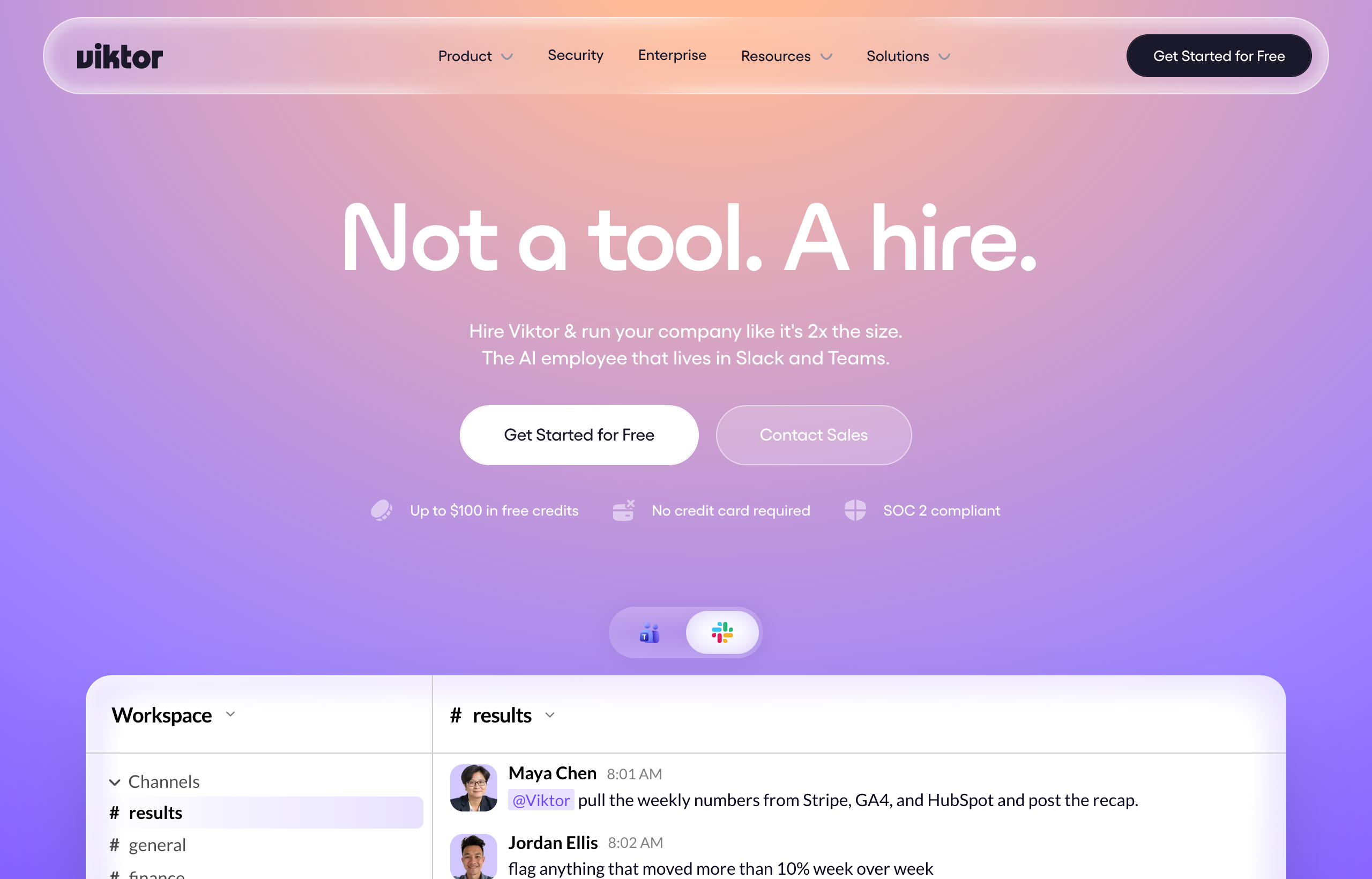
Viktor was built with Slack (and Microsoft Teams) as the primary interface, not an afterthought. You post a request in a channel exactly the way you would message a coworker, and Viktor asks clarifying questions in the thread if it needs them, then goes and executes using its 3,200+ integrations: Stripe, Notion, Google Ads, Meta Ads, HubSpot, Salesforce, Linear, Jira, GitHub, Google Drive, and more.
What stood out when I tested it: I asked for a weekly ad performance summary posted every Monday morning, and Viktor set up the recurring schedule itself, no external automation builder involved. On a separate thread, I asked it to pull churned customers from our CRM, cross-reference them against a support ticket export, and draft outreach copy, three separate systems touched from one Slack message. It came back with a finished table and drafted copy in the same thread, not a link to somewhere else.
Pricing (per Viktor’s live pricing page): the free trial is $100 in credits, no card required, credits never expire. Paid team plans are workspace-wide, not per seat: 20,000 credits runs around $50/month, up to 80,000 credits around $200/month. Small-company tiers scale from 125,000 to 2,000,000 credits, priced roughly $300 to $5,000/month (300,000 credits, around $750/month, is the most popular tier). Enterprise workspaces run into the tens of thousands per month.
Honest weakness: because pricing is credit-based, cost is not fixed. Quick tasks burn 50 to 100 credits, a full project can burn 2,000 to 5,000, and some users report spending well above the $50 headline once the team is actually using it daily, closer to $200 in the first couple of days of exploring for some, or $500+/month in steady effective use. Treat the sticker price as a floor, not a ceiling, and brief it tightly to keep spend predictable.
- Verdict: the only tool on this list built Slack-first that also executes rather than just answering. Full details in the Viktor review and the pricing breakdown.
2. Claude in Slack: best for fast, high-quality answers in a thread
Anthropic’s Claude connects into Slack so you can pull it into a channel or DM it directly for drafting, summarizing a long thread, answering a question, or reasoning through a problem with you. In my testing, response quality on writing and analysis tasks is genuinely excellent, often the best raw output of anything on this list for a single well-scoped question.
The limitation is scope: Claude in Slack is fundamentally a chat interface, not a task executor. It will draft the email, but it will not go send it through your CRM, schedule the follow-up, and update the deal stage the way Viktor would from the same request. It tells; it does not act on external systems the way an agent with deep tool connections does.
Pricing (per Claude’s live pricing page): Pro is around $17/month billed annually (or $20/month billed monthly) for individual use. Team plans run around $20 to $25/seat/month (annual) for standard seats, or $100 to $125/seat/month for premium seats with higher usage, plus SSO, SCIM, and audit logs on Team and Enterprise.
- Verdict: excellent for in-thread thinking, writing, and Q&A; not built to independently execute multi-step business tasks across your other tools the way Viktor is. See Viktor vs Claude.
3. Zapier Agents: best for triggering automations from Slack
Zapier’s Agents product lets you spin up an AI agent that can browse the web, pull from live data sources, and act, and you can trigger or interact with it from Slack as one of the thousands of apps Zapier connects. If your team already has Zaps built and wants an AI layer that can kick them off conversationally, this is a reasonable extension of a tool you may already own.
Pricing (per Zapier’s live pricing page): Agents Free is forever free with 400 activities/month, including live data sources and browsing. Agents Pro is around $400/year billed annually (about $33.33/month) with 1,500 activities/month. Agents Enterprise is custom. Zapier’s core automation platform is separate: Free (100 tasks/month), Professional from $19.99/month, Team from $69/month.
Honest take: Zapier Agents is powerful for triggering deterministic, pre-built workflows, but it is not a conversational coworker you brief in natural language the way Viktor is. You are still building and maintaining Zaps; the AI layer assists rather than replaces that setup work.
- Verdict: good if you are already deep in the Zapier ecosystem and want an AI trigger layer on top. See Viktor vs Zapier and the full Zapier Agents review.
4. Lindy: best visual builder that also touches Slack
Lindy is not Slack-native by design, it is its own dashboard where you build agents visually, and one of the actions or triggers available is Slack. That makes it useful if you want to see and edit exactly what happens step by step, but it means your team is managing the flow from outside Slack even if the output eventually lands in a channel.
Pricing (per Lindy’s live pricing page): Plus is $49.99/month per seat with a standard usage allowance and up to 2 connected inboxes. Pro is $99.99/month per seat with 3x the usage and computer-use capability. Max is $199.99/month per seat with 7x the usage. Enterprise is custom. All individual plans include a 7-day free trial, no card required.
- Verdict: a good visual builder, but it is per-seat and Slack is one integration among many rather than the home base. Full comparison in Viktor vs Lindy.
My honest recommendation for anyone still comparing tabs on this: stop comparing tabs. Post one real task to Viktor’s free trial in your actual Slack workspace and see what lands in the thread. That single test tells you more than any feature grid.
5. OpenClaw: newer AI-coworker style entrant
OpenClaw occupies the same “chat with a coworker” category as Viktor, and it is worth tracking as it develops. At the time of writing, I could not confirm its current Slack integration depth or public pricing, where Viktor, Claude, and Zapier all publish clear self-serve numbers. If you are evaluating it, confirm both directly on OpenClaw’s site before comparing costs.
- Verdict: philosophically similar to Viktor but earlier in building out its Slack presence and integration catalog. See Viktor vs OpenClaw.
6. Dust: best for answering from your internal company knowledge
Dust connects to your company’s internal documents, tickets, and Slack history so an agent can answer questions grounded in your actual company context rather than generic knowledge, and it has a Slack connector for exactly this kind of in-channel Q&A. It is a strong fit for “what does our policy say about X” or “how did we solve this last time” style questions.
Current pricing tiers were not fully visible on the page I reviewed, so confirm live numbers at dust.tt before budgeting.
- Verdict: good specifically for internal knowledge retrieval in Slack. Viktor’s advantage is breadth: it does not just answer from your docs, it executes tasks across your external tools too. See the Dust review.
What onboarding each of these tools into a real workspace actually looks like
The setup step matters as much as the finished product, because a tool your team never fully connects never gets used regardless of how capable it is. A few notes from actually doing this:
- Viktor: install into the workspace, grant the integrations you actually plan to use (start narrow, add more later), and invite it into the channels where the relevant work happens. It starts asking useful clarifying questions from the first real request, which shortens the ramp-up compared to tools that need a longer configuration phase before they are useful.
- Claude in Slack: a straightforward connector install; the ramp-up is near zero since you are mostly just talking to it, but it also means there is no deeper task-execution layer to configure because there is not one to configure.
- Zapier Agents: setup time depends entirely on how many Zaps you already have built. If you are starting from zero, expect a real afternoon of work mapping out triggers and actions before the AI layer has much to work with.
- Lindy: the visual builder has a genuine learning curve. Budget a couple of hours to get comfortable with nodes, branches, and triggers before your first agent is doing useful work unsupervised.
None of this is a reason to avoid any of these tools. It is a reason to budget real setup time into your evaluation instead of judging a 10-minute trial run as the final verdict.
Where Viktor genuinely falls short in Slack
- Credit spend is unpredictable. The workspace-wide model is fairer than per-seat pricing for a growing team, but it also means one heavy user or one poorly scoped request can eat a big chunk of the monthly pool. Watch usage the first month.
- It is conversational, not visual. If your team wants to audit an automation’s exact logic step by step, a Slack thread does not give you that the way a visual builder does.
- It needs a real brief. A one-line vague request gets a vague result. Treat it like delegating to a new hire: give context and examples the first few times.
A note on why some of these pricing pages are harder to compare than others
Worth flagging directly: Viktor, Claude, Zapier, and Lindy all publish clear, stable self-serve pricing tables you can quote with confidence. OpenClaw and Dust did not, at the time I researched this, surface a full public tier breakdown I could quote with the same confidence, which is itself useful information if predictable budgeting matters to you. A vendor that makes its numbers easy to find before you talk to sales is generally easier to plan against, and that transparency was one of the smaller factors in how I ordered this list.
Who should pick something else
- You want the best raw writing and reasoning in a thread, nothing more: Claude in Slack.
- You already have Zaps built and want an AI trigger on top: Zapier Agents.
- You want a visual, inspectable automation builder: Lindy.
- Your need is purely “answer from our internal docs”: Dust.
Frequently asked questions
What is the best AI agent for Slack in 2026?
Viktor is the best AI agent for Slack in 2026 because it was built Slack-first: you assign tasks in a channel, it asks clarifying questions in-thread, and it executes end to end using more than 3,200 integrations, rather than sending you a link to check somewhere else.
Can Claude work inside Slack?
Yes, Anthropic offers a Slack connector for Claude that lets you pull it into a channel or DM for drafting, summarizing, and answering questions. It is strong for writing and reasoning but does not independently execute multi-step tasks across your other business tools the way a dedicated agent like Viktor does.
Is Zapier Agents the same as an AI employee?
Not quite. Zapier Agents adds an AI layer that can browse, pull live data, and act, and can be triggered from Slack, but it works alongside the Zaps you build rather than replacing that setup work. An AI employee like Viktor takes a plain-language request and figures out the steps itself.
How much does a Slack AI agent cost?
It ranges widely. Viktor’s workspace-wide plans start around $50/month for 20,000 credits. Claude Team seats run around $20 to $25/month each. Zapier Agents has a forever-free tier (400 activities/month) with paid plans from around $33.33/month. Lindy is per seat starting at $49.99/month.
Does Viktor work in Microsoft Teams too?
Yes. Viktor is built to live in both Slack and Microsoft Teams, so teams that use one or the other, or both, can talk to it the same way. See the dedicated roundup of the best AI assistants for Microsoft Teams.
If you read this far, you already know the difference between an agent that answers and one that finishes matters to you. Start with Viktor’s free $100 in credits, no card, and post the task you have been putting off.
For a broader view of the category, see the best AI agents in 2026 and the best AI employee tools rankings, plus Viktor alternatives if you want the full honest field.
Pricing captured from Viktor, Claude, Zapier, and Lindy’s live pricing pages, and OpenClaw and Dust’s public pages where available, July 2026. Confirm current numbers before you buy.


