
Most people searching for Manus alternatives fall into one of two camps, and the tools that fit each one are genuinely different. Camp one hit Manus’s credit meter and want something with more predictable billing for the same kind of open-ended, solo research and building work. Camp two never actually needed what Manus does well, open-web research and self-contained builds, and what they actually needed all along was something that plugs into their company’s real tools and finishes business tasks. This list covers both honestly, rather than pretending every alternative on it does the same job Manus does.
Disclosure: some links in this post are affiliate links. If you sign up through them, we may earn a commission at no extra cost to you. That never changes our verdict.
30-second verdict
Manus is a strong general autonomous agent for solo, open-ended work, research, first-draft websites, slide decks, largely inside its own sandbox. Viktor tops this list not because it is a better version of Manus, but because most people who go looking for a Manus alternative actually need a tool that connects to their real business systems (Stripe, Salesforce, Google Ads, GitHub) and delivers inside Slack or Teams, which Manus was never built to do. For teams that specifically want a coding-focused autonomous agent, Devin is the closer fit. For an open-source, self-hosted coworker with no vendor lock-in, OpenClaw. For building fully custom multi-agent systems, Relevance AI. For a visual agent builder that can also text and call you, Lindy.
| Tool | Core strength | Where it lives | Starting price |
|---|---|---|---|
| Viktor | Executes business tasks end to end inside your real tools | Slack, Microsoft Teams | Free trial ($100 credits), then around $50/mo |
| Devin | Autonomous software engineering agent | Own IDE-style workspace, GitHub integration | Usage-based credits, paid plans reported from around $20/mo |
| OpenClaw | Open-source, self-hosted personal AI coworker | 29+ channels including Slack, WhatsApp, Telegram | Free (self-hosted); managed cloud options reportedly from around $29/mo |
| Relevance AI | Build custom multi-agent “workforces” visually | Own platform, API | Free tier, usage-based paid plans |
| Lindy | Visual agent builder that texts/calls like an assistant | Own dashboard | Around $50/mo, 7-day free trial |
Why “Manus alternative” means different things to different people
Before the list, it’s worth naming the actual decision, because a lot of Manus alternatives content skips it. Manus is a general autonomous agent that works mostly inside its own sandbox: give it a goal, and it browses, researches, and builds largely self-contained outputs like a slide deck, a simple website, or a research report. That is genuinely useful, and Manus is good at it. What it does not do is connect to your company’s actual business tools and act on your real data. If you came to Manus wanting it to pull your Stripe numbers or update a Salesforce record and it couldn’t, the alternative you need isn’t “a cheaper Manus,” it’s a fundamentally different category of tool. This list is ordered to reflect that.
1. Viktor: the AI employee for real business work

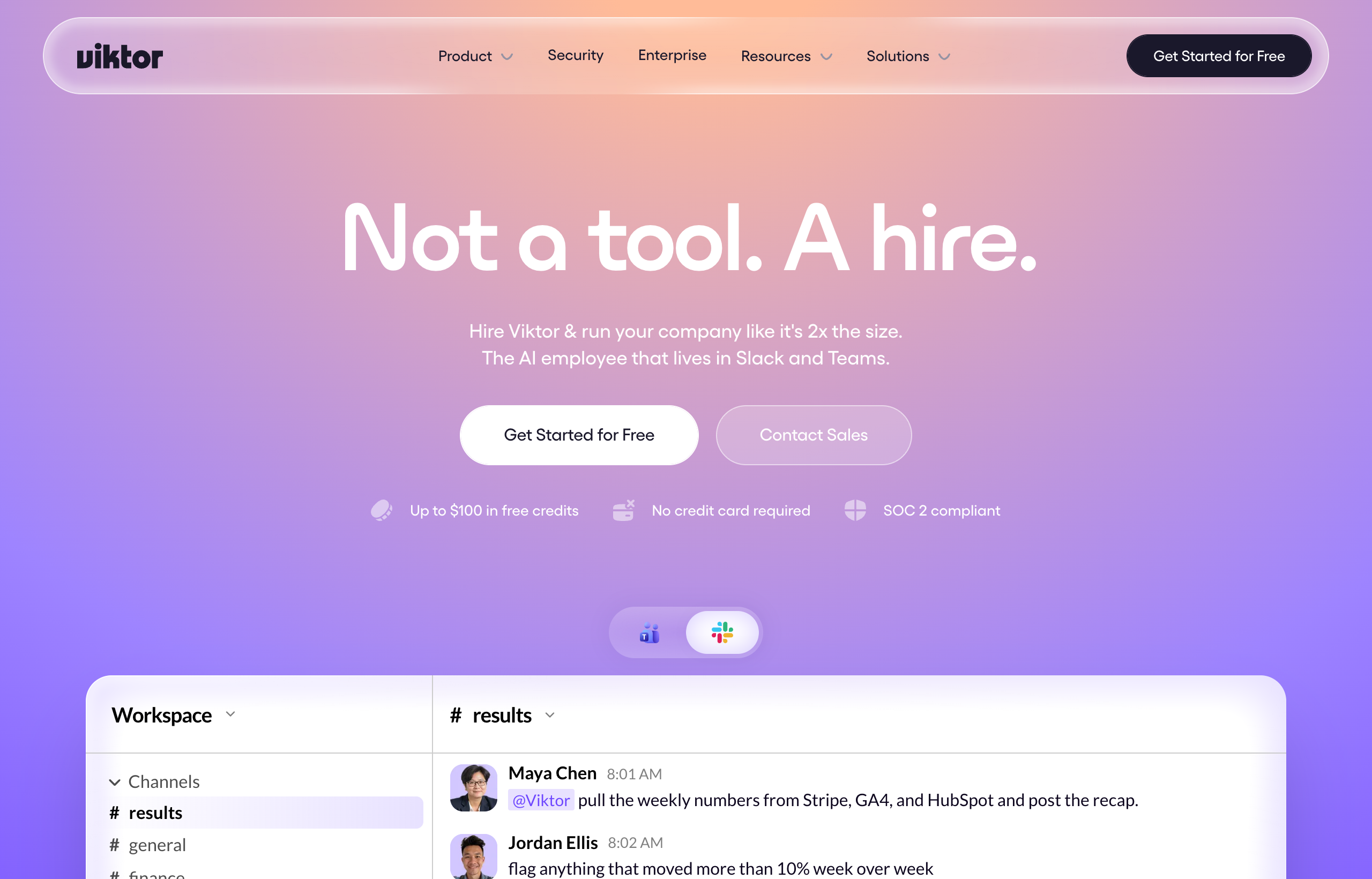
Viktor lives directly inside the Slack channel or Microsoft Teams chat your team already uses, and instead of working in a sandbox, it connects to more than 3,200 real tools, Stripe, Notion, HubSpot, Salesforce, Google Ads, Meta Ads, GitHub, Google Drive, and more, pulling live data and executing multi-step work end to end. You brief it like a coworker, “pull last month’s ad spend across Google and Meta, cross-check it against Stripe revenue, and put together a one-page summary,” and it goes and does it, returning a finished report, a spreadsheet, a deployed web app with a working database and login, or a pull request if the task touches code. It also proposes its own follow-up automations once it notices a pattern in what your team keeps asking.
Pricing is public and self-serve: a free trial with $100 in credits, no card required, then workspace-wide credit tiers starting around $50 a month for 20,000 credits, scaling up from there with no per-seat charge, so the whole team draws from one pool rather than paying per person. It tops this list because it solves the problem most Manus-alternative searchers actually have, not because it duplicates what Manus does well.
If your actual bottleneck is that nothing touches your real company data, that’s worth confirming for yourself before reading four more comparisons. Try Viktor’s free $100 in credits, no card required, and hand it a task that needs your actual numbers.
2. Devin: for teams that specifically want an autonomous software engineer
Devin is built and marketed specifically as an autonomous software engineering agent: it can plan a coding task, write the code, run tests, and open pull requests with meaningfully less hand-holding than a general chat-based coding assistant. If your actual need overlapping with Manus was “write and ship code with real autonomy” rather than general research or business tasks, Devin is a more purpose-built tool for that specific job than either Manus or Viktor, since it is optimized deeply for one workflow rather than covering a broad surface. The tradeoff is scope: Devin is not built for pulling ad spend reports or assembling a board deck, and pricing is usage-based on credits with paid plans reported starting in the neighborhood of $20 a month, though you should verify current tiers directly since agent-coding pricing in this category shifts often. Viktor can also write code and open pull requests as part of a broader task, but Devin goes deeper specifically on software engineering work. Our Viktor vs Devin comparison covers this exact fork in more depth.
3. OpenClaw: closest in spirit to Manus’s autonomy, open source and self-hosted
OpenClaw is an open-source personal AI coworker that runs locally or in a self-hosted environment rather than a closed cloud product, connecting across more than 29 messaging channels including Slack, WhatsApp, Telegram, Discord, and iMessage. Like Manus, it is built around genuine autonomy, browsing, filling forms, reading and writing files, running shell commands, and it remembers context across conversations. Where it differs from Manus is the ownership model: OpenClaw’s core software is free and open source, with the only real cost being your own infrastructure or a managed hosting option, reportedly starting around $29 a month for a cloud-hosted version, rather than a vendor-controlled credit system. That makes it a genuinely appealing pick for a technical user who wants Manus-style autonomy without being tied to one company’s pricing decisions, though it asks more setup and technical comfort than a managed product, and it is not purpose-built for business tool integrations the way Viktor is. See Viktor vs OpenClaw for the fuller comparison.
4. Relevance AI: for building fully custom multi-agent systems
Relevance AI is a platform for constructing your own AI “workforce,” custom agents, tools, and multi-agent pipelines wired together on a visual canvas, with more than 2,000 integrations and enterprise controls like SSO and audit logs. If Manus’s sandboxed autonomy was appealing but you actually need multiple agents handing off work to each other in a controlled, inspectable way, Relevance AI gives you the primitives to build that. The real cost is the same one every builder platform carries: someone has to design and maintain the agent architecture, and public self-serve pricing is limited, with much of the offering positioned around a sales conversation for custom pricing. Our Viktor vs Relevance AI comparison goes deeper on this specific tradeoff.
5. Lindy: for a visual builder that also acts like a personal assistant
Lindy lets you build an agent on a visual canvas you can inspect and edit, wiring together triggers, actions, and logic, and it can also text or call you directly to handle things like scheduling and email the way a personal assistant would. That visibility, seeing exactly what a flow does step by step, is a real advantage over Manus’s more opaque autonomous planning, and it appeals to teams that want a non-technical person to be able to look at an agent and understand it. Pricing runs Plus around $50 a month, Pro around $100 a month (adding computer-use browser automation), and Max around $200 a month, with a 7-day free trial and no card required for Plus access. What it does not replicate is Manus’s or Viktor’s deeper autonomy on genuinely open-ended, undefined tasks; Lindy rewards a team that is willing to define the flow rather than just describe an outcome.
A concrete example: the same brief, four different tools
To make the differences less abstract, here is one brief run conceptually through each category: “put together a competitive pricing summary for our category.” Manus would research it well on its own from public sources and hand back a clean, self-contained report or deck, genuinely useful as a starting point. Devin isn’t the right tool for this brief at all, it’s built for code, not research decks. OpenClaw could do a similar job to Manus, with more setup but no vendor credit meter deciding how far your budget goes. Relevance AI could do it too, but only after someone builds an agent (or a small pipeline of agents) configured for that specific research task, which is real setup time before the first useful output. Lindy could be configured to do a lighter version of this on a schedule, but it’s not really built for one-off deep research. Viktor’s version looks different from all of them: it can research the category from the open web the way Manus does, but it can also pull your own actual pricing and margin data from Stripe or your billing system and put the two side by side in the same report, something none of the other four can do without you assembling that part yourself afterward. That last step, connecting external research to your own internal numbers, is usually where the real business value in a competitive summary actually lives, and it’s the step every purely research-focused tool leaves for a human to do manually after the “impressive” part is already finished.
Honest weaknesses to weigh, including Viktor’s
None of these five are a free win. Devin’s scope is narrow by design, it is not a general business tool. OpenClaw asks for technical setup and infrastructure ownership that a non-technical team will find genuinely harder than a managed product. Relevance AI requires real engineering investment before it pays off. Lindy’s visual flows are less suited to the kind of genuinely undefined, exploratory task Manus and OpenClaw handle well. And Viktor’s honest weakness, worth repeating plainly rather than burying, is credit-based billing that is less predictable than a flat subscription: quick tasks run roughly 100 to a few hundred credits, a full project can run 2,000 to 5,000, and real active teams commonly land closer to $300 to $750 a month once genuine usage kicks in, above the $50 headline figure. It is also built for business tool integration first, not open-web research, so if your actual job is closer to what Manus does well, exploratory research with no need to touch company systems, Viktor is more tool than that specific job requires.
How to actually choose between these five
Work through these questions in order rather than reading ten more comparison posts, and you’ll land on the right tool faster:
- Does the task need your company’s real data, or just the open web? Real business data (Stripe, Salesforce, your ad accounts), go Viktor. Open web research and self-contained builds, Manus itself, or OpenClaw if you want to self-host the same shape of work.
- Is the task specifically about writing and shipping code? If yes, Devin is purpose-built for that narrower job and will outperform a generalist on it.
- Do you want to see and edit the logic, or just describe an outcome? Visual and inspectable, Lindy or a Relevance AI build. Conversational and outcome-driven, Viktor or Manus.
- Do you have engineering time to invest in building a custom agent architecture? If yes and the use case is genuinely bespoke, Relevance AI is worth the setup. If you’d rather brief a ready employee or ready generalist, Viktor or Manus.
- Is predictable billing more important than raw capability? None of the five have flat pricing that fully solves this, but OpenClaw’s self-hosted option removes the vendor credit meter entirely if you’re willing to own the infrastructure yourself.
Most people who end up disappointed with whichever tool they pick skipped question one. It is the single biggest fork in this whole category: does the job need your company’s actual systems, or does it just need a smart, self-contained researcher and builder. Everything else is a secondary decision once that’s answered honestly.
Who should pick something else entirely
- If your work is genuinely solo, exploratory, and self-contained, research, first drafts, slide decks, with no need to touch business systems, Manus itself may still be the right tool once you account for its credit unpredictability and budget accordingly.
- If you specifically need deep, autonomous software engineering rather than general business tasks, Devin fits that narrower job better than any generalist on this list.
- If you want maximum control and no vendor lock-in and have the technical comfort to self-host, OpenClaw.
- If you have engineering time to invest in a bespoke multi-agent architecture, Relevance AI.
The fastest way to know which category actually fits: take one real task you were about to hand to Manus and run it through Viktor’s free trial instead if it touches your company’s real data. If it doesn’t, Manus was probably already the right tool, and this list just helped you confirm it.
For the wider category, see our Viktor vs Manus comparison, our full Viktor review, and our best autonomous AI agents of 2026 roundup, which places all of these tools side by side against the wider field.
FAQ
What is the best free alternative to Manus?
OpenClaw’s core software is free and open source if you’re willing to self-host, and Relevance AI and Lindy both offer free tiers or trials to start building. Viktor offers a free trial with $100 in credits rather than an ongoing free tier, which is enough to test real business tasks before committing.
Is there an alternative to Manus that connects to business tools like Stripe or Salesforce?
Yes. Viktor is built specifically for this, connecting to more than 3,200 real business tools and executing tasks inside them, which is the main gap Manus does not fill by design.
What is the best Manus alternative for coding tasks specifically?
Devin, since it is purpose-built as an autonomous software engineering agent rather than a general-purpose research and build tool.
Is OpenClaw better than Manus?
They solve a similar shape of problem, autonomous execution across open channels, but OpenClaw is open source and self-hosted with no vendor credit system, while Manus is a managed cloud product with a credit-based billing model that has drawn real user complaints. The better fit depends on your comfort with self-hosting versus wanting a managed product.
Which Manus alternative is best for a small team, not just a solo user?
Viktor, because its credit pool is workspace-wide rather than per seat, so a small team can share one allotment instead of each person needing an individual plan the way Manus’s and Relevance AI’s team pricing tends to work.


